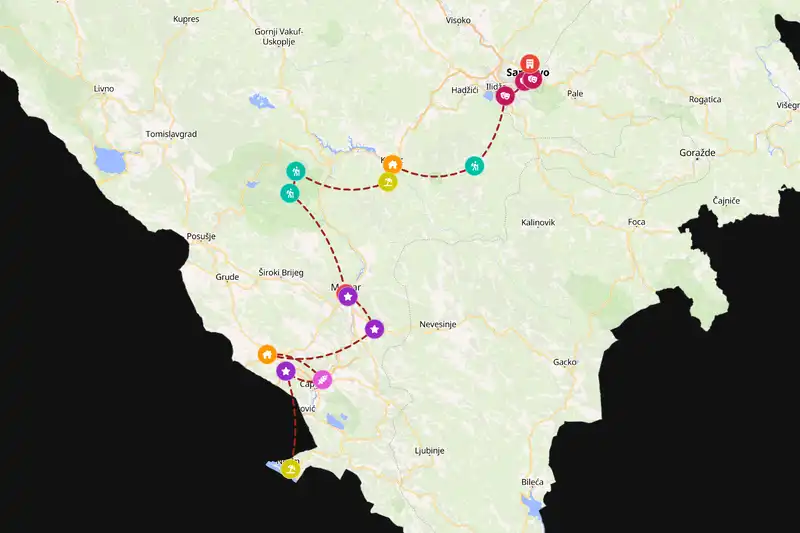
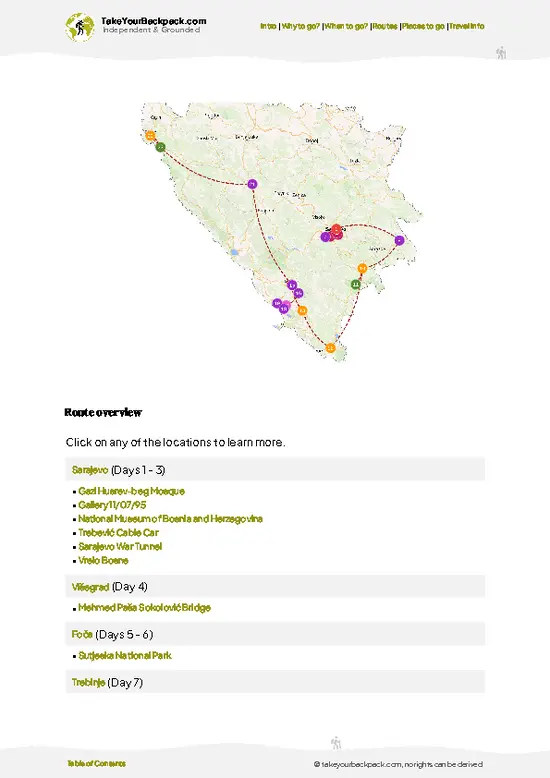
This 15-day loop through Bosnia and Herzegovina suits travelers who want the whole arc of the country: Ottoman stone, socialist-era monuments, war history told without filters, and long river valleys that change color from emerald to slate. The pace is steady with real breathing room, usually two or three nights per base and travel legs of two to four hours. You can do it entirely by intercity bus, plus the city tram in Sarajevo and a few taxis or organized trips where the rivers and parks sit beyond the bus lines.
Days 1-4: Sarajevo
Give
Sarajevo three nights and split it into layers. Start in Baščaršija with the
Gazi Husrev-beg Mosque Complex, built in the 1530s, where the courtyard fountain and the covered bezistan next door show how the Ottoman city actually worked as a trading hub. That afternoon, the
Gallery 11/07/95 Sarajevo lays out the Srebrenica genocide through photographs and survivor testimony; it is heavy, and it is the right preparation for the eastern half of this route. …
read more 👉This 15-day loop through Bosnia and Herzegovina suits travelers who want the whole arc of the country: Ottoman stone, socialist-era monuments, war history told without filters, and long river valleys that change color from emerald to slate. The pace is steady with real breathing room, usually two or three nights per base and travel legs of two to four hours. You can do it entirely by intercity bus, plus the city tram in Sarajevo and a few taxis or organized trips where the rivers and parks sit beyond the bus lines.
Days 1-4: Sarajevo
Give Sarajevo three nights and split it into layers. Start in Baščaršija with the Gazi Husrev-beg Mosque Complex, built in the 1530s, where the courtyard fountain and the covered bezistan next door show how the Ottoman city actually worked as a trading hub. That afternoon, the Gallery 11/07/95 Sarajevo lays out the Srebrenica genocide through photographs and survivor testimony; it is heavy, and it is the right preparation for the eastern half of this route. Day two belongs to the National Museum of Bosnia and Herzegovina, with its medieval stećci tombstones in the garden, then the Trebević Cable Car and Abandoned Bobsleigh Track, where graffiti now covers the concrete curves built for the 1984 Winter Olympics. On day three, take the tram west to Ilidža for the Sarajevo War Tunnel in Butmir, the roughly 800-meter passage under the airport that kept the besieged city supplied, and finish under the plane trees at Vrelo Bosne, where the Bosna River rises from a cluster of cold springs.Days 4-7: Višegrad, Foča and Sutjeska
Head east by bus, 2.5 to 3 hours, to Višegrad for one night. The Mehmed Paša Sokolović Bridge in Višegrad, finished in 1577 and the subject of Ivo Andrić’s novel The Bridge on the Drina, is best walked at dusk when the eleven arches go amber over green water. Next morning it is a short hop of about 1.5 hours to Foča, two nights. Foča is the gateway to Tara River rafting and to Sutjeska National Park, home to the Perućica old-growth forest and Maglić, at 2,386 meters the country’s highest peak. A local guide or rafting outfit can drive you into the park for a full day, which is the only realistic way to reach the trails without your own wheels.Days 7-8: Trebinje
The bus south to Trebinje (about 3 hours) runs straight through the Sutjeska canyon past the giant Partisan memorial at Tjentište, so keep a window seat. One night is enough to slow right down: coffee under the plane trees of the old town square, a walk over the Arslanagić Bridge, and a climb to the hilltop Hercegovačka Gračanica church for views over the Trebišnjica valley. After the mountains of the east, this is your first taste of Mediterranean light.Days 8-11: Stolac and Mostar
Travel to Mostar via Stolac, around 3 hours in total, and break the journey there for the Radimlja necropolis of carved medieval tombstones just outside town. Then settle into Mostar for three nights. Watch divers leap from the Old Bridge in Mostar, rebuilt in 2004 after its destruction in 1993, but walk the east bank at 7 a.m. before the tour buses arrive. Spend one day on the southern circuit: Blagaj Tekke, the dervish house tucked under a cliff where the Buna River surges out of a cave, the hillside Ottoman village of Počitelj, and the Roman villa ruins at Mogorjelo near Čapljina, ending with a swim at Kravice Waterfalls. Minibus tours from Mostar hostels bundle most of this for around KM 50 to 80 (US$28 to 45), far easier than piecing together local buses.Days 11-13: Jajce
The bus north to Jajce takes 3.5 to 4 hours and climbs past the turquoise Jablanica reservoir. Two nights here let you see the Jajce Waterfall, where the Pliva drops about 20 meters into the Vrbas right below town, plus the medieval fortress, the underground catacombs and the wooden watermills on the Pliva lakes, a 5 km walk or a short taxi ride away.Days 13-15: Bihac and Una National Park
Finish in Bihac, 3 to 4 hours by bus, with two nights to give the river its due. Una National Park centers on Štrbački buk, a wide curtain of cascades on the Croatian border, and the travertine falls at Martin Brod further upstream. Taxis or guesthouse transfers cover the roughly 25 km to Štrbački buk, and Bihać rafting companies run half-day trips down the calmer stretches. From here, Zagreb is about 3 hours away, which makes this an easy exit point.
On the way out, detour to Ostrožac Castle near Cazin, a fortress with a 19th-century mansion bolted onto its medieval walls and an open-air garden of modern stone sculptures.

 Best Backpacking