×
Burundi🇧🇮 | 5 days itinerary

Backpacking Burundi: A 5-Day Guide

By Johan Kruseman 🇳🇱 | Updated May 10, 2026
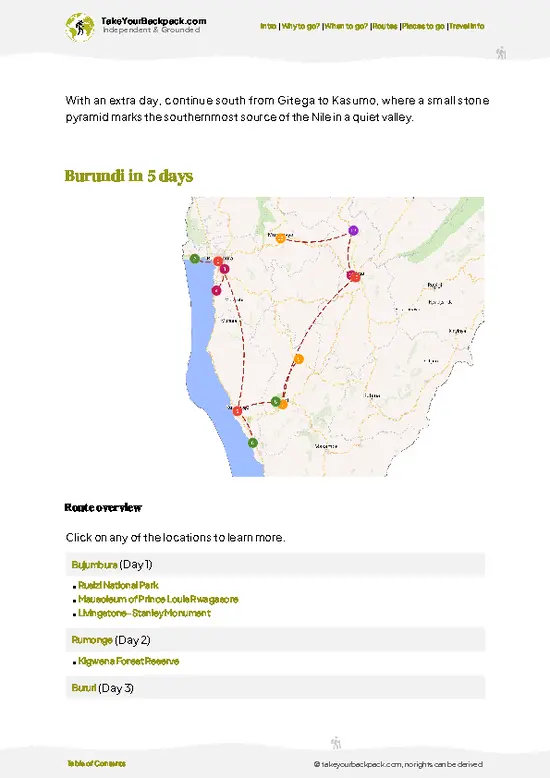
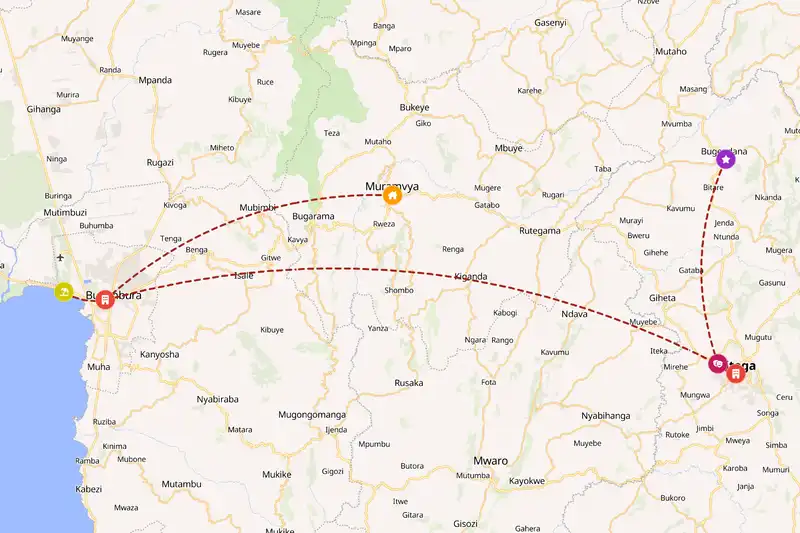
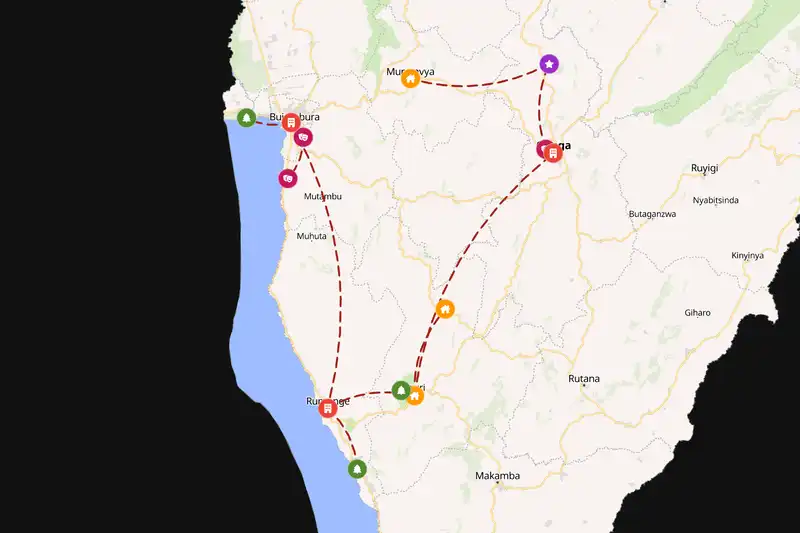
This 5-day Burundi circuit is for travelers who want to go beyond the capital and actually feel the country’s different faces—lake, forest, royal hilltops, and southern shoreline—without turning the trip into a punishing endurance test; it’s moderately paced, using a mix of private car hires and shared taxis, with no back-to-back marathon drives. You’ll loop from Bujumbura through Gitega and Gishora, then down to Bururi, Rumonge, and Nyanza-Lac, stitching together national parks, drum culture, and long, lazy hours on Lake Tanganyika’s beaches.

Day 1: Bujumbura orientation & Rusizi wetlands

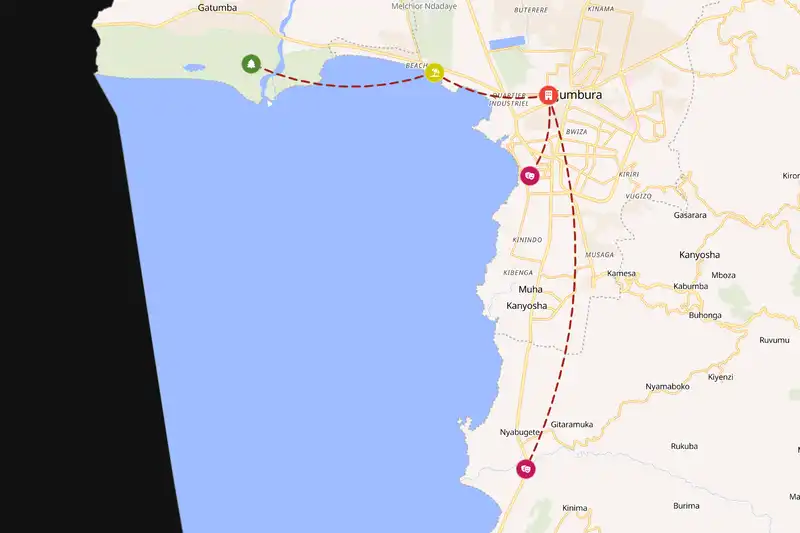
Land in Bujumbura and give yourself a morning to get grounded: a walk through the Bujumbura Central Market sets the tone with color, noise, and the smell of charcoal fires, while a quick stop at the Monument de l’Indépendance anchors you in the country’s modern story. By late morning you head out by taxi or arranged car to Rusizi National Park, where the real goal is a boat trip from the Rusizi River Hippo read more 👉
This 5-day Burundi circuit is for travelers who want to go beyond the capital and actually feel the country’s different faces—lake, forest, royal hilltops, and southern shoreline—without turning the trip into a punishing endurance test; it’s moderately paced, using a mix of private car hires and shared taxis, with no back-to-back marathon drives. You’ll loop from Bujumbura through Gitega and Gishora, then down to Bururi, Rumonge, and Nyanza-Lac, stitching together national parks, drum culture, and long, lazy hours on Lake Tanganyika’s beaches.

Day 1: Bujumbura orientation & Rusizi wetlands

Land in Bujumbura and give yourself a morning to get grounded: a walk through the Bujumbura Central Market sets the tone with color, noise, and the smell of charcoal fires, while a quick stop at the Monument de l’Indépendance anchors you in the country’s modern story. By late morning you head out by taxi or arranged car to Rusizi National Park, where the real goal is a boat trip from the Rusizi River Hippo and Crocodile Viewing Area; drifting along the river with hippos, crocs, and birdlife all sharing the same stage is a powerful way to reset your brain to “I’m actually in Burundi now.” You return to Bujumbura by late afternoon, with the option of a quick look at the Musée Vivant Cultural and Craft Area if you want a compact cultural hit before dinner, then sleep in the capital to keep logistics simple on night one.

Day 2: Royal drums of Gishora & Gitega’s highland calm

On day two you leave the lake and climb into the hills toward Gitega, trading humidity for cooler air and sweeping valley views. Your key stop en route is Gishora, where the Gishora Royal Drummers Site turns what could be a dry history lesson into something you feel in your chest—drums echoing across the hills, performers in traditional dress, and a sense of continuity that makes the country’s past feel very present. From there you continue to Gitega, where the Gitega National Museum helps you connect the dots between kingdoms, colonialism, and the modern state while also showcasing everyday objects that tell quieter stories. You overnight in Gitega, giving yourself time to wander the streets, talk to people, and enjoy the slower, highland rhythm that contrasts sharply with Bujumbura’s lakeside sprawl.

Day 3: Forests of Bururi & southern highlands

Day three is your pivot south, heading by road from Gitega toward Bururi, where the air cools again and the landscape tightens into forested hills. Your focus is the Bururi Forest Nature Reserve, a highland forest area that offers quieter trails and birdlife than the more famous parks, making it ideal if you like your nature with fewer crowds and more time to listen to the forest itself; you can spend a few hours on gentle paths rather than pushing for a hardcore trek. After your time in the Bururi Forest Nature Reserve, you settle into Bururi town for the night, giving yourself a proper pause between the inland cultural arc and the lake-hugging southern leg of the journey.

Day 4: Rumonge shoreline & Kigwena coastal forest

On day four you descend from the highlands toward the lake again, heading to Rumonge, where the road starts to flirt with the shoreline of Lake Tanganyika. Before you fully commit to beach mode, you detour into Kigwena National Park, a coastal forest strip near Kigwena town where you can stretch your legs, look for monkeys and birds, and feel the shift from highland chill to lake humidity. From there you continue to Rumonge, where the combination of lakeside setting and small-town energy makes it a perfect base; you can wander the waterfront, sample grilled fish, and watch the sun drop into the lake without the busyness of the capital. You overnight in Rumonge, letting the sound of the water and the slower pace reset you after the previous days of driving and forest walks.

Day 5: Nyanza-Lac beach day & lakeside farewell

Your final day pushes further south along the lake to Nyanza-Lac, where you spend most of your time at Nyanza Lac Beach, a long, relaxed stretch of sand that rewards doing very little: swimming if conditions are safe, strolling the shoreline, and watching fishing boats slide in and out. The adjacent town of Nyanza-Lac gives you a window into daily life at the southern edge of the country, far from the capital’s orbit, and the slower tempo here makes it easy to process everything you’ve seen—from royal drums to highland forests—while your feet are in the sand. Depending on your onward plans, you either overnight in Nyanza-Lac or make a late-afternoon return to Rumonge or Bujumbura, closing the loop with a final look at Lake Tanganyika’s long, shimmering horizon from the road.

For a future deep-cut detour when you have more time, keep the remote Karera tea-plantation backroads in mind, where narrow lanes wind through emerald fields and you can walk for hours with only farmers and the rustle of tea leaves for company.
Loading the map 🌍
film
0
0
0a
Bujumbura
film
1
1
1a
Bujumbura Central Market
film
2
2
2a
Monument de l’Indépendance
film
3
3
3a
Gishora Royal Drummers Site
film
4
4
4a
Gitega National Museum
film
5
5
5a
Bururi Forest Nature Reserve

✈️ The backpacker research shortcutBurundi Travel Guide

An offline-friendly backpacking guide with optimized travel routes, ranked highlights, transport advice, and the best areas to stay.
example page 0 from our offline Travel Guide for Burundiexample page 1 from our offline Travel Guide for Burundiexample page 2 from our offline Travel Guide for Burundiexample page 3 from our offline Travel Guide for Burundiexample page 4 from our offline Travel Guide for Burundiexample page 5 from our offline Travel Guide for Burundi
The digital guide (213 pages) contains:
60 highlights, ranked by travel appeal
Optimized 2, 3 & 5-day travel routes
Best neighborhoods to stay
How to get around
Offline-friendly for travel without Wi-Fi
👉 See all 30+ guide features

📅 Plan smarter in minutes, not weeks
Month by month travel advice
Festivals & national holidays
Budget expectations

🗺️ Go to the right places, skip the overrated ones
Honest pros & cons of destinations
Top hikes, parks & viewpoints
Lesser-known places most travelers miss
Clear “worth it vs skip it” guidance

🛏️ Travel smoothly without rookie mistakes
Best areas to stay
Transport systems explained simply
Common scams & safety advice
SIM cards, money & practical tips

🌍 Understand the country, not just visit it
Culture & traditions
52 Essential phrases & customs
Festivals worth planning around
Traveler-friendly historical context
Insights that make places more meaningful

📱 Built for real travel conditions
Fully downloadable PDF
Works completely offline
Optimized for phone use
Useful in remote areas & buses
Everything in one place
Save weeks of stressful planning
Get instant access to the full guide directly. 30-day money-back guarantee.


Sent to your inbox immediately after payment • 100% Secure Checkout
Best Backpacking Travel Advisor 2025 tourism awardBest Backpacking
Travel Advisor
2025
What others say about Take Your Backpack Guides:
⭐⭐⭐⭐⭐
Fantastic, amazing amount of information!
⭐⭐⭐⭐⭐
My goodness this is amazing, it's what I've been looking for hats off too you!
⭐⭐⭐⭐⭐
I think this is absolutely BRILLIANT
⭐⭐⭐⭐
Very complete and informative. It's still missing places, but I gotta to commend you
⭐⭐⭐⭐⭐
This is truly amazing, thank you, can't wait to explore it with my kids!
⭐⭐⭐⭐⭐
Awesome resource, thank you!
⭐⭐⭐⭐⭐
This is amazing! Can't wait to explore the ones I haven't seen
⭐⭐⭐⭐
I love this! Well done, great idea.
⭐⭐⭐⭐⭐
Thanks for taking the time to make this gem!
⭐⭐⭐⭐⭐
This might be the best website I've ever seen.
⭐⭐⭐⭐⭐
Congratulations, and thank you so much for your work; it's incredibly valuable.
⭐⭐⭐⭐
In all seriousness I think you did a great job pointing out the important spots
⭐⭐⭐⭐⭐
10/10 very good
⭐⭐⭐⭐⭐
As someone who's only just starting to visit regularly this is awesome, thank you.
⭐⭐⭐⭐
Thank you very much! I'm going to visit my dad, it's going to be very useful!
⭐⭐⭐⭐⭐
This is really cool! We'll be travelling for the first time and this definitely come in handy.
⭐⭐⭐⭐⭐
You are now our minister of culture, congratulations 👨‍💼
⭐⭐⭐⭐⭐
Just wanted to tell you that this is a pearl! Going to follow your recommendations.
⭐⭐⭐⭐⭐
This is so cool. I'll definitely be using the resource for my travels soon.
⭐⭐⭐⭐⭐
This is very impressive! Good work.
⭐⭐⭐⭐⭐
This is an amazing and informative site. Very well done!

🧭 RouteAdjust Your Pace

Travel Burundi your way — from a quick highlights trip to a slow-paced adventure.

🙋 FAQTraveler FAQ

Short version: Burundi is doable to backpack independently if you already have some Africa or off‑the‑beaten‑path experience; it’s not ideal as a first-ever solo destination. Infrastructure is thin, English is rare outside the capital, and information on guesthouses and transport is often word-of-mouth. That said, it’s small, people are generally welcoming, and costs can be low if you move like a local.

The main friction points are visas and permits, safety awareness, and logistics. Visa rules change often and may require advance planning through an embassy or e-visa system; you do not want to wing this at the border. In Bujumbura and larger towns you’ll find basic guesthouses and midrange hotels, but very few classic hostels. You’ll rely on cheap local hotels, church guesthouses, and the occasional lakeside lodge, so flexibility is key.

French and Kirundi are the working languages; if you don’t speak at least basic French, you’ll lean heavily on translation apps and gestures. Independent backpacking works best if you’re comfortable with shared taxis, moto-taxis, and asking around for information at bus stands. Solo women can travel here, but should be extra cautious about moving after dark, choosing central accommodation, and dressing conservatively.

If you want a smoother ride, combine independent travel with a few targeted local guides: for hiking in the highlands, visiting rural communities, or arranging boat trips on Lake Tanganyika. That keeps costs reasonable while removing the most frustrating logistics. Overall: possible, rewarding if you like raw travel, but not plug-and-play.
For a tight, budget-conscious overview, 5–7 days is enough to get a feel for Burundi without burning out on transport days. That lets you base yourself in Bujumbura, do a couple of day trips, and squeeze in one inland destination.

If you want to move at backpacker pace and actually enjoy the country instead of collecting border stamps, 10–14 days is the sweet spot. That gives you time to:
- Spend 2–3 days in and around Bujumbura (markets, lakeside, nearby hills).
- Take 2–3 days in the highlands (Gitega area, tea/coffee regions, waterfalls, short hikes).
- Add 2–3 days for Lake Tanganyika downtime or a lakeside village stay.
- Keep 1–2 buffer days for slow transport, weather, or admin.

More than two weeks only makes sense if you’re really into slow travel, language learning, or using Burundi as part of a longer Great Lakes loop (Rwanda, Tanzania, DRC). Because the country is compact, extra time doesn’t mean more famous sights; it means deeper time in villages, more hikes, and more conversations. If you’re on a long overland trip, 7–10 days is a good compromise between ‘I barely saw it’ and ‘I stayed longer than the place can really offer in terms of variety.’
You can absolutely get around Burundi without your own car, but you trade comfort and predictability for cost savings. For a budget traveler, that’s usually a fair deal.

Between major towns, you’ll rely on:
- Shared minibuses and coaster buses: cheap, frequent on main routes, but they leave when full, not on a strict schedule. Expect tight seating and slow progress.
- Shared taxis: more expensive than buses but faster and less crowded; good for awkward connections or late departures.

Within towns and for short hops:
- Moto-taxis: very common and cheap in and around cities; always agree the price beforehand and wear a helmet if one is offered.
- Bicycle taxis and walking: in smaller towns, you’ll mostly walk or hop on a bicycle taxi for short distances.

The main limitations without a car are remote waterfalls, rural tea/coffee areas, and some lakeside spots that don’t sit on main roads. For those, you can:
- Hire a moto-taxi for a half or full day.
- Arrange a local guide with a vehicle through your guesthouse.
- Team up with other travelers (if you find them) to split a car and driver.

Travel after dark is not recommended: roads are poorly lit, vehicles can be in bad condition, and security is more fragile at night. Plan your days so you arrive before sunset. If you’re patient, flexible, and okay with some discomfort, you can see most of what matters without ever renting a car.
For a backpacker on a budget, the must-visits are less about big-ticket attractions and more about a few key areas that show different sides of the country without wrecking your wallet.

1. Bujumbura and Lake Tanganyika
Use Bujumbura as your landing pad. Wander the central markets, grab street food, and then escape the heat with time along Lake Tanganyika. Public or semi-public beaches and simple lakeside bars give you that ‘I’m really in Central Africa’ feeling for the price of a drink and a plate of grilled fish. It’s also your best place to sort cash, SIM cards, and onward transport.

2. The Highlands around Gitega
Gitega and the surrounding highlands show you Burundi’s rural backbone: cooler air, terraced hills, and small farms. This is where short hikes, village walks, and tea/coffee landscapes come into play. You don’t need expensive tours; a local guide arranged through your guesthouse can turn a simple walk into a full day of stories and farm visits.

3. Waterfalls and Countryside Day Trips
Within reach of the main towns are several waterfalls and viewpoints that feel like proper adventures without requiring a 4×4 safari budget. The joy here is the journey: hopping minibuses, then hiring a moto-taxi for the last stretch, and ending up at a viewpoint with just a handful of locals.

4. Lakeside Chill Time
If you can, spend at least one night outside the capital on the lake. A basic guesthouse or small lodge right on Tanganyika gives you sunrise swims, fishermen heading out in dugout canoes, and long, quiet evenings. It’s a good reset between bus days and a rare chance to slow down.

If you hit these four ‘zones’—capital and lake, highlands, a waterfall day trip, and at least one quiet lakeside night—you’ll leave feeling like you actually met Burundi, not just its bus stations.
If you’re short on time or cash, skip anything that eats a full day of transport for a single photo or a tick on a map.

1. Deeply Remote Corners
Far-flung border areas and tiny towns that require multiple vehicle changes are usually not worth it unless you have a specific reason (research, family, or a long-term project). You’ll spend more time stuck in transit than actually exploring, and accommodation options can be very basic without adding much new in terms of scenery.

2. Over-Structured ‘Cultural Shows’
If someone tries to sell you a pricey, highly staged cultural performance aimed at diplomats or NGO visitors, you can safely skip it. You’ll get more authentic interaction by visiting markets, chatting with people at roadside cafés, or hiring a local guide for a simple village walk.

3. Rushing Every ‘Geographic Marker’
Burundi has various ‘source of the Nile’ or geographic claim spots. Unless you’re a hardcore geography nerd, you don’t need to chase every single one. Pick one if it fits naturally into your route; don’t burn a whole day detouring just to stand by a plaque.

4. Trying to Do the Whole Country
On a short trip, don’t attempt a full loop of every region. Focus on Bujumbura + lake, one highland base (like Gitega area), and one or two day trips. Skipping the extra long-haul legs keeps your budget down, your stress low, and your experience deeper.

5. High-End Resorts Aimed at Expats
If you’re backpacking, you don’t need to blow a day’s budget on a fancy resort that could be anywhere in the world. Drop in for a drink if you want the view, then sleep and eat where locals do. Your money goes further, and your stories get better.

🇧🇮 BurundiSee More of Burundi

Ready to build a truly unique trip? Predefined routes are perfect for first-time visitors, but there is so much more to discover. Whether you are chasing a city trip, pristine national parks, local food scenes, or quiet beaches, pick a category to design your own path.