×

Burundi🇧🇮 | best attractionsBest 10 attractions in Burundi

Burundi has no big-ticket sights, and that is the point. Attractions here are lake beaches, rainforest, drumming and a few modest museums. Bujumbura and the Lake Tanganyika shore are easy and cheap. The south and the highlands take more effort, with rough roads and almost no other foreigners. Independent travelers get privacy and low costs, but should skip anything needing slick facilities.

By Johan Kruseman 🇳🇱 | Updated October 20, 2026
Explore the best festivals in Burundi

Why go?Why These attraction Stand Out

Burundi suits travelers who want unpackaged, low-volume experiences. It sits on the Albertine Rift, so one small country holds a huge lake, mountain rainforest and rolling highlands within a few hours of each other. Tourism is barely developed, so crowds are close to zero and prices stay low, but so do services: few signed trails, patchy booking systems and limited English.

Culture is a real draw. Royal drumming traditions and Kirundi-speaking, agricultural communities shape everyday life, and visitors are still a novelty.

Know before you choose it: this is not a country for ticking off famous landmarks. Cash is king outside Bujumbura, French and Kirundi matter more than English, and political tension means checking current government travel advice before booking. If you need polish, pick Rwanda or Tanzania instead.
Evaluating the Top Choices
The list of best attractions in Burundi is created based on cultural significance or entertainment value. If you feel a attraction is missing in this list, please let us know.

When to go?Optimal Periods for Travel

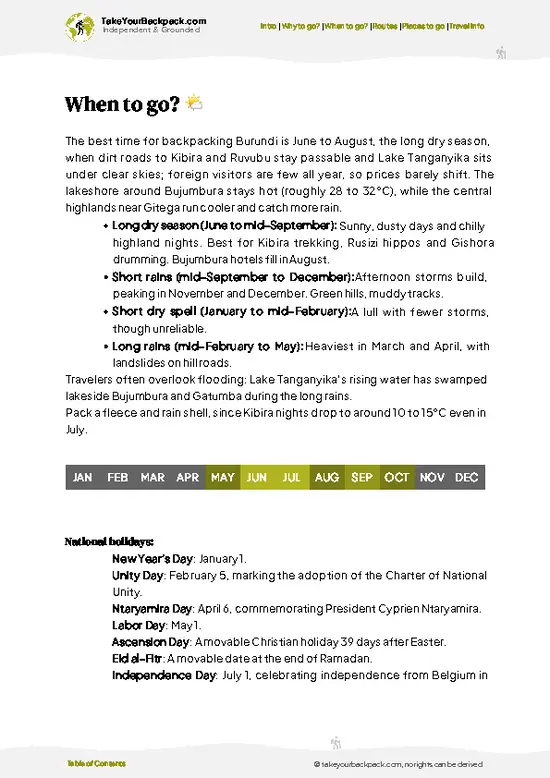
Best months: The best months are June to August, the long dry season, when roads are firmest and trails and lake beaches are at their most reliable. Highland hikes and forest walks are muddy and slippery in the wet months, so avoid them then.
Weather and seasons: Bujumbura on the lake is hot, around 25 to 30°C by day, while the highlands are cooler at roughly 15 to 22°C and nights can feel chilly. Rain falls mainly from October to December and again from February to May, with the heaviest downpours in March and April. A short dry spell in January and February is a workable shoulder period. September is also dry but dustier.
Crowds and prices: There is no true high season, so there are no price spikes. Expect the same rates all year, and book transport earlier around public holidays.

attraction hoppingPlanning Your Route Efficiently

How long to allow: A trip combining several attractions in Burundi needs 7 to 10 days, because roads are slow and distances feel longer than they look.
Direction and pacing: Start in Bujumbura, the only real transport hub, and treat the lake shore as one cluster. Then head inland to Gitega (about 2 to 3 hours by minibus) and onward to the northern or southern highlands, finishing back in the capital or crossing to Rwanda. Allow 1 to 2 days per stop and 2 to 5 hours between regions.
Planning mistakes: Travelers try to cover everything in five days, and end up in minibuses more than at sights. Pick two regions and go slowly. Another mistake is traveling after dark, when roads are poorly lit and checkpoints are slower. Leave by early morning, since minibuses depart when full and fill faster before noon.

The ListTop attractions of Burundi

1 Gitega National Museum

ethnographic collections, cultural artifacts, regional history

Browse displays of everyday objects and ceremonial items that illustrate the diversity and complexity of Burundian society.

burundi-attraction-gitega-national-museum
© Google |

2 Livingstone–Stanley Monument

explorer meeting point, lakeside monument, historical plaque

Stand at the site marking a notable encounter between explorers, with views over Lake Tanganyika and interpretive signage.

burundi-attraction-livingstone-stanley-monument
© Google |

3 Musée Vivant

artisan workshops, live demonstrations, cultural exhibits

Watch craftspeople at work and explore interactive displays that highlight traditional skills and local artistic practices.

4 Bujumbura Central Market

local produce stalls, textile vendors, daily commerce

Navigate busy aisles lined with fresh goods and fabrics, observing the rhythms of daily trade and the city’s economic pulse.

burundi-attraction-bujumbura-central-market
© Google |

5 Mausoleum of Prince Louis Rwagasore

national memorial, independence leader, hillside site

Reflect at the resting place of a pivotal figure in Burundi’s history, surrounded by quiet grounds and panoramic city views.

6 Église Saint-Michel

distinctive architecture, stained glass, city landmark

Admire intricate design and colorful windows in a prominent church that serves as a focal point for local religious life.

burundi-attraction-eglise-saint-michel
© Google |

7 Regina Mundi Cathedral

modernist design, religious murals, prominent spire

Step inside a spacious cathedral known for its striking architecture and interior artwork that reflects contemporary faith.

burundi-attraction-regina-mundi-cathedral
© Google |

8 Place de l’Indépendance

public square, civic gatherings, urban focal point

Spend time in a central plaza where daily life unfolds and major events draw crowds from across the city.

9 Monument de l’Unité

unity column, national symbolism, landscaped grounds

Contemplate the ideals of national cohesion at a monument set in open gardens, designed to represent collective identity.

burundi-attraction-monument-de-lunite
© Google |

10 Monument du Soldat Inconnu

military tribute, remembrance site, ceremonial plaza

Honor the memory of unidentified soldiers at a solemn location used for official commemorations and moments of reflection.

Loading the map 🌍

Expert viewTips and Advice from Travelers

How many to visit: Plan on four to six attractions in total. Roads are slow and minibuses leave when full, so each extra stop costs half a day, and beyond six you are mostly commuting.
What to prioritize: Beach and lake travelers should lean on the Bujumbura shoreline, which is easy and needs no guide. Culture seekers should put drumming and village visits first, as they give the most distinctive experience for the money. Hikers and nature fans should choose the forest and highland sites, accepting rougher access. Skip anything that needs a long detour for a small museum or monument.
Budget: Count on US$25 to 50 a day for food, basic lodging and local transport. Entry fees at national parks and reserves typically run US$10 to 30 per visit, a guide adds around US$10 to 25, and a moto-taxi to … read more 👉
How many to visit: Plan on four to six attractions in total. Roads are slow and minibuses leave when full, so each extra stop costs half a day, and beyond six you are mostly commuting.
What to prioritize: Beach and lake travelers should lean on the Bujumbura shoreline, which is easy and needs no guide. Culture seekers should put drumming and village visits first, as they give the most distinctive experience for the money. Hikers and nature fans should choose the forest and highland sites, accepting rougher access. Skip anything that needs a long detour for a small museum or monument.
Budget: Count on US$25 to 50 a day for food, basic lodging and local transport. Entry fees at national parks and reserves typically run US$10 to 30 per visit, a guide adds around US$10 to 25, and a moto-taxi to a trailhead runs US$2 to 8. Carry US dollars in clean, recent notes (older ones are often refused) plus Burundian francs, since ATMs outside Bujumbura are unreliable and card payment is rare.
Safety and culture: Check your government’s travel advice before going, as the security situation shifts, and avoid the border areas with the DRC. Carry a passport copy for checkpoints and keep photography of soldiers, police and government buildings off the menu, since it can lead to detention. Ask before photographing people, especially drummers and villagers. Dress modestly in rural areas.
Costs and delays to avoid: Arrange transport and guides the day before, so you are not paying tourist-rate fares on the spot. Confirm fees before you start, and get a receipt. Build a spare day into any schedule, since breakdowns and rain-washed roads are routine.

✈️ The backpacker research shortcutBurundi Travel Guide

An offline-friendly backpacking guide with optimized travel routes, ranked highlights, transport advice, and the best areas to stay.
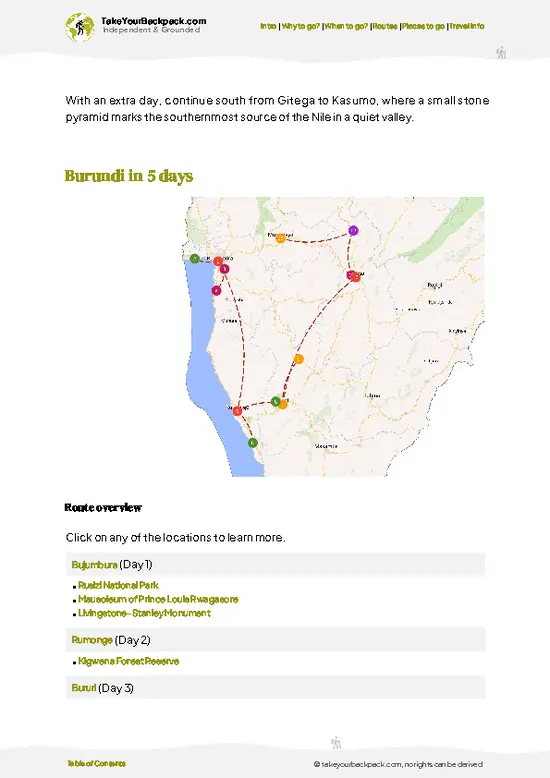
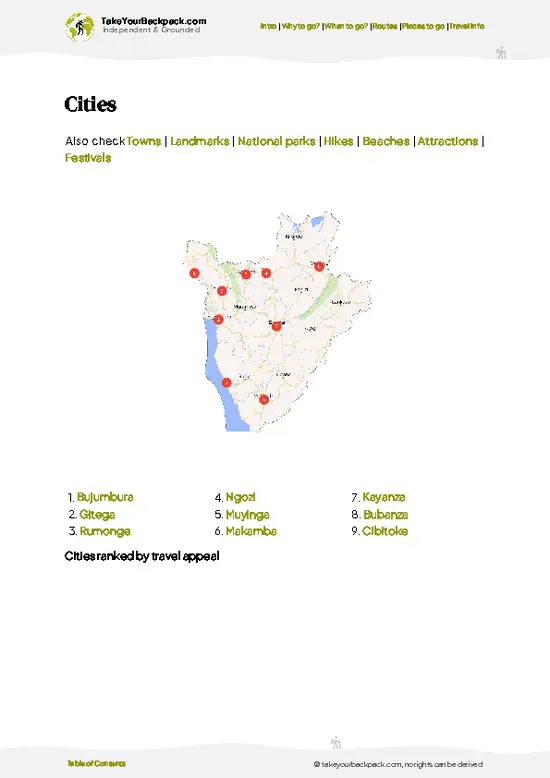
example page 0 from our offline Travel Guide for Burundi
example page 1 from our offline Travel Guide for Burundi
example page 2 from our offline Travel Guide for Burundi
example page 3 from our offline Travel Guide for Burundi
example page 4 from our offline Travel Guide for Burundi
example page 5 from our offline Travel Guide for Burundi
example page 6 from our offline Travel Guide for Burundi
example page 7 from our offline Travel Guide for Burundi
The digital guide (209 pages) contains:
✅ 47 highlights, ranked by travel appeal
✅ Optimized 2, 3 & 5-day travel routes
✅ Cities, national parks, landmarks, beaches
✅ How to get around
✅ Offline-friendly for travel without Wi-Fi
👉 Click to see all 30+ guide features

📅 Plan smarter in minutes, not weeks
✅ Month by month travel advice
✅ Festivals & national holidays
✅ Budget expectations

🗺️ Go to the right places, skip the overrated ones
✅ Honest pros & cons of destinations
✅ Top hikes, parks & viewpoints
✅ Lesser-known places most travelers miss
✅ Clear “worth it vs skip it” guidance

🛏️ Travel smoothly without rookie mistakes
✅ Best areas to stay
✅ Transport systems explained simply
✅ Common scams & safety advice
✅ SIM cards, money & practical tips

🌍 Understand the country, not just visit it
✅ Culture & traditions
✅ 52 Essential phrases & customs
✅ Festivals worth planning around
✅ Traveler-friendly historical context
✅ Insights that make places more meaningful

📱 Built for real travel conditions
✅ Fully downloadable PDF
✅ Works completely offline
✅ Optimized for phone use
✅ Useful in remote areas & buses
✅ Everything in one place
Stop searching, start planning
Get instant access to your full guide. 30‑day money-back guarantee.
+ Add another guide for just

By proceeding you agree to our terms.
Sent to your inbox immediately after payment • 100% Secure Checkout
Best Backpacking Travel Advisor 2025 tourism awardBest Backpacking
Travel Advisor
2025
What others say about Take Your Backpack Guides:
⭐⭐⭐⭐⭐
Fantastic, amazing amount of information!
⭐⭐⭐⭐⭐
My goodness this is amazing, it's what I've been looking for hats off too you!
⭐⭐⭐⭐⭐
I think this is absolutely BRILLIANT
⭐⭐⭐⭐
Very complete and informative. It's still missing places, but I gotta to commend you
⭐⭐⭐⭐⭐
This is truly amazing, thank you, can't wait to explore it with my kids!
⭐⭐⭐⭐⭐
Awesome resource, thank you!
⭐⭐⭐⭐⭐
This is amazing! Can't wait to explore the ones I haven't seen
⭐⭐⭐⭐
I love this! Well done, great idea.
⭐⭐⭐⭐⭐
Thanks for taking the time to make this gem!
⭐⭐⭐⭐⭐
This might be the best website I've ever seen.
⭐⭐⭐⭐⭐
Congratulations, and thank you so much for your work; it's incredibly valuable.
⭐⭐⭐⭐
In all seriousness I think you did a great job pointing out the important spots
⭐⭐⭐⭐⭐
10/10 very good
⭐⭐⭐⭐⭐
As someone who's only just starting to visit regularly this is awesome, thank you.
⭐⭐⭐⭐
Thank you very much! I'm going to visit my dad, it's going to be very useful!
⭐⭐⭐⭐⭐
This is really cool! We'll be travelling for the first time and this definitely come in handy.
⭐⭐⭐⭐⭐
You are now our minister of culture, congratulations 👨‍💼
⭐⭐⭐⭐⭐
Just wanted to tell you that this is a pearl! Going to follow your recommendations.
⭐⭐⭐⭐⭐
This is so cool. I'll definitely be using the resource for my travels soon.
⭐⭐⭐⭐⭐
This is very impressive! Good work.
⭐⭐⭐⭐⭐
This is an amazing and informative site. Very well done!

🛏️ Where to stay?Top Places to Consider Staying

Burundi has almost no dedicated backpacker hostels, but simple guesthouses and church-run hostels in Bujumbura and Gitega offer private rooms for roughly BIF 40,000 to 90,000 (about US$14 to 30 at the official rate) a night. In Bujumbura, Rohero puts you closest to restaurants, cafés and evening life in a calm, well-patrolled area, while Centre-ville is handy for the central bus station and markets but goes dead and feels less comfortable after dark. The lakeside strip around Kinindo and Kabondo is the place for beach bars and weekend nightlife, and hillside Kiriri is the quietest with lake views but needs a car to reach town.

If you enjoy meeting fellow travelers, consider choosing hostels with … read more 👉
Burundi has almost no dedicated backpacker hostels, but simple guesthouses and church-run hostels in Bujumbura and Gitega offer private rooms for roughly BIF 40,000 to 90,000 (about US$14 to 30 at the official rate) a night. In Bujumbura, Rohero puts you closest to restaurants, cafés and evening life in a calm, well-patrolled area, while Centre-ville is handy for the central bus station and markets but goes dead and feels less comfortable after dark. The lakeside strip around Kinindo and Kabondo is the place for beach bars and weekend nightlife, and hillside Kiriri is the quietest with lake views but needs a car to reach town.

If you enjoy meeting fellow travelers, consider choosing hostels with high ratings for atmosphere. On the other hand, if you prefer having your own space, a hotel might be a better option.

BurundiMore Places Across Burundi

👋 Meet the founderWho’s Behind Take Your Backpack?

Johan, backpacker and founder of TakeYourBackpackHi, I’m Johan (Netherlands 🇳🇱), the creator of TakeYourBackpack. Over the past 3 decades, I’ve backpacked through 90+ countries across six continents, gaining extensive experience with independent travel, long-term trips, and overland routes.

This site is built on a combination of firsthand travel experience and carefully curated insights from other backpackers. Many guides are based on places I’ve personally visited, while others bring together tips, observations, and practical advice shared by trusted travelers I’ve met along the way.

The goal is to provide realistic, experience-driven guidance — not generic itineraries — so you can explore destinations with better context, clearer expectations, and more confidence.