×

Chad🇹🇩 | best national parksThe 6 Top national parks in Chad

National parks in Chad are not a single product. They split into two very different worlds, and picking the wrong one wastes a lot of money. In the southeast, the Sahelian savanna parks are managed with conservation partners, run on a short dry-season window, and cost serious money because access is by charter flight or long 4x4 drives and lodging is in a few tented camps. In the north, the Saharan massifs and lakes are wild, empty and cheaper per day, but you need a vehicle, a guide, permits and fuel logistics. The southwest parks near the Cameroon border are poorly serviced and not worth planning a trip around. Expect almost no crowds anywhere. For independent travel, Chad is hard: no public transport reaches any park, and a licensed operator is the practical route. Choose the savanna for wildlife, the Sahara for landscapes and rock art.

By Johan Kruseman 🇳🇱 | Updated October 20, 2026
Explore the best hikes in Chad

Why go?Understanding Their Importance

Chad suits national parks for one reason: it sits where the Sahara meets the Sahel and the Sudanian savanna, so a single country holds desert massifs, seasonal wetlands and wooded grassland. That spread of climate zones supports species that have vanished across much of Central Africa, and the low human population in the north has kept large areas almost untouched. Distance has protected them.

The same factors make Chad a poor choice for casual park-hopping. Infrastructure is thin. Paved roads are few outside N’Djamena and the south, tracks wash out in the rainy season, and fuel, spare parts and food must be carried in. There is no self-drive park culture, no network of budget lodges and no park bus. Visiting means paying for a guide, a 4x4 and often a charter seat.

History matters too. … read more 👉
Chad suits national parks for one reason: it sits where the Sahara meets the Sahel and the Sudanian savanna, so a single country holds desert massifs, seasonal wetlands and wooded grassland. That spread of climate zones supports species that have vanished across much of Central Africa, and the low human population in the north has kept large areas almost untouched. Distance has protected them.

The same factors make Chad a poor choice for casual park-hopping. Infrastructure is thin. Paved roads are few outside N’Djamena and the south, tracks wash out in the rainy season, and fuel, spare parts and food must be carried in. There is no self-drive park culture, no network of budget lodges and no park bus. Visiting means paying for a guide, a 4x4 and often a charter seat.

History matters too. Decades of conflict and poaching emptied several areas, and the parks that work today do so because private conservation management took over with armed ranger teams and funding. Others exist mostly on paper, with little staff, no visitor facilities and no reliable information. Do not plan around a park just because it carries the national park label.

Before choosing Chad, accept three things. It is expensive for what you get in comfort. It needs advance paperwork, including a visa, letters of invitation or operator confirmation, and travel permits. And security varies sharply by region, with border areas near Sudan, Nigeria and the Lake Chad basin carrying real risk. Check your government’s advice before booking. In return you get empty landscapes, wildlife viewing without other vehicles and a sense of remoteness that few countries can offer.
How the List Was Created
The list of best national parks in Chad is created based on landscapes, wildlife, adventure opportunities, facilities, and overall experience. If you feel a national park is missing in this list, please let us know.

When to go?When to Plan Your Trip

Best months: The best months for national parks in Chad are November to April, when the rains have ended, tracks are passable and wildlife in the south concentrates around shrinking water. Outside this window many routes are closed or unreliable, and the main savanna camps are shut.
Southern savanna: rain and heat: The south receives its rain between roughly June and October, with around 800 to 1,000 mm in the far south. Roads turn to mud and rivers flood. From February to April animal viewing is at its best because water is scarce, but daytime temperatures climb to 38 to 43°C. November to January is cooler, around 30 to 35°C, though the grass is still tall early on and hides animals. Peak season is February to April. Expect higher lodge pricing then, and book months ahead because camps are … read more 👉
Best months: The best months for national parks in Chad are November to April, when the rains have ended, tracks are passable and wildlife in the south concentrates around shrinking water. Outside this window many routes are closed or unreliable, and the main savanna camps are shut.
Southern savanna: rain and heat: The south receives its rain between roughly June and October, with around 800 to 1,000 mm in the far south. Roads turn to mud and rivers flood. From February to April animal viewing is at its best because water is scarce, but daytime temperatures climb to 38 to 43°C. November to January is cooler, around 30 to 35°C, though the grass is still tall early on and hides animals. Peak season is February to April. Expect higher lodge pricing then, and book months ahead because camps are tiny.
Northern Sahara: cool season: The northern massifs and lakes are almost rainless, so the issue is heat, not water. November to February is the only comfortable stretch, with days of 25 to 32°C and nights that can fall to 5 to 10°C in January, so pack a warm layer. From March, daytime heat passes 40°C, and May to September brings 40 to 45°C and sandstorms. Skip the north in summer. It is miserable and tour operators rarely run trips then.
Harmattan haze: From December to February, the dry Harmattan wind carries dust that can flatten photographs and irritate throats. It is not a reason to avoid those months, but it makes late November and March slightly better for clear skies.
Shoulder periods and Ramadan: November and April-May are the shoulder months. Fewer visitors and lower prices are possible, but with less guaranteed access. Ramadan shifts each year and can slow logistics, since drivers and staff fast during the day.

national park hoppingTips for Visiting Multiple Destinations

How many days a multi-park trip needs: Plan 14 to 21 days for a trip that links more than one national park in Chad, and treat anything under 10 days as a single-park trip. Distances are long, tarmac is scarce, and every leg eats a full day.
Which regions group together: N’Djamena is the only practical hub. Flights and overland departures all start there, and permits, convoy arrangements and vehicle hire are sorted there. From the capital, the sensible cluster is the south and southeast, where the savanna and wetland areas sit within a few long driving days of each other. The far east and the Sahara north belong to a separate trip. Joining the two in one go means 3 to 5 extra days of driving, and the second half of that drive is mostly empty road. Skip the idea.
Travel outward on the shorter, … read more 👉
How many days a multi-park trip needs: Plan 14 to 21 days for a trip that links more than one national park in Chad, and treat anything under 10 days as a single-park trip. Distances are long, tarmac is scarce, and every leg eats a full day.
Which regions group together: N’Djamena is the only practical hub. Flights and overland departures all start there, and permits, convoy arrangements and vehicle hire are sorted there. From the capital, the sensible cluster is the south and southeast, where the savanna and wetland areas sit within a few long driving days of each other. The far east and the Sahara north belong to a separate trip. Joining the two in one go means 3 to 5 extra days of driving, and the second half of that drive is mostly empty road. Skip the idea.
Travel outward on the shorter, easier leg first and finish on the toughest one. Gear problems, permit delays and fatigue are easier to fix near the capital than in the remote interior. Flying back to N’Djamena from the far end, where a charter or scheduled seat exists, saves a full day of backtracking.
Time per stop and between regions: Give each park 2 to 4 nights. One night is not enough, because wildlife is spotted at dawn and dusk and a single night leaves you with one drive. More than 4 nights only pays off where you hike or walk with rangers. Between regions, count 8 to 14 hours of driving on mixed tarmac and piste, and add a buffer day in the rainy months, when tracks turn to mud and rivers swell.
Planning mistakes to avoid: The first mistake is judging distance by the map. A 300 km stretch on dirt can take 8 hours or more, so plan on 30 to 40 km an hour on piste. The second is skipping a spare day. Checkpoints, vehicle repairs and fuel shortages are routine, and a tight schedule breaks at the first delay. Build in one free day per 5 days of travel. The third is booking a return flight with no slack. Leave 2 days between your last park and your departure from N’Djamena. The fourth is arriving without the paperwork. Registration, travel permits and park permits take days in the capital, so start there before heading out, not after.
A single trusted driver and vehicle for the whole trip beats switching operators midway, which costs time and money.

The ListHighly Recommended national parks of Chad

1 Zakouma National Park

flooded grasslands, large buffalo herds, central wildlife hub

Experience dense concentrations of wildlife and shifting habitats as you explore a park known for its dynamic animal gatherings.

2 Ennedi Massif

sandstone arches, prehistoric rock art, desert canyons

Traverse dramatic gorges and discover ancient carvings while navigating a remote landscape of sculpted rock and hidden water sources.

chad-national-park-ennedi-massif
© Google |

3 Ouadi Rimé-Ouadi Achim Faunal Reserve

Sahelian grasslands, antelope herds, reintroduction zones

Track wildlife across open plains and witness conservation efforts in a vast, arid region where rare species are making a comeback.

chad-national-park-ouadi-rime-ouadi-achim-faunal-reserve
© Google |

4 Siniaka-Minia Faunal Reserve

savanna woodlands, elephant corridors, seasonal rivers

Follow elephant trails through open woodland and observe wildlife drawn to temporary rivers during the brief wet season.

5 Aouk National Park

seasonal floodplains, migratory birds, scattered acacia groves

Watch herds gather at waterholes and spot rare birds as you move through shifting landscapes shaped by the annual rains.

6 Bahr Salamat Faunal Reserve

riverine forests, wetland habitats, aquatic birdlife

Navigate waterways lined with forest and watch for aquatic birds in a reserve defined by its seasonal floods and lush riverbanks.

Loading the map 🌍

Expert viewTips and Advice from Travelers

How many parks to visit: Visit one or two, never more. Chad’s distances and costs mean each additional stop adds 2 to 3 days of driving or a charter flight, plus another round of permits and fuel. One well-run savanna park for four nights gives more than three rushed stops. Add a second only if you have a full 14 days and your budget stretches to it.
Which kind to prioritize: If you want wildlife, choose the managed savanna park in the southeast and go between February and April. If you want landscape, rock art and empty desert, choose the northeast Sahara and go November to February. Do not mix the aims. Skip the poorly serviced southwestern parks, where there is little infrastructure and no reliable visitor information. Travelers on a tight budget should choose the Sahara, because overland … read more 👉
How many parks to visit: Visit one or two, never more. Chad’s distances and costs mean each additional stop adds 2 to 3 days of driving or a charter flight, plus another round of permits and fuel. One well-run savanna park for four nights gives more than three rushed stops. Add a second only if you have a full 14 days and your budget stretches to it.
Which kind to prioritize: If you want wildlife, choose the managed savanna park in the southeast and go between February and April. If you want landscape, rock art and empty desert, choose the northeast Sahara and go November to February. Do not mix the aims. Skip the poorly serviced southwestern parks, where there is little infrastructure and no reliable visitor information. Travelers on a tight budget should choose the Sahara, because overland camping tours cost less per day than staying at a safari camp.
What it costs: Savanna camps charge roughly US$300 to 600 per person per night full board, with park fees, guiding and game drives usually bundled, plus charter flights from N’Djamena that can add several hundred dollars each way. A four-night stay therefore lands around US$1,500 to 3,000. Sahara trips with a licensed operator cost about US$150 to 300 a day including 4x4, driver, guide, fuel, food and camping gear, so a 6-day trip runs US$900 to 1,800. Add permits and visa costs of roughly US$100 to 200. In N’Djamena, budget hotels run US$40 to 100 a night and meals cost US$5 to 12. Currency is the CFA franc (about 600 to the US dollar), and ATMs are unreliable outside the capital, so carry euros or dollars in cash, in clean recent notes.
Costs and delays that catch travelers out: Booking late is the first trap. Savanna camps hold very few beds and fill for February to April, so reserve 4 to 6 months ahead. The second is paperwork. Visas, photography permits and regional travel authorizations can take a week or more, so apply early and do not schedule a flight to a park the day after you land. The third is fuel and vehicle failure. Operators charge extra for breakdowns and long detours, so confirm in writing what the daily rate covers, including fuel, water, a second vehicle and a spare tire. The fourth is cash. A card is useless in the field, and a shortfall cannot be fixed with a bank transfer.
Safety and cultural considerations: Check official travel advice before booking, because it changes. Areas near the Lake Chad basin, the Nigerian border and the Sudanese border carry the highest risk from armed groups and conflict spillover, and some regions are off limits. Do not travel to park areas without an operator who knows the current situation and carries a satellite phone. Never enter remote areas alone. Landmines and unexploded ordnance remain a hazard in parts of the north, so stay on established tracks.
Behavior in the field: Chad is majority Muslim in much of the north and east. Dress modestly, with covered shoulders and knees, and ask before photographing people, especially women. Photographing officials, military and bridges can cause trouble, and a photography permit is expected. Carry copies of your passport, visa and permits for frequent checkpoints. Pay for meals and water at the camp you use, not through informal intermediaries. Malaria prophylaxis and a yellow fever certificate are needed, and medical care outside N’Djamena is minimal, so evacuation insurance is not optional.

✈️ The backpacker research shortcutChad Travel Guide

An offline-friendly backpacking guide with optimized travel routes, ranked highlights, transport advice, and the best areas to stay.
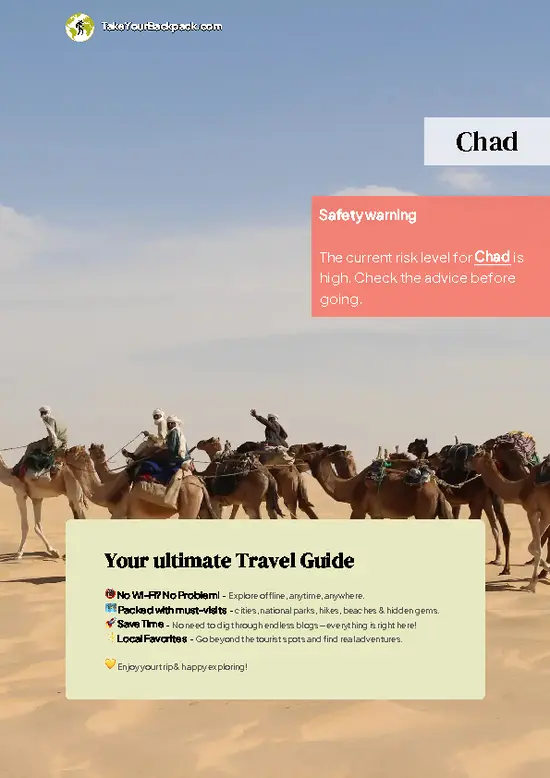
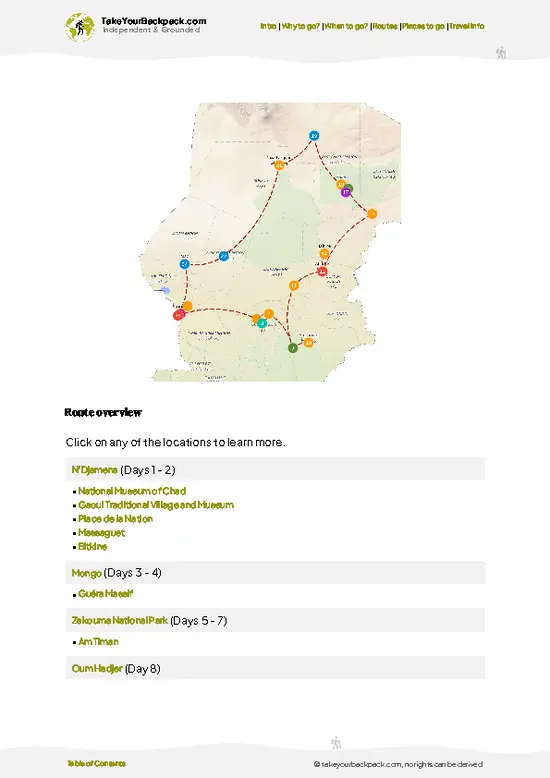
example page 0 from our offline Travel Guide for Chad
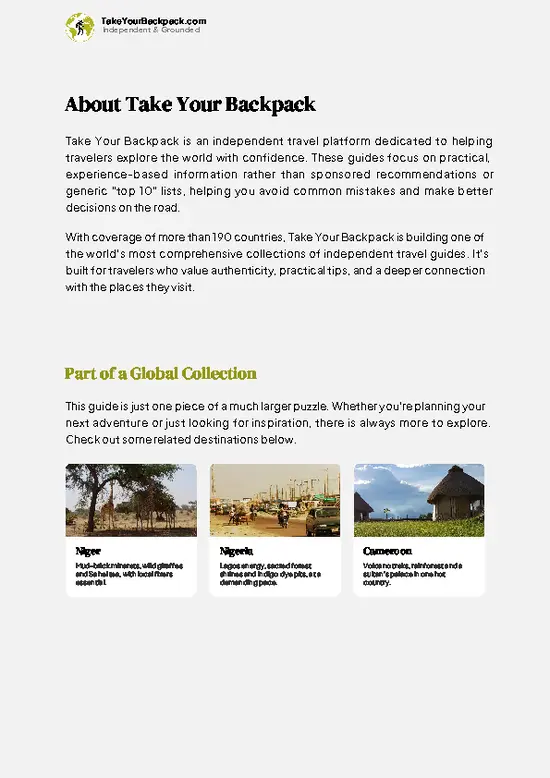
example page 1 from our offline Travel Guide for Chad
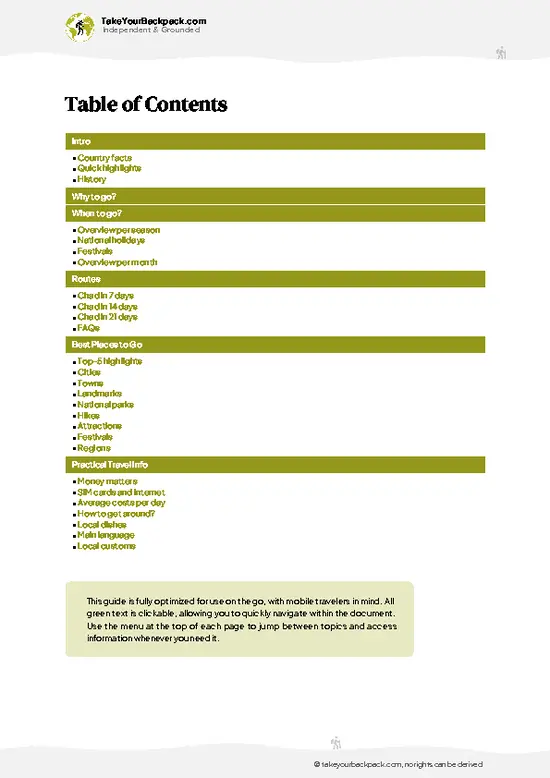
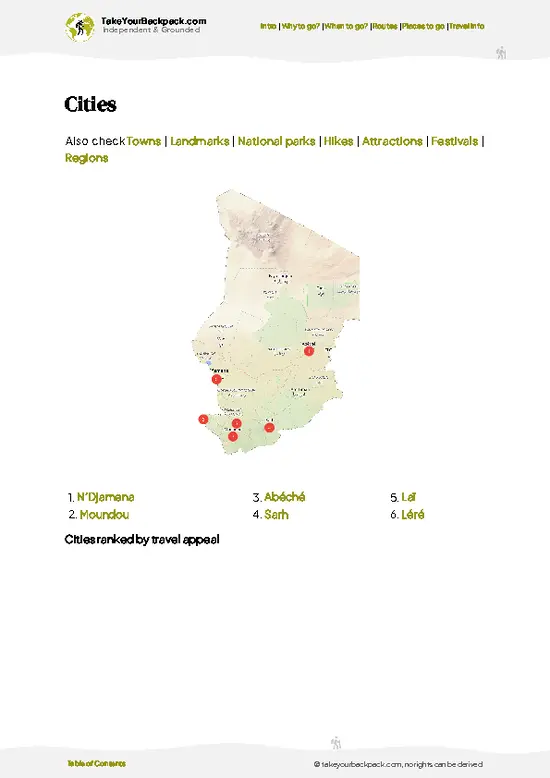
example page 2 from our offline Travel Guide for Chad
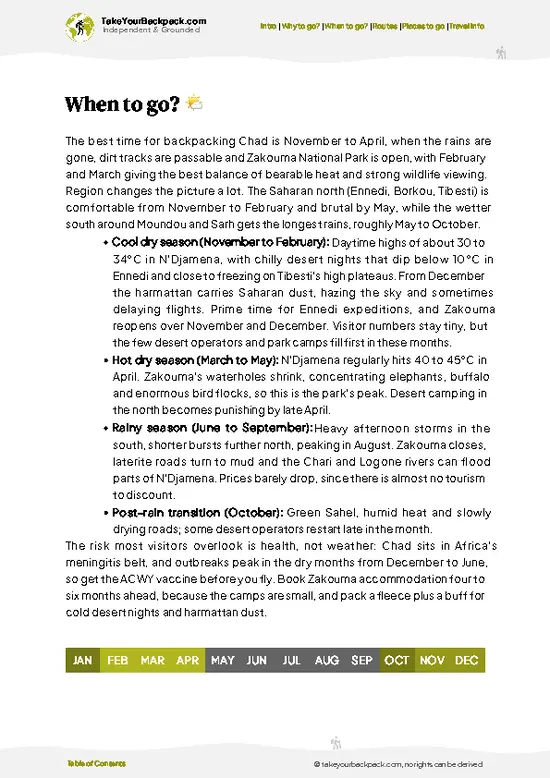
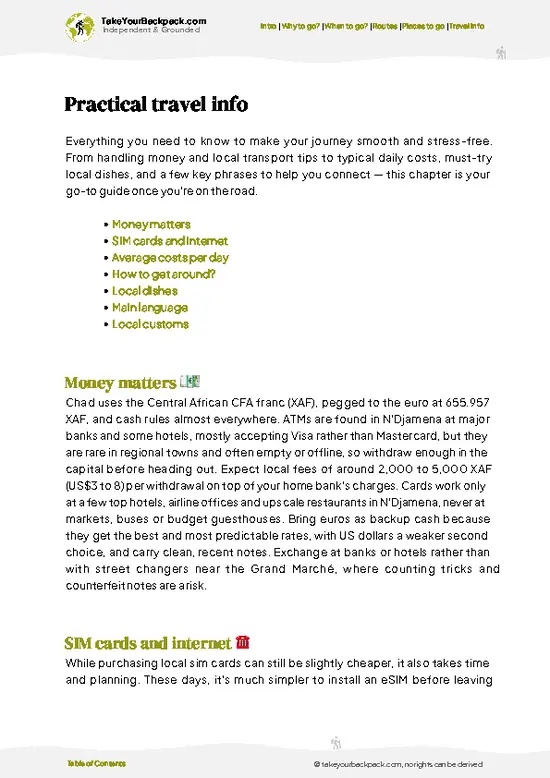
example page 3 from our offline Travel Guide for Chad
example page 4 from our offline Travel Guide for Chad
example page 5 from our offline Travel Guide for Chad
example page 6 from our offline Travel Guide for Chad
example page 7 from our offline Travel Guide for Chad
The digital guide (262 pages) contains:
✅ 57 highlights, ranked by travel appeal
✅ Optimized 7, 14 & 21-day travel routes
✅ Cities, national parks, landmarks, beaches
✅ How to get around
✅ Offline-friendly for travel without Wi-Fi
👉 Click to see all 30+ guide features

📅 Plan smarter in minutes, not weeks
✅ Month by month travel advice
✅ Festivals & national holidays
✅ Budget expectations

🗺️ Go to the right places, skip the overrated ones
✅ Honest pros & cons of destinations
✅ Top hikes, parks & viewpoints
✅ Lesser-known places most travelers miss
✅ Clear “worth it vs skip it” guidance

🛏️ Travel smoothly without rookie mistakes
✅ Best areas to stay
✅ Transport systems explained simply
✅ Common scams & safety advice
✅ SIM cards, money & practical tips

🌍 Understand the country, not just visit it
✅ Culture & traditions
✅ 52 Essential phrases & customs
✅ Festivals worth planning around
✅ Traveler-friendly historical context
✅ Insights that make places more meaningful

📱 Built for real travel conditions
✅ Fully downloadable PDF
✅ Works completely offline
✅ Optimized for phone use
✅ Useful in remote areas & buses
✅ Everything in one place
Stop searching, start planning
Get instant access to your full guide. 30‑day money-back guarantee.
+ Add another guide for just

By proceeding you agree to our terms.
Sent to your inbox immediately after payment • 100% Secure Checkout
Best Backpacking Travel Advisor 2025 tourism awardBest Backpacking
Travel Advisor
2025
What others say about Take Your Backpack Guides:
⭐⭐⭐⭐⭐
Fantastic, amazing amount of information!
⭐⭐⭐⭐⭐
My goodness this is amazing, it's what I've been looking for hats off too you!
⭐⭐⭐⭐⭐
I think this is absolutely BRILLIANT
⭐⭐⭐⭐
Very complete and informative. It's still missing places, but I gotta to commend you
⭐⭐⭐⭐⭐
This is truly amazing, thank you, can't wait to explore it with my kids!
⭐⭐⭐⭐⭐
Awesome resource, thank you!
⭐⭐⭐⭐⭐
This is amazing! Can't wait to explore the ones I haven't seen
⭐⭐⭐⭐
I love this! Well done, great idea.
⭐⭐⭐⭐⭐
Thanks for taking the time to make this gem!
⭐⭐⭐⭐⭐
This might be the best website I've ever seen.
⭐⭐⭐⭐⭐
Congratulations, and thank you so much for your work; it's incredibly valuable.
⭐⭐⭐⭐
In all seriousness I think you did a great job pointing out the important spots
⭐⭐⭐⭐⭐
10/10 very good
⭐⭐⭐⭐⭐
As someone who's only just starting to visit regularly this is awesome, thank you.
⭐⭐⭐⭐
Thank you very much! I'm going to visit my dad, it's going to be very useful!
⭐⭐⭐⭐⭐
This is really cool! We'll be travelling for the first time and this definitely come in handy.
⭐⭐⭐⭐⭐
You are now our minister of culture, congratulations 👨‍💼
⭐⭐⭐⭐⭐
Just wanted to tell you that this is a pearl! Going to follow your recommendations.
⭐⭐⭐⭐⭐
This is so cool. I'll definitely be using the resource for my travels soon.
⭐⭐⭐⭐⭐
This is very impressive! Good work.
⭐⭐⭐⭐⭐
This is an amazing and informative site. Very well done!

🛏️ Where to stay?Where to Stay in Chad

Chad has no real hostel scene, so budget travel here means simple guesthouses, local auberges and church-run mission lodgings, with basic rooms in N’Djamena typically costing 15,000 to 35,000 CFA (about US$25 to 60) a night. The city center around Avenue Charles de Gaulle has the widest choice and puts you within walking distance of the Grand Marché, banks and the few bars that stay open late, though traffic and checkpoints make it the noisiest base. Residential districts such as Moursal and Chagoua to the southeast are quieter and slightly cheaper, while elsewhere in the country, towns like Abéché and Moundou offer only a handful of basic lodgings near the main market roads.

If you enjoy meeting … read more 👉
Chad has no real hostel scene, so budget travel here means simple guesthouses, local auberges and church-run mission lodgings, with basic rooms in N’Djamena typically costing 15,000 to 35,000 CFA (about US$25 to 60) a night. The city center around Avenue Charles de Gaulle has the widest choice and puts you within walking distance of the Grand Marché, banks and the few bars that stay open late, though traffic and checkpoints make it the noisiest base. Residential districts such as Moursal and Chagoua to the southeast are quieter and slightly cheaper, while elsewhere in the country, towns like Abéché and Moundou offer only a handful of basic lodgings near the main market roads.

If you enjoy meeting fellow travelers, consider choosing hostels with high ratings for atmosphere. On the other hand, if you prefer having your own space, a hotel might be a better option.

ChadMore of Chad

👋 Meet the founderWho’s Behind Take Your Backpack?

Johan, backpacker and founder of TakeYourBackpackHi, I’m Johan (Netherlands 🇳🇱), the creator of TakeYourBackpack. Over the past 3 decades, I’ve backpacked through 90+ countries across six continents, gaining extensive experience with independent travel, long-term trips, and overland routes.

This site is built on a combination of firsthand travel experience and carefully curated insights from other backpackers. Many guides are based on places I’ve personally visited, while others bring together tips, observations, and practical advice shared by trusted travelers I’ve met along the way.

The goal is to provide realistic, experience-driven guidance — not generic itineraries — so you can explore destinations with better context, clearer expectations, and more confidence.