How many attractions to plan: Plan two or three attractions on one trip, four at the very most. Chad has almost no paved road network outside the southwest, and a single desert or park leg routinely swallows a full week once fuel stops, checkpoints and breakdowns are counted. A fourth stop usually means rushing the first three, and rushing in Chad costs real money because every extra day on a 4x4 expedition is billed at the daily rate. Fewer stops, done properly, beat a long list ticked off from a vehicle window.
Which kind to prioritize: Desert landscapes are the reason most people come, and they are the right first pick if you want rock formations, camel caravans and nights under empty sky. They need a vehicle, a driver, a cook and fuel, so they only suit you if you can split costs with a …
read more 👉 How many attractions to plan: Plan two or three attractions on one trip, four at the very most. Chad has almost no paved road network outside the southwest, and a single desert or park leg routinely swallows a full week once fuel stops, checkpoints and breakdowns are counted. A fourth stop usually means rushing the first three, and rushing in Chad costs real money because every extra day on a 4x4 expedition is billed at the daily rate. Fewer stops, done properly, beat a long list ticked off from a vehicle window.
Which kind to prioritize: Desert landscapes are the reason most people come, and they are the right first pick if you want rock formations, camel caravans and nights under empty sky. They need a vehicle, a driver, a cook and fuel, so they only suit you if you can split costs with a group or accept a high daily rate. Wildlife parks suit travelers who want comfort and a short, predictable stay, but they are the most expensive per night and only run in the dry months. Lake and river areas, plus the capital’s markets and museums, are the budget-friendly option, yet several lakeside zones sit in security-restricted areas and are not worth the risk for a sightseeing visit. If money is tight, choose the capital and the south over the Sahara, and do not pretend a cheap desert trip exists. It does not.
What it actually costs: Expect
US$50 to 90 a day if you stay in town, using basic hotels (US$35 to 80 a night in N’Djamena, less elsewhere), local meals (US$4 to 12) and shared taxis. An organized desert 4x4 expedition runs about
US$180 to 350 a day per person in a small group, with driver, vehicle, fuel, cook and camping gear included. Solo travelers pay the top of that range because the vehicle cost is not shared. Park-based lodge stays commonly start around US$300 a night per person and rise from there.
Per visit, budget US$10 to 30 for community or park entry fees, and a further US$5 to 20 for a local guide where one is required. Photography permits are mandatory and are normally arranged by your agency. Chad uses the Central African CFA franc (about 600 XAF to US$1). Cards are rarely accepted and ATMs are unreliable, so carry clean euros or dollars and change them in the capital before leaving.
Costs and delays that catch people out: Booking a desert trip on arrival is the costliest mistake. Agencies need lead time for permits, and waiting in N’Djamena burns hotel nights at US$40 or more while paperwork moves. Arrange the operator and permits weeks ahead. Fuel is the second trap. Prices are set per vehicle, and a late departure or detour adds days of food, driver and fuel. Agree in writing what is included, especially water, camping fees and the driver’s tips.
Visas are not issued casually. Apply well ahead and expect to need a hotel booking or invitation. Flights are infrequent and get cancelled, so leave a buffer of at least two days before any international departure. Overland border crossings are not a sightseeing shortcut. Several of Chad’s frontiers are closed or unsafe.
Safety and conduct: Check your government’s current advice before booking, because large parts of the country, including the eastern border with Sudan, areas near Lake Chad and the far north, carry serious warnings. Landmines remain in parts of the north, so never leave tracks your driver knows or wander off to explore alone. Carry several photocopies of your passport, visa and permits, since checkpoints are frequent and each one wants paper. Register with local police when asked.
Photographing soldiers, government buildings, bridges, airports or anything military causes arrests, and a permit does not cover those subjects. Ask before photographing any person, and expect refusals, particularly from women. Most of the north and center is Muslim, so cover shoulders and knees, avoid public displays of affection and skip alcohol outside the capital and southern towns. During Ramadan, eating and drinking openly in daytime is rude, and travel services slow down.
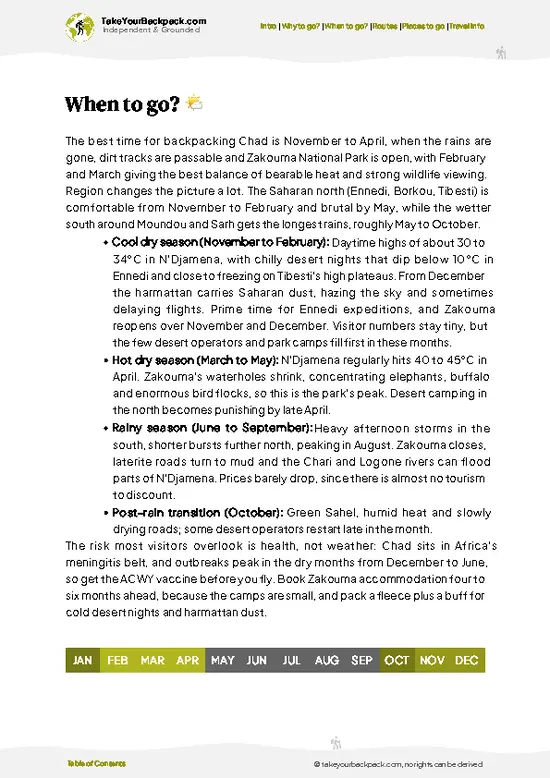
In the desert, plan for at least 5 liters of water per person per day and use agencies that carry spare tires, a second water supply and a satellite phone. A cheaper operator that lacks them is not a saving. Daytime heat above 40°C in the hot months makes midday travel miserable, so ask your operator to rest at midday rather than push through.


 Best Backpacking
 Hi, I’m Johan (Netherlands 🇳🇱), the creator of TakeYourBackpack. Over the past 3 decades, I’ve backpacked through 90+ countries across six continents, gaining extensive experience with independent travel, long-term trips, and overland routes.