×

Chad🇹🇩 | best festivalsThe 4 Top festivals in Chad

Festivals in Chad are not scheduled tourist events. They are community gatherings tied to rain, cattle, harvests, religion and national politics, and dates shift with the season or the moon. That shapes everything. The Sahel and Lake Chad belt offers pastoral gatherings in open country with almost no infrastructure, no tickets and no crowds beyond the participants. N’Djamena offers organized cultural festivals with music, dance and crafts, easy to reach and the only kind a short trip can rely on. The Sahara north has desert gatherings that are slow, expensive and logistically heavy.

Do not plan a trip around a festival date you cannot confirm locally. For independent travel, the capital is the realistic choice. For a rural gathering, accept a guide, permits and a budget well above typical West African backpacking. Chad is expensive and rough, and it pays off only with patience.

By Johan Kruseman 🇳🇱 | Updated October 20, 2026
Explore the best regions in Chad

Why go?Understanding Their Importance

Chad suits festivals because of its ethnic and ecological spread. Over 200 groups live across three zones: Sahara in the north, Sahel in the middle and wetter savanna in the south. Nomadic herders, fishing communities on Lake Chad and settled farmers each keep calendars of their own, so gatherings follow rainfall and herd movements rather than tourist seasons. Arabic and French are the official languages, and Islam and Christianity sit beside older customs, which gives the national calendar a mix of religious holidays and local ceremonies.

The same factors make Chad poorly suited to casual festival hopping. It is landlocked, huge and has very few paved roads. Outside N’Djamena, accommodation is basic and often absent, and overland distances eat days. Rain can cut tracks between July and September, … read more 👉
Chad suits festivals because of its ethnic and ecological spread. Over 200 groups live across three zones: Sahara in the north, Sahel in the middle and wetter savanna in the south. Nomadic herders, fishing communities on Lake Chad and settled farmers each keep calendars of their own, so gatherings follow rainfall and herd movements rather than tourist seasons. Arabic and French are the official languages, and Islam and Christianity sit beside older customs, which gives the national calendar a mix of religious holidays and local ceremonies.

The same factors make Chad poorly suited to casual festival hopping. It is landlocked, huge and has very few paved roads. Outside N’Djamena, accommodation is basic and often absent, and overland distances eat days. Rain can cut tracks between July and September, exactly when some pastoral gatherings happen. Dates are often announced late, and an event can be postponed or moved for security, weather or politics.

Know the rules before choosing Chad. A visa is required and takes planning. Foreigners need to register on arrival, and travel outside the capital usually needs permits and a local operator, especially in the north. Many governments advise against travel to the Lake Chad region and the eastern and northern borders, so check current advisories first. Photography of officials, military and infrastructure is restricted, and photographing people at gatherings needs consent.

Do not come for polished, scheduled spectacle, because it is rare. Come for unstaged cultural occasions, with time and money to match, and expect to depend on local contacts rather than printed programs.
Evaluating the Top Choices
The list of best festivals in Chad is created based on energy, traditions, crowd experience, activities, and overall excitement. If you feel a festival is missing in this list, please let us know.

When to go?When to Plan Your Trip

Best months: The best months for festivals in Chad are October to February, when the rains have ended, roads dry out and temperatures are bearable. N’Djamena runs roughly 15 to 32°C from November to February, with almost no rain. Gatherings tied to the end of the rains cluster in September and October, just as tracks in the Sahel are drying but can still be muddy.

Rainy season: The rainy season runs about June to September in the south and the capital, peaking in August. N’Djamena receives roughly 500 to 650 mm a year, most of it in these months. Heavy downpours flood low roads and slow travel toward Lake Chad and the Sahel. The north gets almost no rain, so the Sahara stays passable, but heat makes it a poor choice for much of the year.

Hot season: March to May is the worst time. Temperatures … read more 👉
Best months: The best months for festivals in Chad are October to February, when the rains have ended, roads dry out and temperatures are bearable. N’Djamena runs roughly 15 to 32°C from November to February, with almost no rain. Gatherings tied to the end of the rains cluster in September and October, just as tracks in the Sahel are drying but can still be muddy.

Rainy season: The rainy season runs about June to September in the south and the capital, peaking in August. N’Djamena receives roughly 500 to 650 mm a year, most of it in these months. Heavy downpours flood low roads and slow travel toward Lake Chad and the Sahel. The north gets almost no rain, so the Sahara stays passable, but heat makes it a poor choice for much of the year.

Hot season: March to May is the worst time. Temperatures in N’Djamena regularly pass 40°C, and parts of the Sahel and north go higher. Dust is thick, driving is exhausting and outdoor events are punishing. Skip this window unless a specific event forces it.

Shoulder and peak periods: November to February is both the comfortable season and the busiest for the limited tourism Chad receives. Flights, 4x4 hire and guides tighten up, and prices for vehicles and permits can run 20 to 40 percent higher around December and January. Hotels in N’Djamena fill around national holidays and major conferences, so book early. The Saharan north is best in the cool months, with nights near freezing in Ennedi and Tibesti from December to January, so pack warm layers.

Islamic holidays move about 11 days earlier each year, and they affect transport, opening hours and prices. Confirm dates locally a few weeks ahead.

festival hoppingTips for Visiting Multiple Destinations

How many days: A trip combining several festivals in Chad needs 10 to 16 days, and more if the north is included. Distances and rough roads, not the events, set the pace.

Regions that group well: N’Djamena is the hub, because international flights land there and permits, registration and guides are arranged there. It pairs well with the Lake Chad and Sahel belt (Bol is roughly 5 to 7 hours by road, depending on track and checkpoints), where gatherings follow the rains. The Ennedi and the Saharan north do not combine with the Sahel on a short trip, since reaching Fada from the capital means days on tracks or limited flights. Treat the north as its own trip.

Direction and time per stop: Start in N’Djamena with 2 to 3 days for registration, permits, cash (carry euros, since cards rarely work and … read more 👉
How many days: A trip combining several festivals in Chad needs 10 to 16 days, and more if the north is included. Distances and rough roads, not the events, set the pace.

Regions that group well: N’Djamena is the hub, because international flights land there and permits, registration and guides are arranged there. It pairs well with the Lake Chad and Sahel belt (Bol is roughly 5 to 7 hours by road, depending on track and checkpoints), where gatherings follow the rains. The Ennedi and the Saharan north do not combine with the Sahel on a short trip, since reaching Fada from the capital means days on tracks or limited flights. Treat the north as its own trip.

Direction and time per stop: Start in N’Djamena with 2 to 3 days for registration, permits, cash (carry euros, since cards rarely work and ATMs are unreliable) and local confirmation of dates. Then travel outward and return to the capital last, since flights out are the least flexible link. Allow 2 to 4 days at a rural gathering, which includes travel on both sides and a buffer for postponements.

Planning mistakes: The biggest mistake is stacking events on consecutive days. Dates move, tracks flood and a vehicle breakdown can swallow a full day, so leave at least one spare day between stops. Another is booking international flights before dates are confirmed. Choose a flexible fare or hold off until local contacts confirm. A third is relying on domestic flights or public buses for tight connections, since schedules change and seats go quickly. Hire a vehicle and driver for the whole loop instead. Finally, do not underestimate checkpoints and permits. Carry multiple copies of passport, visa and permits, and build in time for stops along each route.

The ListHighly Recommended festivals of Chad

1 Gerewol Festival

Wodaabe courtship dances, elaborate face paint, nomadic gatherings, cattle camps

Witness Wodaabe men compete in beauty rituals and dance for days, as nomadic clans converge in the Sahel for this annual gathering.

2 Festival Dary

multinational performances, art exhibitions, urban venues, cross-cultural exchange

Experience a week of music, dance, and art from across Africa and beyond, staged in N’Djamena’s theaters and open-air spaces.

3 Chadian Independence Day

flag-raising ceremonies, military parades, public speeches, national unity

Join crowds in city squares as Chadians mark independence with official events, patriotic displays, and a strong sense of shared identity.

4 Fête de la Musique

open-air concerts, amateur musicians, city streets, spontaneous performances

Stroll through towns as musicians of all ages fill public spaces with live music, transforming everyday streets into impromptu stages.

Loading the map 🌍

Expert viewTips and Advice from Travelers

How many festivals to plan: Plan for one festival, or two at the very most, on a single Chad trip. Festivals here are tied to community calendars, pastoral movements and the weather, so dates are often confirmed only weeks ahead. Distances are also huge and roads are mostly sand tracks. A second festival makes sense only if you have at least three weeks and a flexible return flight. Anything more than two turns the trip into a race against fuel, permits and breakdowns, and you arrive tired at events that reward time on the ground.
The larger the gathering, the more important it is to arrive a day early. Late arrivals miss the ceremonies that set the tone, and vehicles often get stuck at the edge of the site when crowds build.
Which kind suits which traveler: Pick by travel style, not by fame. … read more 👉
How many festivals to plan: Plan for one festival, or two at the very most, on a single Chad trip. Festivals here are tied to community calendars, pastoral movements and the weather, so dates are often confirmed only weeks ahead. Distances are also huge and roads are mostly sand tracks. A second festival makes sense only if you have at least three weeks and a flexible return flight. Anything more than two turns the trip into a race against fuel, permits and breakdowns, and you arrive tired at events that reward time on the ground.
The larger the gathering, the more important it is to arrive a day early. Late arrivals miss the ceremonies that set the tone, and vehicles often get stuck at the edge of the site when crowds build.
Which kind suits which traveler: Pick by travel style, not by fame. Urban cultural events in N'Djamena are the easiest choice for first-timers and budget travelers: you can reach them on foot or by taxi, sleep in a guesthouse and leave when you like. They suit anyone without a big budget. Rural gatherings in the Sahel belt and the desert north are the ones that feel distinct from anywhere else in Africa, but they need a 4x4, a driver-guide, fuel, food and often permits. They are not a place to improvise. Skip them if you are traveling alone on a tight budget, because the vehicle cost does not shrink when you travel solo. Join a small group departure or find travel partners before booking. Those wanting photographs should favor smaller, less formal gatherings, where people have time to talk and the experience is not shaped by a crowd of cameras.
What it costs: Budget US$40 to 70 a day for N'Djamena alone: a basic room is roughly US$25 to 50, meals at local restaurants US$4 to 10, short taxi rides about US$1 to 3. Prices are quoted in Central African CFA francs (XAF), around 560 to 620 per US$1, and cash is far more reliable than cards. Bring euros to exchange and carry small notes.
Once you leave the capital, costs jump. A driver-guide with 4x4 typically runs US$150 to 250 a day for the vehicle, plus fuel and food, so an organized desert trip lands around US$200 to 350 a day per person in a small group. Entry to a festival is often free or a small contribution of a few thousand XAF, but expect separate fees for photography, a local guide or camp space, usually US$5 to 30 in total. Budget extra for a visa (commonly US$100 to 150, with a letter of invitation or an agent often needed) and a yellow fever certificate. The expensive mistake is paying a deposit to an unlicensed operator. Use a company with a verifiable office in N'Djamena and get the inclusions in writing.
Delays and paperwork that catch people out: Permits cause the most lost days. Travel in the north and east often requires authorization, and photography in N'Djamena requires a permit from the tourism ministry. Apply as soon as you arrive, or have the operator do it before you land. Carry several photocopies of passport, visa and permits, since checkpoints are frequent and each one expects paper. Allow a buffer day before any festival and before a flight home: vehicles break down, river crossings and sand slow convoys, and schedules slip by half a day without anyone panicking. Do not book a tight onward connection.
Safety and cultural rules: Check government travel advisories before booking, since large parts of Chad, including areas near Lake Chad and the borders with Libya, Sudan, Nigeria and the Central African Republic, are classed as high risk. Stay out of those areas and keep to the routes your operator has cleared. Travel in daylight, never alone off the main track, and carry extra water, a satellite messenger or phone, and a basic medical kit. Malaria prophylaxis is advisable.
At gatherings, dress modestly: shoulders and knees covered, and women should carry a light scarf. Ask before photographing any person, especially women, elders and during prayer or ritual, and accept a refusal without argument. Some communities expect a small gift or payment, so agree it through your guide first. Drones attract police attention, so leave them at home. Alcohol is limited and discreet in Muslim communities, and Ramadan changes both the schedule and the food options. Greet people properly, with the right hand, before asking for anything. That small courtesy opens more doors than any fee.

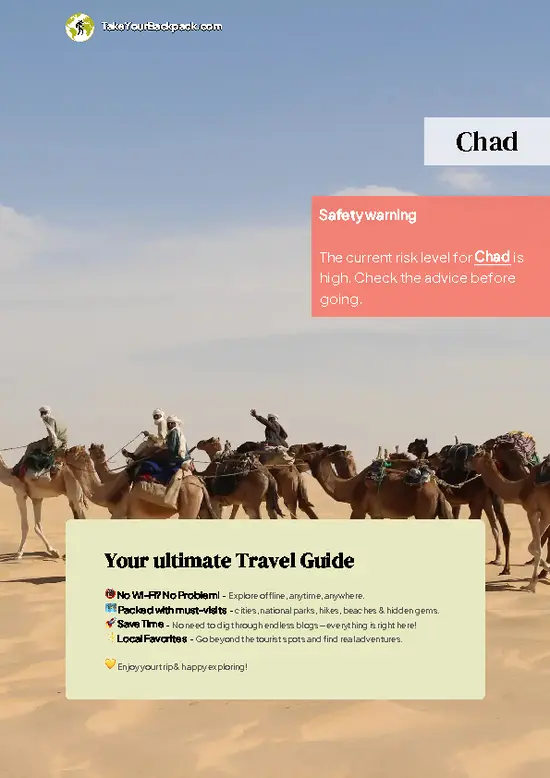
✈️ The backpacker research shortcutChad Travel Guide

An offline-friendly backpacking guide with optimized travel routes, ranked highlights, transport advice, and the best areas to stay.
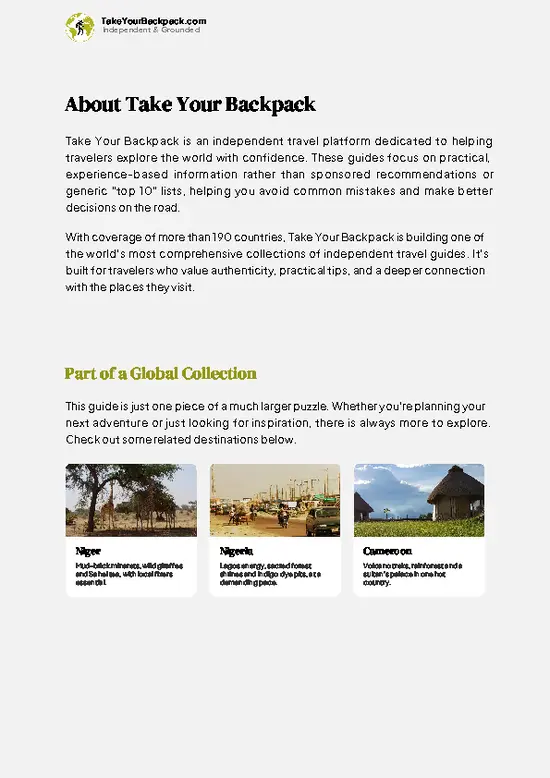
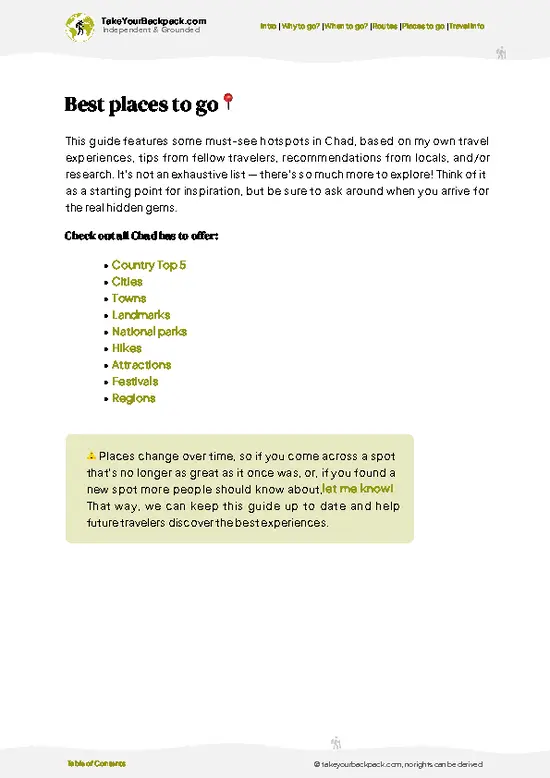
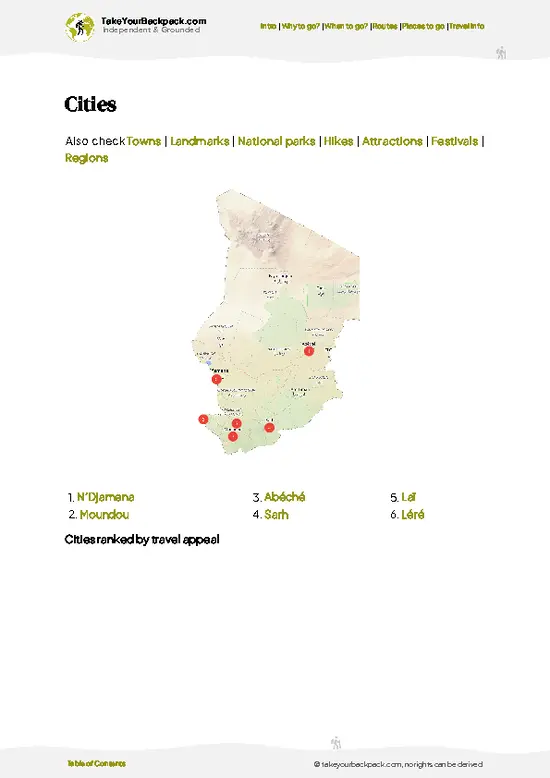
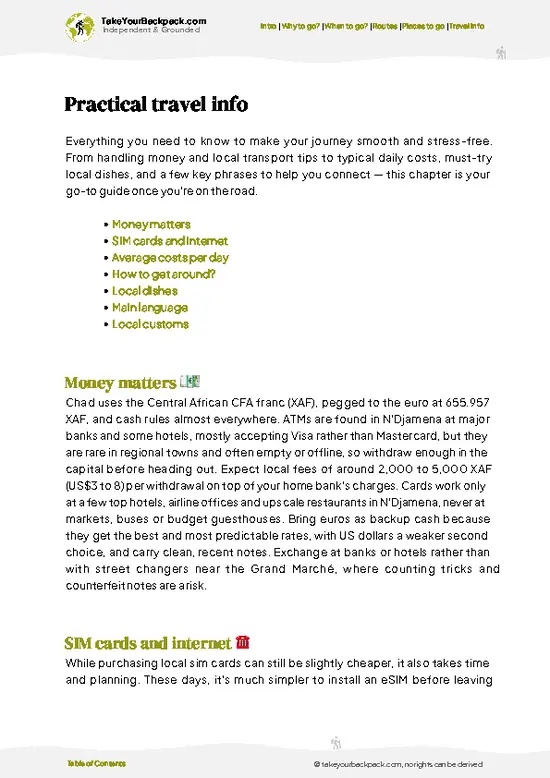
example page 0 from our offline Travel Guide for Chad
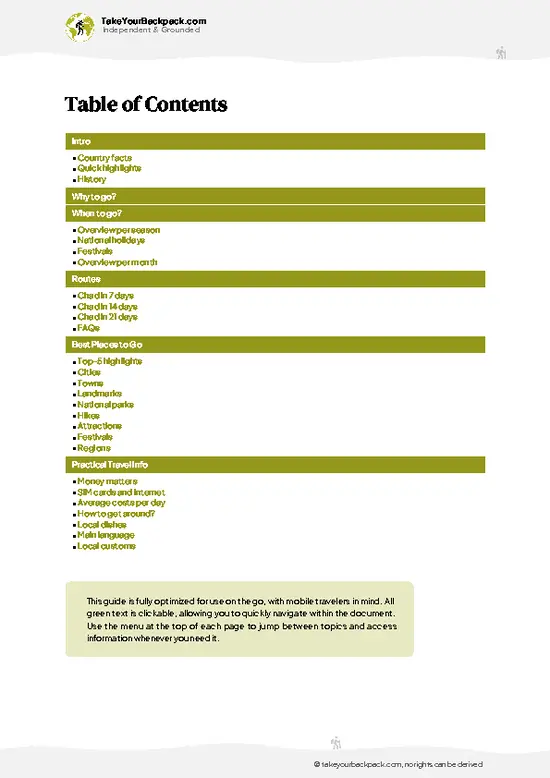
example page 1 from our offline Travel Guide for Chad
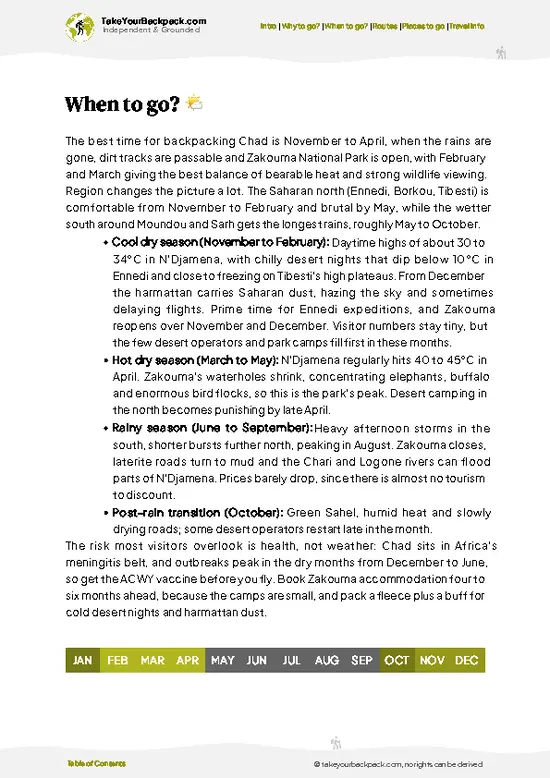
example page 2 from our offline Travel Guide for Chad
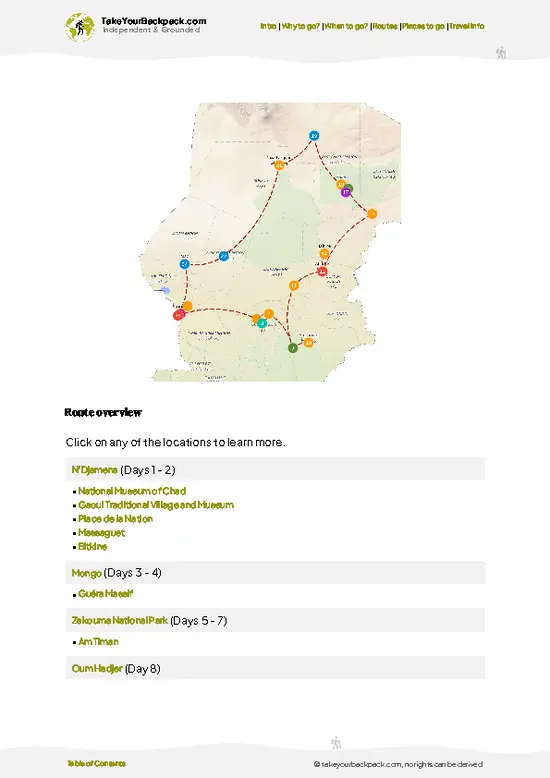
example page 3 from our offline Travel Guide for Chad
example page 4 from our offline Travel Guide for Chad
example page 5 from our offline Travel Guide for Chad
example page 6 from our offline Travel Guide for Chad
example page 7 from our offline Travel Guide for Chad
The digital guide (262 pages) contains:
✅ 57 highlights, ranked by travel appeal
✅ Optimized 7, 14 & 21-day travel routes
✅ Cities, national parks, landmarks, beaches
✅ How to get around
✅ Offline-friendly for travel without Wi-Fi
👉 Click to see all 30+ guide features

📅 Plan smarter in minutes, not weeks
✅ Month by month travel advice
✅ Festivals & national holidays
✅ Budget expectations

🗺️ Go to the right places, skip the overrated ones
✅ Honest pros & cons of destinations
✅ Top hikes, parks & viewpoints
✅ Lesser-known places most travelers miss
✅ Clear “worth it vs skip it” guidance

🛏️ Travel smoothly without rookie mistakes
✅ Best areas to stay
✅ Transport systems explained simply
✅ Common scams & safety advice
✅ SIM cards, money & practical tips

🌍 Understand the country, not just visit it
✅ Culture & traditions
✅ 52 Essential phrases & customs
✅ Festivals worth planning around
✅ Traveler-friendly historical context
✅ Insights that make places more meaningful

📱 Built for real travel conditions
✅ Fully downloadable PDF
✅ Works completely offline
✅ Optimized for phone use
✅ Useful in remote areas & buses
✅ Everything in one place
Stop searching, start planning
Get instant access to your full guide. 30‑day money-back guarantee.
+ Add another guide for just

By proceeding you agree to our terms.
Sent to your inbox immediately after payment • 100% Secure Checkout
Best Backpacking Travel Advisor 2025 tourism awardBest Backpacking
Travel Advisor
2025
What others say about Take Your Backpack Guides:
⭐⭐⭐⭐⭐
Fantastic, amazing amount of information!
⭐⭐⭐⭐⭐
My goodness this is amazing, it's what I've been looking for hats off too you!
⭐⭐⭐⭐⭐
I think this is absolutely BRILLIANT
⭐⭐⭐⭐
Very complete and informative. It's still missing places, but I gotta to commend you
⭐⭐⭐⭐⭐
This is truly amazing, thank you, can't wait to explore it with my kids!
⭐⭐⭐⭐⭐
Awesome resource, thank you!
⭐⭐⭐⭐⭐
This is amazing! Can't wait to explore the ones I haven't seen
⭐⭐⭐⭐
I love this! Well done, great idea.
⭐⭐⭐⭐⭐
Thanks for taking the time to make this gem!
⭐⭐⭐⭐⭐
This might be the best website I've ever seen.
⭐⭐⭐⭐⭐
Congratulations, and thank you so much for your work; it's incredibly valuable.
⭐⭐⭐⭐
In all seriousness I think you did a great job pointing out the important spots
⭐⭐⭐⭐⭐
10/10 very good
⭐⭐⭐⭐⭐
As someone who's only just starting to visit regularly this is awesome, thank you.
⭐⭐⭐⭐
Thank you very much! I'm going to visit my dad, it's going to be very useful!
⭐⭐⭐⭐⭐
This is really cool! We'll be travelling for the first time and this definitely come in handy.
⭐⭐⭐⭐⭐
You are now our minister of culture, congratulations 👨‍💼
⭐⭐⭐⭐⭐
Just wanted to tell you that this is a pearl! Going to follow your recommendations.
⭐⭐⭐⭐⭐
This is so cool. I'll definitely be using the resource for my travels soon.
⭐⭐⭐⭐⭐
This is very impressive! Good work.
⭐⭐⭐⭐⭐
This is an amazing and informative site. Very well done!

🛏️ Where to stay?Best Stay Options in Chad

Chad has no real hostel scene, so budget travel here means simple guesthouses, local auberges and church-run mission lodgings, with basic rooms in N’Djamena typically costing 15,000 to 35,000 CFA (about US$25 to 60) a night. The city center around Avenue Charles de Gaulle has the widest choice and puts you within walking distance of the Grand Marché, banks and the few bars that stay open late, though traffic and checkpoints make it the noisiest base. Residential districts such as Moursal and Chagoua to the southeast are quieter and slightly cheaper, while elsewhere in the country, towns like Abéché and Moundou offer only a handful of basic lodgings near the main market roads.

If you enjoy meeting … read more 👉
Chad has no real hostel scene, so budget travel here means simple guesthouses, local auberges and church-run mission lodgings, with basic rooms in N’Djamena typically costing 15,000 to 35,000 CFA (about US$25 to 60) a night. The city center around Avenue Charles de Gaulle has the widest choice and puts you within walking distance of the Grand Marché, banks and the few bars that stay open late, though traffic and checkpoints make it the noisiest base. Residential districts such as Moursal and Chagoua to the southeast are quieter and slightly cheaper, while elsewhere in the country, towns like Abéché and Moundou offer only a handful of basic lodgings near the main market roads.

If you enjoy meeting fellow travelers, consider choosing hostels with high ratings for atmosphere. On the other hand, if you prefer having your own space, a hotel might be a better option.

ChadWhere to Go Next

👋 Meet the founderWho’s Behind Take Your Backpack?

Johan, backpacker and founder of TakeYourBackpackHi, I’m Johan (Netherlands 🇳🇱), the creator of TakeYourBackpack. Over the past 3 decades, I’ve backpacked through 90+ countries across six continents, gaining extensive experience with independent travel, long-term trips, and overland routes.

This site is built on a combination of firsthand travel experience and carefully curated insights from other backpackers. Many guides are based on places I’ve personally visited, while others bring together tips, observations, and practical advice shared by trusted travelers I’ve met along the way.

The goal is to provide realistic, experience-driven guidance — not generic itineraries — so you can explore destinations with better context, clearer expectations, and more confidence.