×

Chad🇹🇩 | best landmarksThe 3 Top landmarks in Chad

Landmarks in Chad are not ticketed monuments with gift shops. They are remote, mostly natural and cultural sites spread across a country twice the size of Texas, and getting to them is the main event. The north holds the Sahara sites: rock art, lake systems and sandstone massifs reached only by 4x4 with a permit, a guide and a security escort. Expect no crowds, almost no signage and costs driven by vehicle hire, not entry fees. The south and the capital region are easier. Roads exist, taxis and buses run, and a day trip is realistic, but the sites are modest and not worth a special flight. Independent travel here works only with planning, because there is no walk-up infrastructure. If you want cheap, spontaneous sightseeing, skip Chad. If you want empty desert and real expedition feel, the north is the reason to come, and it justifies the price.

By Johan Kruseman 🇳🇱 | Updated October 20, 2026
Explore the best national parks in Chad

Why go?Understanding Their Importance

Chad is a poor choice for ticking off famous monuments and an excellent one for raw, uncurated landscapes. Its position at the meeting point of the Sahara and the Sahel means the country holds extremes: ancient desert geology, seasonal lakes and a long record of human presence preserved by dry air. Rock engravings and paintings survive because almost no one lives near them and almost no one visits. That isolation is the appeal, and also the obstacle.

Infrastructure is thin. Paved roads are largely limited to the area around N’Djamena and a few corridors, and the northern interior has tracks, not roads. Fuel, water and food must be carried. Mobile coverage disappears outside towns. Nothing is built around visitors, so there are few facilities, little interpretation and no standardized pricing. … read more 👉
Chad is a poor choice for ticking off famous monuments and an excellent one for raw, uncurated landscapes. Its position at the meeting point of the Sahara and the Sahel means the country holds extremes: ancient desert geology, seasonal lakes and a long record of human presence preserved by dry air. Rock engravings and paintings survive because almost no one lives near them and almost no one visits. That isolation is the appeal, and also the obstacle.

Infrastructure is thin. Paved roads are largely limited to the area around N’Djamena and a few corridors, and the northern interior has tracks, not roads. Fuel, water and food must be carried. Mobile coverage disappears outside towns. Nothing is built around visitors, so there are few facilities, little interpretation and no standardized pricing. Do not expect museums to fill the gaps. Collections are small and often hard to access.

Before choosing Chad for landmarks, understand the practical conditions. Foreign travel advisories are restrictive for large parts of the country, including border zones with Libya, Sudan and the Lake Chad region, so check current government guidance and your insurance cover first. Travel permits are typically required for movement outside the capital, and the north normally requires an authorized local operator, not a self-drive plan. Budget for that: independent in spirit does not mean unguided.

Culturally, the country is a mix of Arab, Sahelian and Saharan peoples, and religious and social norms are conservative. Photography of people, officials and anything military needs permission. The sites that matter most are those where landscape and human history overlap, and they reward travelers with time, money and flexibility. Anyone short of one of those three should pick a different country.
Why These Made the Cut
The list of best unique sites in Chad is created based on history or culture, wow factor, atmosphere, quirks, and memorability. If you feel a unique site is missing in this list, please let us know.

When to go?When to Plan Your Trip

Best months: The best months for landmarks in Chad are November to February, when northern daytime highs sit around 25 to 32°C and nights can drop to 5 to 12°C, which makes desert driving and camping workable. Outside this window the Sahara is punishing: from April to June, highs in the north and around N’Djamena regularly reach 40 to 45°C, and travel is miserable and risky for vehicles and people.

Rainy season: In the south and around the capital, rain falls from roughly June to September, with annual totals of about 600 to 900 mm near N’Djamena and more in the far south. Unpaved roads turn to mud, rivers rise and some tracks become impassable. Skip the south in July and August unless you have no choice. The far north gets almost no rain, under 50 mm a year in much of the Sahara, but summer … read more 👉
Best months: The best months for landmarks in Chad are November to February, when northern daytime highs sit around 25 to 32°C and nights can drop to 5 to 12°C, which makes desert driving and camping workable. Outside this window the Sahara is punishing: from April to June, highs in the north and around N’Djamena regularly reach 40 to 45°C, and travel is miserable and risky for vehicles and people.

Rainy season: In the south and around the capital, rain falls from roughly June to September, with annual totals of about 600 to 900 mm near N’Djamena and more in the far south. Unpaved roads turn to mud, rivers rise and some tracks become impassable. Skip the south in July and August unless you have no choice. The far north gets almost no rain, under 50 mm a year in much of the Sahara, but summer heat makes it the wrong season anyway.

Shoulder seasons and dust: October and March are workable shoulders. October can still bring late storms in the south. March warms fast, with highs in the high 30s. From December to February the Harmattan wind carries dust from the northeast, cutting visibility and softening distant views, so photographers should expect haze at times.

Crowds and prices: There is no true crowd season, because visitor numbers are tiny. Prices move with demand for 4x4 vehicles and guides, which peaks in the cool months. Expect operators to charge more and book out earlier from November to February, so arrange transport and permits at least a month ahead. Travel in the hot months can be cheaper, but the savings are not worth the heat risk. Check holiday dates too, since Ramadan shifts opening hours and availability of drivers and food outside towns.

unique site hoppingTips for Visiting Multiple Destinations

How long you need: A trip combining several landmarks in Chad needs 10 to 14 days at minimum, and more if the northern desert is included. Distances are large and speeds are slow, so the usual error is trying to fit too much into one week.

Grouping regions: Two clusters work. The first is N’Djamena and the south, linked by paved and semi-paved roads, where a loop of several days is practical by bus, shared taxi or hired car. The second is the northern Sahara, which needs its own expedition from a base such as Faya-Largeau, reached by a long overland drive or a flight arranged through an operator. Do not mix both clusters casually. Treat them as separate trips that happen to share a capital.

Direction and timing: Start in N’Djamena for permits, registration and supplies, then head to the … read more 👉
How long you need: A trip combining several landmarks in Chad needs 10 to 14 days at minimum, and more if the northern desert is included. Distances are large and speeds are slow, so the usual error is trying to fit too much into one week.

Grouping regions: Two clusters work. The first is N’Djamena and the south, linked by paved and semi-paved roads, where a loop of several days is practical by bus, shared taxi or hired car. The second is the northern Sahara, which needs its own expedition from a base such as Faya-Largeau, reached by a long overland drive or a flight arranged through an operator. Do not mix both clusters casually. Treat them as separate trips that happen to share a capital.

Direction and timing: Start in N’Djamena for permits, registration and supplies, then head to the area where road conditions are least certain first, while you have buffer days. Finish with the easier stretch. Allow 1 to 2 days per stop in the south and 3 to 5 days across a northern desert circuit, because 4x4 progress often averages 20 to 40 km an hour on sand and rock. Travel between the capital and the far north commonly takes 2 to 3 days overland, or a short flight if available.

Planning mistakes: Travelers underestimate transfer times and book tight onward flights. Leave at least one spare day at each end. They also arrive without permits, which can cost days in N’Djamena, so start paperwork before landing. Another error is relying on fixed schedules: buses leave when full, and tracks flood or shift. Carry extra fuel, water and cash in CFA francs, since cards and ATMs rarely work outside the capital. Finally, do not add border or lake areas without current security clearance. Drop a stop instead of rushing it.

The ListHighly Recommended landmarks of Chad

1 Guelta d’Archei

desert canyon, permanent water pools, Saharan crocodiles

Hike through sandstone gorges to find ancient waterholes where crocodiles survive, and nomads water their herds in the heart of the Ennedi.

2 Grand Mosque of N’Djamena

ornate minaret, central prayer hall, Friday gatherings

Experience the daily rhythm of N’Djamena as worshippers gather, markets bustle nearby, and intricate tilework frames moments of quiet reflection.

3 Lac Iro

seasonal lake, migratory birds, floodplain grasslands

Watch shifting waters attract flocks of birds and herders’ cattle, revealing the lake’s changing boundaries and the pulse of local life.

Loading the map 🌍

Expert viewTips and Advice from Travelers

How many landmarks to visit: Plan for three to five landmarks in a single trip. Distances and logistics eat days, and each stop in a remote region needs a vehicle, fuel, a guide and often a permit. Packing in more means long drives with little time on site and a budget that balloons. Fewer, longer stops give you time to walk, photograph and talk with local guides.

Which kind to prioritize: Choose by travel style. Adventure travelers with money and time should put the northern Saharan sites first: empty, physically demanding, and the real reason to visit Chad. Budget travelers and short-trip visitors should stick to the southern and capital-area sites, which are accessible by public transport and cheap. Cultural travelers should add time in towns, where markets, mosques and local museums give … read more 👉
How many landmarks to visit: Plan for three to five landmarks in a single trip. Distances and logistics eat days, and each stop in a remote region needs a vehicle, fuel, a guide and often a permit. Packing in more means long drives with little time on site and a budget that balloons. Fewer, longer stops give you time to walk, photograph and talk with local guides.

Which kind to prioritize: Choose by travel style. Adventure travelers with money and time should put the northern Saharan sites first: empty, physically demanding, and the real reason to visit Chad. Budget travelers and short-trip visitors should stick to the southern and capital-area sites, which are accessible by public transport and cheap. Cultural travelers should add time in towns, where markets, mosques and local museums give context that the open desert does not. Skip anything that requires a long detour for a small payoff, like sites with no guide, no access road and no interpretation.

What it costs: Southern independent travel runs about US$40 to 70 a day (roughly 25,000 to 43,000 CFA francs) including basic lodging, food and shared transport. Northern expeditions are a different category: expect US$150 to 300 a day per person in a group, covering a 4x4, driver, cook, fuel and escorts. Entry fees at sites are usually small, around US$5 to 20, but guide fees and local permits add US$10 to 40 per visit. Photo permits can be charged separately. Carry cash in CFA francs, because cards rarely work outside N’Djamena.

Costs and delays that catch travelers out: Permit delays are the biggest drain. Registration and travel authorization in N’Djamena can take several days, and missing paperwork at checkpoints leads to fines or turnbacks. Start the process before arrival through your operator. Fuel shortages in remote towns can strand vehicles, so carry extra and budget for it. Informal fees at checkpoints are common; ask your operator what is expected and carry small notes to avoid arguments over change. Last-minute vehicle hire is far more expensive than booking ahead, and quotes that sound cheap often leave out fuel and driver costs, so get inclusions in writing.

Safety and cultural considerations: Security is the main constraint. Large parts of Chad, including border areas and the Lake Chad region, carry strong government travel warnings. Check current advice, buy insurance that covers evacuation, and do not travel in restricted zones. In the north, use an authorized operator with satellite communication and an escort where required. Never go off-track alone: navigation errors in the desert can be fatal.

Photography needs care. Ask before photographing people, and never photograph military sites, officials, airports or bridges, which can lead to detention. Dress modestly, with covered shoulders and knees, and more conservatively in Muslim-majority areas. Rock art and archaeological sites are fragile, so do not touch engravings, move stones or take souvenirs. Visits during Ramadan are possible, but avoid eating or drinking openly in public in daylight, and expect slower services and fewer drivers available.

Health planning matters as much as paperwork. Carry more water than you think you need, at least 5 to 6 liters per person a day in the desert, plus electrolytes and sun protection. Malaria is present in the south, so take prophylaxis. Medical care outside N’Djamena is limited, which is why insurance with evacuation cover is not optional.

✈️ The backpacker research shortcutChad Travel Guide

An offline-friendly backpacking guide with optimized travel routes, ranked highlights, transport advice, and the best areas to stay.
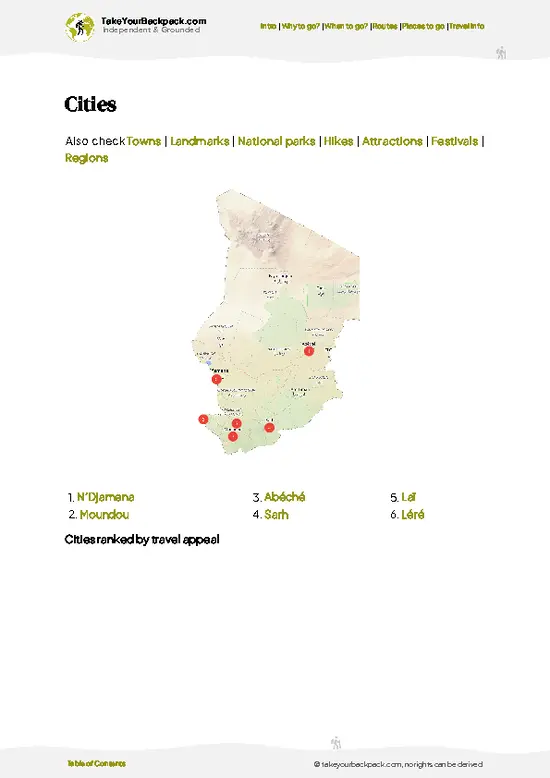
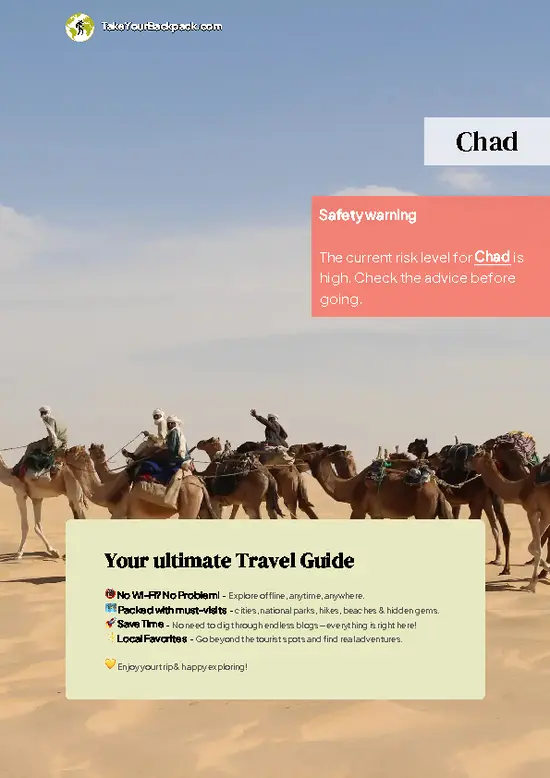
example page 0 from our offline Travel Guide for Chad
example page 1 from our offline Travel Guide for Chad
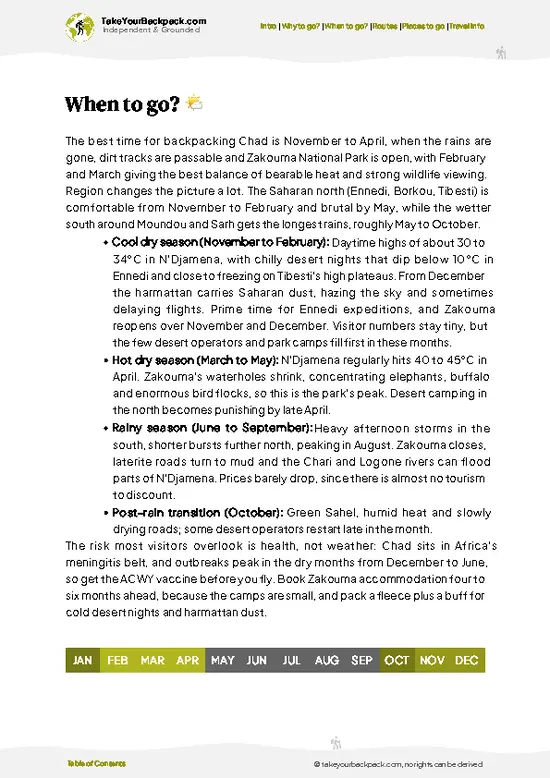
example page 2 from our offline Travel Guide for Chad
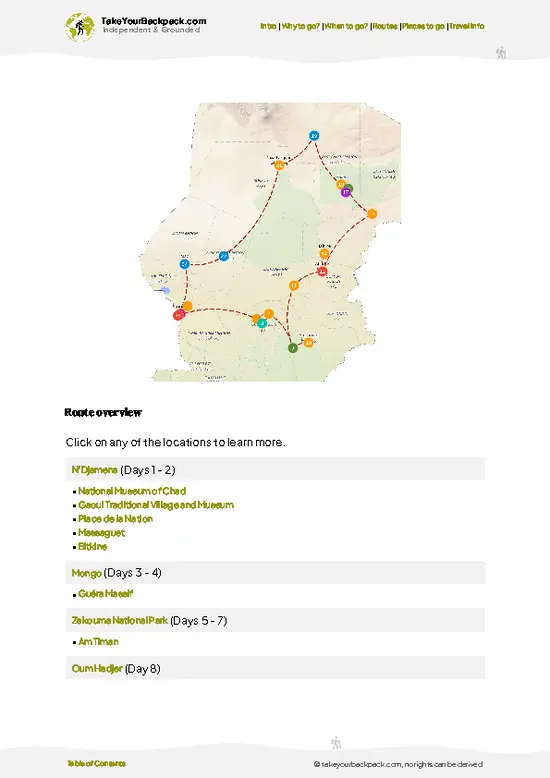
example page 3 from our offline Travel Guide for Chad
example page 4 from our offline Travel Guide for Chad
example page 5 from our offline Travel Guide for Chad
example page 6 from our offline Travel Guide for Chad
example page 7 from our offline Travel Guide for Chad
The digital guide (262 pages) contains:
✅ 57 highlights, ranked by travel appeal
✅ Optimized 7, 14 & 21-day travel routes
✅ Cities, national parks, landmarks, beaches
✅ How to get around
✅ Offline-friendly for travel without Wi-Fi
👉 Click to see all 30+ guide features

📅 Plan smarter in minutes, not weeks
✅ Month by month travel advice
✅ Festivals & national holidays
✅ Budget expectations

🗺️ Go to the right places, skip the overrated ones
✅ Honest pros & cons of destinations
✅ Top hikes, parks & viewpoints
✅ Lesser-known places most travelers miss
✅ Clear “worth it vs skip it” guidance

🛏️ Travel smoothly without rookie mistakes
✅ Best areas to stay
✅ Transport systems explained simply
✅ Common scams & safety advice
✅ SIM cards, money & practical tips

🌍 Understand the country, not just visit it
✅ Culture & traditions
✅ 52 Essential phrases & customs
✅ Festivals worth planning around
✅ Traveler-friendly historical context
✅ Insights that make places more meaningful

📱 Built for real travel conditions
✅ Fully downloadable PDF
✅ Works completely offline
✅ Optimized for phone use
✅ Useful in remote areas & buses
✅ Everything in one place
Stop searching, start planning
Get instant access to your full guide. 30‑day money-back guarantee.
+ Add another guide for just

By proceeding you agree to our terms.
Sent to your inbox immediately after payment • 100% Secure Checkout
Best Backpacking Travel Advisor 2025 tourism awardBest Backpacking
Travel Advisor
2025
What others say about Take Your Backpack Guides:
⭐⭐⭐⭐⭐
Fantastic, amazing amount of information!
⭐⭐⭐⭐⭐
My goodness this is amazing, it's what I've been looking for hats off too you!
⭐⭐⭐⭐⭐
I think this is absolutely BRILLIANT
⭐⭐⭐⭐
Very complete and informative. It's still missing places, but I gotta to commend you
⭐⭐⭐⭐⭐
This is truly amazing, thank you, can't wait to explore it with my kids!
⭐⭐⭐⭐⭐
Awesome resource, thank you!
⭐⭐⭐⭐⭐
This is amazing! Can't wait to explore the ones I haven't seen
⭐⭐⭐⭐
I love this! Well done, great idea.
⭐⭐⭐⭐⭐
Thanks for taking the time to make this gem!
⭐⭐⭐⭐⭐
This might be the best website I've ever seen.
⭐⭐⭐⭐⭐
Congratulations, and thank you so much for your work; it's incredibly valuable.
⭐⭐⭐⭐
In all seriousness I think you did a great job pointing out the important spots
⭐⭐⭐⭐⭐
10/10 very good
⭐⭐⭐⭐⭐
As someone who's only just starting to visit regularly this is awesome, thank you.
⭐⭐⭐⭐
Thank you very much! I'm going to visit my dad, it's going to be very useful!
⭐⭐⭐⭐⭐
This is really cool! We'll be travelling for the first time and this definitely come in handy.
⭐⭐⭐⭐⭐
You are now our minister of culture, congratulations 👨‍💼
⭐⭐⭐⭐⭐
Just wanted to tell you that this is a pearl! Going to follow your recommendations.
⭐⭐⭐⭐⭐
This is so cool. I'll definitely be using the resource for my travels soon.
⭐⭐⭐⭐⭐
This is very impressive! Good work.
⭐⭐⭐⭐⭐
This is an amazing and informative site. Very well done!

🛏️ Where to stay?Top Areas to Stay

Chad has no real hostel scene, so budget travel here means simple guesthouses, local auberges and church-run mission lodgings, with basic rooms in N’Djamena typically costing 15,000 to 35,000 CFA (about US$25 to 60) a night. The city center around Avenue Charles de Gaulle has the widest choice and puts you within walking distance of the Grand Marché, banks and the few bars that stay open late, though traffic and checkpoints make it the noisiest base. Residential districts such as Moursal and Chagoua to the southeast are quieter and slightly cheaper, while elsewhere in the country, towns like Abéché and Moundou offer only a handful of basic lodgings near the main market roads.

If you enjoy meeting … read more 👉
Chad has no real hostel scene, so budget travel here means simple guesthouses, local auberges and church-run mission lodgings, with basic rooms in N’Djamena typically costing 15,000 to 35,000 CFA (about US$25 to 60) a night. The city center around Avenue Charles de Gaulle has the widest choice and puts you within walking distance of the Grand Marché, banks and the few bars that stay open late, though traffic and checkpoints make it the noisiest base. Residential districts such as Moursal and Chagoua to the southeast are quieter and slightly cheaper, while elsewhere in the country, towns like Abéché and Moundou offer only a handful of basic lodgings near the main market roads.

If you enjoy meeting fellow travelers, consider choosing hostels with high ratings for atmosphere. On the other hand, if you prefer having your own space, a hotel might be a better option.

ChadDiscover the Country

👋 Meet the founderWho’s Behind Take Your Backpack?

Johan, backpacker and founder of TakeYourBackpackHi, I’m Johan (Netherlands 🇳🇱), the creator of TakeYourBackpack. Over the past 3 decades, I’ve backpacked through 90+ countries across six continents, gaining extensive experience with independent travel, long-term trips, and overland routes.

This site is built on a combination of firsthand travel experience and carefully curated insights from other backpackers. Many guides are based on places I’ve personally visited, while others bring together tips, observations, and practical advice shared by trusted travelers I’ve met along the way.

The goal is to provide realistic, experience-driven guidance — not generic itineraries — so you can explore destinations with better context, clearer expectations, and more confidence.