×

Chile🇨🇱 | citiesIquiqueTandem paragliding, nitrate mansions, Cavancha swimming, fried-fish stalls | things to do and best time to go

Explore AricaExplore Punta Arenas

Backpacking in Iquique
👍 Recommendedcity ranked #9
By Johan Kruseman 🇳🇱 | Updated October 19, 2026

Iquique gives you a Pacific beach city with duty-free shopping and one of South America’s best paragliding launches, all within a few blocks of a walkable center. It sits in the north of Chile, squeezed between the ocean and a steep wall of desert sand. The trade is simple: you give up Patagonia’s scenery and get warm water, cheap surf lessons and easy desert access. For a backpacker that beats a pricier resort town, though it suits beach and adventure types more than museum hunters. At a stall near the Mercado Centenario I paid about US$5 for a plate of fried fish and a cold drink, and nothing on the coast gave better value. A first day could mean ceviche at the market, a stroll along Playa Cavancha, and sunset from the cliff.

Discover everything you want to know in the 📖 Chile Travel Guide.


example page 0 from our offline Travel Guide for Chile
example page 1 from our offline Travel Guide for Chile
example page 2 from our offline Travel Guide for Chile
example page 3 from our offline Travel Guide for Chile
example page 4 from our offline Travel Guide for Chile
example page 5 from our offline Travel Guide for Chile
example page 6 from our offline Travel Guide for Chile
example page 7 from our offline Travel Guide for Chile
Loading the map 🌍
CLICK TO FILTER
cities
towns
villages
landmarks
national parks
hikes
beaches
attractions
festivals
regions
SHOW COUNTRY’S BESTSHOW ALL

✨ Why go?
Ranked #9 city in Chile
What sets this place apart

Iquique earns a place on a northern Chile route because it packs paragliding off Cerro Dragón, surf, and a historic center into a compact grid you can cover on foot. Few cities let you fly over the sand dunes in the morning and eat fresh seafood by lunch. The city also works as a base for the Atacama side of the region, with desert, ghost towns and salt flats within reach, so two or three nights let you mix beach days with excursions. Hostels cluster near the center and the waterfront, making it easy to meet people for group trips. The Zofri duty-free mall is a draw for gear and electronics, though it is hardly a reason alone. Nightlife is lively on weekends along the coast. If you only want sights, a short stop is enough; if you want sun and activity, stay longer.

💡 HighlightsWhat this place is best known for

  1. Plaza Prat and Teatro Municipal: The main square holds the 1878 clock tower and a grand theater from 1889 with a restored interior. Visit in the morning. The plaza is free, and theater visits cost around US$2 to 3 for 30 minutes.
  2. Paseo Baquedano: A wooden-sidewalk street lined with Georgian-style mansions from the nitrate boom, plus old tram tracks. Go late afternoon for cooler air. It is free and takes 30 to 45 minutes.
  3. Museo Naval de Iquique: Dedicated to the 1879 Battle of Iquique, with ship models and a replica of the Esmeralda’s deck. Entry is about US$1 to 2. Allow 1 hour.
  4. Playa Cavancha: The city’s main beach, calm and protected by a breakwater, with a promenade and a sea lion colony at the nearby rocks. Best on a sunny afternoon. Free, 2 to 3 hours.
  5. Paragliding from Alto Hospicio: Tandem
… read more 👉
  1. Plaza Prat and Teatro Municipal: The main square holds the 1878 clock tower and a grand theater from 1889 with a restored interior. Visit in the morning. The plaza is free, and theater visits cost around US$2 to 3 for 30 minutes.
  2. Paseo Baquedano: A wooden-sidewalk street lined with Georgian-style mansions from the nitrate boom, plus old tram tracks. Go late afternoon for cooler air. It is free and takes 30 to 45 minutes.
  3. Museo Naval de Iquique: Dedicated to the 1879 Battle of Iquique, with ship models and a replica of the Esmeralda’s deck. Entry is about US$1 to 2. Allow 1 hour.
  4. Playa Cavancha: The city’s main beach, calm and protected by a breakwater, with a promenade and a sea lion colony at the nearby rocks. Best on a sunny afternoon. Free, 2 to 3 hours.
  5. Paragliding from Alto Hospicio: Tandem flights launch from the cliff above the city and land on the beach. Mornings and afternoons have the steadiest winds. Expect US$60 to 90 for 20 to 30 minutes in the air.
  6. Mercado Centenario: A working market with seafood stalls and fruit sellers. Go at lunchtime for set meals. Expect US$5 to 9 and about 1 hour.
  7. Palacio Astoreca: A restored 1904 mansion with period furniture and sample nitrate-era interiors. Entry is roughly US$1 to 2. Allow 45 minutes.
Day trips from the city include the Humberstone and Santa Laura saltpeter works, the Pica oasis, and the giant Atacama Giant geoglyph near Huara. Skip the Zofri mall if time is short, since it offers little beyond shopping.
Spotted a mistake or missing something? Contact us.

Things to do in Iquique

Ratings based on Tripadvisor reviews. When you book through this link, you support our work at no extra cost to you.

🏘️ NeighborhoodsWhere things are and how it's laid out

Iquique stretches along a narrow coastal shelf under a huge sand dune, so each area is a short hop from the next and the choice is mostly about what you want to do after dark.
  • Centro and Plaza Prat: The old core has Georgian-style wooden buildings of the nitrate era along Baquedano, a pedestrian street with raised wooden sidewalks, plus the Teatro Municipal and cheap lunch spots. It is flat and fully walkable, and it gives the most for the least money, but it quiets down after about 9 pm.
  • Playa Cavancha: The main beach strip, 15 to 20 minutes on foot from the plaza, has surf, a seafront promenade, sea lion viewing at the rocks, and the bars and restaurants that stay open late. Prices run higher than downtown, though a walk along the shore costs nothing.
  • Península de Cavancha: The peninsula at
… read more 👉
Iquique stretches along a narrow coastal shelf under a huge sand dune, so each area is a short hop from the next and the choice is mostly about what you want to do after dark.
  • Centro and Plaza Prat: The old core has Georgian-style wooden buildings of the nitrate era along Baquedano, a pedestrian street with raised wooden sidewalks, plus the Teatro Municipal and cheap lunch spots. It is flat and fully walkable, and it gives the most for the least money, but it quiets down after about 9 pm.
  • Playa Cavancha: The main beach strip, 15 to 20 minutes on foot from the plaza, has surf, a seafront promenade, sea lion viewing at the rocks, and the bars and restaurants that stay open late. Prices run higher than downtown, though a walk along the shore costs nothing.
  • Península de Cavancha: The peninsula at the end of the beach has hotels and the coast road, best by short taxi or colectivo rather than on foot.
  • Zofri and the south: The duty-free mall is a bargain stop for electronics and gear, but it is a transit errand, not a place to wander. Take a colectivo and go midday.

⌛️ 1 dayA smart one-day plan

8:00 AM, Mercado Centenario: Start here because the stalls are freshest and quietest early. Have coffee and a pastry, then walk five minutes to the main square.
9:30 AM, Plaza Prat and Teatro Municipal: See the clock tower and step into the restored theater. Then stroll along Paseo Baquedano to see the wooden mansions.
11:30 AM, Museo Naval: A short walk away, the museum explains the 1879 naval battle through its replica deck. It is compact and easy to finish in an hour.
1:00 PM, Lunch near the port: Eat fish at a casual spot, where locals favor fried or grilled catch of the day.
3:00 PM, Caleta Riquelme: This small fishing cove is outside the usual tourist route. Watch boats unload and pelicans circle for scraps. Take a taxi or walk along the coast.
5:00 PM, Playa Cavancha: Swim or just walk the … read more 👉
8:00 AM, Mercado Centenario: Start here because the stalls are freshest and quietest early. Have coffee and a pastry, then walk five minutes to the main square.
9:30 AM, Plaza Prat and Teatro Municipal: See the clock tower and step into the restored theater. Then stroll along Paseo Baquedano to see the wooden mansions.
11:30 AM, Museo Naval: A short walk away, the museum explains the 1879 naval battle through its replica deck. It is compact and easy to finish in an hour.
1:00 PM, Lunch near the port: Eat fish at a casual spot, where locals favor fried or grilled catch of the day.
3:00 PM, Caleta Riquelme: This small fishing cove is outside the usual tourist route. Watch boats unload and pelicans circle for scraps. Take a taxi or walk along the coast.
5:00 PM, Playa Cavancha: Swim or just walk the promenade, then watch the sea lions on the rocks.
7:30 PM, Dinner on the coast: Finish with ceviche and a pisco sour at a waterfront restaurant, then head back to your hostel.

🌤️ When to go?Choosing the right time of year

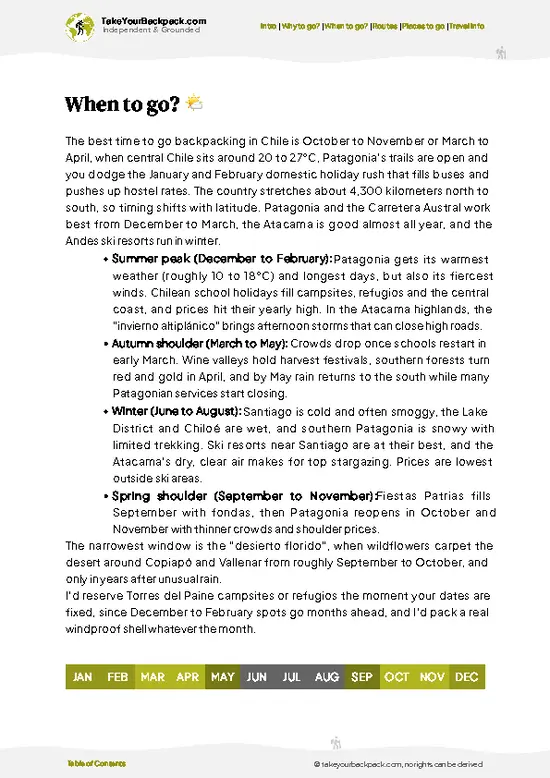
Iquique has one of the most stable climates in Chile, with almost no rain all year, so timing is about beach weather, crowds and price.
  • Summer (Dec to Mar): Highs of 24 to 28°C (75 to 82°F) and long evenings suit swimming and paragliding. Chilean holiday crowds peak in January and February, and beds cost the most.
  • Autumn and spring (Apr to Jun, Sep to Nov): Highs of 20 to 24°C (68 to 75°F), calmer beaches and easy bookings.
  • Winter (Jul to Aug): Highs of 18 to 20°C (64 to 68°F), nights near 14°C (57°F) and daily cloud called camanchaca that lifts by midday. Prices drop, and the Andean day trips are clearer.
Mid-November or March gives warm sea, thin crowds and lower prices.

source: climatestotravel.comJANJanuary: highly recommended for travelingFEBFebruary: highly recommended for travelingMARMarch: good for travelingAPRApril: highly recommended for travelingMAYMay: highly recommended for travelingJUNJune: excellent for travelingJULJuly: excellent for travelingAUGAugust: excellent for travelingSEPSeptember: highly recommended for travelingOCTOctober: highly recommended for travelingNOVNovember: highly recommended for travelingDECDecember: highly recommended for traveling
when-to-go

✈️ The backpacker research shortcutChile Travel Guide

An offline-friendly backpacking guide with optimized travel routes, ranked highlights, transport advice, and the best areas to stay.
example page 0 from our offline Travel Guide for Chile
example page 1 from our offline Travel Guide for Chile
example page 2 from our offline Travel Guide for Chile
example page 3 from our offline Travel Guide for Chile
example page 4 from our offline Travel Guide for Chile
example page 5 from our offline Travel Guide for Chile
example page 6 from our offline Travel Guide for Chile
example page 7 from our offline Travel Guide for Chile
The digital guide (333 pages) contains:
✅ 107 highlights, ranked by travel appeal
✅ Optimized 7, 14 & 21-day travel routes
✅ Cities, national parks, landmarks, beaches
✅ How to get around
✅ Offline-friendly for travel without Wi-Fi
👉 Click to see all 30+ guide features

📅 Plan smarter in minutes, not weeks
✅ Month by month travel advice
✅ Festivals & national holidays
✅ Budget expectations

🗺️ Go to the right places, skip the overrated ones
✅ Honest pros & cons of destinations
✅ Top hikes, parks & viewpoints
✅ Lesser-known places most travelers miss
✅ Clear “worth it vs skip it” guidance

🛏️ Travel smoothly without rookie mistakes
✅ Best areas to stay
✅ Transport systems explained simply
✅ Common scams & safety advice
✅ SIM cards, money & practical tips

🌍 Understand the country, not just visit it
✅ Culture & traditions
✅ 52 Essential phrases & customs
✅ Festivals worth planning around
✅ Traveler-friendly historical context
✅ Insights that make places more meaningful

📱 Built for real travel conditions
✅ Fully downloadable PDF
✅ Works completely offline
✅ Optimized for phone use
✅ Useful in remote areas & buses
✅ Everything in one place
Stop searching, start planning
Get instant access to your full guide. 30‑day money-back guarantee.
+ Add another guide for just

By proceeding you agree to our terms.
Sent to your inbox immediately after payment • 100% Secure Checkout
Best Backpacking Travel Advisor 2025 tourism awardBest Backpacking
Travel Advisor
2025
What others say about Take Your Backpack Guides:
⭐⭐⭐⭐⭐
Fantastic, amazing amount of information!
⭐⭐⭐⭐⭐
My goodness this is amazing, it's what I've been looking for hats off too you!
⭐⭐⭐⭐⭐
I think this is absolutely BRILLIANT
⭐⭐⭐⭐
Very complete and informative. It's still missing places, but I gotta to commend you
⭐⭐⭐⭐⭐
This is truly amazing, thank you, can't wait to explore it with my kids!
⭐⭐⭐⭐⭐
Awesome resource, thank you!
⭐⭐⭐⭐⭐
This is amazing! Can't wait to explore the ones I haven't seen
⭐⭐⭐⭐
I love this! Well done, great idea.
⭐⭐⭐⭐⭐
Thanks for taking the time to make this gem!
⭐⭐⭐⭐⭐
This might be the best website I've ever seen.
⭐⭐⭐⭐⭐
Congratulations, and thank you so much for your work; it's incredibly valuable.
⭐⭐⭐⭐
In all seriousness I think you did a great job pointing out the important spots
⭐⭐⭐⭐⭐
10/10 very good
⭐⭐⭐⭐⭐
As someone who's only just starting to visit regularly this is awesome, thank you.
⭐⭐⭐⭐
Thank you very much! I'm going to visit my dad, it's going to be very useful!
⭐⭐⭐⭐⭐
This is really cool! We'll be travelling for the first time and this definitely come in handy.
⭐⭐⭐⭐⭐
You are now our minister of culture, congratulations 👨‍💼
⭐⭐⭐⭐⭐
Just wanted to tell you that this is a pearl! Going to follow your recommendations.
⭐⭐⭐⭐⭐
This is so cool. I'll definitely be using the resource for my travels soon.
⭐⭐⭐⭐⭐
This is very impressive! Good work.
⭐⭐⭐⭐⭐
This is an amazing and informative site. Very well done!

🛏️ Where to stay?How to pick the right area

The best budget base is the Centro near Plaza Prat, where most hostels and cheap guesthouses cluster and dorm beds are easy to find outside January and February. It is flat, close to the bus terminal area and colectivo lines, and you can walk to restaurants and markets at any hour. Streets around the plaza are lively in the evening but quiet late, so noise is rarely a problem, and the area feels fine for solo travelers at night if you keep to the main streets.
The second option is the Playa Cavancha area, with fewer dorms and higher prices, but close to the surf, the promenade and the nightlife. … read more 👉
The best budget base is the Centro near Plaza Prat, where most hostels and cheap guesthouses cluster and dorm beds are easy to find outside January and February. It is flat, close to the bus terminal area and colectivo lines, and you can walk to restaurants and markets at any hour. Streets around the plaza are lively in the evening but quiet late, so noise is rarely a problem, and the area feels fine for solo travelers at night if you keep to the main streets.
The second option is the Playa Cavancha area, with fewer dorms and higher prices, but close to the surf, the promenade and the nightlife. It suits those who want to walk home from a bar, and taxis or colectivos connect you quickly to the center. In peak summer, book ahead for both areas, because beds fill fast.

🚌 Getting aroundTransportation options and practical tips

A colectivo ride within Iquique costs about US$0.80 to 1.20, paid in cash in Chilean pesos directly to the driver, and these shared taxis with route numbers on the roof cover most of the city. The center and Cavancha are flat and walkable, traffic is light except at rush hour, and public transport is dependable until late evening.
  • Walking: Free, and the fastest option within the center. Walking from the plaza to Cavancha takes 15 to 20 minutes along the coast and beats any vehicle for the money.
  • Colectivos: Best value for longer legs such as Zofri or the south. They run roughly from early morning to around midnight, are quicker than buses, and are a bit cramped, so carry small bills.
  • Buses and micros: Local buses cost about US$0.70 to 1, and are slower and less direct, so they mainly suit routes
… read more 👉
A colectivo ride within Iquique costs about US$0.80 to 1.20, paid in cash in Chilean pesos directly to the driver, and these shared taxis with route numbers on the roof cover most of the city. The center and Cavancha are flat and walkable, traffic is light except at rush hour, and public transport is dependable until late evening.
  • Walking: Free, and the fastest option within the center. Walking from the plaza to Cavancha takes 15 to 20 minutes along the coast and beats any vehicle for the money.
  • Colectivos: Best value for longer legs such as Zofri or the south. They run roughly from early morning to around midnight, are quicker than buses, and are a bit cramped, so carry small bills.
  • Buses and micros: Local buses cost about US$0.70 to 1, and are slower and less direct, so they mainly suit routes you already know. Intercity buses to Pica, Humberstone and Arica leave from the terminal and cost US$3 to 12 depending on the distance.
  • Taxis and ride apps: A short city taxi is US$3 to 6. Worth it at night or with luggage, since the fare is about four times a colectivo seat, and apps often show clearer prices.
  • Rental car: From about US$40 to 60 a day, which pays off only if you want to reach remote sites like the Atacama geoglyphs on your own schedule; otherwise tours or shared transfers cost less.

👛 Costs (as of 19 October 2026)Travel costs and budget guide for Iquique

A backpacker in Iquique should plan on about US$57 to 60 a day in high season, with a dorm bed taking the biggest bite.
CategoryBudget RangeLocal Reality
Dorm (high season)US$15 to 22Jan and Feb fill early near Cavancha.
Dorm (off-season)US$10 to 15Easy to bargain for longer stays.
MealsUS$15 to 22Set lunch US$6 to 9, plus market snacks and a self-catered breakfast.
Local transportUS$2 to 4Colectivos at roughly US$0.80 to 1.20 a ride.
City transport passNoneNo pass is needed, pay cash per ride.
Activities and entry feesUS$8 to 12Museums are cheap; Humberstone is about US$8 to 10; paragliding costs much more.
MiscellaneousUS$5 to 8Sunscreen, water, laundry and the odd beer.
Total Daily BudgetUS$57 to 60Using high-season dorm prices.
Eating the set lunch as your main meal and buying groceries for dinner saves the most money.

source: chile.travel
⚠️ Prices can change and everyone travels differently, so take this as a rough guide. Hope it helps you plan your adventure!

🚌 Day tripsWhere to go beyond the main area

Iquique works well as a day-trip base, because the desert sites around it are 45 minutes to 2 hours away and tours or buses leave early.
Humberstone and Santa Laura:
This abandoned nitrate town, a UNESCO site, sits about 45 minutes inland. Colectivos and buses from the terminal cost US$2 to 4 each way, and entry is around US$8 to 10. Go early, because the pampa heat builds fast and there is no shade.

Pica:
This oasis town is roughly 1.5 hours away by bus for US$4 to 7 each way. Its natural pools at Cocha Resbaladero cost about US$3 to 5, and the mango and lemon juice is a treat. Many first-timers arrive in the afternoon, which leaves little time for swimming, so leave before 9 am.

Cerro Pintados geoglyphs:
These giant hillside figures are about 1.5 hours south and are hard to reach by bus. … read more 👉
Iquique works well as a day-trip base, because the desert sites around it are 45 minutes to 2 hours away and tours or buses leave early.
Humberstone and Santa Laura:
This abandoned nitrate town, a UNESCO site, sits about 45 minutes inland. Colectivos and buses from the terminal cost US$2 to 4 each way, and entry is around US$8 to 10. Go early, because the pampa heat builds fast and there is no shade.

Pica:
This oasis town is roughly 1.5 hours away by bus for US$4 to 7 each way. Its natural pools at Cocha Resbaladero cost about US$3 to 5, and the mango and lemon juice is a treat. Many first-timers arrive in the afternoon, which leaves little time for swimming, so leave before 9 am.

Cerro Pintados geoglyphs:
These giant hillside figures are about 1.5 hours south and are hard to reach by bus. A shared tour costs US$30 to 50, and a rental car makes it cheaper for groups. Midday light flattens the figures, so go in the morning.

Pisagua:
Pisagua, a quiet coastal village, lies about 2 hours north with a faded port and a haunting history. A tour or car is the practical way to reach it. Bring snacks, since there are very few places to eat.

🍲 FoodEating & Drinking in Iquique

Iquique’s plates come from the Pacific, so start with ceviche and fresh machas a la parmesana, baked clams under cheese. The northern coast also gives you erizos (sea urchin) and locos, often eaten with lemon and cilantro. A filling menú del día in the center costs around US$6 to 9 and usually starts with a seafood soup or a fish main.
The Mercado Centenario area and the stalls near the fishing pier are where locals eat cheap and fresh, and you can watch pelicans squabble over scraps. Nearby Pica supplies the mango and lemon juice sold across town. For a drink, ask for a pisco sour with the local lemons, and for the evening, bars along Cavancha and the Baquedano area pour craft beer and cocktails.

🛡️ SafetySafety Tips and Common Scams in Iquique

Iquique is a calm city and most visitors have no trouble, though petty theft is the usual problem. Keep phones and cameras out of sight on Cavancha beach and around Zofri, and never leave bags unattended on the sand. The center is fine by day, but at night avoid the dark side streets away from Plaza Prat and take a taxi or ride app after midnight. Solo travelers, including women, generally get on well if they use common sense. Snatch thefts happen near the bus terminal, so keep your bag in front. Swimming spots with strong currents and rip tides can be a bigger hazard than crime, so check the flags. Tsunami evacuation signs are everywhere; follow them if an earthquake lasts long.

FAQTraveler FAQ

Three days is enough for Iquique, covering the old center, Playa Cavancha and a trip to Humberstone, which is about 45 minutes away. Add a fourth day for Pica, about 1.5 hours by bus, or the Cerro Pintados geoglyphs. Paragliding from the dune is a half-day activity.
Iquique is considered one of the easier Chilean cities for solo backpackers, with petty theft being the main concern. Keep your belongings close on Cavancha beach and around the bus terminal, and use a taxi or app after midnight, which costs about US$3 to 6. The center near Plaza Prat is lively and well used into the evening.
Iquique is known for its beaches, paragliding and sandboarding off the huge dune above the city, and a duty-free zone called Zofri. Its wooden nitrate-era buildings along Baquedano and nearby Humberstone, a UNESCO ghost town 45 minutes away, reflect the saltpeter boom. Fresh seafood like ceviche and a set lunch around US$6 to 9 are a staple.
⚠️ Things can change over time, so always validate details locally before you go.

Other Chilean cities near Iquique

Explore more nearby:

  • Arica—Eiffel iron church, Chinchorro mummies, Morro headland, calm city beaches| 197 km away
  • Calama—copper mines, desert plateau, gateway to Atacama| 276 km away
  • Copiapó—Silver boom, mineral museums, pepper-tree plaza, supply stop| 793 km away

💡 Not sure where to go next?
Create a personalized itinerary for Chile including Iquique and the places that fit your trip.

Generate my itinerary

👉 Discover all cities

Or checkout all Chile has to offer (think cities, towns, villages, national parks, hikes, beaches, festivals)
Country photo of Chile

We 💚 feedbackKey takeaways before you go

Iquique is at its best on a weekday morning, when the water is calm and the markets are filling with fresh catch. I would book the paragliding flight for early in the day and skip weekend crowds at the beach. It is a place for sun and action, not deep sightseeing.

✈️ When did I visit Chile?
I have visited Chile, together with Argentina, in September 2012.

✍️ Help improve this page!
The information on this page is based on my own backpacking experience in Chile, supplemented with up-to-date research and feedback from other travelers. Travel details can change, so if you notice anything outdated or incomplete, feel free to let me know.


🙋‍♂️ Give feedback

👋 Meet the founderWho’s Behind Take Your Backpack?

Johan, backpacker and founder of TakeYourBackpackHi, I’m Johan (Netherlands 🇳🇱), the creator of TakeYourBackpack. Over the past 3 decades, I’ve backpacked through 90+ countries across six continents, gaining extensive experience with independent travel, long-term trips, and overland routes.

This site is built on a combination of firsthand travel experience and carefully curated insights from other backpackers. Many guides are based on places I’ve personally visited, while others bring together tips, observations, and practical advice shared by trusted travelers I’ve met along the way.

The goal is to provide realistic, experience-driven guidance — not generic itineraries — so you can explore destinations with better context, clearer expectations, and more confidence.