×

Chile🇨🇱 | best citiesYour Guide to the 10 Best cities in Chile

Cities in Chile are shaped by geography: a country about 4,300 kilometers long and rarely more than 180 kilometers wide, squeezed between the Andes and the Pacific. That is why urban life here splits into distinct regional types. The central valley holds the capital and the main port region, with the best transport links, the widest range of hostels and the most year-round activity. The north is desert, so towns exist where water or minerals do, and distances between them are long, dry and expensive to cover. The south is greener, smaller in scale and cooler, with lake and rainforest towns that run on tourism and farming, and prices that climb sharply in summer. Far Patagonia is the costliest, because everything arrives by long supply lines. For backpacking or any independent trip, the useful question is whether you want easy access and low costs in the center, or remoteness and higher bills at the edges.

By Johan Kruseman 🇳🇱 | Updated October 20, 2026
Explore the best towns in Chile

Why go?Understanding Their Importance

Chile suits cities in a specific, limited way. Its shape forced settlement into pockets: a Mediterranean-climate heartland with fertile land, desert oases and mining outposts in the north, and wet, forested lands in the south. The result is a centralized urban system where one metropolitan area dominates politics, culture and nightlife, while the rest of the country has much smaller towns that feel more regional than metropolitan. If you want a dense choice of museums, markets and food, Chile delivers it in the middle of the country. If you expect a string of major cities like Italy or Mexico, it does not.

History adds another layer. The Spanish colonial grid is visible in plazas and street plans, but earthquakes have destroyed or rebuilt many older buildings, so heritage is often a mix of … read more 👉
Chile suits cities in a specific, limited way. Its shape forced settlement into pockets: a Mediterranean-climate heartland with fertile land, desert oases and mining outposts in the north, and wet, forested lands in the south. The result is a centralized urban system where one metropolitan area dominates politics, culture and nightlife, while the rest of the country has much smaller towns that feel more regional than metropolitan. If you want a dense choice of museums, markets and food, Chile delivers it in the middle of the country. If you expect a string of major cities like Italy or Mexico, it does not.

History adds another layer. The Spanish colonial grid is visible in plazas and street plans, but earthquakes have destroyed or rebuilt many older buildings, so heritage is often a mix of preserved neighborhoods and modern construction. Chile sits on the Pacific Ring of Fire, which also explains the strict building codes and the regular tremors you may feel. Most are minor and locals take them calmly.

Before choosing Chile for its cities, understand the infrastructure. Roads, buses and airports are among the best in South America, and domestic flights cover the long gaps between regions. Chile is also one of the pricier countries on the continent, so budgets stretch less far than in Peru or Bolivia. Distances are the final factor: a map makes stops look close, but the country is long enough that moving between regions takes hours or a flight. Plan around a region, not the whole country, and the cities will reward you.
Behind the Scenes of Selection
The list of best cities in Chile is created based on culture, vibe, attractions, transport ease, and local charm. If you feel a city is missing in this list, please let us know.

When to go?Optimal Periods for Travel

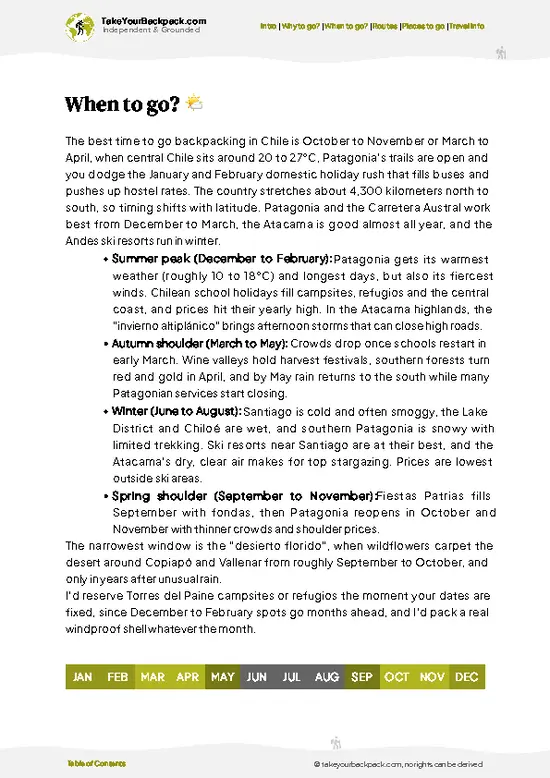
Best months for city travel: The best months for Chile’s cities are October to April, when central Chile is dry and warm and the south is open, with November and March the most comfortable. Daytime highs in the central valley run about 25 to 32°C from December to February, with almost no rain, because the Mediterranean climate concentrates precipitation in winter. In the south, summer highs are around 18 to 22°C.
Shoulder seasons and winter: March to April and October to November are the shoulder seasons. Central Chile sits around 18 to 24°C, crowds thin out and accommodation is cheaper than in January. Autumn also brings grape harvest activity in the wine valleys. Winter, from June to August, brings rain and cold to central and southern Chile. Santiago’s highs sit around 12 to 16°C with cold … read more 👉
Best months for city travel: The best months for Chile’s cities are October to April, when central Chile is dry and warm and the south is open, with November and March the most comfortable. Daytime highs in the central valley run about 25 to 32°C from December to February, with almost no rain, because the Mediterranean climate concentrates precipitation in winter. In the south, summer highs are around 18 to 22°C.
Shoulder seasons and winter: March to April and October to November are the shoulder seasons. Central Chile sits around 18 to 24°C, crowds thin out and accommodation is cheaper than in January. Autumn also brings grape harvest activity in the wine valleys. Winter, from June to August, brings rain and cold to central and southern Chile. Santiago’s highs sit around 12 to 16°C with cold nights, and most rain falls in this period, with the south far wetter and often 5 to 10°C. Pollution can also settle over the capital in winter because cold air traps smog in the valley. In the north the desert stays dry year-round, with mild days and cold nights, so it works in any month, though high-altitude areas are cold after dark.
Peak periods and prices: The real peak is January and February, when Chilean school holidays fill beaches and southern lake towns. Prices there can run 30 to 50 percent above shoulder levels, and buses and hostels book out, so reserve ahead. Southern Patagonia has a shorter season, roughly November to March, and many services close outside it. Other busy times include Easter week and mid-September, when Fiestas Patrias shuts offices and packs long-distance buses for several days. In Santiago, by contrast, August and January are quiet because locals leave the city, so some small restaurants may close.

city hoppingOptimizing Your Multi-Stop Itinerary

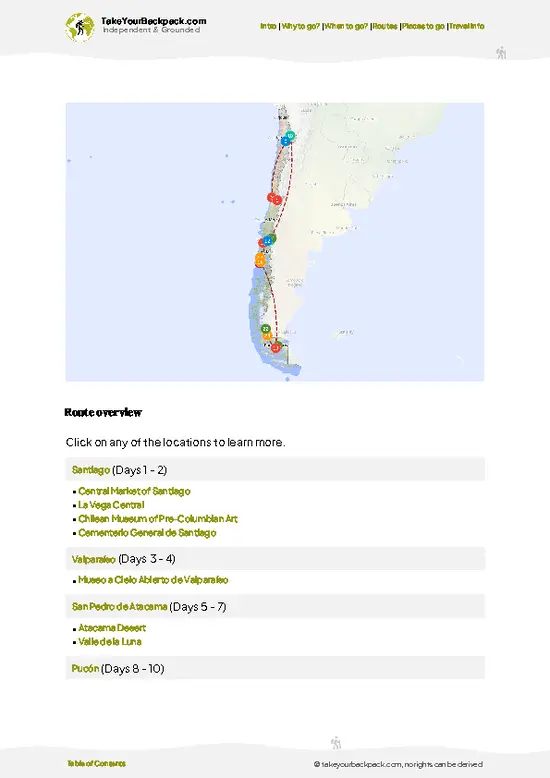
How many days to plan: A trip combining several cities in Chile needs 10 to 21 days, and the lower end only works if you stay within one or two regions. The country’s length is the reason. Linking stops from north to south by land can take 20 hours or more per leg, so the numbers rise quickly.
Which regions group well: The most efficient cluster is central Chile, where the capital, the coast and the wine valleys are linked by frequent buses taking about 1.5 to 2 hours between them. The south forms a second cluster, where lake and forest towns sit 1 to 4 hours apart by bus. The far north is a third cluster, reached by flight from the capital in about 2 to 2.5 hours. Patagonia is a fourth, often 3 to 4 hours by air from the capital. Because regions are so separate, treat each as a base and avoid … read more 👉
How many days to plan: A trip combining several cities in Chile needs 10 to 21 days, and the lower end only works if you stay within one or two regions. The country’s length is the reason. Linking stops from north to south by land can take 20 hours or more per leg, so the numbers rise quickly.
Which regions group well: The most efficient cluster is central Chile, where the capital, the coast and the wine valleys are linked by frequent buses taking about 1.5 to 2 hours between them. The south forms a second cluster, where lake and forest towns sit 1 to 4 hours apart by bus. The far north is a third cluster, reached by flight from the capital in about 2 to 2.5 hours. Patagonia is a fourth, often 3 to 4 hours by air from the capital. Because regions are so separate, treat each as a base and avoid trying to link every one.
Direction and pacing: Travel north to south or south to north with a flight covering the biggest jump, instead of crossing the full length overland. Many travelers fly into the capital, work through central Chile, then fly onward to the south or north and return by air to the departure point. This limits backtracking. Give a major city 2 to 3 nights, and smaller regional towns 1 to 2 nights, with an extra day if you plan a day trip. Overnight buses between regions run 8 to 14 hours and save a hotel night, but arrive tired.
Common planning mistakes: The first mistake is underestimating distance, which leaves you spending more days on buses than in places. Pick fewer regions and fly the long gaps. The second is ignoring seasonal closures in the south and Patagonia, where ferries and tour operators run reduced winter schedules. The third is booking tight connections, since long-distance buses and flights can be delayed by weather or strikes. Leave a buffer day before an international flight.

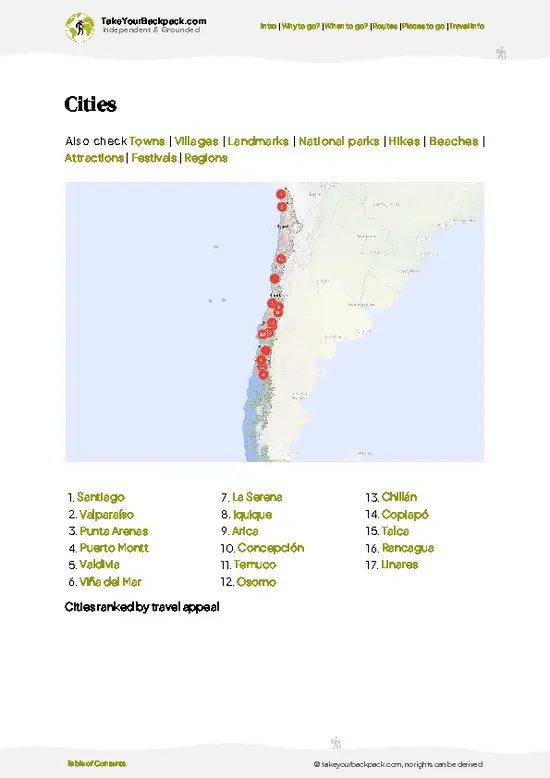
The ListThe Best cities of Chile

1 Santiago

Andes backdrop, Lastarria lanes, Vega market, memory museum

Ride the funicular up San Cristóbal for the mountain skyline, then eat at La Vega and spend an evening in Lastarria.

chile-city-santiago
© Google |

2 Valparaíso

Hillside funiculars, street-art lanes, Neruda’s La Sebastiana, harbor boats

Ride wooden lifts up the hills, follow murals along the lanes, and tour a poet’s eccentric house above the port.

3 Punta Arenas

Magellan Strait, wool-baron mansions, Selk’nam memorial, king crab

Walk cypress-lined cemetery avenues and wool-era mansion rooms, then follow the waterfront pier as the wind dies down.

4 Puerto Montt

Angelmó stalls, curanto, Reloncaví Sound, Chiloé gateway

Order fish soup beside the smoking stalls of Angelmó, then cross by boat to Tenglo Island for views over the sound.

chile-city-puerto-montt
© Google |

5 Valdivia

Sea lions, river market, Corral fort, Kunstmann brewery

Hear sea lions barking over fish stalls at the river market, then take a boat across the bay to a Spanish fort.

6 Viña del Mar

Floral clock, moai museum, Castillo Wulff, palm-lined grid

Stroll flat promenades from the flower clock to a waterfront mansion on the rocks, with an Easter Island moai along the way.

7 La Serena

Diaguita ceramics, Japanese garden, La Recova, long beachfront

Compare zigzag Diaguita pottery with an Easter Island moai, then shop papaya sweets and dried fruit at a two-floor market.

chile-city-la-serena
© Google | Guillermo Sansana

8 Iquique

Tandem paragliding, nitrate mansions, Cavancha swimming, fried-fish stalls

Launch from the cliff above town and land on the sand, then walk wooden sidewalks past mansions from the nitrate era.

9 Arica

Eiffel iron church, Chinchorro mummies, Morro headland, calm city beaches

Climb the headland above the port, then descend to a museum built over ancient burials and a beach for late swims.

chile-city-arica
© Google |

10 Concepción

Camarena mural, campus life, fried-fish market, rain jacket

Follow a giant 1964 mural up a university stairwell, then wander tree-lined grounds and finish with stew at the central market.

chile-city-concepcion
© Google |

11 Temuco

Mapuche silverwork, Feria Libre, steam locomotives, rain-dark streets

Browse merkén and honey at the street market, trace Mapuche history in a wooden mansion, and climb a forested hill park.

12 Osorno

German kuchen, wooden settler houses, Huilliche history, river fort

Taste settler-style cakes, then trace Huilliche, Spanish and German layers through a compact museum and a quiet district of timber houses.

13 Chillán

Sprawling Feria, Siqueiros murals, merkén, farm-town routine

Eat at counter stalls in the big produce market, then look at Mexican murals covering the walls of a quake-era school.

14 Copiapó

Silver boom, mineral museums, pepper-tree plaza, supply stop

Trace the silver rush and the 2010 miners' rescue in the regional museum, then browse Atacama mineral collections in a working valley city.

15 Talca

Palm-shaded plaza, chess players, Maule wine base, university life

Wander a working valley city where locals play chess under palms, then visit a restored hacienda house and the riverside paths.

16 Rancagua

Rodeo ring, 1814 battle sites, copper region, Andes base

Visit the church and colonial house tied to the 1814 defeat, then book a seat at a rodeo in Chile’s best-known ring.

chile-city-rancagua
© Google | Nelson Rivera

17 Linares

Maule market lunches, Panamericana stopover, shaded plaza, local prices

Stay a night for cheap cazuela at the municipal market and an evening in the shaded plaza.

Think you know Chile?

Prove you’re a true local — uncover 7 lesser-known cities in Chile that locals tend to keep to themselves.
Loading the map 🌍

Expert viewWhat You Should Know

How many cities to visit: I advise three to four cities on a trip of two to three weeks, because Chile’s distances turn each extra stop into a half or full day of transit. Beyond four, you spend more time in terminals than in streets, and you pay for it twice, in fares and lost time. Slower travel also lets you use a city properly: markets, free walking tours, neighborhood cafes and day trips need unhurried mornings.
Choosing the kind of city: Match the type to your style. If you want culture, food and nightlife, favor the central metropolitan area, where museums, live music and a wide restaurant scene cluster. If you want outdoor access, choose gateway towns in the lakes, desert or Patagonia, which are small but surrounded by hikes and volcano or lake activities. If you want low cost, central … read more 👉
How many cities to visit: I advise three to four cities on a trip of two to three weeks, because Chile’s distances turn each extra stop into a half or full day of transit. Beyond four, you spend more time in terminals than in streets, and you pay for it twice, in fares and lost time. Slower travel also lets you use a city properly: markets, free walking tours, neighborhood cafes and day trips need unhurried mornings.
Choosing the kind of city: Match the type to your style. If you want culture, food and nightlife, favor the central metropolitan area, where museums, live music and a wide restaurant scene cluster. If you want outdoor access, choose gateway towns in the lakes, desert or Patagonia, which are small but surrounded by hikes and volcano or lake activities. If you want low cost, central cities win because hostels, set-lunch restaurants and public transport are cheaper there than in remote regions. Experienced travelers mix one big city with one or two gateway towns, since that balances prices and scenery.
What it costs: Chile is expensive by South American standards, so budget realistically. A backpacker on a tight plan spends about US$40 to 60 a day, or roughly CLP 38,000 to 57,000, covering a dorm bed (CLP 10,000 to 20,000), a set lunch called a “menú del día” (CLP 5,000 to 8,000), and metro or local buses. Mid-range independent travelers spend US$70 to 110. Costs rise in Patagonia and in the south in January and February, where dorm beds can reach CLP 25,000 to 35,000.

Per visit, museums charge about CLP 2,000 to 12,000 and many are free on certain days, often Sundays or the last Sunday of the month. Free walking tours run on tips, and CLP 5,000 to 10,000 per person is fair. Day trips by tour run US$40 to 100, while doing them by public bus is often a third of that. Intercity buses cost roughly US$8 to 25 for 3 to 8 hours, and flights between regions run US$50 to 200 booked early. The smarter move is to buy buses at terminals or online in advance, and use a Bip! card in the capital, because it gives lower fares than cash.
Safety and local etiquette: Chile is among the safer countries in South America, but petty theft is the main urban risk. Phones are snatched on busy streets and metro platforms, and bags are lifted at bus terminals and beaches. Experienced travelers keep phones out of sight near stations, carry a daypack in front on crowded transit, and avoid walking alone through quiet downtown areas after dark. Protests happen, particularly in the capital, and can involve tear gas and water cannons, so steer away from demonstrations and follow local news.

Earthquakes are normal here. Read the evacuation signs in your accommodation, and if a strong quake hits, move to open ground or a doorway once shaking stops. Coastal areas have tsunami routes marked with blue signs.

Socially, Chileans are polite and reserved at first. Greet people with a handshake or a single cheek kiss, and say “buenos días” when entering shops. Tipping about 10 percent is customary in restaurants, and the bill often includes a suggested tip you may decline. Spanish is essential, since English is limited outside tourist hotels, and Chilean slang is fast, so learning a few basics helps. Cash is useful at small markets, but cards work in most places.

✈️ The backpacker research shortcutChile Travel Guide

An offline-friendly backpacking guide with optimized travel routes, ranked highlights, transport advice, and the best areas to stay.
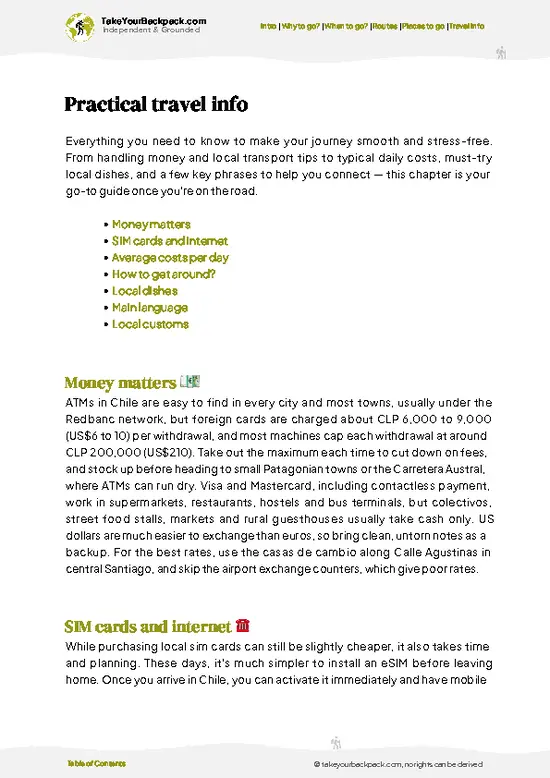
example page 0 from our offline Travel Guide for Chile
example page 1 from our offline Travel Guide for Chile
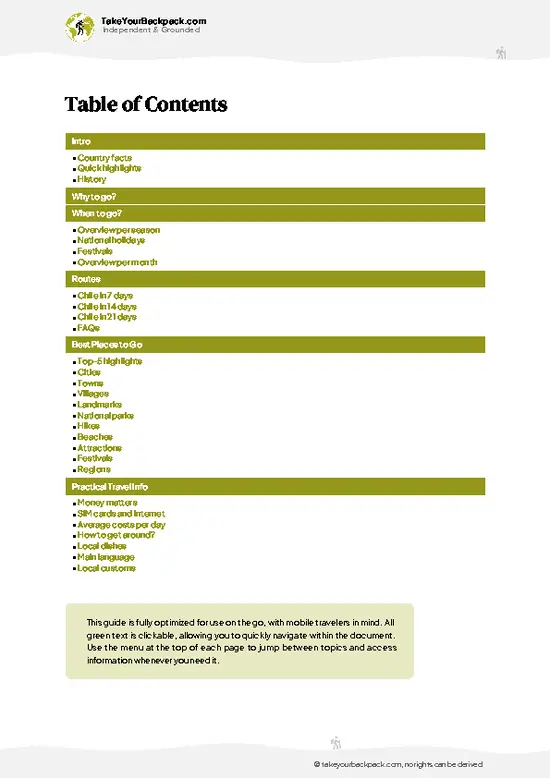
example page 2 from our offline Travel Guide for Chile
example page 3 from our offline Travel Guide for Chile
example page 4 from our offline Travel Guide for Chile
example page 5 from our offline Travel Guide for Chile
example page 6 from our offline Travel Guide for Chile
example page 7 from our offline Travel Guide for Chile
The digital guide (333 pages) contains:
✅ 107 highlights, ranked by travel appeal
✅ Optimized 7, 14 & 21-day travel routes
✅ Cities, national parks, landmarks, beaches
✅ How to get around
✅ Offline-friendly for travel without Wi-Fi
👉 Click to see all 30+ guide features

📅 Plan smarter in minutes, not weeks
✅ Month by month travel advice
✅ Festivals & national holidays
✅ Budget expectations

🗺️ Go to the right places, skip the overrated ones
✅ Honest pros & cons of destinations
✅ Top hikes, parks & viewpoints
✅ Lesser-known places most travelers miss
✅ Clear “worth it vs skip it” guidance

🛏️ Travel smoothly without rookie mistakes
✅ Best areas to stay
✅ Transport systems explained simply
✅ Common scams & safety advice
✅ SIM cards, money & practical tips

🌍 Understand the country, not just visit it
✅ Culture & traditions
✅ 52 Essential phrases & customs
✅ Festivals worth planning around
✅ Traveler-friendly historical context
✅ Insights that make places more meaningful

📱 Built for real travel conditions
✅ Fully downloadable PDF
✅ Works completely offline
✅ Optimized for phone use
✅ Useful in remote areas & buses
✅ Everything in one place
Stop searching, start planning
Get instant access to your full guide. 30‑day money-back guarantee.
+ Add another guide for just

By proceeding you agree to our terms.
Sent to your inbox immediately after payment • 100% Secure Checkout
Best Backpacking Travel Advisor 2025 tourism awardBest Backpacking
Travel Advisor
2025
What others say about Take Your Backpack Guides:
⭐⭐⭐⭐⭐
Fantastic, amazing amount of information!
⭐⭐⭐⭐⭐
My goodness this is amazing, it's what I've been looking for hats off too you!
⭐⭐⭐⭐⭐
I think this is absolutely BRILLIANT
⭐⭐⭐⭐
Very complete and informative. It's still missing places, but I gotta to commend you
⭐⭐⭐⭐⭐
This is truly amazing, thank you, can't wait to explore it with my kids!
⭐⭐⭐⭐⭐
Awesome resource, thank you!
⭐⭐⭐⭐⭐
This is amazing! Can't wait to explore the ones I haven't seen
⭐⭐⭐⭐
I love this! Well done, great idea.
⭐⭐⭐⭐⭐
Thanks for taking the time to make this gem!
⭐⭐⭐⭐⭐
This might be the best website I've ever seen.
⭐⭐⭐⭐⭐
Congratulations, and thank you so much for your work; it's incredibly valuable.
⭐⭐⭐⭐
In all seriousness I think you did a great job pointing out the important spots
⭐⭐⭐⭐⭐
10/10 very good
⭐⭐⭐⭐⭐
As someone who's only just starting to visit regularly this is awesome, thank you.
⭐⭐⭐⭐
Thank you very much! I'm going to visit my dad, it's going to be very useful!
⭐⭐⭐⭐⭐
This is really cool! We'll be travelling for the first time and this definitely come in handy.
⭐⭐⭐⭐⭐
You are now our minister of culture, congratulations 👨‍💼
⭐⭐⭐⭐⭐
Just wanted to tell you that this is a pearl! Going to follow your recommendations.
⭐⭐⭐⭐⭐
This is so cool. I'll definitely be using the resource for my travels soon.
⭐⭐⭐⭐⭐
This is very impressive! Good work.
⭐⭐⭐⭐⭐
This is an amazing and informative site. Very well done!

🛏️ Where to stay?Best Places to Stay in Chile

Chile has a solid hostel scene, with dorm beds typically running CLP 12,000 to 25,000 (about US$13 to 27) a night and more in Patagonia and San Pedro de Atacama. In Santiago, Bellavista puts you on top of the nightlife but gets loud on weekends, Lastarria is walkable to the center and calmer, and Barrio Brasil is the cheapest of the three but feels rougher after dark. In Valparaíso, Cerro Alegre and Cerro Concepción hold most hostels, with views and street art right outside but steep hills and petty theft to keep in mind, while Puerto Natales and Pucón are compact, quiet bases for trekking and volcano trips.

If you enjoy meeting fellow travelers, consider choosing hostels with high ratings for … read more 👉
Chile has a solid hostel scene, with dorm beds typically running CLP 12,000 to 25,000 (about US$13 to 27) a night and more in Patagonia and San Pedro de Atacama. In Santiago, Bellavista puts you on top of the nightlife but gets loud on weekends, Lastarria is walkable to the center and calmer, and Barrio Brasil is the cheapest of the three but feels rougher after dark. In Valparaíso, Cerro Alegre and Cerro Concepción hold most hostels, with views and street art right outside but steep hills and petty theft to keep in mind, while Puerto Natales and Pucón are compact, quiet bases for trekking and volcano trips.

If you enjoy meeting fellow travelers, consider choosing hostels with high ratings for atmosphere. On the other hand, if you prefer having your own space, a hotel might be a better option.

ChileExplore Chile

👋 Meet the founderWho’s Behind Take Your Backpack?

Johan, backpacker and founder of TakeYourBackpackHi, I’m Johan (Netherlands 🇳🇱), the creator of TakeYourBackpack. Over the past 3 decades, I’ve backpacked through 90+ countries across six continents, gaining extensive experience with independent travel, long-term trips, and overland routes.

This site is built on a combination of firsthand travel experience and carefully curated insights from other backpackers. Many guides are based on places I’ve personally visited, while others bring together tips, observations, and practical advice shared by trusted travelers I’ve met along the way.

The goal is to provide realistic, experience-driven guidance — not generic itineraries — so you can explore destinations with better context, clearer expectations, and more confidence.