×

Colombia🇨🇴 | national parksIsla de Salamanca National Parkcoastal barrier, bird migration, brackish lagoons | things to do and best time to go

Explore Serranía de la Macarena National ParkExplore Pisba National Park

Backpacking in Isla de Salamanca
👍 Recommendednational park ranked #15
By Johan Kruseman 🇳🇱 | Updated September 4, 2026

Most people online sell Isla de Salamanca as a “beach day near Barranquilla,” but for backpackers it’s closer to a bird‑watching wetland corridor than a classic Caribbean hangout. Sitting between Barranquilla and Santa Marta on Colombia’s Caribbean coast, it’s flat mangroves, lagoons, and boardwalks, not big hikes. Wildlife is strong (especially birds), scenery is subtle, and crowds are light, but public transport drop‑offs and entrances can be confusing, camping is basically a no, and budget stays are better in Barranquilla or Santa Marta. Compared with Tayrona or Sierra Nevada, it’s cheaper, quieter, and far less dramatic—worth it if you care about ecosystems and birds, skippable if you want beaches and trails.

Discover everything you want to know in the 📖 Colombia Travel Guide.
Loading the map 🌍
CLICK TO FILTER
cities
towns
villages
landmarks
national parks
hikes
beaches
attractions
festivals
regions
SHOW COUNTRY’S BESTSHOW ALL

✨ Why go?
Ranked #15 national park in Colombia
What sets this place apart

Isla de Salamanca National Park attracts backpackers for several solid reasons. Independent exploration is a major draw; the park’s trails are well-marked, allowing you to wander without a guide. Nearby, you’ll find budget camping options and hostels that won’t break the bank, making it easy to stretch your funds. The trail variety caters to different skill levels, from leisurely strolls to more challenging hikes, ensuring everyone finds their groove. Plus, the park is particularly suited for self-guided travelers. While tours are available, they often miss the park’s quieter corners. By going solo, you can soak in the natural beauty at your own pace, preserving your energy and budget for the moments that truly matter.
Want to include Isla de Salamanca National Park in your Colombia route?
Create a personalized Colombia itinerary that includes Isla de Salamanca National Park and the places that fit your trip — based on your travel style, budget, and available time. Get your route in seconds.

Generate my trip

💡 HighlightsKey sights and experiences for travelers

  • Mangrove labyrinths and tidal channels: a dense tangle of red and black mangroves that you explore by small boat or canoe — the roots, mudflats and narrow waterways feel elemental, and they’re the nursery for most of the park’s fish and crustaceans.
  • Birdwatching hotspots: one of the best coastal bird sites near Barranquilla — expect herons, egrets, ibises, terns and pelicans, plus lots of migratory shorebirds; if you’re patient you might even spot small flocks of flamingo-like visitors during certain seasons.
  • Bocas de Ceniza / Magdalena River mouth: where the mighty Magdalena meets the Caribbean — dramatic currents, shifting sandbanks and strong contrasts between river and sea make for great photos and an interesting lesson in coastal dynamics.
  • Sandy beaches and dunes: quiet, off-the-beaten-path
read more 👉
  • Mangrove labyrinths and tidal channels: a dense tangle of red and black mangroves that you explore by small boat or canoe — the roots, mudflats and narrow waterways feel elemental, and they’re the nursery for most of the park’s fish and crustaceans.
  • Birdwatching hotspots: one of the best coastal bird sites near Barranquilla — expect herons, egrets, ibises, terns and pelicans, plus lots of migratory shorebirds; if you’re patient you might even spot small flocks of flamingo-like visitors during certain seasons.
  • Bocas de Ceniza / Magdalena River mouth: where the mighty Magdalena meets the Caribbean — dramatic currents, shifting sandbanks and strong contrasts between river and sea make for great photos and an interesting lesson in coastal dynamics.
  • Sandy beaches and dunes: quiet, off-the-beaten-path Caribbean beaches and sandbars where you can walk for miles, watch big sunsets and find pieces of the coast that feel properly wild (bring water and sun protection — there’s little shade).
  • Short trails and observation towers: easy boardwalks and lookout platforms give you elevated views over the wetlands — perfect for spotting birds and getting a sense of the landscape without trudging through mud.
  • Local fishing villages and coastal culture: small communities on the park’s edges still fish and gather from the mangroves; a respectful visit or a simple meal bought from locals connects the natural story with everyday life here.
  • Crustaceans, juvenile fish and intertidal life: the mudflats are teeming with fiddler crabs, mudskippers and juvenile fish — small, fascinating life that shows why protecting the mangroves matters. (Personal favorite: the slow, quiet boat trips through the mangroves — best time is early morning for light and bird activity.)
Spotted a mistake or missing something? Contact us.
🌤️ When to go?Weather, crowds, and seasonal trade-offs


  • Weather: Isla de Salamanca has a tropical climate with a wet season from April to November. Heavy rains can turn trails muddy and limit wildlife spotting, so aim for the drier months of December to March.

  • Temperature: Expect highs around 30°C (86°F) year-round, with nights cooling to about 22°C (72°F). The temperature is stable, but humidity spikes during the rainy season can sap your energy.

  • Daylight Hours: Daylight stays consistent, roughly 12 hours daily, so you get reliable time for hikes and birdwatching regardless of when you visit.

  • Crowds: Peak tourist season aligns with the dry months, especially December and January. Visiting just before or after can mean fewer people without sacrificing weather quality.

  • Seasonal Activities: Dry season is best for exploring mangroves and
read more 👉

  • Weather: Isla de Salamanca has a tropical climate with a wet season from April to November. Heavy rains can turn trails muddy and limit wildlife spotting, so aim for the drier months of December to March.

  • Temperature: Expect highs around 30°C (86°F) year-round, with nights cooling to about 22°C (72°F). The temperature is stable, but humidity spikes during the rainy season can sap your energy.

  • Daylight Hours: Daylight stays consistent, roughly 12 hours daily, so you get reliable time for hikes and birdwatching regardless of when you visit.

  • Crowds: Peak tourist season aligns with the dry months, especially December and January. Visiting just before or after can mean fewer people without sacrificing weather quality.

  • Seasonal Activities: Dry season is best for exploring mangroves and spotting migratory birds. Wet season brings lush greenery but limits access to some trails.

  • Price Fluctuations: Accommodation and tours cost more during the dry season’s peak months. Booking in shoulder months can save money and avoid the rush.


Pro-tip: Plan for late February or early March—dry enough for smooth trekking, fewer crowds, and better rates than the December-January rush.


source: climatestotravel.comJANJanuary: excellent for travelingFEBFebruary: excellent for travelingMARMarch: highly recommended for travelingAPRApril: fair for travelingMAYMay: fair for travelingJUNJune: fair for travelingJULJuly: fair for travelingAUGAugust: fair for travelingSEPSeptember: fair for travelingOCTOctober: fair for travelingNOVNovember: fair for travelingDECDecember: excellent for traveling
when-to-go

✈️ The backpacker research shortcutColombia Travel Guide

An offline-friendly backpacking guide with optimized travel routes, ranked highlights, transport advice, and the best areas to stay.
example page 0 from our offline Travel Guide for Colombia
example page 1 from our offline Travel Guide for Colombia
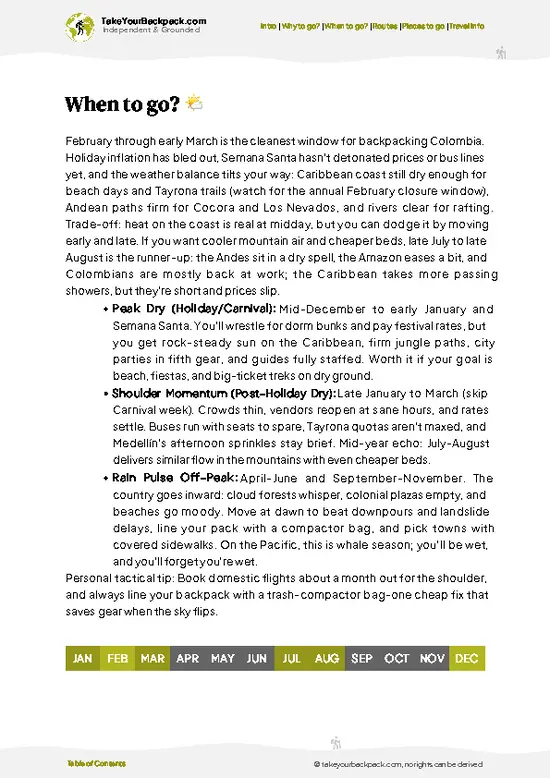
example page 2 from our offline Travel Guide for Colombia
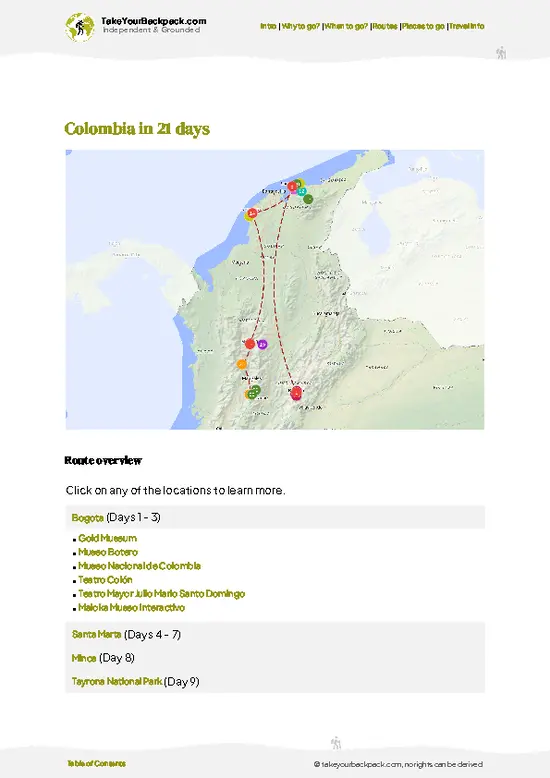
example page 3 from our offline Travel Guide for Colombia
example page 4 from our offline Travel Guide for Colombia
example page 5 from our offline Travel Guide for Colombia
example page 6 from our offline Travel Guide for Colombia
example page 7 from our offline Travel Guide for Colombia
The digital guide (464 pages) contains:
122 highlights, ranked by travel appeal
Optimized 7, 14 & 21-day travel routes
Cities, national parks, landmarks, beaches
How to get around
Offline-friendly for travel without Wi-Fi
👉 Click to see all 30+ guide features

📅 Plan smarter in minutes, not weeks
Month by month travel advice
Festivals & national holidays
Budget expectations

🗺️ Go to the right places, skip the overrated ones
Honest pros & cons of destinations
Top hikes, parks & viewpoints
Lesser-known places most travelers miss
Clear “worth it vs skip it” guidance

🛏️ Travel smoothly without rookie mistakes
Best areas to stay
Transport systems explained simply
Common scams & safety advice
SIM cards, money & practical tips

🌍 Understand the country, not just visit it
Culture & traditions
52 Essential phrases & customs
Festivals worth planning around
Traveler-friendly historical context
Insights that make places more meaningful

📱 Built for real travel conditions
Fully downloadable PDF
Works completely offline
Optimized for phone use
Useful in remote areas & buses
Everything in one place
Save weeks of stressful planning
Get instant access to your full guide. 30‑day money-back guarantee.
+ Add another guide for just US$7.80

By proceeding you agree to our terms.
Sent to your inbox immediately after payment • 100% Secure Checkout
Best Backpacking Travel Advisor 2025 tourism awardBest Backpacking
Travel Advisor
2025
What others say about Take Your Backpack Guides:
⭐⭐⭐⭐⭐
Fantastic, amazing amount of information!
⭐⭐⭐⭐⭐
My goodness this is amazing, it's what I've been looking for hats off too you!
⭐⭐⭐⭐⭐
I think this is absolutely BRILLIANT
⭐⭐⭐⭐
Very complete and informative. It's still missing places, but I gotta to commend you
⭐⭐⭐⭐⭐
This is truly amazing, thank you, can't wait to explore it with my kids!
⭐⭐⭐⭐⭐
Awesome resource, thank you!
⭐⭐⭐⭐⭐
This is amazing! Can't wait to explore the ones I haven't seen
⭐⭐⭐⭐
I love this! Well done, great idea.
⭐⭐⭐⭐⭐
Thanks for taking the time to make this gem!
⭐⭐⭐⭐⭐
This might be the best website I've ever seen.
⭐⭐⭐⭐⭐
Congratulations, and thank you so much for your work; it's incredibly valuable.
⭐⭐⭐⭐
In all seriousness I think you did a great job pointing out the important spots
⭐⭐⭐⭐⭐
10/10 very good
⭐⭐⭐⭐⭐
As someone who's only just starting to visit regularly this is awesome, thank you.
⭐⭐⭐⭐
Thank you very much! I'm going to visit my dad, it's going to be very useful!
⭐⭐⭐⭐⭐
This is really cool! We'll be travelling for the first time and this definitely come in handy.
⭐⭐⭐⭐⭐
You are now our minister of culture, congratulations 👨‍💼
⭐⭐⭐⭐⭐
Just wanted to tell you that this is a pearl! Going to follow your recommendations.
⭐⭐⭐⭐⭐
This is so cool. I'll definitely be using the resource for my travels soon.
⭐⭐⭐⭐⭐
This is very impressive! Good work.
⭐⭐⭐⭐⭐
This is an amazing and informative site. Very well done!

🛏️ Where to stay?Best areas and accommodation options

Isla de Salamanca National Park is a stunning spot, but options for backpackers are limited within the park itself. There are no formal accommodations inside the park, so you’ll need to look to nearby towns.

The closest town is Ciénaga, about 15 kilometers away. Here, you’ll find budget-friendly hostels and guesthouses that cater to backpackers. Look for places like Hostal La Casa de la Cultura, which offers a cozy atmosphere and local charm.

Santa Marta, roughly 40 kilometers away, is another option. It has a wider range of accommodations, from hostels to budget hotels. Just be mindful of … read more 👉
Isla de Salamanca National Park is a stunning spot, but options for backpackers are limited within the park itself. There are no formal accommodations inside the park, so you’ll need to look to nearby towns.

The closest town is Ciénaga, about 15 kilometers away. Here, you’ll find budget-friendly hostels and guesthouses that cater to backpackers. Look for places like Hostal La Casa de la Cultura, which offers a cozy atmosphere and local charm.

Santa Marta, roughly 40 kilometers away, is another option. It has a wider range of accommodations, from hostels to budget hotels. Just be mindful of transportation costs and time; they can add up quickly. Staying in these towns gives you easy access to the park while preserving your energy and budget for the real adventures ahead.

👛 Costs (as of 4 September 2026)Money, prices, and spending tips

Isla de Salamanca National Park in Colombia is a treasure, but it comes with its own set of costs that you should be aware of to avoid surprises.

Entrance fees are typically around $5 to $10 USD per person. This fee grants you access to the park’s diverse ecosystems, from mangroves to wetlands.

Transportation can add up. If you’re coming from Santa Marta, expect to pay about $20 to $30 USD for a taxi or a shared van. Public transport is cheaper but less direct, usually around $5 USD.

Guided tours are a popular option. Prices range from $30 to $100 USD, depending on the length and inclusions. Some tours offer meals and equipment, while others focus solely on the experience.

Food options inside the park are limited. Budget around $10 to $15 USD for a meal if you find a local vendor. Bringing … read more 👉
Isla de Salamanca National Park in Colombia is a treasure, but it comes with its own set of costs that you should be aware of to avoid surprises.

Entrance fees are typically around $5 to $10 USD per person. This fee grants you access to the park’s diverse ecosystems, from mangroves to wetlands.

Transportation can add up. If you’re coming from Santa Marta, expect to pay about $20 to $30 USD for a taxi or a shared van. Public transport is cheaper but less direct, usually around $5 USD.

Guided tours are a popular option. Prices range from $30 to $100 USD, depending on the length and inclusions. Some tours offer meals and equipment, while others focus solely on the experience.

Food options inside the park are limited. Budget around $10 to $15 USD for a meal if you find a local vendor. Bringing snacks is a smart move to keep your energy up without overspending.

Lastly, consider any additional costs for activities like birdwatching or kayaking. These can range from $15 to $50 USD, depending on the provider and duration.

Planning ahead will help you enjoy the park without breaking the bank.


source: colombia.travel
⚠️ Prices can change and everyone travels differently, so take this as a rough guide. Hope it helps you plan your adventure!

🥾 TrailsTrail guide for Isla de Salamanca national park

Isla de Salamanca National Park is a hidden gem for those looking to explore Colombia’s coastal beauty. The park is a mix of mangroves, wetlands, and beaches, creating a unique landscape that’s quite different from the mountains you might be used to. The terrain is mostly flat, making it accessible for a variety of hikers, though some areas can get muddy, especially during the rainy season. Wildlife is abundant here; keep an eye out for colorful birds, playful monkeys, and the occasional crocodile lounging in the sun.

While there aren’t extensive marked trails like in some other parks, you can … read more 👉
Isla de Salamanca National Park is a hidden gem for those looking to explore Colombia’s coastal beauty. The park is a mix of mangroves, wetlands, and beaches, creating a unique landscape that’s quite different from the mountains you might be used to. The terrain is mostly flat, making it accessible for a variety of hikers, though some areas can get muddy, especially during the rainy season. Wildlife is abundant here; keep an eye out for colorful birds, playful monkeys, and the occasional crocodile lounging in the sun.

While there aren’t extensive marked trails like in some other parks, you can explore the Caminata de los Manglares, which is a popular route. Here are some details:
  • Length: 5 km
  • Estimated Duration: 2-3 hours
  • Difficulty Level: Easy
  • Key Features: Stunning views of mangroves, diverse birdlife, and a chance to see local fishermen at work.
  • Terrain: Flat but can be muddy; some boardwalk sections.

Reaching the park is pretty straightforward; you can hop on a bus from Barranquilla or Santa Marta, and it’ll drop you off near the entrance. It’s not usually overcrowded, so you can enjoy the tranquility, especially if you go during the week. As for the entrance fee, it’s quite budget-friendly, but it’s always a good idea to double-check current prices before you go. Pack some snacks and water, and you’ll be set for a lovely day in nature!
⚠️ Hiking info can sometimes be outdated or inaccurate. Before you hit the trail, check the latest conditions with locals. If you do spot anything that's off, I'd love to hear from you, so I can update it for fellow travelers.

🛡️ SafetyScams, Hazards, and Annoyances

Isla de Salamanca National Park is generally well-managed, making it accessible for most hikers. However, be prepared for sudden weather changes; afternoon rain can roll in quickly, so pack a lightweight poncho. The terrain is mostly flat, but some trails can be muddy and slippery, especially after rain, so sturdy footwear is essential.

Wildlife encounters are rare, but if you spot a snake or other critters, give them space. Respect the environment by sticking to marked trails to avoid damaging delicate ecosystems. Timing your hikes for early morning or late afternoon can help you dodge the heat and crowds, preserving your energy for the moments that truly matter.

FAQCommon questions from travelers

1 to 2 days is sufficient to explore Isla de Salamanca National Park thoroughly. This allows time for birdwatching, walking trails, and visiting the mangrove areas. Most visitors find a full day enough, but two days provide a more relaxed experience.
Yes, you can visit Isla de Salamanca National Park without a car. Public transportation options like buses and taxis are available from nearby cities such as Barranquilla. Guided tours often include transport, making it convenient for backpackers without vehicles.
Yes, there is an entrance fee to Isla de Salamanca National Park. The fee is approximately 10,000 Colombian Pesos (around 3 USD) per person. No special permit is required beyond the entrance ticket.
⚠️ Things can change over time, so always validate details locally before you go.

Other Colombian national parks near Isla de Salamanca

Explore more nearby:


💡 Not sure where to go next?
Create a personalized itinerary for Colombia including Isla de Salamanca and the places that fit your trip.

Generate my itinerary

👉 Discover all national parks

Or checkout all Colombia has to offer (think cities, towns, villages, national parks, hikes, beaches, festivals)
Country photo of Colombia

We 💚 feedbackIs it worth it?

Isla de Salamanca National Park is a slice of biodiversity that’s hard to beat. You’ll find unique ecosystems and vibrant wildlife. But be ready for the heat and humidity; it can drain your energy fast. Stay hydrated and plan your hikes early. It’s all about pacing yourself to soak in the beauty without burning out.

✈️ When did I visit Colombia?
Did a good 3-week trip around Colombia in August 2014.

✍️ Help improve this page!
The information on this page is based on my own backpacking experience in Colombia, supplemented with up-to-date research and feedback from other travelers. Travel details can change, so if you notice anything outdated or incomplete, feel free to let me know.


🙋‍♂️ Give feedback

👋 Meet the founderWho’s Behind Take Your Backpack?

Johan, backpacker and founder of TakeYourBackpackHi, I’m Johan (Netherlands 🇳🇱), the creator of TakeYourBackpack. Over the past decade, I’ve backpacked through 80+ countries across six continents, gaining extensive experience with independent travel, long-term trips, and overland routes.

This site is built on a combination of firsthand travel experience and carefully curated insights from other backpackers. Many guides are based on places I’ve personally visited, while others bring together tips, observations, and practical advice shared by trusted travelers I’ve met along the way.

The goal is to provide realistic, experience-driven guidance — not generic itineraries — so you can explore destinations with better context, clearer expectations, and more confidence.

Get full Colombia guide •
Instant download • 122 highlights • Full Offline guide