×

Cuba🇨🇺 | best landmarksDiscover the 2 Best landmarks Across Cuba

Landmarks in Cuba are mostly colonial plazas, fortresses, revolutionary sites and a few UNESCO-listed towns, and they cost far less than the hype suggests. Entry is usually US$1 to 10 in pesos or dollars. Havana is the densest and busiest, with touts and tour buses around the main squares. Trinidad is pretty but packed by midday. The east, around Santiago and Baracoa, has fewer visitors and harder transport. For independent travel, skip anything that needs a pricey organized tour and favor the colonial towns and revolution sites you can reach by shared taxi or Viazul bus.

By Johan Kruseman 🇳🇱 | Updated October 23, 2026
Explore the best national parks in Cuba

Why go?What Makes Them Special

Cuba suits landmarks better than almost anywhere in the Caribbean, because five centuries of layered history sit in a small, walkable footprint. Spanish colonial grids, sugar-era estates, Afro-Cuban religious sites and Cold War relics all survive in the same country, and the island’s economic isolation means many were never rebuilt or replaced. Decay has preserved as much as it has damaged. UNESCO has inscribed several colonial cities and cultural landscapes, so the colonial core is well documented and easy to find on foot.

Before choosing Cuba for this, know what the infrastructure will and will not do. Signage and interpretation are thin, opening hours change without notice, and many smaller sites close on Mondays or for unannounced repairs. Internet is patchy and paid by the hour, so download … read more 👉
Cuba suits landmarks better than almost anywhere in the Caribbean, because five centuries of layered history sit in a small, walkable footprint. Spanish colonial grids, sugar-era estates, Afro-Cuban religious sites and Cold War relics all survive in the same country, and the island’s economic isolation means many were never rebuilt or replaced. Decay has preserved as much as it has damaged. UNESCO has inscribed several colonial cities and cultural landscapes, so the colonial core is well documented and easy to find on foot.

Before choosing Cuba for this, know what the infrastructure will and will not do. Signage and interpretation are thin, opening hours change without notice, and many smaller sites close on Mondays or for unannounced repairs. Internet is patchy and paid by the hour, so download offline maps and plan the day before you reach a town. Fuel shortages and unreliable buses mean distances between sites cost more time than the map suggests.

Cash decides the experience. Foreign visitors often pay higher entry prices than locals, card acceptance is unreliable, and euros or US dollars in cash exchanged at informal rates stretch much further than official ones. Budget extra for the occasional required guide. Skip any landmark that needs a long, costly taxi for a brief photo stop. The ones worth the trouble sit in compact, lived-in places where the surroundings add as much as the monument.
Why These Made the Cut
The list of best unique sites in Cuba is created based on history or culture, wow factor, atmosphere, quirks, and memorability. If you feel a unique site is missing in this list, please let us know.

When to go?Best Time to Visit Cuba for landmarks

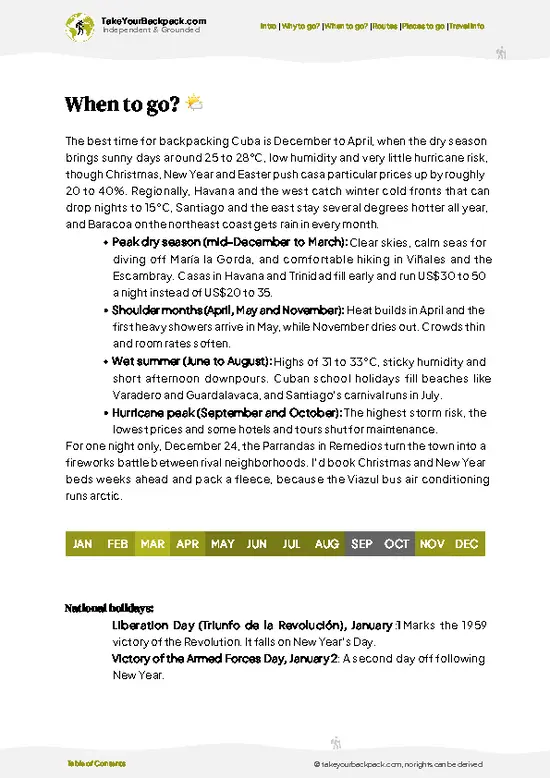
Best months: The best months for landmarks in Cuba are December to April, when it is dry, with highs of 26 to 30°C and humidity low enough to walk cobbled streets all day. Rain is rare, typically 30 to 70 mm a month nationwide.
Shoulder and peak seasons: November and May are good shoulder months. Prices and crowds drop, but heat climbs toward 32°C. Peak season runs from mid-December to early January and again around Easter, when casas particulares in Havana and Trinidad can cost 20 to 40 percent more and book out. Book ahead then, especially on the Viazul buses.
Months to avoid: June to October is hot and wet, with highs of 32 to 35°C, afternoon downpours and 150 to 250 mm of monthly rain. It is not worth visiting outdoor fortresses and ruins at midday in July and August. Hurricane season runs … read more 👉
Best months: The best months for landmarks in Cuba are December to April, when it is dry, with highs of 26 to 30°C and humidity low enough to walk cobbled streets all day. Rain is rare, typically 30 to 70 mm a month nationwide.
Shoulder and peak seasons: November and May are good shoulder months. Prices and crowds drop, but heat climbs toward 32°C. Peak season runs from mid-December to early January and again around Easter, when casas particulares in Havana and Trinidad can cost 20 to 40 percent more and book out. Book ahead then, especially on the Viazul buses.
Months to avoid: June to October is hot and wet, with highs of 32 to 35°C, afternoon downpours and 150 to 250 mm of monthly rain. It is not worth visiting outdoor fortresses and ruins at midday in July and August. Hurricane season runs June to November, with the greatest risk from August to October, mostly affecting the east and south coast. Cheap rooms are tempting, but cancellations and washed-out roads are common.
Regional differences: The east, around Santiago and Baracoa, is hotter and wetter year-round. Baracoa gets rain even in winter, so pack a poncho. Western Cuba, including Havana and Viñales, is cooler in January and February, with evenings of 16 to 20°C.

unique site hoppingHow to Combine landmarks Into One Trip

How many days: A trip combining several landmarks in Cuba needs 10 to 14 days, and 7 days works only if you stay in the west and center. The country is long, roughly 1,000 km from Havana to Santiago, so a full pass takes more time than a map suggests.
Grouping regions and direction: Group the west (Havana, Viñales), the center-south (Cienfuegos, Trinidad, Santa Clara) and the east (Camagüey, Santiago, Baracoa) as three blocks. Travel west to east, starting in Havana, because flights home from Santiago are fewer and the better international connections are in Havana. Alternatively fly into Havana and out of Holguín or Santiago, which saves a 12 to 14 hour backtrack.
Time per stop: Give Havana 3 to 4 days, Trinidad and Cienfuegos 1 to 2 nights each, Santa Clara one night at most and Santiago 2 … read more 👉
How many days: A trip combining several landmarks in Cuba needs 10 to 14 days, and 7 days works only if you stay in the west and center. The country is long, roughly 1,000 km from Havana to Santiago, so a full pass takes more time than a map suggests.
Grouping regions and direction: Group the west (Havana, Viñales), the center-south (Cienfuegos, Trinidad, Santa Clara) and the east (Camagüey, Santiago, Baracoa) as three blocks. Travel west to east, starting in Havana, because flights home from Santiago are fewer and the better international connections are in Havana. Alternatively fly into Havana and out of Holguín or Santiago, which saves a 12 to 14 hour backtrack.
Time per stop: Give Havana 3 to 4 days, Trinidad and Cienfuegos 1 to 2 nights each, Santa Clara one night at most and Santiago 2 nights. Typical rides run 3 hours Havana to Viñales, 4 to 5 hours Havana to Cienfuegos, 1.5 hours Cienfuegos to Trinidad and 12 hours or more from Trinidad to Santiago by road.
Planning mistakes: The biggest mistake is adding Santiago to a one-week trip. Fly Havana to Santiago instead, or leave the east for another trip. Another is waiting to buy bus tickets until arrival, as Viazul seats sell out. Reserve a few days ahead, or share a taxi at about US$15 to 30 per seat on longer hops. Do not plan more than one big transfer in a day.

The ListHighly Recommended landmarks of Cuba

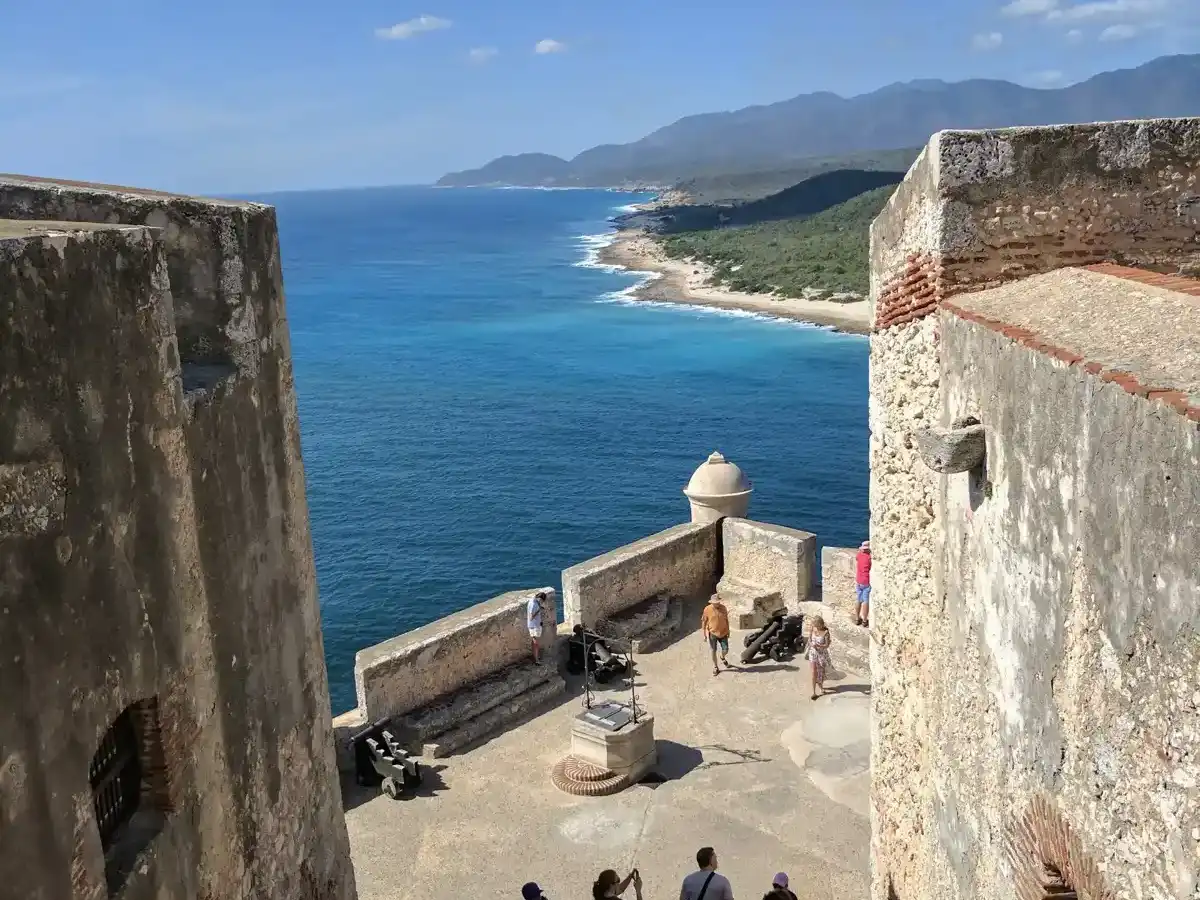
1 Castillo de San Pedro de la Roca

Sea-edge bastions, cannon batteries, bay-mouth views, dusk cannon firing

Climb stepped stone terraces above Santiago Bay, walk cool vaulted passages past iron guns, and stay for the costumed cannon firing at dusk.

cuba-unique-site-castillo-de-san-pedro-de-la-roca
© Google | Marnin G

2 Soroa

Orchid garden, swimming waterfall, pine hills, birdwatching trails

Wander shaded orchid paths, hike to a valley viewpoint, then cool off beneath a 22-meter waterfall in the Sierra del Rosario hills.

Loading the map 🌍

Expert viewWhat You Should Know

How many landmarks to visit: Plan on six to eight landmark stops over two weeks, and no more than two paid sites in a day. Cuba’s heat, transport delays and short opening hours shrink what you can do. Past eight, sites blur and you spend most of the trip waiting for a bus.
What to prioritize: If you like architecture and street life, put colonial centers first. They are free to walk, and the entry fees only apply to museums, towers and churches. If history and politics are your interest, choose revolution sites and museums, which are inexpensive and well run, though the narrative is one-sided. Nature-minded travelers should treat the landmark list as secondary to the countryside. Skip anything that is a packaged coach stop with a mandatory lunch, as it is not worth the time and the price is … read more 👉
How many landmarks to visit: Plan on six to eight landmark stops over two weeks, and no more than two paid sites in a day. Cuba’s heat, transport delays and short opening hours shrink what you can do. Past eight, sites blur and you spend most of the trip waiting for a bus.
What to prioritize: If you like architecture and street life, put colonial centers first. They are free to walk, and the entry fees only apply to museums, towers and churches. If history and politics are your interest, choose revolution sites and museums, which are inexpensive and well run, though the narrative is one-sided. Nature-minded travelers should treat the landmark list as secondary to the countryside. Skip anything that is a packaged coach stop with a mandatory lunch, as it is not worth the time and the price is inflated. Where crowds are heavy, such as the main squares in Havana and Trinidad, go early, before 9 a.m., or after 5 p.m. when the day-trippers have left.
What it costs: A backpacker can manage on US$40 to 70 a day including a casa particular room (US$20 to 35), meals (US$10 to 20) and sightseeing. Individual entry fees are usually US$1 to 10 for museums and forts, with extra for photography at some sites and US$2 to 5 for a bell tower climb. Guides run US$5 to 20 per person at the major sites, and are worth it at larger sites with little signage. Local transport is cheap, but shared taxis between towns cost US$10 to 30 a seat. Many places prefer cash, and card machines can fail, so carry more than you think you need, in euros or dollars to exchange at a good rate. Expect the official and informal exchange rates to differ widely, so check the current rate before you change money.
Safety and cultural considerations: Violent crime is low, but petty theft and scams are common in Havana and Trinidad. Fake guides, “closed today” lies and cigar sellers steering you to a friend’s shop are the usual tricks. Keep your phone and camera out of sight on crowded streets. Dress modestly in churches. Taking photos of police, military buildings and ports is forbidden, so ask first. Do not climb on ruins, and leave memorials quiet. Locals often chat to foreigners, and a small tip of US$1 to 2 is appreciated for informal help. Power cuts can close museums without notice, so keep a backup for each day.

✈️ The backpacker research shortcutCuba Travel Guide

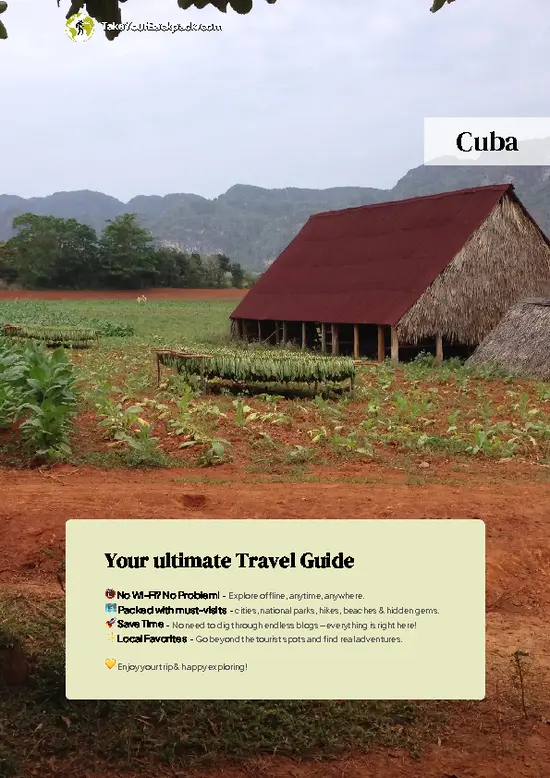
An offline-friendly backpacking guide with optimized travel routes, ranked highlights, transport advice, and the best areas to stay.
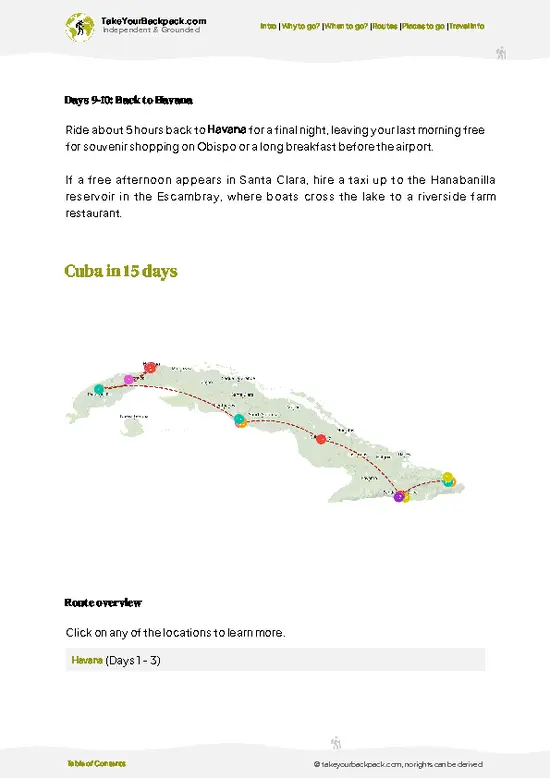
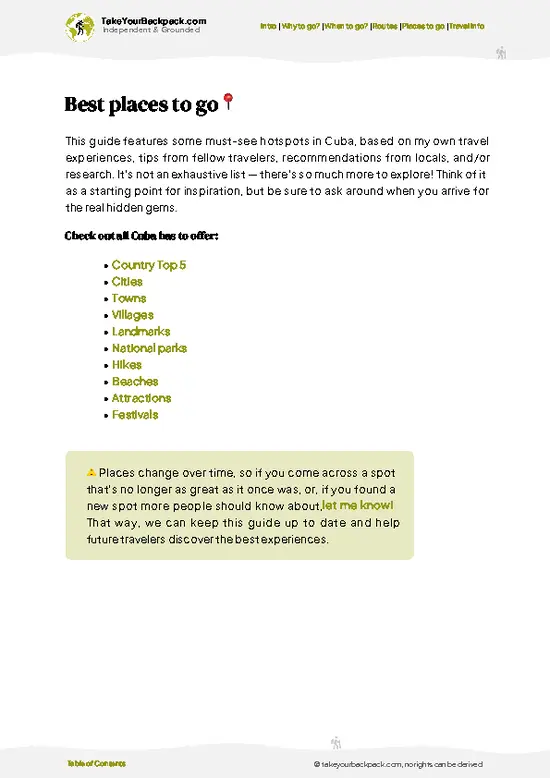
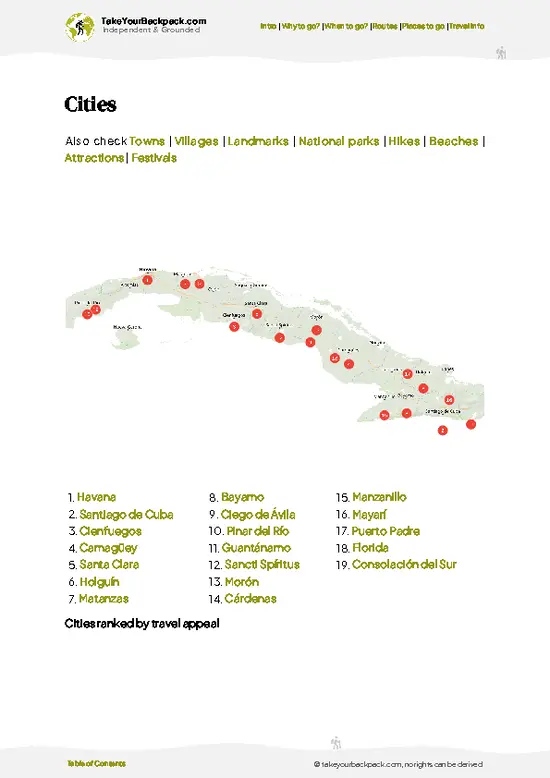
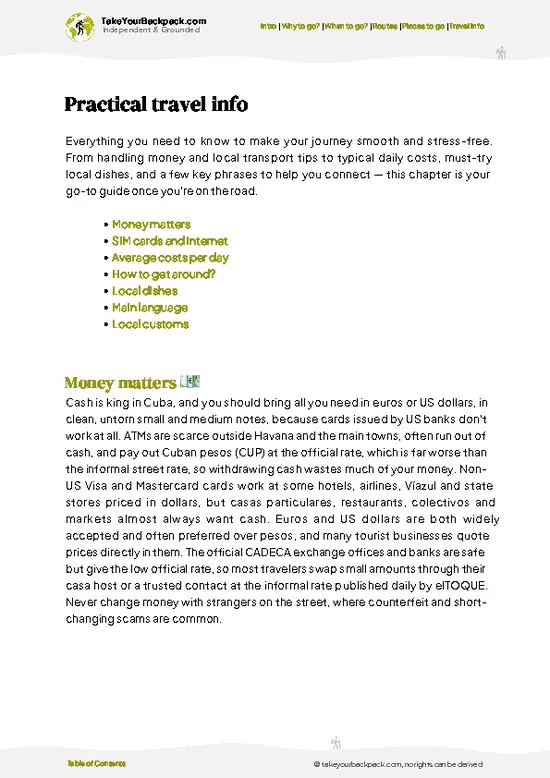
example page 0 from our offline Travel Guide for Cuba
example page 1 from our offline Travel Guide for Cuba
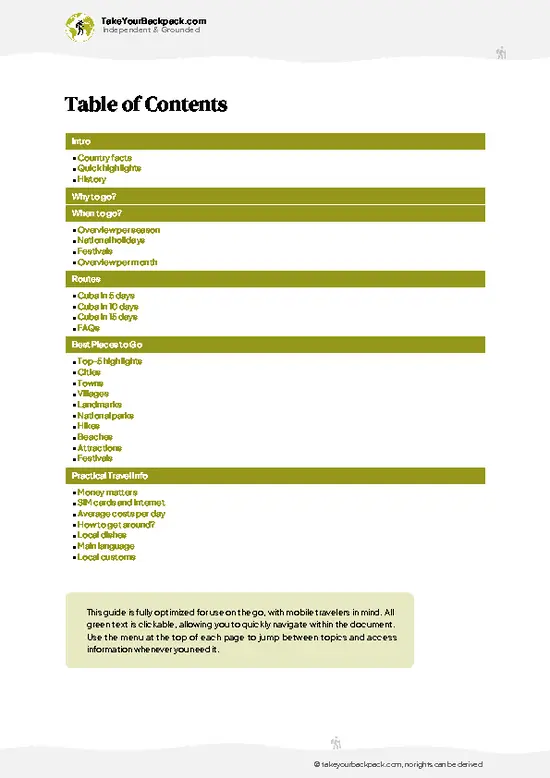
example page 2 from our offline Travel Guide for Cuba
example page 3 from our offline Travel Guide for Cuba
example page 4 from our offline Travel Guide for Cuba
example page 5 from our offline Travel Guide for Cuba
example page 6 from our offline Travel Guide for Cuba
example page 7 from our offline Travel Guide for Cuba
The digital guide (327 pages) contains:
✅ 113 highlights, ranked by travel appeal
✅ Optimized 5, 10 & 15-day travel routes
✅ Cities, national parks, landmarks, beaches
✅ How to get around
✅ Offline-friendly for travel without Wi-Fi
👉 Click to see all 30+ guide features

📅 Plan smarter in minutes, not weeks
✅ Month by month travel advice
✅ Festivals & national holidays
✅ Budget expectations

🗺️ Go to the right places, skip the overrated ones
✅ Honest pros & cons of destinations
✅ Top hikes, parks & viewpoints
✅ Lesser-known places most travelers miss
✅ Clear “worth it vs skip it” guidance

🛏️ Travel smoothly without rookie mistakes
✅ Best areas to stay
✅ Transport systems explained simply
✅ Common scams & safety advice
✅ SIM cards, money & practical tips

🌍 Understand the country, not just visit it
✅ Culture & traditions
✅ 52 Essential phrases & customs
✅ Festivals worth planning around
✅ Traveler-friendly historical context
✅ Insights that make places more meaningful

📱 Built for real travel conditions
✅ Fully downloadable PDF
✅ Works completely offline
✅ Optimized for phone use
✅ Useful in remote areas & buses
✅ Everything in one place
Stop searching, start planning
Get instant access to your full guide. 30‑day money-back guarantee.
+ Add another guide for just

By proceeding you agree to our terms.
Sent to your inbox immediately after payment • 100% Secure Checkout
Best Backpacking Travel Advisor 2025 tourism awardBest Backpacking
Travel Advisor
2025
What others say about Take Your Backpack Guides:
⭐⭐⭐⭐⭐
Fantastic, amazing amount of information!
⭐⭐⭐⭐⭐
My goodness this is amazing, it's what I've been looking for hats off too you!
⭐⭐⭐⭐⭐
I think this is absolutely BRILLIANT
⭐⭐⭐⭐
Very complete and informative. It's still missing places, but I gotta to commend you
⭐⭐⭐⭐⭐
This is truly amazing, thank you, can't wait to explore it with my kids!
⭐⭐⭐⭐⭐
Awesome resource, thank you!
⭐⭐⭐⭐⭐
This is amazing! Can't wait to explore the ones I haven't seen
⭐⭐⭐⭐
I love this! Well done, great idea.
⭐⭐⭐⭐⭐
Thanks for taking the time to make this gem!
⭐⭐⭐⭐⭐
This might be the best website I've ever seen.
⭐⭐⭐⭐⭐
Congratulations, and thank you so much for your work; it's incredibly valuable.
⭐⭐⭐⭐
In all seriousness I think you did a great job pointing out the important spots
⭐⭐⭐⭐⭐
10/10 very good
⭐⭐⭐⭐⭐
As someone who's only just starting to visit regularly this is awesome, thank you.
⭐⭐⭐⭐
Thank you very much! I'm going to visit my dad, it's going to be very useful!
⭐⭐⭐⭐⭐
This is really cool! We'll be travelling for the first time and this definitely come in handy.
⭐⭐⭐⭐⭐
You are now our minister of culture, congratulations 👨‍💼
⭐⭐⭐⭐⭐
Just wanted to tell you that this is a pearl! Going to follow your recommendations.
⭐⭐⭐⭐⭐
This is so cool. I'll definitely be using the resource for my travels soon.
⭐⭐⭐⭐⭐
This is very impressive! Good work.
⭐⭐⭐⭐⭐
This is an amazing and informative site. Very well done!

🛏️ Where to stay?Accommodation Highlights

Cuba has a small number of true hostels (mostly in Havana, Viñales and Trinidad, with dorm beds at roughly US$8 to 15), but most budget travelers stay in casas particulares, licensed private homestays where a double room usually runs US$20 to 35 and breakfast is often available for a few dollars more. In Havana, Habana Vieja puts you within walking distance of the main sights but is loud and touristy, Centro Habana is cheaper and more local but gritty, with more petty theft and blackouts, and Vedado is leafier and quieter, with the city’s best live music and late bars a short taxi ride from the old town. In Trinidad and Viñales, rooms within a few blocks of the central plaza or main street put … read more 👉
Cuba has a small number of true hostels (mostly in Havana, Viñales and Trinidad, with dorm beds at roughly US$8 to 15), but most budget travelers stay in casas particulares, licensed private homestays where a double room usually runs US$20 to 35 and breakfast is often available for a few dollars more. In Havana, Habana Vieja puts you within walking distance of the main sights but is loud and touristy, Centro Habana is cheaper and more local but gritty, with more petty theft and blackouts, and Vedado is leafier and quieter, with the city’s best live music and late bars a short taxi ride from the old town. In Trinidad and Viñales, rooms within a few blocks of the central plaza or main street put you close to the evening music and restaurants, while streets farther out are quieter and slightly cheaper.

If you enjoy meeting fellow travelers, consider choosing hostels with high ratings for atmosphere. On the other hand, if you prefer having your own space, a hotel might be a better option.

CubaSee More of Cuba

👋 Meet the founderWho’s Behind Take Your Backpack?

Johan, backpacker and founder of TakeYourBackpackHi, I’m Johan (Netherlands 🇳🇱), the creator of TakeYourBackpack. Over the past 3 decades, I’ve backpacked through 90+ countries across six continents, gaining extensive experience with independent travel, long-term trips, and overland routes.

This site is built on a combination of firsthand travel experience and carefully curated insights from other backpackers. Many guides are based on places I’ve personally visited, while others bring together tips, observations, and practical advice shared by trusted travelers I’ve met along the way.

The goal is to provide realistic, experience-driven guidance — not generic itineraries — so you can explore destinations with better context, clearer expectations, and more confidence.