Trip Planning
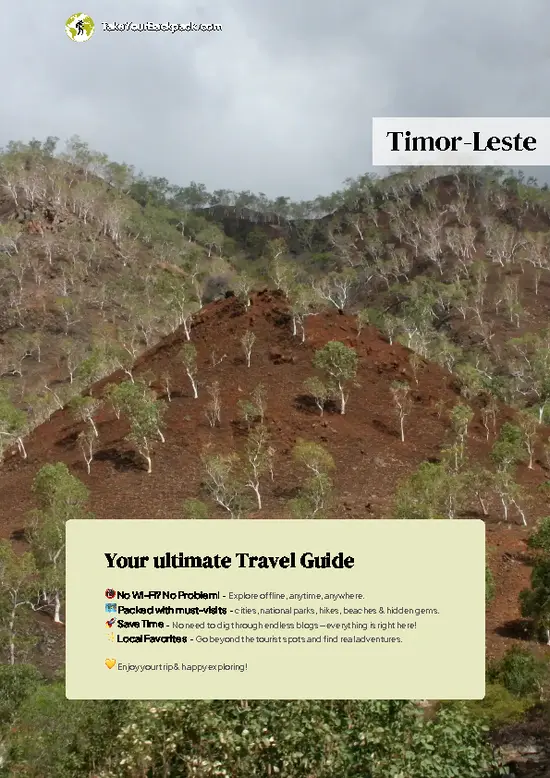
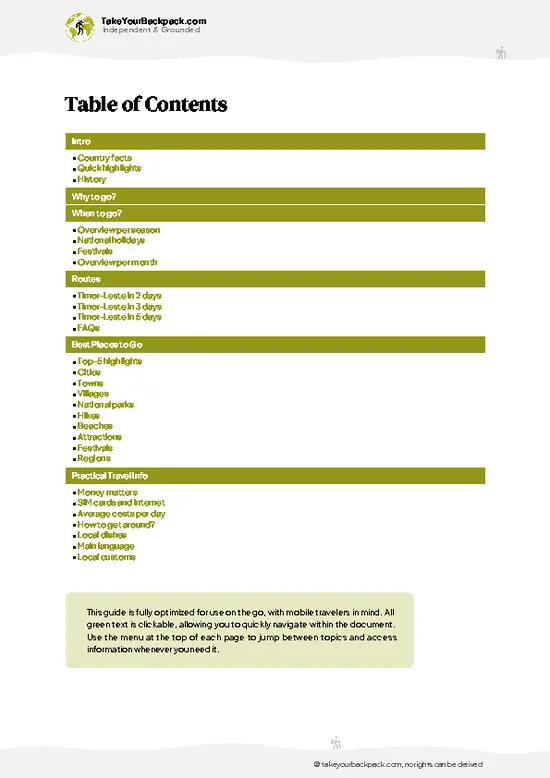
The TakeYourBackpack guidebooks are your all-in-one travel companion, featuring the best cities, national parks, hikes, beaches, and unique sites, along with essential tips on when to go, how to get around, exchanging money, and even local phrases to get you started — everything you need for a smooth, unforgettable backpacking adventure.
Stop researching. Start exploring.Discover all 47 highlights,ranked
and organized into practical routes.
Get instant access
Planning a backpacking route through Timor-Leste can be tricky — you need to balance must-see places, travel times, budget, and how long to stay in each destination. Our free personalized Timor-Leste itinerary planner creates a route based on your travel style, trip duration, and interests, so you can spend less time researching and more time exploring.
Personal tip: I normally search on good rating for atmosphere (for meeting people) and location (for easy exploring). Cleanliness as a bonus.
Travel Essentials
No vaccinations are mandatory for most visitors to Timor-Leste, although a yellow fever certificate is required if you arrive from a country with yellow fever risk. Recommended vaccines are routine shots (MMR, tetanus-diphtheria, polio), hepatitis A and typhoid, with hepatitis B, Japanese encephalitis and rabies worth discussing with a travel clinic for longer or rural trips, since rabies cases have appeared in the Oecusse enclave. The World Health Organization certified the country malaria-free in 2025, but dengue is a serious risk, especially in the wet season, so pack strong insect repellent.
vaccination requirementsWhen I first started traveling, I often spent part of my first day in a new country hunting for a local SIM card. While this can still be slightly cheaper, it also takes time and planning.
These days, it's much simpler to install an eSIM before leaving home. Once you arrive in Timor-Leste, you can activate it immediately and have mobile data from the moment you land — which is especially useful for ordering transport or navigating away from busy airports.
There are many providers nowadays, and price differences are usually small. I personally go with
Holafly, as it offers excellent network coverage throughout the country and strong global coverage, so you can manage multiple countries from a single app.
HolaFly eSimCulture & Customs
Timor-Leste is deeply Catholic, so dress modestly with shoulders and knees covered in villages and churches, and keep swimwear to the beach. Do ask before photographing people, especially elders, and ask permission before approaching an uma lulik (sacred house), never touching or entering one without an invitation. Do accept offered coffee or betel nut with your right hand, or politely decline, and remove your shoes when entering homes. Don’t raise your voice or show anger in public, since keeping calm and patient matters a lot here. Treat sites linked to the Indonesian occupation, such as the Santa Cruz Cemetery, with quiet respect. Women should expect more conservative attitudes outside Dili and may find that modest clothing makes interactions easier, while LGBTQ+ travelers should avoid public displays of affection.
Trying traditional food is always a great way to experience the culture. Here are some must-try dishes for Timor-Leste.
- Ikan sabuko: Spanish mackerel marinated in tamarind, garlic and chili, then grilled over coconut husks along the Dili waterfront. It’s the country’s signature fish and a cheap evening feast at the beachside grills.
- Batar da’an: a thick, earthy stew of corn, mung beans and pumpkin, simmered slowly. It’s everyday home cooking in the countryside and shows how central corn is to the Timorese diet.
- Tukir: spiced meat (often goat, pork or venison) packed into bamboo tubes and cooked over embers. It’s a festive dish served at ceremonies and family gatherings.
- Budu: a sharp sauce of tomato, chili, shallot, lime and basil that goes on nearly everything, from rice to grilled fish. No Timorese meal feels complete without it.
- Caril: a mild Timorese chicken curry with coconut milk, a nod to Portuguese and Goan influences. It’s a favorite at family meals and local restaurants.
- Feijoada: a hearty bean and pork stew inherited from Portuguese rule, adapted with local spices. It’s a comfort dish that reflects the country’s colonial past.
- Tapai: fermented sticky rice with a sweet, mildly boozy flavor, often eaten during celebrations and as a traditional snack.
Tap water in Timor-Leste is not safe to drink, and most locals boil it or buy large refillable water containers instead. Travelers should stick to bottled, boiled or filtered water, including for brushing teeth outside better hotels in Dili. Many guesthouses have refill dispensers, and a filter bottle cuts plastic waste, which matters on Atauro and in rural areas.
The main language in Timor-Leste is
Tetum. Backpacking is way more rewarding if you know a bit of the local language, so I'd suggest brushing up on the basics just in case your Tetum skills have become a bit rusty.
Want to understand locals better?The complete Travel Guide for Timor-Leste includes 52 essential words and phrases — greetings, thank-yous, ordering food, transport, numbers, and common local expressions you'll actually hear.
Get your local basic phrases 👉
Get the Travel Guide - in Timor-Leste is patchy: you’ll manage in Dili’s guesthouses, cafés and dive shops thanks to the NGO and expat crowd, and many younger Timorese have picked up some English through school and social media. Outside the capital, English becomes rare quickly, and in rural villages you’ll rely on gestures and goodwill. Bahasa Indonesia is the most useful second language, widely understood by adults who went to school before 1999, while Portuguese gets a polite but limited response. Learn a handful of Tetum phrases like “bondia” (good morning) and “obrigadu/obrigada” (thank you), and download offline Indonesian in a translation app.
Money & Payments
The local currency of Timor-Leste is USD ($).
Timor-Leste uses the US dollar as its official currency, alongside locally minted centavo coins, so bringing clean, undamaged US dollar notes is the easiest plan, since torn or old notes are often refused. ATMs are easy to find in Dili, scarce in larger towns like Baucau and Maliana, and largely absent in rural areas and on Atauro, so withdraw enough cash before leaving the capital. Expect fees of around US$3 to 5 per withdrawal on top of your home bank’s charges. Cards are accepted at upmarket hotels, larger supermarkets and some restaurants in Dili, but guesthouses, warungs, markets and transport outside the capital are cash only. Euros and Australian dollars can be exchanged at banks in Dili, which are the safest places to change money, though rates are better if you simply arrive with US dollars. Carry plenty of small notes and coins, because change for a US$20 note is often hard to find in villages.
Tipping is not a strong tradition in Timor-Leste and is never expected at local warungs, markets or from minibus drivers. Rounding up the bill or leaving US$1 to 2 for good service is appreciated, and around 10% is common at upmarket restaurants in Dili. Guides and drivers on multi-day trips, such as Mount Ramelau climbs or Atauro excursions, value a tip of a few dollars per day.
v2.webp)
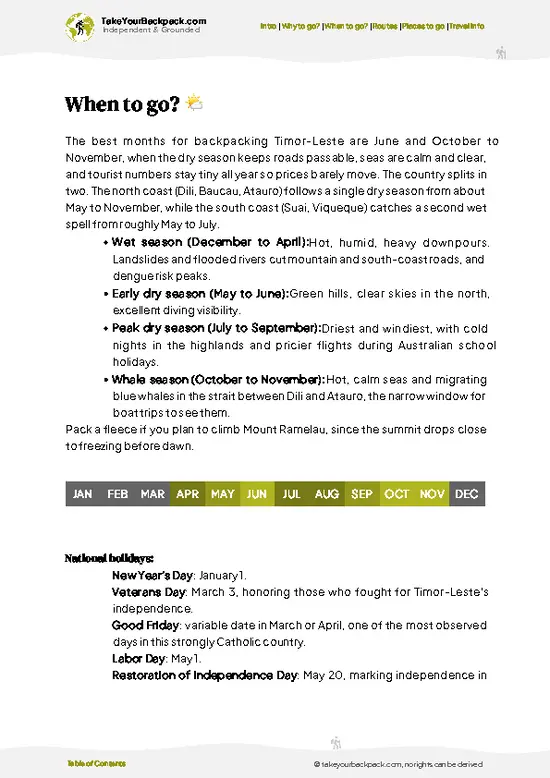
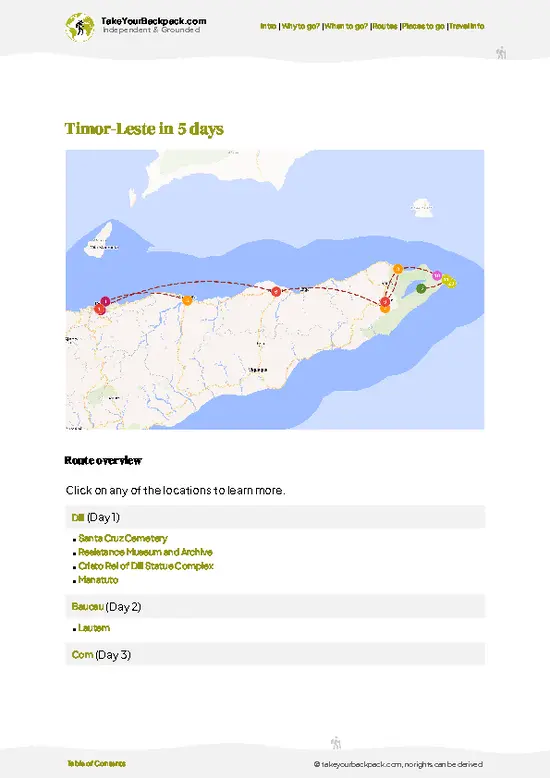
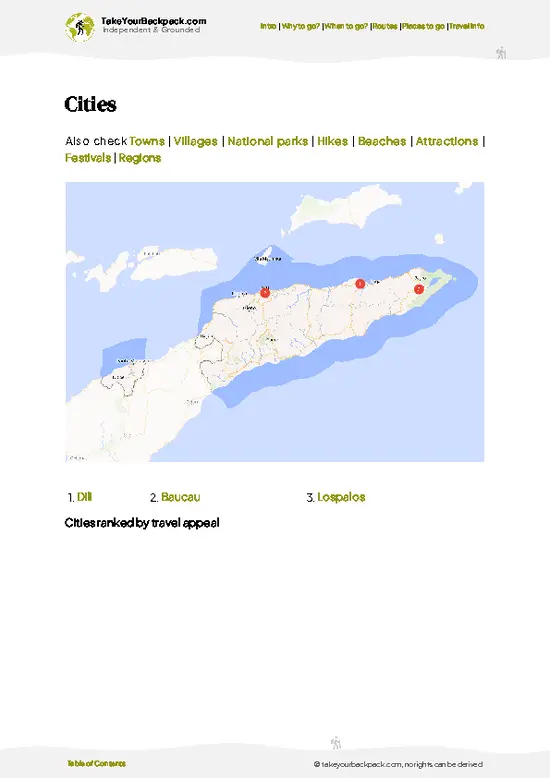
 Best Backpacking
.jpg) Over the years, I've learned the importance of packing minimally. It's so much easier to jump on the back of a truck or squeeze yourself into the last spot of a minibus without that supersized backpack. If you're headed to a warm destination, leave your winter jacket at home; for colder regions, opt for thin thermal underlayers. Instead of packing your entire wardrobe, bring just three sets of clothes, as laundry facilities are available everywhere.
Over the years, I've learned the importance of packing minimally. It's so much easier to jump on the back of a truck or squeeze yourself into the last spot of a minibus without that supersized backpack. If you're headed to a warm destination, leave your winter jacket at home; for colder regions, opt for thin thermal underlayers. Instead of packing your entire wardrobe, bring just three sets of clothes, as laundry facilities are available everywhere.

.jpg) Hi, I’m Johan (Netherlands 🇳🇱), the creator of TakeYourBackpack. Over the past 3 decades, I’ve backpacked through 90+ countries across six continents, gaining extensive experience with independent travel, long-term trips, and overland routes.
Hi, I’m Johan (Netherlands 🇳🇱), the creator of TakeYourBackpack. Over the past 3 decades, I’ve backpacked through 90+ countries across six continents, gaining extensive experience with independent travel, long-term trips, and overland routes.