×
Quito

Ecuador🇪🇨 | citiesQuitoColonial core, gilded church, equator line, cable car | things to do and best time to go

Explore OtavaloExplore Riobamba

Backpacking in Quito
UNESCO World Heritage site
🏆 Top pickcity ranked #1
By Johan Kruseman 🇳🇱 | Updated October 19, 2026

Quito used to be the city travelers cleared out of fast, a stopover for altitude headaches and a quick dash to the Galápagos or the Amazon. Today you can happily spend days here. This is Ecuador’s capital, strung along a narrow Andean valley in the north of the country at about 2,850 meters, with a colonial core that sits beside a lively, cafe-packed new town. It suits curious walkers, food hunters and anyone who likes hills with their history. It is less kind to people who want flat, quiet beaches or hate steep climbs, and night streets in some areas demand care. Early on, I asked a vendor outside a church for the best empanada, and she laughed, pointed up a lane and said, “Follow the smoke, mijo.” I followed, and the empanada de viento came out of the fryer sugared and blistering hot. Taking the cheap local bus beats a taxi on time and comfort, and costs far less. Your first day could mean a slow morning in the old town, lunch in a market, and a cable car ride at dusk.

Discover everything you want to know in the 📖 Ecuador Travel Guide.


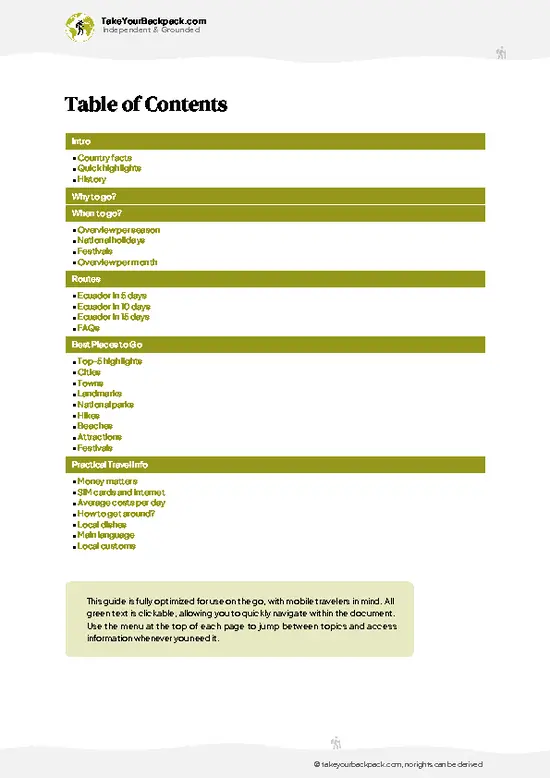
example page 0 from our offline Travel Guide for Ecuador
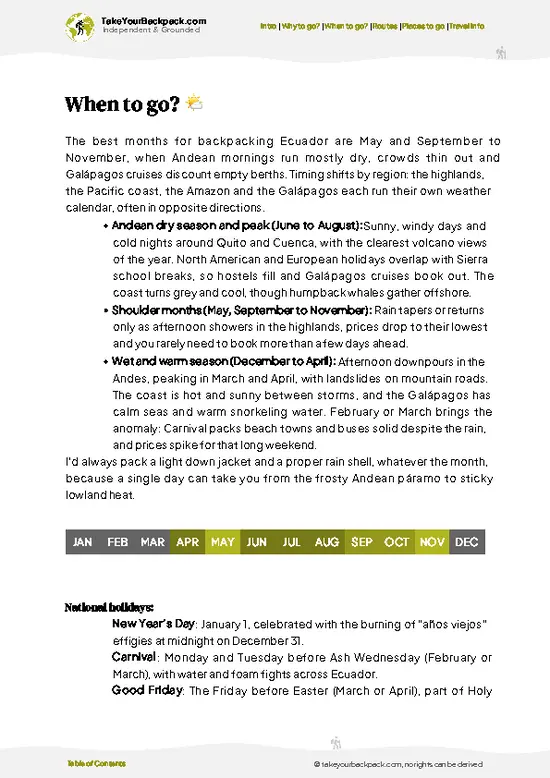
example page 1 from our offline Travel Guide for Ecuador
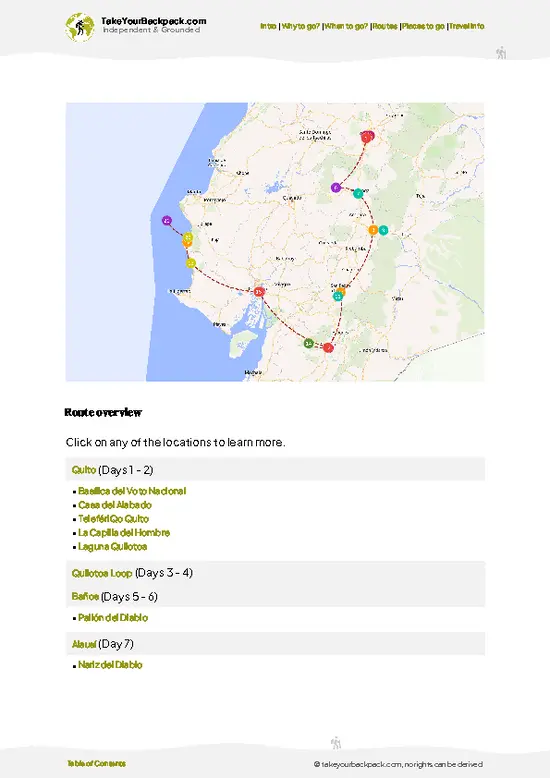
example page 2 from our offline Travel Guide for Ecuador
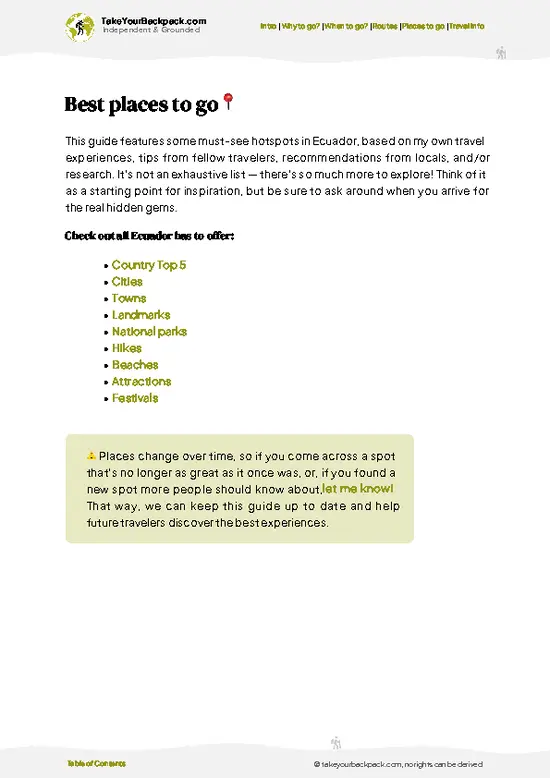
example page 3 from our offline Travel Guide for Ecuador
example page 4 from our offline Travel Guide for Ecuador
example page 5 from our offline Travel Guide for Ecuador
example page 6 from our offline Travel Guide for Ecuador
example page 7 from our offline Travel Guide for Ecuador
Loading the map 🌍
CLICK TO FILTER
cities
towns
landmarks
national parks
hikes
beaches
attractions
festivals
SHOW COUNTRY’S BESTSHOW ALL

✨ Why go?
Ranked #1 city in Ecuador
Why visitors keep coming back

Quito works as a backpacker anchor because the colonial center and the modern district of La Mariscal sit close enough to bounce between in one day. Beds are plentiful and cheap, and the hostel scene is social, so you can pick up travel partners for the Amazon, the coast or the Galápagos within an evening. You can eat very well on little money, especially at set-lunch spots serving soup, a main and juice. The city also gives you a real acclimatization period before climbing volcanoes, and you can arrange guides and gear here without much fuss. The UNESCO-listed old town is among the best preserved in Latin America, and the TelefériQo cable car lifts you toward the ridge above the city. Onward buses fan out to nearly everywhere in the country. Plan two to four nights. Less is a rush, and more … read more 👉
Quito works as a backpacker anchor because the colonial center and the modern district of La Mariscal sit close enough to bounce between in one day. Beds are plentiful and cheap, and the hostel scene is social, so you can pick up travel partners for the Amazon, the coast or the Galápagos within an evening. You can eat very well on little money, especially at set-lunch spots serving soup, a main and juice. The city also gives you a real acclimatization period before climbing volcanoes, and you can arrange guides and gear here without much fuss. The UNESCO-listed old town is among the best preserved in Latin America, and the TelefériQo cable car lifts you toward the ridge above the city. Onward buses fan out to nearly everywhere in the country. Plan two to four nights. Less is a rush, and more only makes sense if you are using Quito as a hub for side trips or Spanish lessons, which are popular and good value here.

💡 HighlightsKey sights and experiences for travelers

  1. Centro Histórico and Plaza Grande: The old town is the city’s signature, with the presidential palace, cathedral and stone-paved lanes climbing in every direction. Go on weekday mornings for lighter crowds. Walking is free and 2 to 3 hours is plenty.
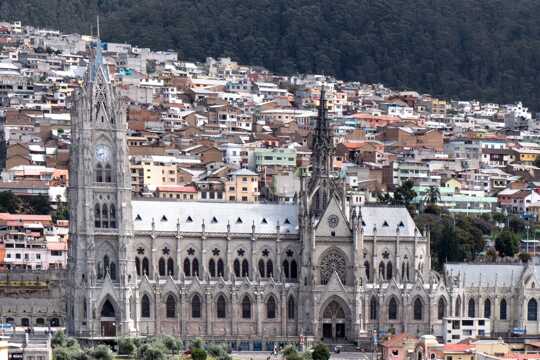
  2. Basílica del Voto Nacional: A neo-Gothic church where the gargoyles are Ecuadorian animals such as tortoises and iguanas. Climb the towers and ladders for rooftop views. Entry is about US$2 to 4 and the visit takes 1 to 1.5 hours. Go in the morning for clear light.
  3. Iglesia de la Compañía de Jesús: The interior is covered in gold leaf, and it is among the most ornate in the Americas. Visit early. Tickets run around US$5 to 6, and it takes 30 to 45 minutes.
  4. Calle La Ronda: A narrow colonial street of balconies, small workshops and cafes. Late afternoon
… read more 👉
  1. Centro Histórico and Plaza Grande: The old town is the city’s signature, with the presidential palace, cathedral and stone-paved lanes climbing in every direction. Go on weekday mornings for lighter crowds. Walking is free and 2 to 3 hours is plenty.
  2. Basílica del Voto Nacional: A neo-Gothic church where the gargoyles are Ecuadorian animals such as tortoises and iguanas. Climb the towers and ladders for rooftop views. Entry is about US$2 to 4 and the visit takes 1 to 1.5 hours. Go in the morning for clear light.
  3. Iglesia de la Compañía de Jesús: The interior is covered in gold leaf, and it is among the most ornate in the Americas. Visit early. Tickets run around US$5 to 6, and it takes 30 to 45 minutes.
  4. Calle La Ronda: A narrow colonial street of balconies, small workshops and cafes. Late afternoon into the evening is best, when locals come for canelazo, a hot spiced cane drink. It is free to wander, and a drink costs US$2 to 4. Allow 1 to 2 hours.
  5. TelefériQo: This gondola climbs from the city to roughly 4,000 meters on the Pichincha slope, with views over the whole valley. Go in the morning before clouds roll in. The ticket is about US$9 for foreigners, and the trip takes 2 to 3 hours with a short walk at the top.
  6. Mitad del Mundo and Intiñan Museum: The equator monument sits north of the city center, with a nearby site museum that does demonstrations. Entry is around US$5 to 10 depending on what you add, and it takes 2 to 3 hours. Go in the morning.
  7. Parque La Carolina and Jardín Botánico: A big city park with paddle boats, joggers and weekend food stalls, and a botanical garden with orchids. The park is free, the garden costs about US$3 to 4, and 1 to 2 hours is enough.
  8. Museo Nacional del Ecuador (Casa de la Cultura): A solid collection spanning pre-Columbian ceramics to colonial art. Admission is usually free or very cheap, and 1.5 to 2 hours covers it. Go midweek.
The Basílica del Voto Nacional and Calle La Ronda fit well in one day, with the church in the morning and the street at dusk. For day trips beyond the city, consider Cotopaxi National Park, Quilotoa Lake, Mindo cloud forest and the Otavalo market.
Spotted a mistake or missing something? Contact us.

Things to do in Quito

Ratings based on Tripadvisor reviews. When you book through this link, you support our work at no extra cost to you.

🏘️ NeighborhoodsWhere things are and how it's laid out

Quito stretches along a narrow Andean valley, so the smartest way to learn it is one pocket at a time, north to south.
  • Centro Histórico is the headline act. Cobbled lanes climb past Plaza Grande, La Compañía church and the steep, loud La Ronda street, where canelazo (hot cane spirit with cinnamon) steams in cups at dusk. Everything sits within a 20-minute walk, the hills will test your lungs at 2,850 m (9,350 ft), and it’s calmer after dark than the daytime crowds suggest. Go early, leave by nightfall, and you get the best of it for free.
  • La Mariscal is the gringo-heavy grid of Plaza Foch, with bars, cheap set lunches, tour agencies and thumping late-night clubs. It’s flat, walkable and loud. Spend an evening here, but treat it as a social stop and not as the place you learn about Quito.
  • La Floresta
… read more 👉
Quito stretches along a narrow Andean valley, so the smartest way to learn it is one pocket at a time, north to south.
  • Centro Histórico is the headline act. Cobbled lanes climb past Plaza Grande, La Compañía church and the steep, loud La Ronda street, where canelazo (hot cane spirit with cinnamon) steams in cups at dusk. Everything sits within a 20-minute walk, the hills will test your lungs at 2,850 m (9,350 ft), and it’s calmer after dark than the daytime crowds suggest. Go early, leave by nightfall, and you get the best of it for free.
  • La Mariscal is the gringo-heavy grid of Plaza Foch, with bars, cheap set lunches, tour agencies and thumping late-night clubs. It’s flat, walkable and loud. Spend an evening here, but treat it as a social stop and not as the place you learn about Quito.
  • La Floresta is a short hop east of Mariscal and far more relaxed. Think indie cafés, murals, small galleries and a few craft beer taps. Walk it in an hour and you’ll feel you’ve found a local secret that costs nothing extra.
  • Guápulo hangs off a ravine edge, reached by stairs from the Mariscal side. Its tiny church and hillside viewpoints reward a downhill wander, though the climb back is brutal, so take a taxi up for about US$2 to 3.
  • La Carolina is the modern business district around a big park with paddle boats, running paths and the botanical garden. It’s ideal for a lazy Sunday, when the main avenues close to cars for cyclists, but it has little backpacker character otherwise.
Hit Centro by day, Mariscal by night, and fill the gaps in La Floresta.

⌛️ 1 dayA smart one-day plan

8:00 AM, Plaza Grande: Start with a market-and-church morning in the old town. Grab a coffee, watch the palace guard and soak up the square before the tour groups arrive.
9:30 AM, Iglesia de la Compañía de Jesús: Walk a few minutes to this gold-covered church. Go in early, when the interior is quiet and the carvings are easy to see.
11:00 AM, Basílica del Voto Nacional: Stroll uphill to the neo-Gothic basilica and climb the towers. The views are wide, and the wooden ladders add a bit of adventure.
1:00 PM, Mercado Central: Walk down to the covered market for a set lunch or a plate of hornado. It is loud, cheap and very local, and it is the best place to eat in the center.
3:00 PM, San Francisco Plaza and Museo del Convento: A short walk takes you to one of the oldest religious complexes in the … read more 👉
8:00 AM, Plaza Grande: Start with a market-and-church morning in the old town. Grab a coffee, watch the palace guard and soak up the square before the tour groups arrive.
9:30 AM, Iglesia de la Compañía de Jesús: Walk a few minutes to this gold-covered church. Go in early, when the interior is quiet and the carvings are easy to see.
11:00 AM, Basílica del Voto Nacional: Stroll uphill to the neo-Gothic basilica and climb the towers. The views are wide, and the wooden ladders add a bit of adventure.
1:00 PM, Mercado Central: Walk down to the covered market for a set lunch or a plate of hornado. It is loud, cheap and very local, and it is the best place to eat in the center.
3:00 PM, San Francisco Plaza and Museo del Convento: A short walk takes you to one of the oldest religious complexes in the city. Stay for the stone square and quiet cloisters.
4:30 PM, Calle La Ronda: Stroll to this narrow street as workshops open and musicians tune up. Try a hot canelazo and look at the balconies.
6:00 PM, Panecillo viewpoint: Take a taxi up the hill, since walking at dusk is not wise. The Virgin of Quito statue looks over the city lights, and the view is wide.
8:00 PM, La Floresta: This lesser-visited, creative neighborhood has small bars, murals and indie restaurants with few tourists. Take a taxi from the Panecillo, eat dinner and end the night here.

🌤️ When to go?When to go for the best experience

June to September is the driest stretch in Quito, with sunny mornings and the best odds of seeing Cotopaxi and Cayambe from the viewpoints.
  • Dry Season (June to September): Days reach 20 to 22°C (68 to 72°F), nights drop to 7 to 9°C (45 to 48°F). Crowds and tour prices peak in July and August, particularly around local holidays.
  • Wet Seasons (October to May): Expect clear mornings and heavy afternoon downpours, strongest in March and April. Highs stay near 19 to 21°C (66 to 70°F). Hostels get quieter and bargaining on tours is easier.
  • Daylight: Sunrise and sunset barely shift through the year, so you get about 12 hours of light in every month. Plan sightseeing before lunch.
  • Festivals: Carnival in February or March, Holy Week processions in the old town and the Fiestas de Quito in early December
… read more 👉
June to September is the driest stretch in Quito, with sunny mornings and the best odds of seeing Cotopaxi and Cayambe from the viewpoints.
  • Dry Season (June to September): Days reach 20 to 22°C (68 to 72°F), nights drop to 7 to 9°C (45 to 48°F). Crowds and tour prices peak in July and August, particularly around local holidays.
  • Wet Seasons (October to May): Expect clear mornings and heavy afternoon downpours, strongest in March and April. Highs stay near 19 to 21°C (66 to 70°F). Hostels get quieter and bargaining on tours is easier.
  • Daylight: Sunrise and sunset barely shift through the year, so you get about 12 hours of light in every month. Plan sightseeing before lunch.
  • Festivals: Carnival in February or March, Holy Week processions in the old town and the Fiestas de Quito in early December bring parades, closures and higher bed prices.
Book a dorm ahead for Holy Week and early December, and do your outdoor plans in the morning whatever the month.


source: climatestotravel.comJANJanuary: good for travelingFEBFebruary: good for travelingMARMarch: good for travelingAPRApril: good for travelingMAYMay: highly recommended for travelingJUNJune: excellent for travelingJULJuly: excellent for travelingAUGAugust: excellent for travelingSEPSeptember: excellent for travelingOCTOctober: fair for travelingNOVNovember: fair for travelingDECDecember: fair for traveling
Ecuador - Quito

✈️ The backpacker research shortcutEcuador Travel Guide

An offline-friendly backpacking guide with optimized travel routes, ranked highlights, transport advice, and the best areas to stay.
example page 0 from our offline Travel Guide for Ecuador
example page 1 from our offline Travel Guide for Ecuador
example page 2 from our offline Travel Guide for Ecuador
example page 3 from our offline Travel Guide for Ecuador
example page 4 from our offline Travel Guide for Ecuador
example page 5 from our offline Travel Guide for Ecuador
example page 6 from our offline Travel Guide for Ecuador
example page 7 from our offline Travel Guide for Ecuador
The digital guide (274 pages) contains:
✅ 87 highlights, ranked by travel appeal
✅ Optimized 5, 10 & 15-day travel routes
✅ Cities, national parks, landmarks, beaches
✅ How to get around
✅ Offline-friendly for travel without Wi-Fi
👉 Click to see all 30+ guide features

📅 Plan smarter in minutes, not weeks
✅ Month by month travel advice
✅ Festivals & national holidays
✅ Budget expectations

🗺️ Go to the right places, skip the overrated ones
✅ Honest pros & cons of destinations
✅ Top hikes, parks & viewpoints
✅ Lesser-known places most travelers miss
✅ Clear “worth it vs skip it” guidance

🛏️ Travel smoothly without rookie mistakes
✅ Best areas to stay
✅ Transport systems explained simply
✅ Common scams & safety advice
✅ SIM cards, money & practical tips

🌍 Understand the country, not just visit it
✅ Culture & traditions
✅ 52 Essential phrases & customs
✅ Festivals worth planning around
✅ Traveler-friendly historical context
✅ Insights that make places more meaningful

📱 Built for real travel conditions
✅ Fully downloadable PDF
✅ Works completely offline
✅ Optimized for phone use
✅ Useful in remote areas & buses
✅ Everything in one place
Stop searching, start planning
Get instant access to your full guide. 30‑day money-back guarantee.
+ Add another guide for just

By proceeding you agree to our terms.
Sent to your inbox immediately after payment • 100% Secure Checkout
Best Backpacking Travel Advisor 2025 tourism awardBest Backpacking
Travel Advisor
2025
What others say about Take Your Backpack Guides:
⭐⭐⭐⭐⭐
Fantastic, amazing amount of information!
⭐⭐⭐⭐⭐
My goodness this is amazing, it's what I've been looking for hats off too you!
⭐⭐⭐⭐⭐
I think this is absolutely BRILLIANT
⭐⭐⭐⭐
Very complete and informative. It's still missing places, but I gotta to commend you
⭐⭐⭐⭐⭐
This is truly amazing, thank you, can't wait to explore it with my kids!
⭐⭐⭐⭐⭐
Awesome resource, thank you!
⭐⭐⭐⭐⭐
This is amazing! Can't wait to explore the ones I haven't seen
⭐⭐⭐⭐
I love this! Well done, great idea.
⭐⭐⭐⭐⭐
Thanks for taking the time to make this gem!
⭐⭐⭐⭐⭐
This might be the best website I've ever seen.
⭐⭐⭐⭐⭐
Congratulations, and thank you so much for your work; it's incredibly valuable.
⭐⭐⭐⭐
In all seriousness I think you did a great job pointing out the important spots
⭐⭐⭐⭐⭐
10/10 very good
⭐⭐⭐⭐⭐
As someone who's only just starting to visit regularly this is awesome, thank you.
⭐⭐⭐⭐
Thank you very much! I'm going to visit my dad, it's going to be very useful!
⭐⭐⭐⭐⭐
This is really cool! We'll be travelling for the first time and this definitely come in handy.
⭐⭐⭐⭐⭐
You are now our minister of culture, congratulations 👨‍💼
⭐⭐⭐⭐⭐
Just wanted to tell you that this is a pearl! Going to follow your recommendations.
⭐⭐⭐⭐⭐
This is so cool. I'll definitely be using the resource for my travels soon.
⭐⭐⭐⭐⭐
This is very impressive! Good work.
⭐⭐⭐⭐⭐
This is an amazing and informative site. Very well done!

🛏️ Where to stay?Best areas to stay in Ecuador

La Mariscal is the best area for a budget bed in Quito, with the Centro Histórico a close second.
Mariscal has the densest cluster of hostels in the city, so dorm beds run about US$8 to 14 and private rooms about US$20 to 35, with plenty of options even at short notice. It’s flat, close to restaurants, laundries, ATMs and tour offices, and meeting other travelers takes no effort. Taxis and the trolebús line are right there, and the airport shuttle drops here. The trade-off is noise. Weekends bring loud bars until 3:00 am, so ask for a room away from the street or pack earplugs. Walk the main strip … read more 👉
La Mariscal is the best area for a budget bed in Quito, with the Centro Histórico a close second.
Mariscal has the densest cluster of hostels in the city, so dorm beds run about US$8 to 14 and private rooms about US$20 to 35, with plenty of options even at short notice. It’s flat, close to restaurants, laundries, ATMs and tour offices, and meeting other travelers takes no effort. Taxis and the trolebús line are right there, and the airport shuttle drops here. The trade-off is noise. Weekends bring loud bars until 3:00 am, so ask for a room away from the street or pack earplugs. Walk the main strip after dark with attention, and take a taxi for the last few blocks if you are alone.
Centro Histórico has fewer hostels but better atmosphere, with beds in restored colonial houses at similar prices, often with rooftop views of church domes. Quiet settles in early, and a few side streets are empty at night, so arrive before dark and take a taxi back from restaurants after about 9:00 pm. The metro and the trolebús make onward travel simple, and you can walk to the main plazas in minutes.
For most people, Mariscal suits a short stay and a social start, while Centro suits a calmer stay of three or more nights. Avoid choosing far-flung suburbs to save a few dollars, as the commute eats the savings.

🚌 Getting aroundHow to get from A to B

The historic center is a 20-minute walk end to end, but the valley is long and thin (about 35 km), so past Centro you need wheels, and the steep hills make walking uphill slow at altitude.
Quito’s transport is cheap, quick to learn and mostly reliable, though rush hours clog the main avenues.
  • Walking costs nothing and wins in Centro Histórico, La Mariscal and La Floresta. Each is compact and full of detail you miss from a window, so lace up and go, but stop at steep Guápulo climbs.
  • Metro runs a single north to south line from Quitumbe to El Labrador, with stops near Centro (San Francisco) and Carolina. A ride costs US$0.45 and trains avoid traffic completely. Operation is roughly 5:00 am to 11:00 pm on weekdays, shorter on weekends. For a long hop, it’s the best value for a backpacker.
  • Trolebús
… read more 👉
The historic center is a 20-minute walk end to end, but the valley is long and thin (about 35 km), so past Centro you need wheels, and the steep hills make walking uphill slow at altitude.
Quito’s transport is cheap, quick to learn and mostly reliable, though rush hours clog the main avenues.
  • Walking costs nothing and wins in Centro Histórico, La Mariscal and La Floresta. Each is compact and full of detail you miss from a window, so lace up and go, but stop at steep Guápulo climbs.
  • Metro runs a single north to south line from Quitumbe to El Labrador, with stops near Centro (San Francisco) and Carolina. A ride costs US$0.45 and trains avoid traffic completely. Operation is roughly 5:00 am to 11:00 pm on weekdays, shorter on weekends. For a long hop, it’s the best value for a backpacker.
  • Trolebús and Ecovía buses use dedicated lanes along the main north to south corridors for US$0.35 or so, and they connect Mariscal and Centro to the bus terminals. They get packed at rush hour and pickpockets work them, so keep your bag in front of you.
  • Taxis and ride apps cost US$2 to 5 across town and about US$25 to 30 to the airport at Tababela, as the airport sits roughly 45 minutes away by road. They save time at night and on hills, and splitting a car makes them cheaper than they look. Use apps or official yellow taxis with meters running.
  • Intercity buses leave from Quitumbe in the south and Carcelén in the north, and a metro or trolley gets you there for under US$1.
Do your daytime sightseeing on foot, ride the metro for distance and save taxis for after dark.

👛 Costs (as of 19 October 2026)Typical daily expenses

Plan on about US$39 to 55 a day for a backpacker in Quito, and the table below uses US$44 as a high-season figure.
CategoryBudget RangeLocal Reality
Dorm (high season)US$10 to 15Mariscal beds fill in July, August and around holidays; US$12 is typical.
Dorm (off-season)US$8 to 12Easy to haggle for longer stays outside peak months.
MealsUS$10 to 16Set lunches at US$3 to 5, a casual dinner at US$5 to 8, plus coffee.
Local transportUS$2 to 5Metro costs US$0.45 and buses about US$0.35. A short taxi runs US$2 to 4.
City transport passUS$0 to 3Buses and metro use a rechargeable card, so loading US$3 to 5 covers a few days.
Basic activities and entry feesUS$5 to 12Church entries US$2 to 6, TelefériQo cable car near US$9, many plazas and museums free or cheap on some days.
MiscellaneousUS$3 to 6Water, laundry,
… read more 👉
Plan on about US$39 to 55 a day for a backpacker in Quito, and the table below uses US$44 as a high-season figure.
CategoryBudget RangeLocal Reality
Dorm (high season)US$10 to 15Mariscal beds fill in July, August and around holidays; US$12 is typical.
Dorm (off-season)US$8 to 12Easy to haggle for longer stays outside peak months.
MealsUS$10 to 16Set lunches at US$3 to 5, a casual dinner at US$5 to 8, plus coffee.
Local transportUS$2 to 5Metro costs US$0.45 and buses about US$0.35. A short taxi runs US$2 to 4.
City transport passUS$0 to 3Buses and metro use a rechargeable card, so loading US$3 to 5 covers a few days.
Basic activities and entry feesUS$5 to 12Church entries US$2 to 6, TelefériQo cable car near US$9, many plazas and museums free or cheap on some days.
MiscellaneousUS$3 to 6Water, laundry, SIM data and the odd beer.
Total Daily BudgetUS$44Using high-season dorm, mid-range figures for the rest.
Save money by eating the almuerzo as your main meal each day, since it costs half of a dinner and fills you up for hours.
⚠️ Prices can change and everyone travels differently, so take this as a rough guide. Hope it helps you plan your adventure!

🚌 Day tripsShort trips worth adding

Quito sits close to volcanoes, lakes and markets, and most worthwhile trips are easy one-day runs on public buses from the terminals.Mitad del Mundo and Pululahua: The equator monument is the obvious stop, but the better half of the day is Pululahua, a volcanic crater with farms on its floor and clouds spilling over the rim. Take the metro and a bus north, around 1 hour each way, with total costs of US$5 to 10 plus entry fees. Go in the morning, before the crater fills with cloud, and don’t pay for the first guide who approaches.
👉 Explore Pululahua Geobotanical ReserveOtavalo Market: The Saturday market is the big one, with weavers, spice sellers and alpaca sweaters piled in plazas and hundreds of stalls. Buses leave Carcelén for about US$3 to 4 each way and take roughly 2 to 2.5 hours. Arrive … read more 👉
Quito sits close to volcanoes, lakes and markets, and most worthwhile trips are easy one-day runs on public buses from the terminals.Mitad del Mundo and Pululahua: The equator monument is the obvious stop, but the better half of the day is Pululahua, a volcanic crater with farms on its floor and clouds spilling over the rim. Take the metro and a bus north, around 1 hour each way, with total costs of US$5 to 10 plus entry fees. Go in the morning, before the crater fills with cloud, and don’t pay for the first guide who approaches.
👉 Explore Pululahua Geobotanical ReserveOtavalo Market: The Saturday market is the big one, with weavers, spice sellers and alpaca sweaters piled in plazas and hundreds of stalls. Buses leave Carcelén for about US$3 to 4 each way and take roughly 2 to 2.5 hours. Arrive by 9:00 am and bargain gently, since prices open high. A common first-timer error is going on a weekday and finding a much smaller market.
👉 Explore OtavaloCotopaxi National Park: Cotopaxi is a snow-capped cone above 5,800 m, and the park’s lake and paramo trails are doable in a day. Tours cost around US$40 to 70 and public transport requires a transfer near Latacunga, so a tour is simpler. Plan on 1.5 to 2 hours each way. Go during the drier months and take warm layers, because altitude catches people who rush.
👉 Explore Cotopaxi National ParkMindo Cloud Forest: Mindo is a lush, bird-heavy valley with waterfalls, butterfly farms and chocolate tours. Buses from the La Ofelia terminal run about 2 hours for about US$4. Total costs, including entries, sit near US$20 to 35. Leave early, bring a rain jacket, and expect afternoon showers.
👉 Explore Mindo

🍲 FoodWhat to Eat & Drink

Quito’s highland kitchen leans on potatoes, corn and pork. Locro de papa is a thick potato and cheese soup, often served with avocado and a bit of fried cheese, and it’s the cozy answer to a cold afternoon. Try empanadas de viento, which are puffy cheese-filled pastries sprinkled with sugar, and hornado, slow-roasted pork with llapingachos (potato patties) and pickled onions. For breakfast, locals favor a tamal with a hot coffee, or humitas, a sweet corn cake.
On the drink side, order a canelazo in the old town after dark, a hot cane spirit with cinnamon and naranjilla fruit, and taste colada morada and guaguas de pan around early November. Fresh juices from naranjilla and tree tomato are a daily habit.
For budget meals, look for set lunches called almuerzos, which usually include soup, a main … read more 👉
Quito’s highland kitchen leans on potatoes, corn and pork. Locro de papa is a thick potato and cheese soup, often served with avocado and a bit of fried cheese, and it’s the cozy answer to a cold afternoon. Try empanadas de viento, which are puffy cheese-filled pastries sprinkled with sugar, and hornado, slow-roasted pork with llapingachos (potato patties) and pickled onions. For breakfast, locals favor a tamal with a hot coffee, or humitas, a sweet corn cake.
On the drink side, order a canelazo in the old town after dark, a hot cane spirit with cinnamon and naranjilla fruit, and taste colada morada and guaguas de pan around early November. Fresh juices from naranjilla and tree tomato are a daily habit.
For budget meals, look for set lunches called almuerzos, which usually include soup, a main and juice for about US$3 to 5. They’re found everywhere in Mariscal and Centro, while the stalls around Mercado Central serve ceviche, encebollado and fried pork for similar money. Bars in La Floresta and Mariscal pour craft beer for a bit more, and evenings run late on weekends.

🛡️ SafetyStaying Safe: What Travelers Should Know

Quito is manageable for backpackers if you stay alert to petty theft, which is the real issue, rather than violence. Phones and cameras vanish on the packed trolebús, in Plaza Foch and around the Basílica, so carry bags in front and keep valuables out of sight. After dark, take a taxi or a ride app from bar to bed, particularly in Centro’s empty side streets and around the steep slope of the Panecillo, where you should avoid walking up and down. The cable car to Cruz Loma and the Panecillo viewpoint are fine by day with sensible company. Solo travelers do well here, especially in Mariscal and La Floresta, so keep your drink in sight and avoid sharing taxis with strangers. Common annoyances include unmetered taxis quoting inflated fares, and distraction tricks like a stain splashed on your … read more 👉
Quito is manageable for backpackers if you stay alert to petty theft, which is the real issue, rather than violence. Phones and cameras vanish on the packed trolebús, in Plaza Foch and around the Basílica, so carry bags in front and keep valuables out of sight. After dark, take a taxi or a ride app from bar to bed, particularly in Centro’s empty side streets and around the steep slope of the Panecillo, where you should avoid walking up and down. The cable car to Cruz Loma and the Panecillo viewpoint are fine by day with sensible company. Solo travelers do well here, especially in Mariscal and La Floresta, so keep your drink in sight and avoid sharing taxis with strangers. Common annoyances include unmetered taxis quoting inflated fares, and distraction tricks like a stain splashed on your jacket, where a helper offers to wipe it while a partner lifts your bag. Say no, step away and keep walking. Altitude headaches also hit hard in the first two days, so drink water and go easy.

FAQFrequently asked questions about Quito

Three days covers Quito well, with one for Centro Histórico, one for the TelefériQo, La Floresta and Guápulo, and one for Mitad del Mundo or Pululahua. Add a fourth or fifth day if you want Cotopaxi (about US$40 to 70 on a tour) or Otavalo market (2 to 2.5 hours each way). Spend the first day easy, since the 2,850 m altitude saps energy.
Quito is reasonably safe for solo backpackers who use sensible habits, and most problems are petty theft rather than violence. Stay in Mariscal or Centro, keep phones out of sight on the trolebús and take taxis (US$2 to 5) or ride apps after dark. Avoid walking up the Panecillo and empty side streets at night.
Quito is known for having one of the best-preserved colonial centers in Latin America, a UNESCO World Heritage site since 1978, with churches like La Compañía and the Basílica. It also sits about 25 km south of the equator, near the Mitad del Mundo monument, and at 2,850 m is among the highest capitals in the world. The TelefériQo cable car rises to about 4,000 m for around US$9.
⚠️ Things can change over time, so always validate details locally before you go.

Other Ecuadorian cities near Quito

Explore more nearby:

  • Otavalo—Saturday textile market, Peguche falls, crater lakes, Kichwa weavers| 58 km away
  • Ibarra—Helado de paila, whitewashed blocks, Imbabura valley, old railway station| 76 km away
  • Ambato—Fruit orchards, flower trade, hillside parks| 115 km away

💡 Not sure where to go next?
Create a personalized itinerary for Ecuador including Quito and the places that fit your trip.

Generate my itinerary

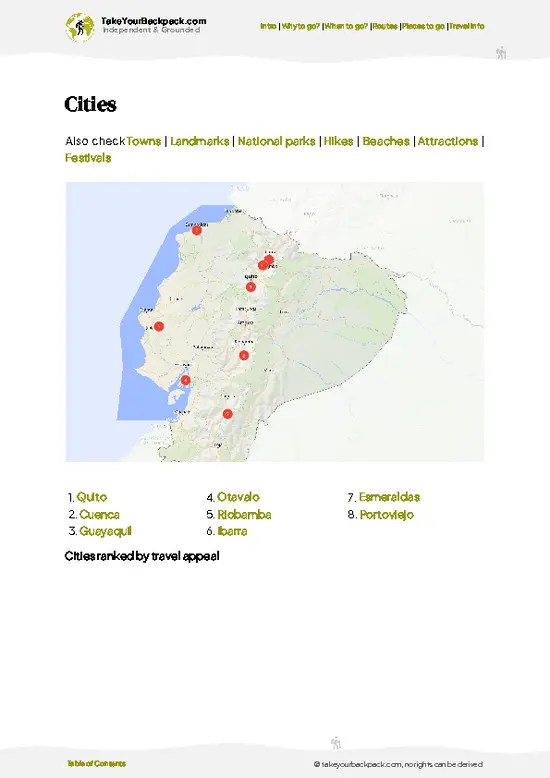
👉 Discover all cities

Or checkout all Ecuador has to offer (think cities, towns, villages, national parks, hikes, beaches, festivals)
Country photo of Ecuador

We 💚 feedbackSumming up the experience

Quito pairs well with a few days of acclimatizing before Cotopaxi, the Quilotoa Loop or the Amazon, and it makes a smart launch pad for the Galápagos. I would spend two nights here at the start, keep the old town for daylight, and use taxis after dark. It is not a beach town, so move on when the urge hits.

✈️ When did I visit Ecuador?
Ecuador I visited during my half year trip through South and Central America back in 2003

✍️ Help improve this page!
The information on this page is based on my own backpacking experience in Ecuador, supplemented with up-to-date research and feedback from other travelers. Travel details can change, so if you notice anything outdated or incomplete, feel free to let me know.


🙋‍♂️ Give feedback

👋 Meet the founderWho’s Behind Take Your Backpack?

Johan, backpacker and founder of TakeYourBackpackHi, I’m Johan (Netherlands 🇳🇱), the creator of TakeYourBackpack. Over the past 3 decades, I’ve backpacked through 90+ countries across six continents, gaining extensive experience with independent travel, long-term trips, and overland routes.

This site is built on a combination of firsthand travel experience and carefully curated insights from other backpackers. Many guides are based on places I’ve personally visited, while others bring together tips, observations, and practical advice shared by trusted travelers I’ve met along the way.

The goal is to provide realistic, experience-driven guidance — not generic itineraries — so you can explore destinations with better context, clearer expectations, and more confidence.