×

Egypt🇪🇬 | best beachesWhere to Find the Best beaches in Egypt

Beaches in Egypt come in two very different versions, and picking the wrong one wastes your trip. The Red Sea coast (Hurghada, Marsa Alam, Dahab, Nuweiba) is where the reef sits a few meters from the sand, so snorkeling is the real draw. The Mediterranean coast (Alexandria, Marsa Matruh, the North Coast) has paler sand and turquoise water, but it is a domestic summer scene, packed in July and August and shuttered in winter.

Resort towns like Hurghada and Sharm el-Sheikh mean private beaches with entry fees, and the free public strip is often thin. Dahab and Nuweiba suit independent travelers: cheap beds, open shoreline, easy reef access. Skip the resort belts if you are on a tight budget, since you pay for lounger access and the sand itself is ordinary.

By Johan Kruseman 🇳🇱 | Updated October 18, 2026
Explore the best attractions in Egypt

Why go?What Makes Them Special

Egypt works for beaches because of one geographic fact: the Red Sea reef system. Fringing coral grows right off the shore along the Sinai and the southern coast, so you can wade in from the sand and be over living reef. Few countries offer that without a boat. The desert climate adds near-constant sunshine and almost no rain, so a beach day is rarely lost to weather.

The flip side is that Egypt is not a place for wild, empty, palm-fringed sand. Most of the coastline is dry desert meeting water, and a great deal of it has been developed into resort frontage since the 1980s and 1990s. Access is often controlled by hotels, which charge day fees or simply block the shoreline. Mediterranean beaches are more public, but they are shaped by Egyptian family holidays, with crowded sand, loud music … read more 👉
Egypt works for beaches because of one geographic fact: the Red Sea reef system. Fringing coral grows right off the shore along the Sinai and the southern coast, so you can wade in from the sand and be over living reef. Few countries offer that without a boat. The desert climate adds near-constant sunshine and almost no rain, so a beach day is rarely lost to weather.

The flip side is that Egypt is not a place for wild, empty, palm-fringed sand. Most of the coastline is dry desert meeting water, and a great deal of it has been developed into resort frontage since the 1980s and 1990s. Access is often controlled by hotels, which charge day fees or simply block the shoreline. Mediterranean beaches are more public, but they are shaped by Egyptian family holidays, with crowded sand, loud music and limited facilities outside the summer season.

Culture matters too. Egypt is a conservative Muslim country, and dress and behavior norms change by location. Resorts and Sinai dive towns are relaxed about swimwear, while public beaches in Alexandria and on the North Coast see many women swim in clothing and most visitors cover up more. Check what is normal at each stop before you pack.

The practical conclusion: choose Egypt if you want snorkeling and diving, reliable warmth and low prices compared with the Mediterranean’s European shores. Skip it if your priority is quiet, untouched sand. Also know that sea conditions, wind and reef protection rules (no touching or standing on coral, and some zones need permits) shape what you can do more than the sand does.
Behind the Scenes of Selection
The list of best beaches in Egypt is created based on beauty, vibe, water quality, activities, and surrounding scenery. If you feel a beach is missing in this list, please let us know.

When to go?When to Plan Your Trip

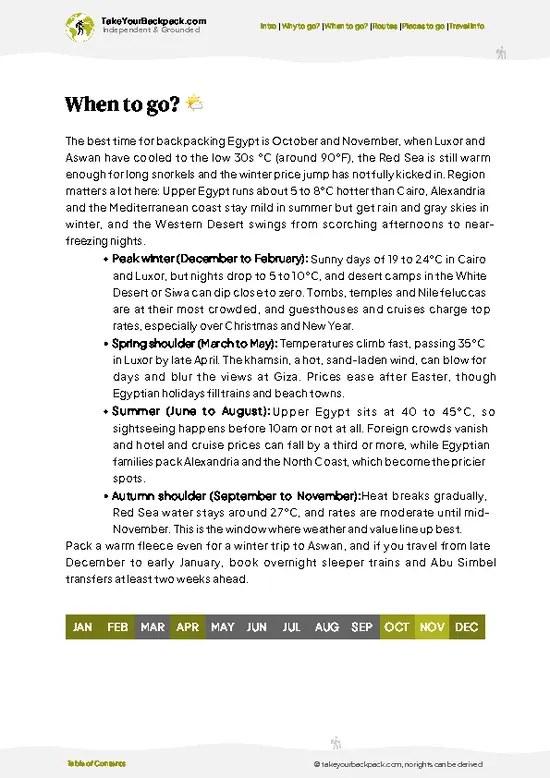
Best months: The best months for Egyptian beaches are March to May and September to November, when Red Sea air temperatures sit around 24 to 33°C and the water is a comfortable 22 to 28°C without the extreme heat of midsummer. Rain is close to nonexistent on the Red Sea, so weather rarely cancels a day.
Summer and winter: June to August is hot: 35 to 42°C on the Red Sea, with sea temperatures near 28 to 30°C. It is fine for snorkeling if you start early and rest at midday, but it is not pleasant for walking around. Hurghada and Sharm el-Sheikh are still busy then, and the wind can be strong in some spots.

December to February is cooler: 18 to 24°C by day and a sea of roughly 21 to 23°C. Swimming is possible, but you will want a wetsuit for longer snorkel sessions, and Dahab can be windy. Winter … read more 👉
Best months: The best months for Egyptian beaches are March to May and September to November, when Red Sea air temperatures sit around 24 to 33°C and the water is a comfortable 22 to 28°C without the extreme heat of midsummer. Rain is close to nonexistent on the Red Sea, so weather rarely cancels a day.
Summer and winter: June to August is hot: 35 to 42°C on the Red Sea, with sea temperatures near 28 to 30°C. It is fine for snorkeling if you start early and rest at midday, but it is not pleasant for walking around. Hurghada and Sharm el-Sheikh are still busy then, and the wind can be strong in some spots.

December to February is cooler: 18 to 24°C by day and a sea of roughly 21 to 23°C. Swimming is possible, but you will want a wetsuit for longer snorkel sessions, and Dahab can be windy. Winter is a poor choice for the Mediterranean coast. Alexandria sees cool, rainy weather (around 14 to 19°C, with most of Egypt’s limited rain falling there) and the North Coast resorts largely close.
Mediterranean season: For Alexandria and the North Coast, the useful window is June to September, when the sea reaches about 25 to 28°C. Peak crowds and highest prices hit in July and August, plus Egyptian holidays, so book ahead or avoid those weeks.
Prices and crowds: Red Sea hotel rates peak at Christmas and New Year and over major holidays, while May, June and October often offer better value. Mid-winter beyond the holiday weeks can be quieter, but you are trading price for cooler water.

beach hoppingOptimizing Your Multi-Stop Itinerary

How many days: A trip combining several Egyptian beaches needs 10 to 14 days, and fewer than 8 turns it into a series of transfers. Distances are the problem: Egypt is large, and the coast is long and thinly connected.
Which regions group well: Two clusters work. The Red Sea and Sinai side groups Hurghada, the southern Red Sea towns near Marsa Alam and the Sinai coast (Dahab, Nuweiba), though crossing between mainland and Sinai takes either a ferry from Hurghada to Sharm el-Sheikh or a long road trip via Cairo or Suez. The Mediterranean cluster (Alexandria, Marsa Matruh and the North Coast) sits to the northwest and links naturally with Cairo. Mixing both coasts is workable only if you build in Cairo as the hub.

A sensible direction is to start in Cairo, run the Mediterranean first only if … read more 👉
How many days: A trip combining several Egyptian beaches needs 10 to 14 days, and fewer than 8 turns it into a series of transfers. Distances are the problem: Egypt is large, and the coast is long and thinly connected.
Which regions group well: Two clusters work. The Red Sea and Sinai side groups Hurghada, the southern Red Sea towns near Marsa Alam and the Sinai coast (Dahab, Nuweiba), though crossing between mainland and Sinai takes either a ferry from Hurghada to Sharm el-Sheikh or a long road trip via Cairo or Suez. The Mediterranean cluster (Alexandria, Marsa Matruh and the North Coast) sits to the northwest and links naturally with Cairo. Mixing both coasts is workable only if you build in Cairo as the hub.

A sensible direction is to start in Cairo, run the Mediterranean first only if it is summer, then move south and east to the Red Sea. In other seasons, skip the Mediterranean entirely and focus on one Red Sea region.
Time per stop and between regions: Allow 3 to 5 nights per Red Sea base, since snorkeling and diving need a day or two to settle in. Alexandria needs just 1 to 2 nights. Expect Cairo to Alexandria at roughly 2.5 to 3 hours by train or road, Cairo to Hurghada about 5 to 6 hours by bus, and Cairo to Dahab around 8 to 9 hours. Hurghada to Marsa Alam is about 4 to 5 hours by road.
Mistakes to avoid: Trying to cover both coasts and the Sinai in a week is the most common mistake. Choose one coast, or one coast plus Cairo. Another is booking overnight buses back to back, which wastes beach days. Plan one long transfer per three to four days instead. Also avoid squeezing a Mediterranean stop into winter, when nothing is open.

The ListMust-Visit beaches in Egypt

1 Cleopatra Beach

historic ruins, tidal pools, Mediterranean setting

Wade through shallow pools near ancient stonework and enjoy a breezy shoreline with a sense of history and local legend.

Loading the map 🌍

Expert viewTips and Advice from Travelers

How many beaches to visit: Plan for two to four beach stops in total. Egypt’s beach time is mostly spent snorkeling or diving, which needs a couple of days to feel worthwhile, and the transfers between regions are long. More than four means you spend more time in buses than in the water.
Which kind for which traveler: Backpackers on a tight budget should prioritize Sinai shoreline towns such as Dahab and Nuweiba, where open reef access, cheap guesthouses and a social scene keep costs low. Divers should choose the Red Sea’s mainland coast for liveaboard and boat-trip access. Those after sand and swimming in summer should go to the Mediterranean, but expect crowds and basic facilities. Resort belts are worth the money only if you want comfort, kids’ amenities or all-inclusive convenience, since … read more 👉
How many beaches to visit: Plan for two to four beach stops in total. Egypt’s beach time is mostly spent snorkeling or diving, which needs a couple of days to feel worthwhile, and the transfers between regions are long. More than four means you spend more time in buses than in the water.
Which kind for which traveler: Backpackers on a tight budget should prioritize Sinai shoreline towns such as Dahab and Nuweiba, where open reef access, cheap guesthouses and a social scene keep costs low. Divers should choose the Red Sea’s mainland coast for liveaboard and boat-trip access. Those after sand and swimming in summer should go to the Mediterranean, but expect crowds and basic facilities. Resort belts are worth the money only if you want comfort, kids’ amenities or all-inclusive convenience, since the sand there is no better than the free options.
Budget: A backpacker can manage on US$25 to 45 a day in Dahab or Nuweiba (EGP 1,200 to 2,200), covering a dorm or basic room, local food and a bit of snorkeling. Hurghada and Sharm el-Sheikh run higher, often US$40 to 70 a day. Public beaches are often free, but beach clubs and resort day passes cost roughly US$5 to 25 (EGP 250 to 1,200) and can include a sun lounger and a meal credit. A snorkel gear rental is about US$3 to 8, and a boat snorkel trip typically costs US$20 to 45. Intro dives cost around US$50 to 80. Taxis between towns add up: confirm the fare before getting in, since there is rarely a meter.
Costs that catch people out: Entry to marine parks (like Ras Mohammed) and some reef zones carries a separate fee, often US$5 to 15 on top of the boat price. Foreigners pay higher rates than Egyptians, and prices are quoted in US dollars or euros at many dive centers, so exchange cash at a bank or ATM rather than relying on tout rates. Settle the full price of any boat trip, including gear and lunch, before boarding. Book snorkel trips directly with licensed operators rather than the first tout on the corniche.
Safety: Sea conditions matter. Strong wind and currents can affect Dahab and parts of the Mediterranean, and some beaches have no lifeguards. Swim where others are in the water and check flags if present. Shark incidents are rare, and operators close beaches when they happen, so follow local guidance. Never stand on or touch coral: it is illegal in protected areas and damages the reef. Wear reef shoes, since sea urchins and sharp rock are common near shore. Use reef-safe sunscreen and a rash guard, because the sun here is intense even in winter.
Cultural considerations: Egypt is conservative, so dress to suit where you are. Resorts and dive towns accept standard swimwear, but public beaches in Alexandria and the North Coast see many locals swimming in clothing. Cover up when walking away from the sand, and ask before photographing people. Women traveling alone can expect unwanted attention at busy public beaches, and choosing a private club or dive-town beach reduces it. During Ramadan, eating and drinking in public are discouraged, and many restaurants close until sunset.

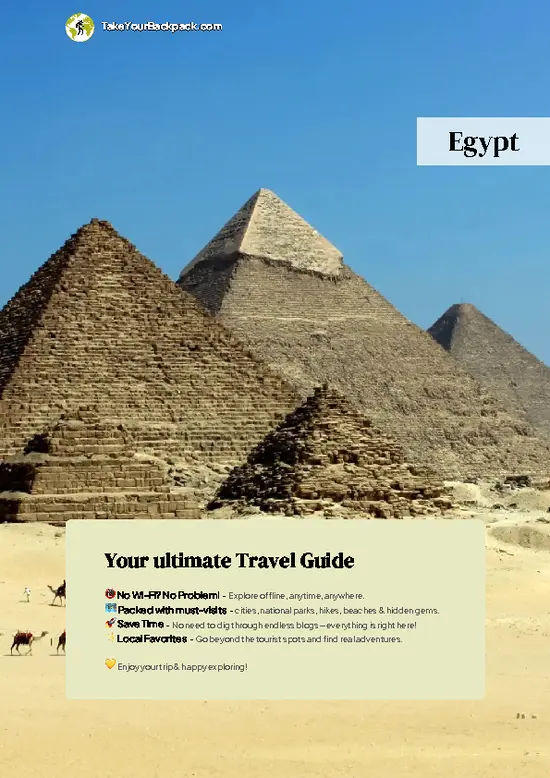
✈️ The backpacker research shortcutEgypt Travel Guide

An offline-friendly backpacking guide with optimized travel routes, ranked highlights, transport advice, and the best areas to stay.
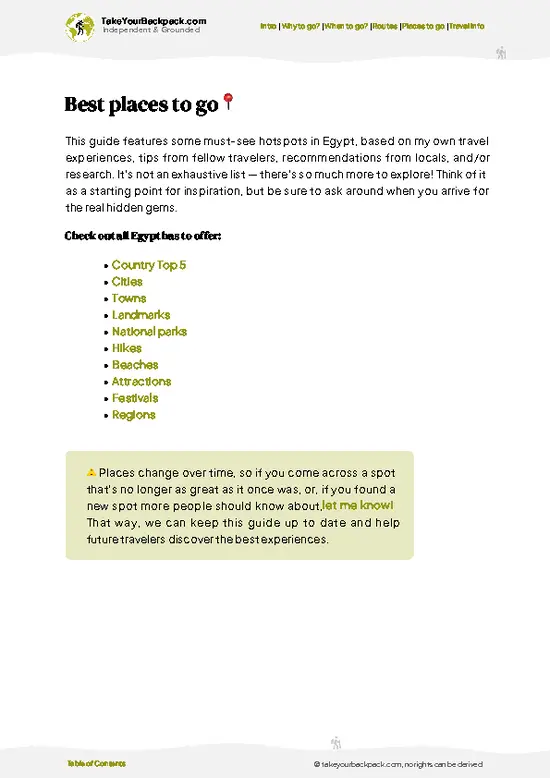
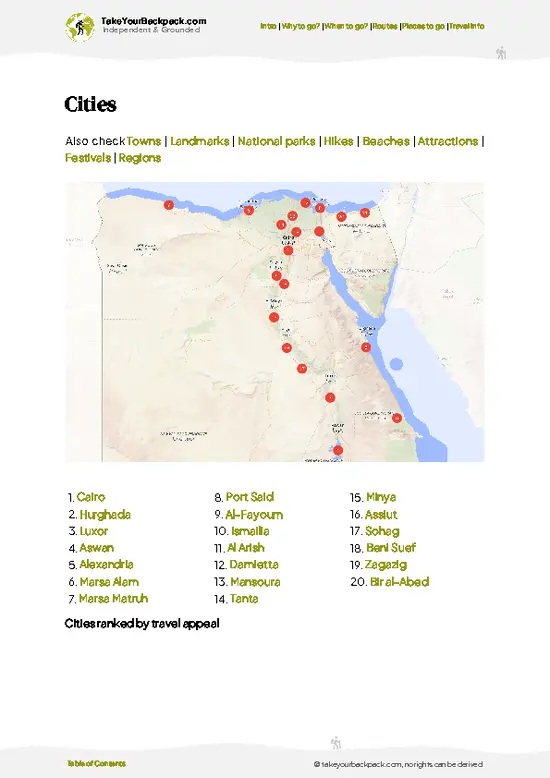
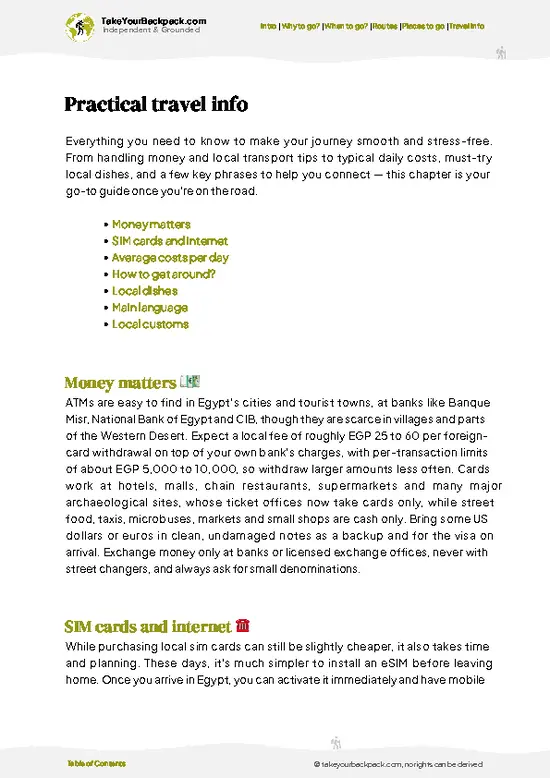
example page 0 from our offline Travel Guide for Egypt
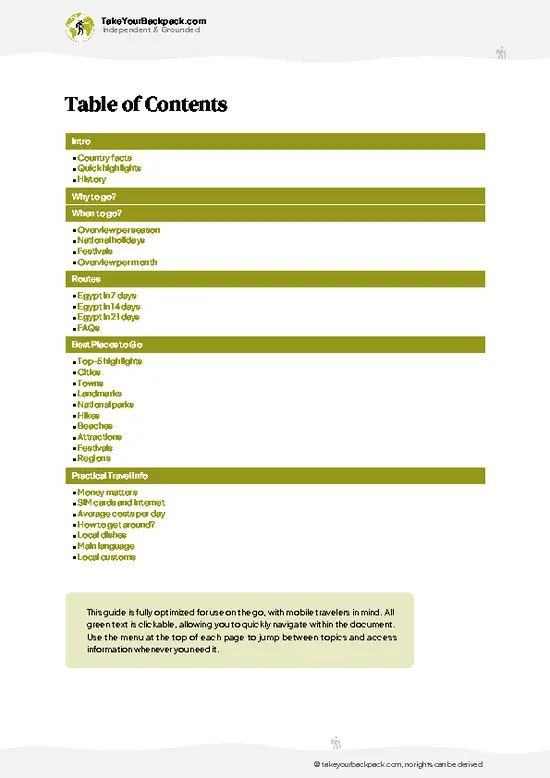
example page 1 from our offline Travel Guide for Egypt
example page 2 from our offline Travel Guide for Egypt
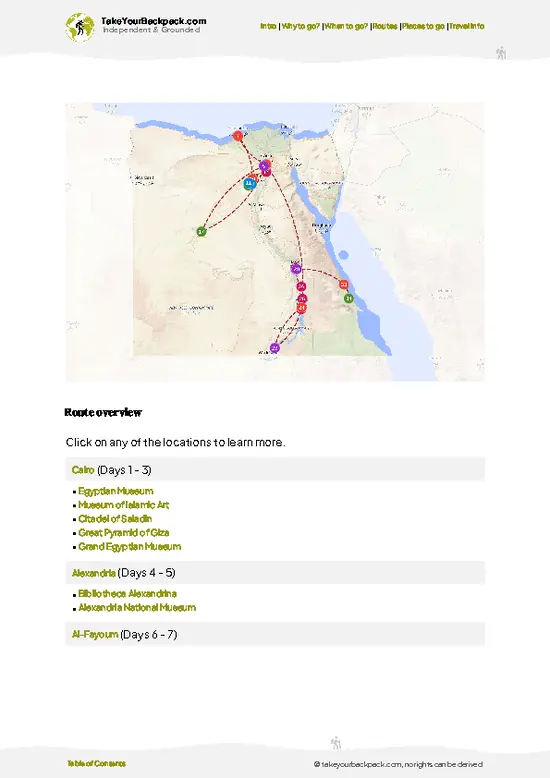
example page 3 from our offline Travel Guide for Egypt
example page 4 from our offline Travel Guide for Egypt
example page 5 from our offline Travel Guide for Egypt
example page 6 from our offline Travel Guide for Egypt
example page 7 from our offline Travel Guide for Egypt
The digital guide (389 pages) contains:
✅ 100 highlights, ranked by travel appeal
✅ Optimized 7, 14 & 21-day travel routes
✅ Cities, national parks, landmarks, beaches
✅ How to get around
✅ Offline-friendly for travel without Wi-Fi
👉 Click to see all 30+ guide features

📅 Plan smarter in minutes, not weeks
✅ Month by month travel advice
✅ Festivals & national holidays
✅ Budget expectations

🗺️ Go to the right places, skip the overrated ones
✅ Honest pros & cons of destinations
✅ Top hikes, parks & viewpoints
✅ Lesser-known places most travelers miss
✅ Clear “worth it vs skip it” guidance

🛏️ Travel smoothly without rookie mistakes
✅ Best areas to stay
✅ Transport systems explained simply
✅ Common scams & safety advice
✅ SIM cards, money & practical tips

🌍 Understand the country, not just visit it
✅ Culture & traditions
✅ 52 Essential phrases & customs
✅ Festivals worth planning around
✅ Traveler-friendly historical context
✅ Insights that make places more meaningful

📱 Built for real travel conditions
✅ Fully downloadable PDF
✅ Works completely offline
✅ Optimized for phone use
✅ Useful in remote areas & buses
✅ Everything in one place
Stop searching, start planning
Get instant access to your full guide. 30‑day money-back guarantee.
+ Add another guide for just

By proceeding you agree to our terms.
Sent to your inbox immediately after payment • 100% Secure Checkout
Best Backpacking Travel Advisor 2025 tourism awardBest Backpacking
Travel Advisor
2025
What others say about Take Your Backpack Guides:
⭐⭐⭐⭐⭐
Fantastic, amazing amount of information!
⭐⭐⭐⭐⭐
My goodness this is amazing, it's what I've been looking for hats off too you!
⭐⭐⭐⭐⭐
I think this is absolutely BRILLIANT
⭐⭐⭐⭐
Very complete and informative. It's still missing places, but I gotta to commend you
⭐⭐⭐⭐⭐
This is truly amazing, thank you, can't wait to explore it with my kids!
⭐⭐⭐⭐⭐
Awesome resource, thank you!
⭐⭐⭐⭐⭐
This is amazing! Can't wait to explore the ones I haven't seen
⭐⭐⭐⭐
I love this! Well done, great idea.
⭐⭐⭐⭐⭐
Thanks for taking the time to make this gem!
⭐⭐⭐⭐⭐
This might be the best website I've ever seen.
⭐⭐⭐⭐⭐
Congratulations, and thank you so much for your work; it's incredibly valuable.
⭐⭐⭐⭐
In all seriousness I think you did a great job pointing out the important spots
⭐⭐⭐⭐⭐
10/10 very good
⭐⭐⭐⭐⭐
As someone who's only just starting to visit regularly this is awesome, thank you.
⭐⭐⭐⭐
Thank you very much! I'm going to visit my dad, it's going to be very useful!
⭐⭐⭐⭐⭐
This is really cool! We'll be travelling for the first time and this definitely come in handy.
⭐⭐⭐⭐⭐
You are now our minister of culture, congratulations 👨‍💼
⭐⭐⭐⭐⭐
Just wanted to tell you that this is a pearl! Going to follow your recommendations.
⭐⭐⭐⭐⭐
This is so cool. I'll definitely be using the resource for my travels soon.
⭐⭐⭐⭐⭐
This is very impressive! Good work.
⭐⭐⭐⭐⭐
This is an amazing and informative site. Very well done!

🛏️ Where to stay?Where to Base Yourself

Egypt has plenty of hostels and budget guesthouses, with dorm beds typically around US$6 to 12 and simple private doubles around US$15 to 30. In Cairo, Downtown holds the biggest cluster of hostels in the upper floors of old apartment blocks, putting you a short walk from Tahrir and the metro, though the traffic noise runs late; Zamalek is leafier and quieter with better bars but costs more, while Giza guesthouses near the pyramids give you sunrise views at the price of a long ride into town. Further south, Luxor’s East Bank is handier for transport and restaurants, its West Bank is calmer and closer to the tombs, Aswan’s Nubian guesthouses across the Nile are peaceful but need a ferry hop, … read more 👉
Egypt has plenty of hostels and budget guesthouses, with dorm beds typically around US$6 to 12 and simple private doubles around US$15 to 30. In Cairo, Downtown holds the biggest cluster of hostels in the upper floors of old apartment blocks, putting you a short walk from Tahrir and the metro, though the traffic noise runs late; Zamalek is leafier and quieter with better bars but costs more, while Giza guesthouses near the pyramids give you sunrise views at the price of a long ride into town. Further south, Luxor’s East Bank is handier for transport and restaurants, its West Bank is calmer and closer to the tombs, Aswan’s Nubian guesthouses across the Nile are peaceful but need a ferry hop, and Dahab’s seafront strip is the cheapest, most social spot on the Red Sea coast.

If you enjoy meeting fellow travelers, consider choosing hostels with high ratings for atmosphere. On the other hand, if you prefer having your own space, a hotel might be a better option.

EgyptExpand Your Journey

👋 Meet the founderWho’s Behind Take Your Backpack?

Johan, backpacker and founder of TakeYourBackpackHi, I’m Johan (Netherlands 🇳🇱), the creator of TakeYourBackpack. Over the past 3 decades, I’ve backpacked through 90+ countries across six continents, gaining extensive experience with independent travel, long-term trips, and overland routes.

This site is built on a combination of firsthand travel experience and carefully curated insights from other backpackers. Many guides are based on places I’ve personally visited, while others bring together tips, observations, and practical advice shared by trusted travelers I’ve met along the way.

The goal is to provide realistic, experience-driven guidance — not generic itineraries — so you can explore destinations with better context, clearer expectations, and more confidence.