×

Eritrea🇪🇷 | best citiesDiscover the 2 Best cities Across Eritrea

Cities in Eritrea are few, compact and low-rise, and they sit in two very different climates. The highland plateau around the capital, at roughly 2,300 meters, is cool, orderly and walkable, with Italian-era architecture and café culture. The Red Sea coast is hot, humid and slower, with coral-stone buildings and a port rhythm. Smaller towns in the western lowlands trade on markets and rail history. Prices are modest but services are thin, and all of it is cash-based. For backpacking or independent travel, the choice comes down to altitude, heat and how far a travel permit will take you.

By Johan Kruseman 🇳🇱 | Updated October 23, 2026
Explore the best towns in Eritrea

Why go?Key Factors That Shape the Experience

Eritrea suits small, walkable cities better than almost anywhere in the region. A century of Italian colonial planning left a grid of modernist and Art Deco buildings in the highlands, and the lack of large-scale redevelopment means much of it survives intact. Geography does the rest. The escarpment drops from the cool plateau to the Red Sea within about 100 kilometers, so urban life changes sharply in a short distance, and the heat on the coast shaped older Ottoman and Egyptian-era architecture.

Before choosing Eritrea for its cities, know the constraints. Visas must be arranged in advance, and a travel permit is required to leave the capital region, so spontaneous detours are not possible. The economy is cash-only for visitors, foreign bank cards do not work, and the official exchange rate … read more 👉
Eritrea suits small, walkable cities better than almost anywhere in the region. A century of Italian colonial planning left a grid of modernist and Art Deco buildings in the highlands, and the lack of large-scale redevelopment means much of it survives intact. Geography does the rest. The escarpment drops from the cool plateau to the Red Sea within about 100 kilometers, so urban life changes sharply in a short distance, and the heat on the coast shaped older Ottoman and Egyptian-era architecture.

Before choosing Eritrea for its cities, know the constraints. Visas must be arranged in advance, and a travel permit is required to leave the capital region, so spontaneous detours are not possible. The economy is cash-only for visitors, foreign bank cards do not work, and the official exchange rate of 15 nakfa to the US dollar differs from street rates. Internet is slow and often limited, and fuel and public transport can be unpredictable.

The upside is a quiet, low-pressure experience. There are few tourists, little hassle and a strong cafe and street culture shaped by coffee, pasta and evening promenades. Expect modest comfort, limited information and a country that rewards planning ahead.
How the List Was Created
The list of best cities in Eritrea is created based on culture, vibe, attractions, transport ease, and local charm. If you feel a city is missing in this list, please let us know.

When to go?Timing Your Visit for the Best Experience

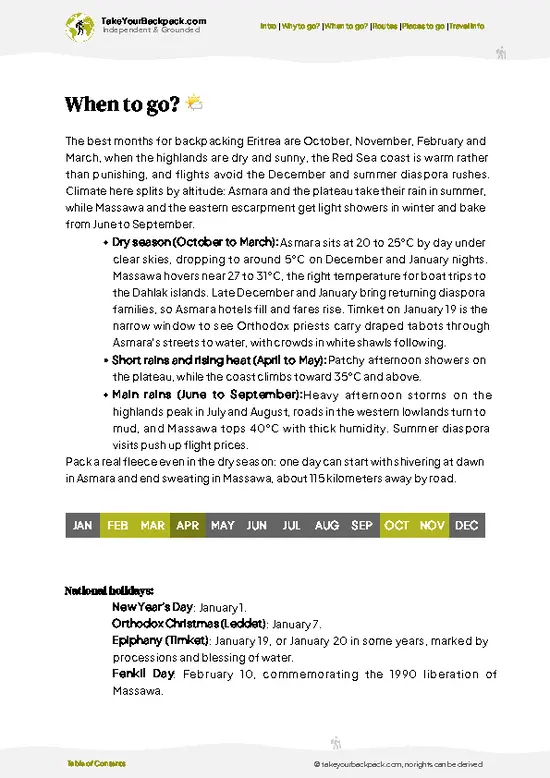
Best months: The best months for Eritrea’s cities are October to March, when the highlands are dry and sunny with daytime highs of 20 to 26°C and the coast is bearable at roughly 25 to 32°C.
Highlands and the coast: In the central highlands, nights between December and February can fall to 3 to 8°C, so a warm layer is needed even though days are bright. The main rains arrive from June to September, peaking in July and August, with afternoon downpours that slow road travel and cloud the mountain views. A lighter rainy spell around March and April is brief and rarely disruptive. October and November are the sweet spot, with green hillsides after the rains and clear air.

The Red Sea coast follows the reverse logic. From May to September, temperatures commonly reach 35 to 45°C with heavy humidity, … read more 👉
Best months: The best months for Eritrea’s cities are October to March, when the highlands are dry and sunny with daytime highs of 20 to 26°C and the coast is bearable at roughly 25 to 32°C.
Highlands and the coast: In the central highlands, nights between December and February can fall to 3 to 8°C, so a warm layer is needed even though days are bright. The main rains arrive from June to September, peaking in July and August, with afternoon downpours that slow road travel and cloud the mountain views. A lighter rainy spell around March and April is brief and rarely disruptive. October and November are the sweet spot, with green hillsides after the rains and clear air.

The Red Sea coast follows the reverse logic. From May to September, temperatures commonly reach 35 to 45°C with heavy humidity, and sightseeing is limited to early morning and evening. Winter is the only comfortable season there, and rain is scarce all year, usually a few showers between November and February.
Peak periods and closures: Prices and crowds change little with the seasons because visitor numbers are low. The exception is July and August, when the diaspora returns for summer events and the annual festival in the capital, and hotels fill. Religious holidays such as Timket in January and Meskel in late September bring processions and some closures. During Ramadan, daytime dining in Muslim-majority lowland towns is limited.

city hoppingOptimizing Your Multi-Stop Itinerary

How many days: A trip linking several Eritrean cities needs 7 to 10 days, because permits, road speeds and limited transport slow everything down.
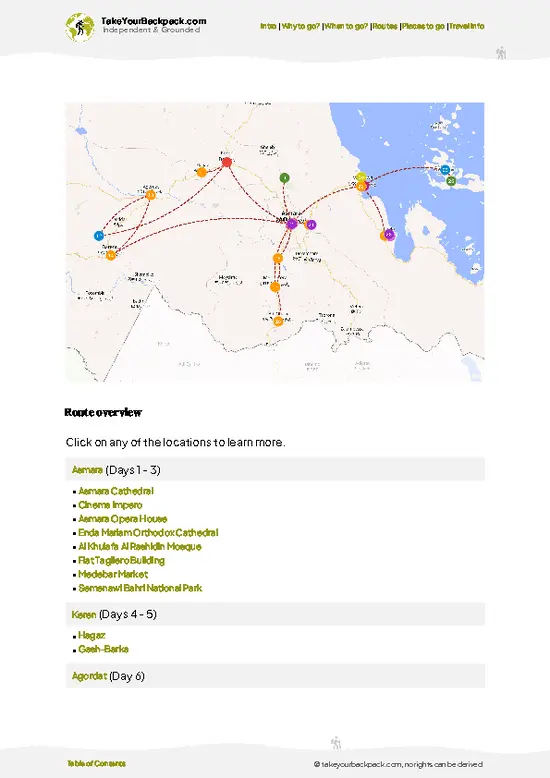
Grouping and direction: Everything radiates from the capital, which is the sensible start and end point because the airport, permit office and most hotels are there. Group the southern highland towns together as short day or overnight trips, since they lie 40 to 100 kilometers away and take 1 to 2.5 hours by bus or hired car. The western lowlands and the Red Sea coast each need a separate leg. The road to the coast takes about 3 to 4 hours for roughly 115 kilometers, descending in long switchbacks, and the western run takes about 2 to 3 hours. A loop works best if you go west and south first while rested, then finish on the coast, where the heat … read more 👉
How many days: A trip linking several Eritrean cities needs 7 to 10 days, because permits, road speeds and limited transport slow everything down.
Grouping and direction: Everything radiates from the capital, which is the sensible start and end point because the airport, permit office and most hotels are there. Group the southern highland towns together as short day or overnight trips, since they lie 40 to 100 kilometers away and take 1 to 2.5 hours by bus or hired car. The western lowlands and the Red Sea coast each need a separate leg. The road to the coast takes about 3 to 4 hours for roughly 115 kilometers, descending in long switchbacks, and the western run takes about 2 to 3 hours. A loop works best if you go west and south first while rested, then finish on the coast, where the heat suits a slower pace.
Time per stop and planning errors: Allow 3 to 4 days in the capital and 1 to 2 nights at each other stop. Common mistakes include applying for permits too late or listing too few destinations, which forces a change of plans, and booking tight connections. Buses are infrequent and often full, so book a day ahead, carry spare cash and build in a buffer day. Use the capital as a base for short excursions instead of repacking every night.

The ListHighly Recommended cities of Eritrea

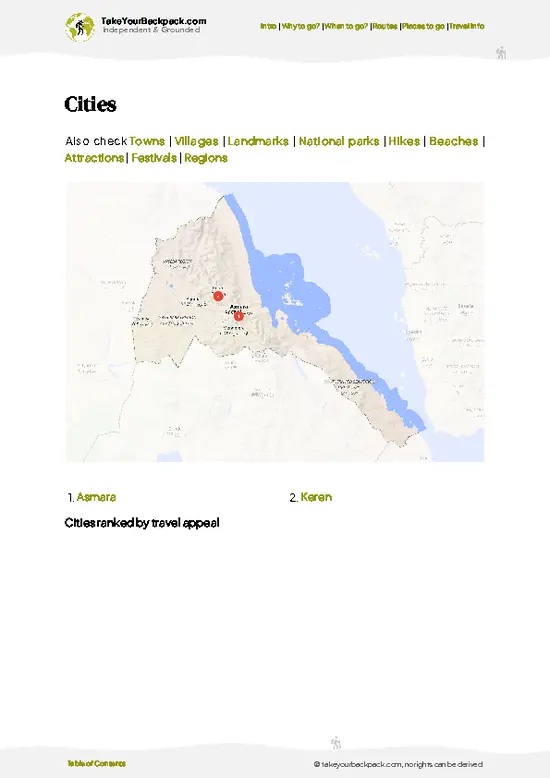
1 Asmara

Modernist avenues, Fiat Tagliero wings, Italian-era cafés, Medebar metalwork

Walk Harnet Avenue past Art Deco cinemas and cantilevered concrete, then drop into Medebar market where metalworkers hammer scrap into stoves and buckets.

2 Keren

Monday camel market, baobab shrine, mixed souk, war cemetery

Arrive early for herders trading camels and goats, then visit a hollow baobab holding a Mary shrine and the quiet rows of the 1941 battle graves.

Loading the map 🌍

Expert viewPro Tips for Exploring the Best

How many cities: Plan on three or four cities in total, including the capital. Permits specify destinations, roads are slow and public transport runs on fixed schedules, so anything beyond four turns the trip into a transit exercise. Three gives you time to sit in cafes and walk without watching the clock.
Which kind to prioritize: If you like architecture, cafe life and easy walking, the highland capital is the priority and deserves the most time. If you want heat, ports, Ottoman and Egyptian-era stonework and sea air, add one coastal city in winter only. If you prefer markets, rural life and a sense of everyday commerce, choose one western or southern market town, ideally timed for market day. Spending a full day in each type is better than adding more of the same.
What it costs: Expect US$40 … read more 👉
How many cities: Plan on three or four cities in total, including the capital. Permits specify destinations, roads are slow and public transport runs on fixed schedules, so anything beyond four turns the trip into a transit exercise. Three gives you time to sit in cafes and walk without watching the clock.
Which kind to prioritize: If you like architecture, cafe life and easy walking, the highland capital is the priority and deserves the most time. If you want heat, ports, Ottoman and Egyptian-era stonework and sea air, add one coastal city in winter only. If you prefer markets, rural life and a sense of everyday commerce, choose one western or southern market town, ideally timed for market day. Spending a full day in each type is better than adding more of the same.
What it costs: Expect US$40 to 80 a day for a comfortable independent trip, or US$30 to 45 on a tight one. Guesthouses and simple hotels run about US$20 to 60 a night, and standard hotels in the capital cost US$60 to 100. Meals at local restaurants cost US$3 to 8, and coffee is under US$1. Intercity buses cost US$2 to 8 for each leg, and a private car with driver runs about US$80 to 150 a day depending on distance. Travel permits cost a small administrative fee, and a local guide, which is optional, costs about US$30 to 60 a day. Museum and site entry fees are usually a few dollars each. Budget about US$300 to 600 for a week, excluding visa and flights.
Money and practicalities: Bring cash in euros or US dollars in clean, recent notes, because foreign cards and ATMs do not work. Exchange officially at banks or the hotel, and avoid street changers, since unofficial trades are illegal. Mobile data is limited and slow, so download maps and keep printed copies of your visa and permits.
Safety and conduct: Street crime is very low, and walking at night in the cities is generally calm. The main risks are administrative. Carry your passport and permit and expect checkpoints on roads between regions. Do not photograph military sites, government buildings, police, or airports and ports, and ask before photographing people. Do not leave the permitted route, and stay away from border zones, which are restricted and sensitive. Keep political discussion measured and let locals raise it first.
Cultural considerations: The country is split roughly between Christian and Muslim communities, and dress should be modest, with covered shoulders and knees, especially in the lowlands. Coffee ceremonies are common, and declining the first cup is considered impolite. Accept at least one, and expect to stay for three rounds. Friday and Sunday shape opening hours, and many shops close in the early afternoon. Public holidays can close banks, so change money in advance.

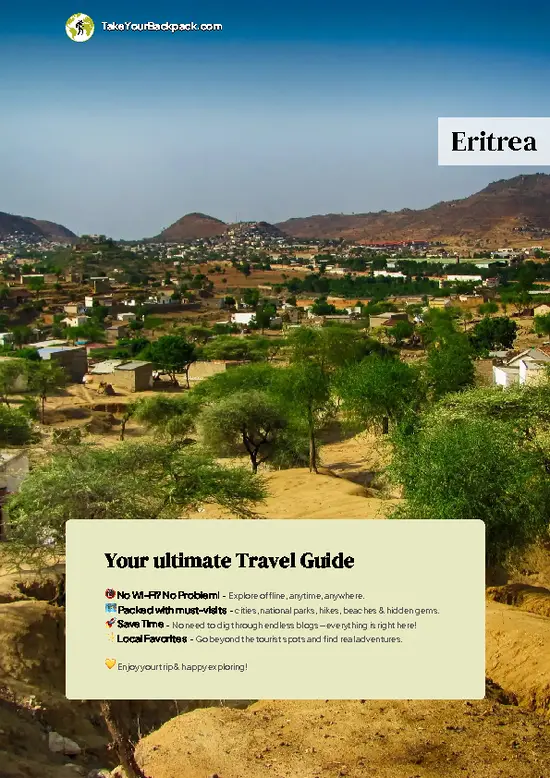
✈️ The backpacker research shortcutEritrea Travel Guide

An offline-friendly backpacking guide with optimized travel routes, ranked highlights, transport advice, and the best areas to stay.
example page 0 from our offline Travel Guide for Eritrea
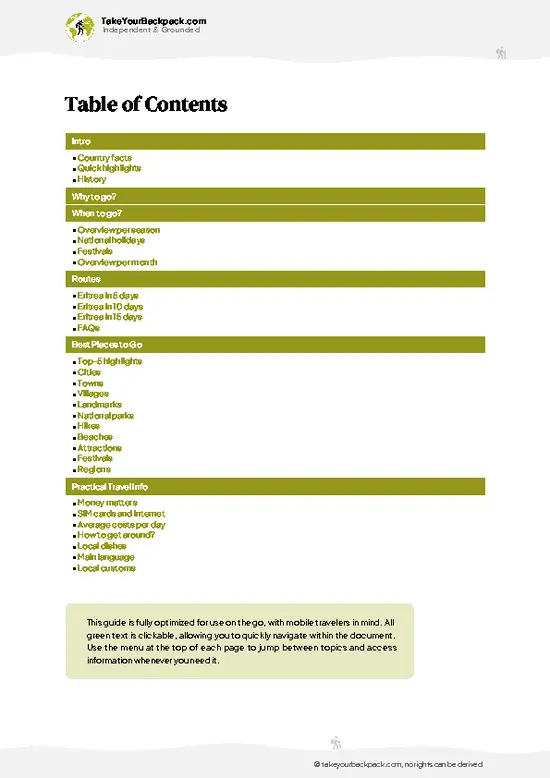
example page 1 from our offline Travel Guide for Eritrea
example page 2 from our offline Travel Guide for Eritrea
example page 3 from our offline Travel Guide for Eritrea
example page 4 from our offline Travel Guide for Eritrea
example page 5 from our offline Travel Guide for Eritrea
example page 6 from our offline Travel Guide for Eritrea
example page 7 from our offline Travel Guide for Eritrea
The digital guide (245 pages) contains:
✅ 56 highlights, ranked by travel appeal
✅ Optimized 5, 10 & 15-day travel routes
✅ Cities, national parks, landmarks, beaches
✅ How to get around
✅ Offline-friendly for travel without Wi-Fi
👉 Click to see all 30+ guide features

📅 Plan smarter in minutes, not weeks
✅ Month by month travel advice
✅ Festivals & national holidays
✅ Budget expectations

🗺️ Go to the right places, skip the overrated ones
✅ Honest pros & cons of destinations
✅ Top hikes, parks & viewpoints
✅ Lesser-known places most travelers miss
✅ Clear “worth it vs skip it” guidance

🛏️ Travel smoothly without rookie mistakes
✅ Best areas to stay
✅ Transport systems explained simply
✅ Common scams & safety advice
✅ SIM cards, money & practical tips

🌍 Understand the country, not just visit it
✅ Culture & traditions
✅ 52 Essential phrases & customs
✅ Festivals worth planning around
✅ Traveler-friendly historical context
✅ Insights that make places more meaningful

📱 Built for real travel conditions
✅ Fully downloadable PDF
✅ Works completely offline
✅ Optimized for phone use
✅ Useful in remote areas & buses
✅ Everything in one place
Stop searching, start planning
Get instant access to your full guide. 30‑day money-back guarantee.
+ Add another guide for just

By proceeding you agree to our terms.
Sent to your inbox immediately after payment • 100% Secure Checkout
Best Backpacking Travel Advisor 2025 tourism awardBest Backpacking
Travel Advisor
2025
What others say about Take Your Backpack Guides:
⭐⭐⭐⭐⭐
Fantastic, amazing amount of information!
⭐⭐⭐⭐⭐
My goodness this is amazing, it's what I've been looking for hats off too you!
⭐⭐⭐⭐⭐
I think this is absolutely BRILLIANT
⭐⭐⭐⭐
Very complete and informative. It's still missing places, but I gotta to commend you
⭐⭐⭐⭐⭐
This is truly amazing, thank you, can't wait to explore it with my kids!
⭐⭐⭐⭐⭐
Awesome resource, thank you!
⭐⭐⭐⭐⭐
This is amazing! Can't wait to explore the ones I haven't seen
⭐⭐⭐⭐
I love this! Well done, great idea.
⭐⭐⭐⭐⭐
Thanks for taking the time to make this gem!
⭐⭐⭐⭐⭐
This might be the best website I've ever seen.
⭐⭐⭐⭐⭐
Congratulations, and thank you so much for your work; it's incredibly valuable.
⭐⭐⭐⭐
In all seriousness I think you did a great job pointing out the important spots
⭐⭐⭐⭐⭐
10/10 very good
⭐⭐⭐⭐⭐
As someone who's only just starting to visit regularly this is awesome, thank you.
⭐⭐⭐⭐
Thank you very much! I'm going to visit my dad, it's going to be very useful!
⭐⭐⭐⭐⭐
This is really cool! We'll be travelling for the first time and this definitely come in handy.
⭐⭐⭐⭐⭐
You are now our minister of culture, congratulations 👨‍💼
⭐⭐⭐⭐⭐
Just wanted to tell you that this is a pearl! Going to follow your recommendations.
⭐⭐⭐⭐⭐
This is so cool. I'll definitely be using the resource for my travels soon.
⭐⭐⭐⭐⭐
This is very impressive! Good work.
⭐⭐⭐⭐⭐
This is an amazing and informative site. Very well done!

🛏️ Where to stay?Where to Stay: Eritrea Edition

Eritrea has no real backpacker hostel scene, so budget travelers sleep in simple family-run pensions and small hotels, typically 300 to 750 nakfa (US$20 to 50) for a private room with a bathroom. In Asmara, the blocks around Harnet Avenue in the city center hold the most options and put you within walking distance of the cafés, the cathedral and the evening passeggiata, though rooms facing the avenue can be noisy, while leafy Gejeret is quieter and residential but a 15 to 25 minute walk from the action. On the coast in Massawa, the old town on Massawa Island has the atmosphere and the cheapest rooms but basic facilities, whereas Taulud offers more reliable air conditioning and calmer streets … read more 👉
Eritrea has no real backpacker hostel scene, so budget travelers sleep in simple family-run pensions and small hotels, typically 300 to 750 nakfa (US$20 to 50) for a private room with a bathroom. In Asmara, the blocks around Harnet Avenue in the city center hold the most options and put you within walking distance of the cafés, the cathedral and the evening passeggiata, though rooms facing the avenue can be noisy, while leafy Gejeret is quieter and residential but a 15 to 25 minute walk from the action. On the coast in Massawa, the old town on Massawa Island has the atmosphere and the cheapest rooms but basic facilities, whereas Taulud offers more reliable air conditioning and calmer streets a short causeway walk away.

If you enjoy meeting fellow travelers, consider choosing hostels with high ratings for atmosphere. On the other hand, if you prefer having your own space, a hotel might be a better option.

EritreaExplore Beyond This Category

👋 Meet the founderWho’s Behind Take Your Backpack?

Johan, backpacker and founder of TakeYourBackpackHi, I’m Johan (Netherlands 🇳🇱), the creator of TakeYourBackpack. Over the past 3 decades, I’ve backpacked through 90+ countries across six continents, gaining extensive experience with independent travel, long-term trips, and overland routes.

This site is built on a combination of firsthand travel experience and carefully curated insights from other backpackers. Many guides are based on places I’ve personally visited, while others bring together tips, observations, and practical advice shared by trusted travelers I’ve met along the way.

The goal is to provide realistic, experience-driven guidance — not generic itineraries — so you can explore destinations with better context, clearer expectations, and more confidence.