×

Eritrea🇪🇷 | best festivalsDiscover the 5 Best festivals Across Eritrea

Festivals in Eritrea are mostly religious and national observances rather than ticketed events. Orthodox Christian feasts, Muslim holidays and independence commemorations fill the calendar, with one large cultural fair in Asmara aimed partly at the diaspora. The highlands around Asmara and Keren offer the easiest access, the most organized crowds and the mildest weather. The coast and lowlands are hotter, quieter and harder to reach. Costs stay modest, but cash is king and lodging is limited. For backpacking or independent travel, plan around one region at a time and expect to be one of very few foreign faces.

By Johan Kruseman 🇳🇱 | Updated October 23, 2026
Explore the best regions in Eritrea

Why go?Key Factors That Shape the Experience

Eritrea suits festivals that are lived rather than staged. Christian and Muslim communities have shared the highlands, Keren and the Red Sea coast for centuries, and the calendar reflects both. Orthodox feasts follow the Ethiopian-style Julian calendar, which is seven to eight years behind the Gregorian one and has thirteen months. Islamic holidays move about eleven days earlier each year. Add the national days that grew out of the long independence struggle, and the result is a country where public gatherings carry real weight and are rarely built for visitors.

There is almost no tourist infrastructure around them. No ticketing, no programs in English, and few signs. That is the appeal for some travelers and the obstacle for others. Asmara is compact, walkable at 2,325 meters and has the … read more 👉
Eritrea suits festivals that are lived rather than staged. Christian and Muslim communities have shared the highlands, Keren and the Red Sea coast for centuries, and the calendar reflects both. Orthodox feasts follow the Ethiopian-style Julian calendar, which is seven to eight years behind the Gregorian one and has thirteen months. Islamic holidays move about eleven days earlier each year. Add the national days that grew out of the long independence struggle, and the result is a country where public gatherings carry real weight and are rarely built for visitors.

There is almost no tourist infrastructure around them. No ticketing, no programs in English, and few signs. That is the appeal for some travelers and the obstacle for others. Asmara is compact, walkable at 2,325 meters and has the best choice of hotels. Outside it, accommodation fills fast during major dates, and buses are crowded or reduced.

Before choosing Eritrea for its festivals, know that a tourist visa is required and should be arranged well ahead. Travel outside Asmara has long needed official permission, so rules should be confirmed before committing to dates. Foreign cards generally do not work, so bring clean US dollars or euros and change at official outlets, where the rate is about 15 nakfa to US$1. Photography near government buildings, soldiers and some religious ceremonies requires care and often permission.
Behind the Scenes of Selection
The list of best festivals in Eritrea is created based on energy, traditions, crowd experience, activities, and overall excitement. If you feel a festival is missing in this list, please let us know.

When to go?Timing Your Visit for the Best Experience

Best months for festivals: The best months are September to February, when the highland rains have ended, skies are clear and days in Asmara sit around 20 to 25°C. The main summer rains run from roughly June to September, so Asmara can see heavy afternoon downpours in July and August, and some roads become slow.

Shoulder seasons and regional differences: March to May is dry and warm in the highlands, with highs of 25 to 28°C, but it is the hot season elsewhere. Nights in Asmara from December to January drop to about 5 to 8°C, so pack a warm layer. In Keren and the western lowlands expect 30 to 38°C in the warmer months. On the Red Sea coast around Massawa, summer heat reaches 35 to 45°C with high humidity, while November to March brings a tolerable 25 to 32°C. Anything on the coast between … read more 👉
Best months for festivals: The best months are September to February, when the highland rains have ended, skies are clear and days in Asmara sit around 20 to 25°C. The main summer rains run from roughly June to September, so Asmara can see heavy afternoon downpours in July and August, and some roads become slow.

Shoulder seasons and regional differences: March to May is dry and warm in the highlands, with highs of 25 to 28°C, but it is the hot season elsewhere. Nights in Asmara from December to January drop to about 5 to 8°C, so pack a warm layer. In Keren and the western lowlands expect 30 to 38°C in the warmer months. On the Red Sea coast around Massawa, summer heat reaches 35 to 45°C with high humidity, while November to March brings a tolerable 25 to 32°C. Anything on the coast between June and September is demanding.

Peaks and prices: Orthodox Christian feasts cluster in September and January, and several national days fall in May and June. Around these dates, Asmara hotels fill and rooms in smaller towns can disappear, so book a week or more ahead. Prices do not change in a formal season, but budget hotels in Asmara run about US$25 to 60, and rooms that are free outside a holiday may carry a premium or be taken. Islamic holidays shift each year, so check the current calendar before fixing dates.

festival hoppingOptimizing Your Multi-Stop Itinerary

How long to allow: A trip that links several festivals in Eritrea needs 7 to 12 days, because internal travel is slow and local transport is limited to set schedules and morning departures.

Which regions group well: Asmara is the natural hub and the best place to start, since it sits at 2,325 meters and gives time to adjust to the altitude and sort out paperwork. From there the clusters are the central highlands (Dekemhare, Mendefera, Senafe, one to three hours by road), Keren to the northwest (about 90 km, roughly 2 hours by bus or shared taxi) and Massawa on the coast (about 115 km, 2.5 to 3 hours on the descent). A sensible direction is highlands first, then Keren, with the coast last, so the heat comes after the trip has settled. Allow 2 to 4 days in Asmara, 1 to 2 in Keren, and 1 to … read more 👉
How long to allow: A trip that links several festivals in Eritrea needs 7 to 12 days, because internal travel is slow and local transport is limited to set schedules and morning departures.

Which regions group well: Asmara is the natural hub and the best place to start, since it sits at 2,325 meters and gives time to adjust to the altitude and sort out paperwork. From there the clusters are the central highlands (Dekemhare, Mendefera, Senafe, one to three hours by road), Keren to the northwest (about 90 km, roughly 2 hours by bus or shared taxi) and Massawa on the coast (about 115 km, 2.5 to 3 hours on the descent). A sensible direction is highlands first, then Keren, with the coast last, so the heat comes after the trip has settled. Allow 2 to 4 days in Asmara, 1 to 2 in Keren, and 1 to 3 in Massawa and the surrounding area.

Planning mistakes: The most common one is stacking two festival towns on consecutive days. Transport is scarce on holidays, and road checkpoints add delay. Leave a buffer day between stops. Another is fixing Islamic dates in advance, since they move by about eleven days each year, so book flexible lodging. A third is assuming same-day onward travel is possible after a late finish. Buses run mostly in the morning, so plan to arrive the evening before. Confirm travel permissions for each region before leaving Asmara.

The ListHighly Recommended festivals of Eritrea

1 Independence Day

24 May, Harnet Avenue, Expo fairground, regional dance

Walk Asmara’s palm-lined boulevard by day, lay quiet respects at the Martyrs’ Cemetery, and reach the Expo grounds after dark for stage music.

2 Fenkil Day

Massawa parade, 10 February, coral-stone lanes, Red Sea seafood

Watch veterans and schoolchildren march through the port that fell in 1990, then cross the causeways to Taulud for grilled fish.

3 Eritrean Orthodox Christmas

Genna, Ge’ez chanting, white netsela, doro wat

Join the quiet pre-dawn walk to church, watch worshippers in white fill the courtyard, then accept a neighbor’s invitation to a spiced chicken stew.

4 Eritrean National Book Fair

Tigrinya and Arabic titles, author readings, children’s corner, coffee stalls

Browse publishers’ halls at the Expo grounds, catch poets and writers on stage, and sit through a slow coffee round between book tables.

5 Sawa Festival

Sawa training center, youth marches, folk troupes, Gash-Barka heat

Observe a formal state celebration in the western lowlands, where student columns, nine ethnic dance styles and krar-led songs fill an acacia-ringed ground.

Loading the map 🌍

Expert viewPro Tips for Exploring the Best

How many festivals to attend: Two is the number I would advise, three at most. Internal travel is slow, permits and lodging need advance planning, and a festival day often absorbs the whole day with long gatherings, early starts and limited transport home. Two lets you see the contrast between a highland occasion and one in another region without spending the trip in transit.

Which kind to prioritize: For first-time visitors and anyone who prefers comfort, choose the events in Asmara, where hotels, restaurants and the best transport connections are close. For travelers who want a quieter, more local experience, a religious feast in a smaller highland town or in Keren gives more contact with families and pilgrims, but you give up hotel choice and English. Anyone interested in history or national … read more 👉
How many festivals to attend: Two is the number I would advise, three at most. Internal travel is slow, permits and lodging need advance planning, and a festival day often absorbs the whole day with long gatherings, early starts and limited transport home. Two lets you see the contrast between a highland occasion and one in another region without spending the trip in transit.

Which kind to prioritize: For first-time visitors and anyone who prefers comfort, choose the events in Asmara, where hotels, restaurants and the best transport connections are close. For travelers who want a quieter, more local experience, a religious feast in a smaller highland town or in Keren gives more contact with families and pilgrims, but you give up hotel choice and English. Anyone interested in history or national identity should add a national commemoration, which has a more formal tone. The coast is best kept for winter and for those comfortable with heat.

What it costs: Plan on US$40 to 70 a day for a mid-budget independent trip, including a hotel at US$25 to 50, meals at US$5 to 12 and local transport. Shared taxis and buses between towns cost roughly US$2 to 8 a journey. Festivals themselves generally charge no entry. Budget US$30 to 60 a day for a driver or guide if one is needed for access or permits. A single festival visit, with transport and a modest meal, usually runs US$10 to 25 on top of lodging. Carry cash in small, clean US dollar or euro notes and change money through official outlets, because cards and most ATMs do not work for foreigners.

Safety and cultural considerations: Eritrea has low street crime, and large gatherings are orderly. The main risks are administrative. Carry your passport and any travel permit, expect checkpoints, and do not photograph soldiers, military sites or government buildings. Ask before photographing people during worship, and never photograph during communion, prayer or processions without clear permission.

Dress modestly. Cover shoulders and knees, and women should carry a scarf for churches and mosques. Remove shoes where others do. Fasting periods affect food availability, and Orthodox fasting days mean meat is often not served in homes or restaurants. During Ramadan, avoid eating or drinking openly in Muslim areas during daylight. Accept offered coffee, which is part of hospitality and is usually served in three rounds.

Check current border and regional advisories before booking, especially for areas near the Ethiopian and Djibouti frontiers. Stay with the main roads, avoid travel after dark, and keep a printed copy of your permit and itinerary.

✈️ The backpacker research shortcutEritrea Travel Guide

An offline-friendly backpacking guide with optimized travel routes, ranked highlights, transport advice, and the best areas to stay.
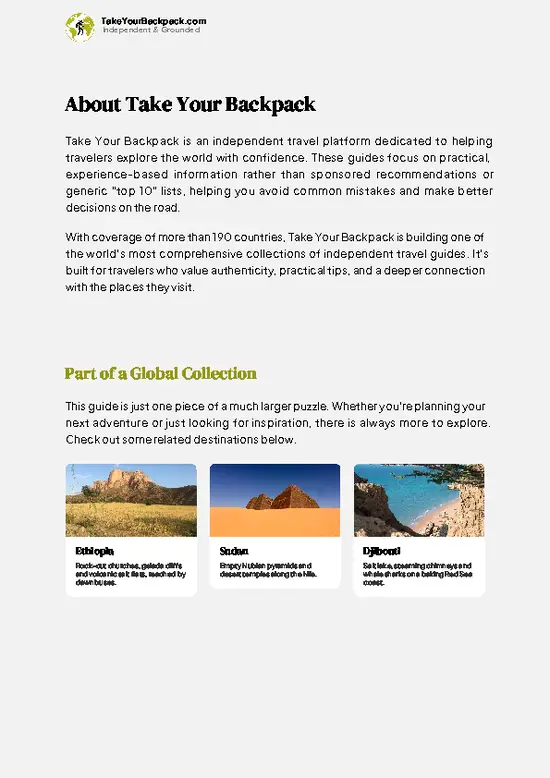
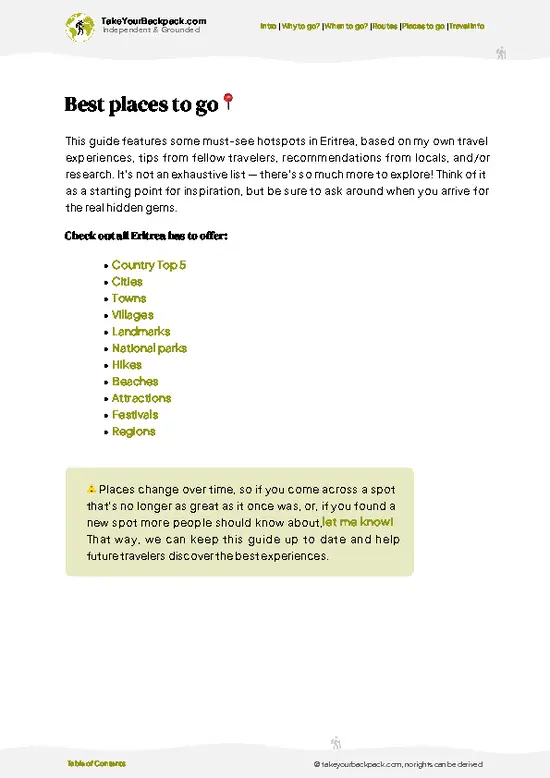
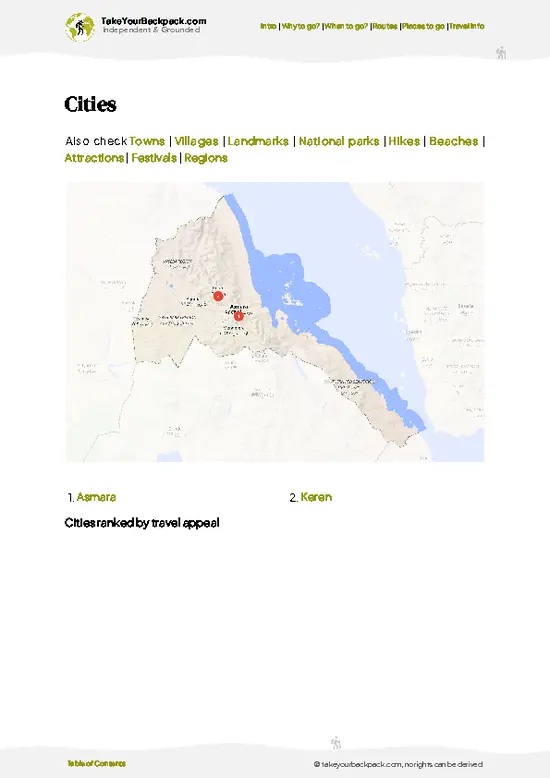
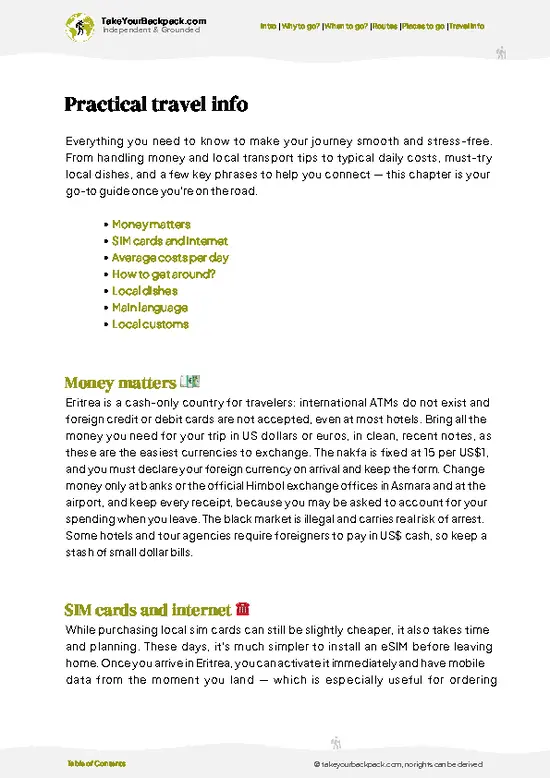
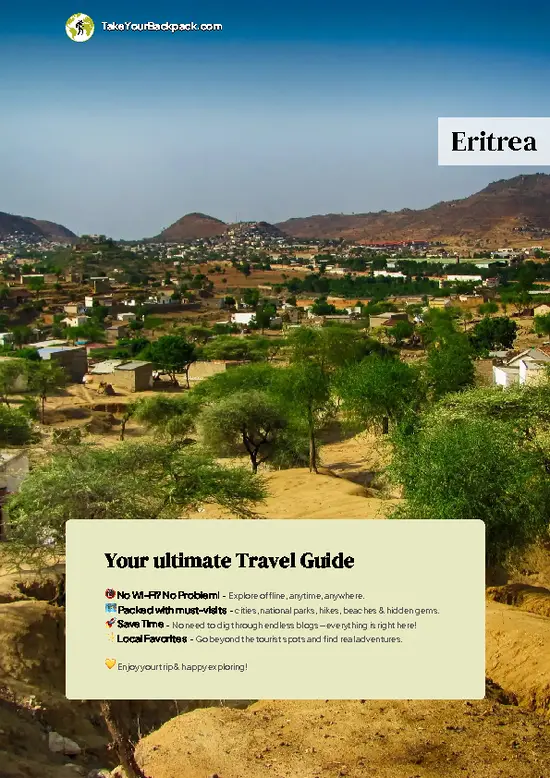
example page 0 from our offline Travel Guide for Eritrea
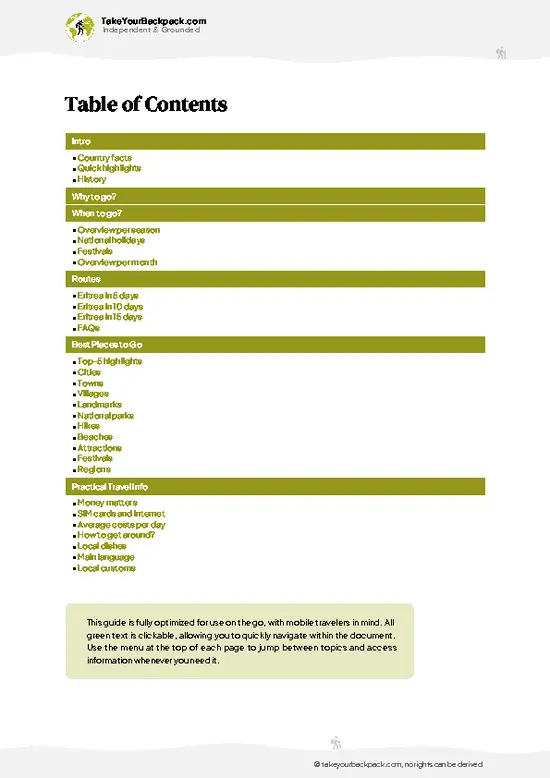
example page 1 from our offline Travel Guide for Eritrea
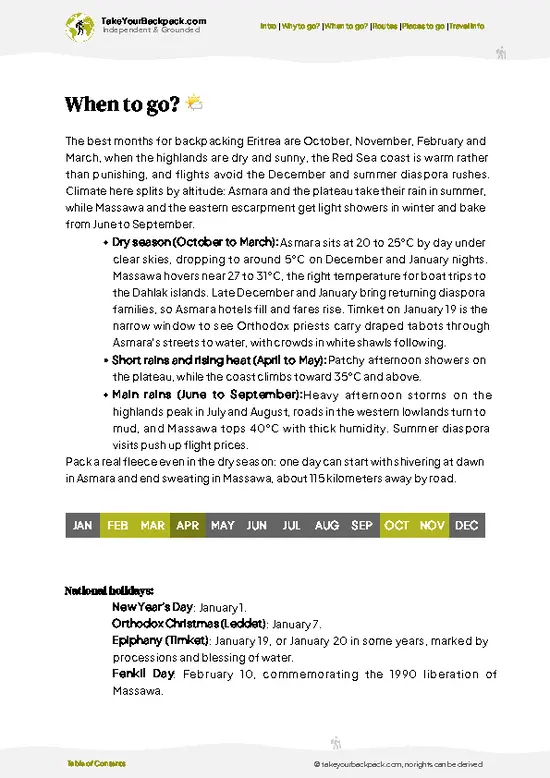
example page 2 from our offline Travel Guide for Eritrea
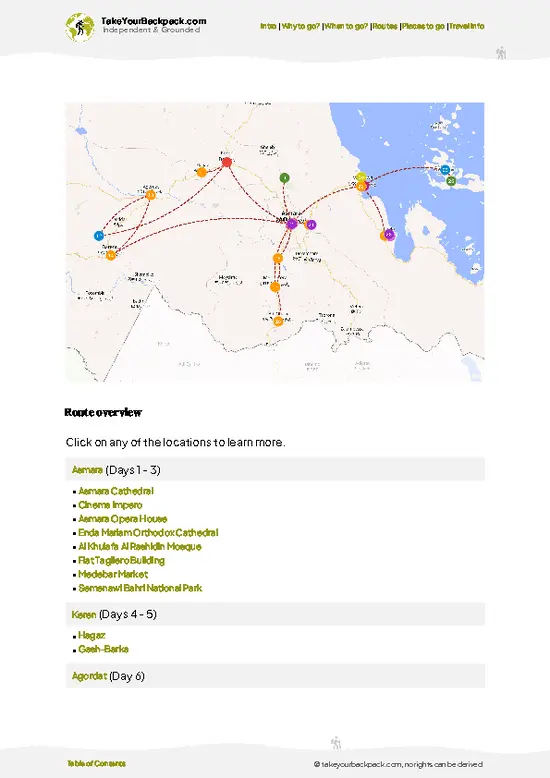
example page 3 from our offline Travel Guide for Eritrea
example page 4 from our offline Travel Guide for Eritrea
example page 5 from our offline Travel Guide for Eritrea
example page 6 from our offline Travel Guide for Eritrea
example page 7 from our offline Travel Guide for Eritrea
The digital guide (245 pages) contains:
✅ 56 highlights, ranked by travel appeal
✅ Optimized 5, 10 & 15-day travel routes
✅ Cities, national parks, landmarks, beaches
✅ How to get around
✅ Offline-friendly for travel without Wi-Fi
👉 Click to see all 30+ guide features

📅 Plan smarter in minutes, not weeks
✅ Month by month travel advice
✅ Festivals & national holidays
✅ Budget expectations

🗺️ Go to the right places, skip the overrated ones
✅ Honest pros & cons of destinations
✅ Top hikes, parks & viewpoints
✅ Lesser-known places most travelers miss
✅ Clear “worth it vs skip it” guidance

🛏️ Travel smoothly without rookie mistakes
✅ Best areas to stay
✅ Transport systems explained simply
✅ Common scams & safety advice
✅ SIM cards, money & practical tips

🌍 Understand the country, not just visit it
✅ Culture & traditions
✅ 52 Essential phrases & customs
✅ Festivals worth planning around
✅ Traveler-friendly historical context
✅ Insights that make places more meaningful

📱 Built for real travel conditions
✅ Fully downloadable PDF
✅ Works completely offline
✅ Optimized for phone use
✅ Useful in remote areas & buses
✅ Everything in one place
Stop searching, start planning
Get instant access to your full guide. 30‑day money-back guarantee.
+ Add another guide for just

By proceeding you agree to our terms.
Sent to your inbox immediately after payment • 100% Secure Checkout
Best Backpacking Travel Advisor 2025 tourism awardBest Backpacking
Travel Advisor
2025
What others say about Take Your Backpack Guides:
⭐⭐⭐⭐⭐
Fantastic, amazing amount of information!
⭐⭐⭐⭐⭐
My goodness this is amazing, it's what I've been looking for hats off too you!
⭐⭐⭐⭐⭐
I think this is absolutely BRILLIANT
⭐⭐⭐⭐
Very complete and informative. It's still missing places, but I gotta to commend you
⭐⭐⭐⭐⭐
This is truly amazing, thank you, can't wait to explore it with my kids!
⭐⭐⭐⭐⭐
Awesome resource, thank you!
⭐⭐⭐⭐⭐
This is amazing! Can't wait to explore the ones I haven't seen
⭐⭐⭐⭐
I love this! Well done, great idea.
⭐⭐⭐⭐⭐
Thanks for taking the time to make this gem!
⭐⭐⭐⭐⭐
This might be the best website I've ever seen.
⭐⭐⭐⭐⭐
Congratulations, and thank you so much for your work; it's incredibly valuable.
⭐⭐⭐⭐
In all seriousness I think you did a great job pointing out the important spots
⭐⭐⭐⭐⭐
10/10 very good
⭐⭐⭐⭐⭐
As someone who's only just starting to visit regularly this is awesome, thank you.
⭐⭐⭐⭐
Thank you very much! I'm going to visit my dad, it's going to be very useful!
⭐⭐⭐⭐⭐
This is really cool! We'll be travelling for the first time and this definitely come in handy.
⭐⭐⭐⭐⭐
You are now our minister of culture, congratulations 👨‍💼
⭐⭐⭐⭐⭐
Just wanted to tell you that this is a pearl! Going to follow your recommendations.
⭐⭐⭐⭐⭐
This is so cool. I'll definitely be using the resource for my travels soon.
⭐⭐⭐⭐⭐
This is very impressive! Good work.
⭐⭐⭐⭐⭐
This is an amazing and informative site. Very well done!

🛏️ Where to stay?Where to Base Yourself

Eritrea has no real backpacker hostel scene, so budget travelers sleep in simple family-run pensions and small hotels, typically 300 to 750 nakfa (US$20 to 50) for a private room with a bathroom. In Asmara, the blocks around Harnet Avenue in the city center hold the most options and put you within walking distance of the cafés, the cathedral and the evening passeggiata, though rooms facing the avenue can be noisy, while leafy Gejeret is quieter and residential but a 15 to 25 minute walk from the action. On the coast in Massawa, the old town on Massawa Island has the atmosphere and the cheapest rooms but basic facilities, whereas Taulud offers more reliable air conditioning and calmer streets … read more 👉
Eritrea has no real backpacker hostel scene, so budget travelers sleep in simple family-run pensions and small hotels, typically 300 to 750 nakfa (US$20 to 50) for a private room with a bathroom. In Asmara, the blocks around Harnet Avenue in the city center hold the most options and put you within walking distance of the cafés, the cathedral and the evening passeggiata, though rooms facing the avenue can be noisy, while leafy Gejeret is quieter and residential but a 15 to 25 minute walk from the action. On the coast in Massawa, the old town on Massawa Island has the atmosphere and the cheapest rooms but basic facilities, whereas Taulud offers more reliable air conditioning and calmer streets a short causeway walk away.

If you enjoy meeting fellow travelers, consider choosing hostels with high ratings for atmosphere. On the other hand, if you prefer having your own space, a hotel might be a better option.

EritreaExpand Your Journey

👋 Meet the founderWho’s Behind Take Your Backpack?

Johan, backpacker and founder of TakeYourBackpackHi, I’m Johan (Netherlands 🇳🇱), the creator of TakeYourBackpack. Over the past 3 decades, I’ve backpacked through 90+ countries across six continents, gaining extensive experience with independent travel, long-term trips, and overland routes.

This site is built on a combination of firsthand travel experience and carefully curated insights from other backpackers. Many guides are based on places I’ve personally visited, while others bring together tips, observations, and practical advice shared by trusted travelers I’ve met along the way.

The goal is to provide realistic, experience-driven guidance — not generic itineraries — so you can explore destinations with better context, clearer expectations, and more confidence.