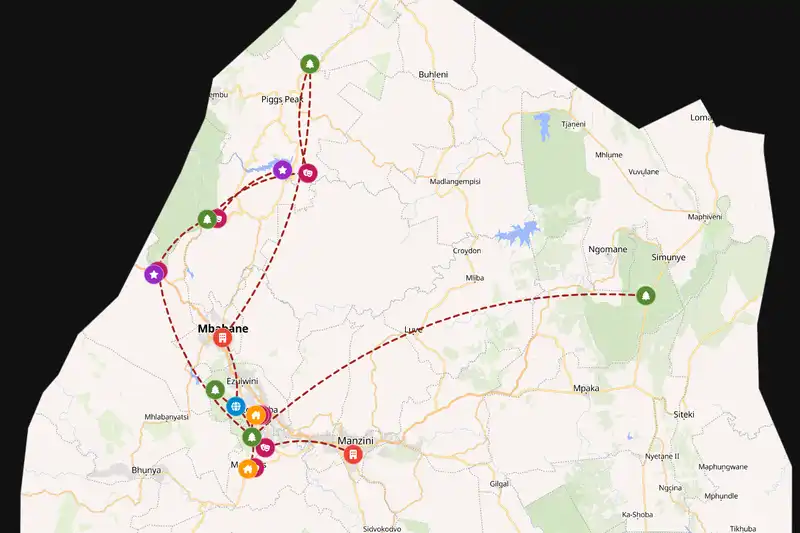
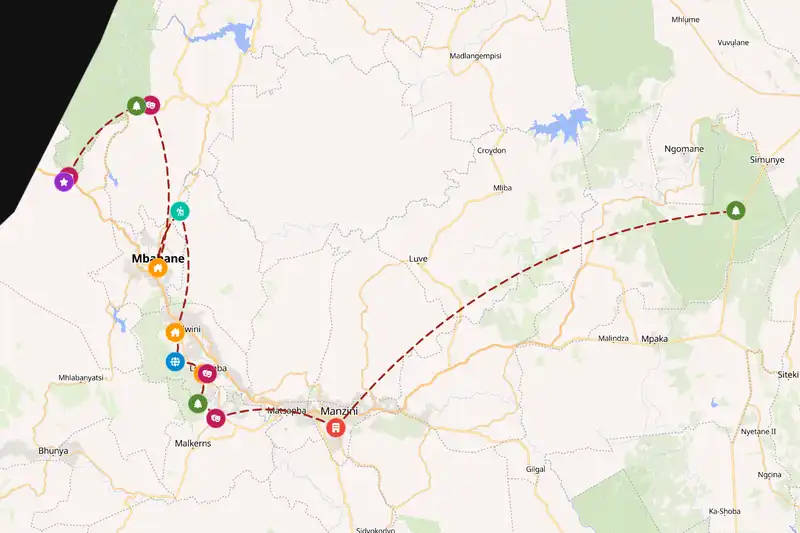
Yes, Eswatini is one of the easiest countries in southern Africa to backpack on your own: it’s small, English is an official language, and shared kombis link every main town.
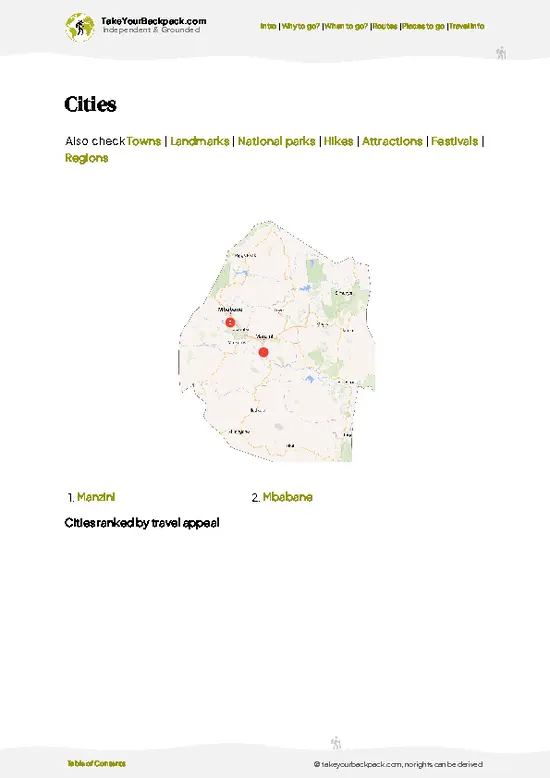
The core corridor from
Mbabane through the
Ezulwini Valley to
Manzini takes 30 to 45 minutes by kombi for about E20 to 30 (US$1 to 2). Dorm beds at
Mlilwane run roughly E230 to 320 (US$13 to 18), and the South African rand is accepted everywhere at par with the lilangeni. A realistic daily budget is US$30 to 50. The harder parts are remote sites like
Nsangwini and the inner trails of
Malolotja, which need a taxi, transfer or rental car.
Three to five days covers Eswatini well; two days is enough for the Ezulwini Valley alone.
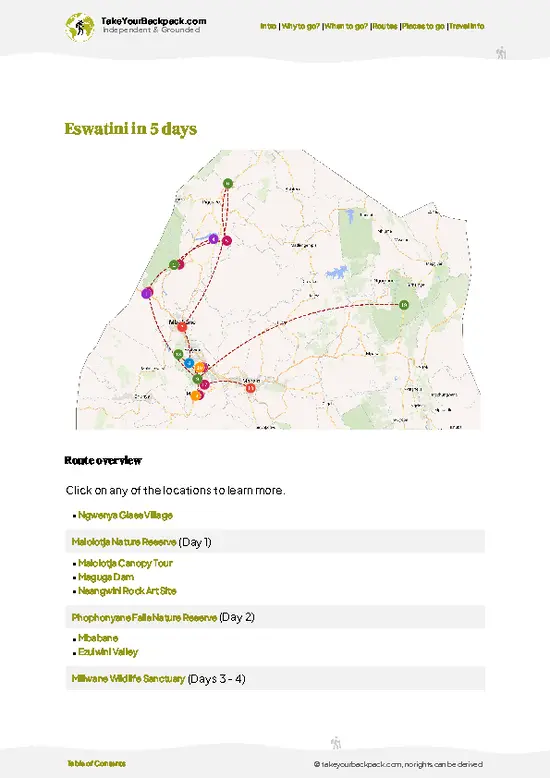
With 2 days, stay at
Mlilwane Wildlife Sanctuary and visit
Lobamba. With 3 days, add
Mbabane for Sibebe Rock and the
Malolotja Canopy Tour, then end at
Hlane, about 2 to 2.5 hours east of Mbabane by kombi with a change in Manzini. Five days lets you add the northern rock art at
Nsangwini and
Phophonyane Falls without rushing. Distances are short (the country is roughly 200 kilometers north to south), so most transfers take 1 to 3 hours.
Yes, you can travel most of Eswatini without a car, as long as you stick to the main road network served by kombis.
Kombis run frequently between
Mbabane,
Ezulwini and
Manzini (30 to 45 minutes, E20 to 30), and from Manzini east to the gate of
Hlane Royal National Park in about 1 to 1.5 hours.
Mkhaya Game Reserve runs pre-booked pickups from a meeting point on the main road. The gaps are
Nsangwini Rock Art Site,
Sibebe Rock and parts of
Malolotja, where a private taxi, lodge transfer or one or two days of car rental saves hours of waiting.
The must-visits in Eswatini are Mlilwane Wildlife Sanctuary, Hlane Royal National Park and Malolotja Nature Reserve, with the Ezulwini Valley as the cultural core.
Mlilwane lets you walk and cycle among zebra and antelope from a cheap backpacker base.
Hlane gives you white rhinos at an unlit waterhole plus lions and elephants on guided drives.
Malolotja combines highland hiking with a canopy tour at around E700 to 900 (US$40 to 50). Add the
National Museum in
Lobamba, a granite climb on
Sibebe Rock,
Ngwenya Glass Village by the western border, and
Manzini Market on a Thursday or Friday morning.
If you’re short on time in Eswatini, skip the far-flung towns and lingering in the cities, and put your days into the parks and the Ezulwini Valley.
Big Bend is a sugar town with little to hold you, and
Bulembu, an old mining town on the northern border, costs most of a day to reach and leave.
Mbabane works as a base but needs no more than an evening. In the valley, the
King Sobhuza II Memorial Park and
Yebo! Art Gallery are easy to drop, and if you’ve seen the National Museum’s homestead, the cultural village at
Mantenga covers similar ground.
Yes, our itinerary-planner does exactly that. Set your trip length in days, give your interests and travel style, optionally give start- and end location and/or some mandatory stops you would like to include and the itinerary planner creates your personalized routes for Eswatini in seconds. Try it out!
Try the itinerary planner
 Best Backpacking