×

Eswatini🇸🇿 | best townsBest 5 towns in Eswatini

Towns in Eswatini (previously Swaziland) are small, low-rise and unhurried, with no city larger than roughly 100,000 people. The country is about 200 kilometers long, so the differences are regional. The Ezulwini Valley and Manzini corridor carry most services and traffic, while the Lubombo east and the Hhohho highlands are quieter and cooler. Independent travelers find costs low, minibuses frequent and crowds thin.

By Johan Kruseman 🇳🇱 | Updated October 23, 2026
Explore the best landmarks in Eswatini

Why go?What Makes Them Special

Eswatini is one of Africa’s last absolute monarchies, and that shapes its towns. Land is largely held under Swazi Nation Land, administered through chiefs, so many settlements grow around homesteads, markets and royal events rather than a single colonial grid. The country is also compact, roughly 17,000 square kilometers, and runs from highveld in the west to lowveld bushland in the east, which means very different towns sit within a couple of hours of each other.

Travelers should know that towns here are practical places, not sightseeing set pieces. Public transport is minibus-based and thins out after late afternoon, and cash remains important in smaller centers. Culture is visible but tied to the calendar, with the Umhlanga (Reed Dance) in late August or early September and Incwala in … read more 👉
Eswatini is one of Africa’s last absolute monarchies, and that shapes its towns. Land is largely held under Swazi Nation Land, administered through chiefs, so many settlements grow around homesteads, markets and royal events rather than a single colonial grid. The country is also compact, roughly 17,000 square kilometers, and runs from highveld in the west to lowveld bushland in the east, which means very different towns sit within a couple of hours of each other.

Travelers should know that towns here are practical places, not sightseeing set pieces. Public transport is minibus-based and thins out after late afternoon, and cash remains important in smaller centers. Culture is visible but tied to the calendar, with the Umhlanga (Reed Dance) in late August or early September and Incwala in the summer months. Expect modest, orderly places with strong local custom.
Our Approach to Ranking
The list of best towns in Eswatini is created based on charm, local culture, atmosphere, hidden gems, and visitor appeal. If you feel a town is missing in this list, please let us know.

When to go?When to Plan Your Trip

Best months: May to September is the best window for towns in Eswatini, because dry, sunny days of roughly 20 to 26°C make walking and minibus hopping comfortable, and roads stay reliable. Nights in the Hhohho highlands can fall to 2 to 8°C in June and July, so a warm layer matters.
Shoulder and wet seasons: October to November and March to April are shoulder months, with warming weather and fewer travelers. The wet season runs November to March, bringing afternoon thunderstorms, humidity and 30 to 35°C heat in the lowveld east, where malaria precautions are advised. The highlands stay cooler, and the western Hhohho and Manzini regions receive more rain than the dry lowveld. Total annual rainfall ranges from about 500 mm in the lowveld to over 1,000 mm in the highlands.
Peak periods: Accommodation … read more 👉
Best months: May to September is the best window for towns in Eswatini, because dry, sunny days of roughly 20 to 26°C make walking and minibus hopping comfortable, and roads stay reliable. Nights in the Hhohho highlands can fall to 2 to 8°C in June and July, so a warm layer matters.
Shoulder and wet seasons: October to November and March to April are shoulder months, with warming weather and fewer travelers. The wet season runs November to March, bringing afternoon thunderstorms, humidity and 30 to 35°C heat in the lowveld east, where malaria precautions are advised. The highlands stay cooler, and the western Hhohho and Manzini regions receive more rain than the dry lowveld. Total annual rainfall ranges from about 500 mm in the lowveld to over 1,000 mm in the highlands.
Peak periods: Accommodation prices rise and beds fill around the Reed Dance in late August or early September and during the December holidays, so book those weeks ahead.

town hoppingTips for Visiting Multiple Destinations

Time needed: A trip linking several towns in Eswatini needs 4 to 7 days, since the whole country can be crossed in about 3 to 4 hours of driving. Group stops by region: the western highlands around Mbabane and the Ezulwini Valley together, the central Manzini and Matsapha corridor next, then the southern and eastern lowveld. Travel from the Oshoek border in the northwest toward Lavumisa in the south or the Lubombo east works well as one sweep, and Manzini is the main minibus hub for connections.
Pacing: Allow 1 to 2 nights per stop. Transfers between regions usually take 1 to 3 hours, plus waiting time because minibuses leave when full. A common mistake is packing in too many stops and arriving after dark, when services thin out and options shrink. Instead, travel in the morning, keep a buffer … read more 👉
Time needed: A trip linking several towns in Eswatini needs 4 to 7 days, since the whole country can be crossed in about 3 to 4 hours of driving. Group stops by region: the western highlands around Mbabane and the Ezulwini Valley together, the central Manzini and Matsapha corridor next, then the southern and eastern lowveld. Travel from the Oshoek border in the northwest toward Lavumisa in the south or the Lubombo east works well as one sweep, and Manzini is the main minibus hub for connections.
Pacing: Allow 1 to 2 nights per stop. Transfers between regions usually take 1 to 3 hours, plus waiting time because minibuses leave when full. A common mistake is packing in too many stops and arriving after dark, when services thin out and options shrink. Instead, travel in the morning, keep a buffer for slow border or road checks, and carry small cash for fares.

The ListTop towns of Eswatini

1 Ezulwini

Mantenga Falls, beehive huts, hot springs, roadside craft stalls

Pick two or three stops along a long highway valley, from a dance show and waterfall walk to thermal pools and woodcarving stalls.

2 Lobamba

Royal village, Reed Dance, parliament, memorial museums

Visit the museums and memorial park of the legislative capital, and time a trip for the late-summer ceremony when young women carry reeds.

3 Bulembu

Ex-asbestos mine, misty hills, sawmill, rough road

Climb to the rusted mine headframe above a former company town, then walk plantation tracks and visit the sawmill and children’s care program.

4 Malkerns

Glassblowers, candle workshops, pineapple farms, live music

Watch recycled bottles become glass animals, browse studios and stalls, then catch an evening concert or stroll quiet lanes between fruit plots.

eswatini-city-malkerns
© Google |

5 Big Bend

Usutu River bend, sugar cane plains, cane trucks, lowveld sunsets

Walk the cane roads and the river bend that names this working sugar town, then watch the lowveld flatten toward the Lubombo ridge.

Loading the map 🌍

Expert viewWhat You Should Know

How many to visit: Three to four towns is the sensible number for most trips. Distances are short, but minibus waits, market days and unhurried service make each stop take a full day to absorb, and more than four turns the trip into transfers.
Choosing the kind: Backpackers on a tight budget should prioritize the practical hub towns, which have banks, ATMs, supermarkets and the cheapest transport. Travelers who want nature and quiet should favor the highland and lowveld settlements near reserves and trails. Those interested in culture should time a visit around the Reed Dance or Incwala, and accept higher prices and booked-out beds in return.
What it costs: Budget about US$25 to 45 a day: hostel dorms or basic guesthouses at roughly E250 to 500 (US$14 to 27), local meals at E50 to 120, and minibus … read more 👉
How many to visit: Three to four towns is the sensible number for most trips. Distances are short, but minibus waits, market days and unhurried service make each stop take a full day to absorb, and more than four turns the trip into transfers.
Choosing the kind: Backpackers on a tight budget should prioritize the practical hub towns, which have banks, ATMs, supermarkets and the cheapest transport. Travelers who want nature and quiet should favor the highland and lowveld settlements near reserves and trails. Those interested in culture should time a visit around the Reed Dance or Incwala, and accept higher prices and booked-out beds in return.
What it costs: Budget about US$25 to 45 a day: hostel dorms or basic guesthouses at roughly E250 to 500 (US$14 to 27), local meals at E50 to 120, and minibus fares of about E15 to 60 per hop depending on distance. Entry to reserves and craft centers typically runs E50 to 200 (US$3 to 11), and guided walks or cultural visits add roughly E150 to 400. Small notes are useful, as change is often short. The lilangeni is pegged to the South African rand, and rand are widely accepted, but change usually comes back in lilangeni.
Safety and etiquette: Towns are generally calm, though petty theft occurs around bus ranks and in the larger centers, so keep phones out of sight and avoid walking after dark. Dress modestly, particularly away from the main tourist areas, and cover shoulders and knees when visiting homesteads. Ask before photographing people, and never photograph royal residences, police or military sites. Greet people before asking for anything, as this matters locally. Criticizing the monarchy in conversation is best avoided. In the lowveld, take malaria precautions, especially in the wet season. Carry a passport copy, as police checkpoints on main roads are routine.

✈️ The backpacker research shortcutEswatini Travel Guide

An offline-friendly backpacking guide with optimized travel routes, ranked highlights, transport advice, and the best areas to stay.
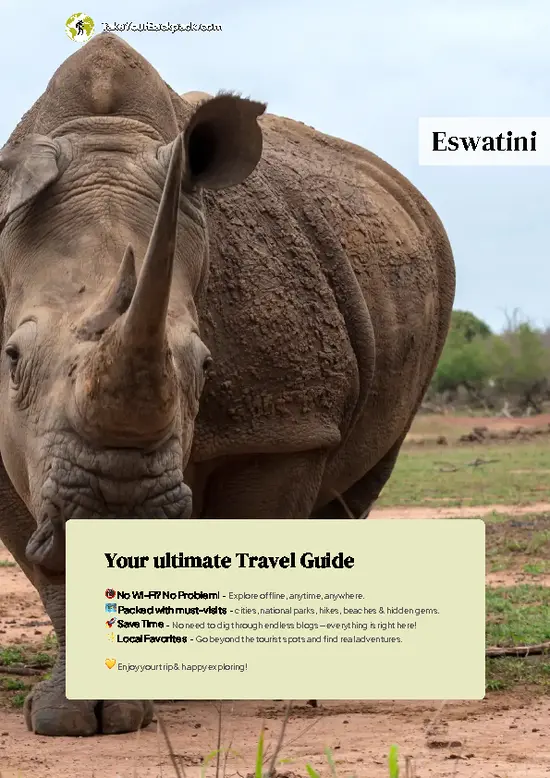
example page 0 from our offline Travel Guide for Eswatini
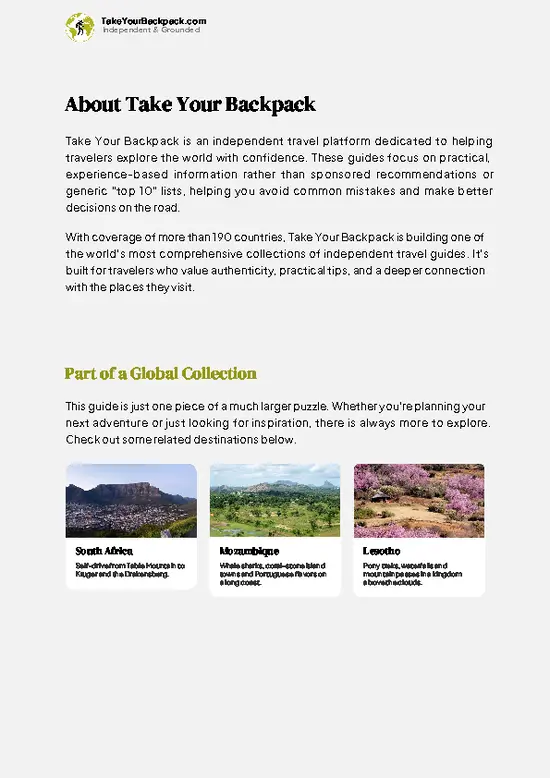
example page 1 from our offline Travel Guide for Eswatini
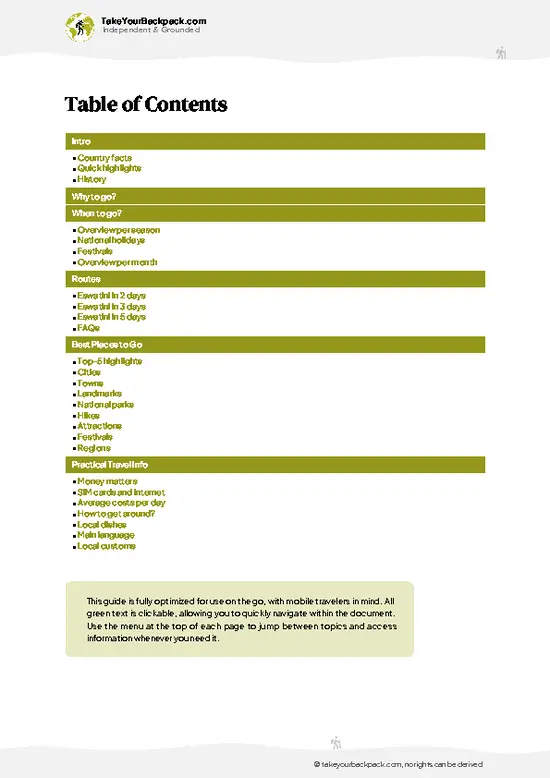
example page 2 from our offline Travel Guide for Eswatini
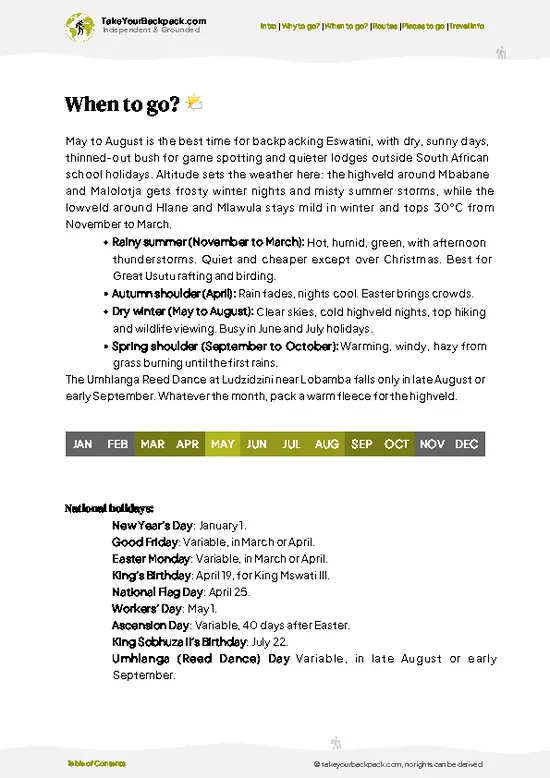
example page 3 from our offline Travel Guide for Eswatini
example page 4 from our offline Travel Guide for Eswatini
example page 5 from our offline Travel Guide for Eswatini
example page 6 from our offline Travel Guide for Eswatini
example page 7 from our offline Travel Guide for Eswatini
The digital guide (151 pages) contains:
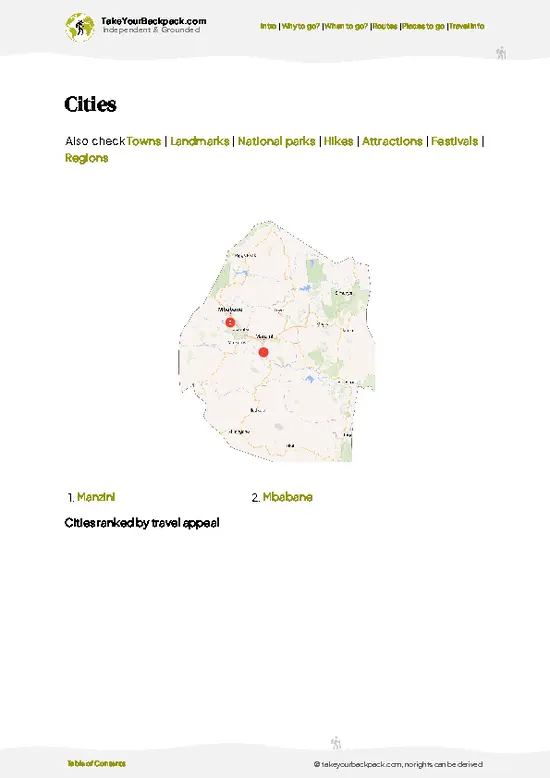
✅ 33 highlights, ranked by travel appeal
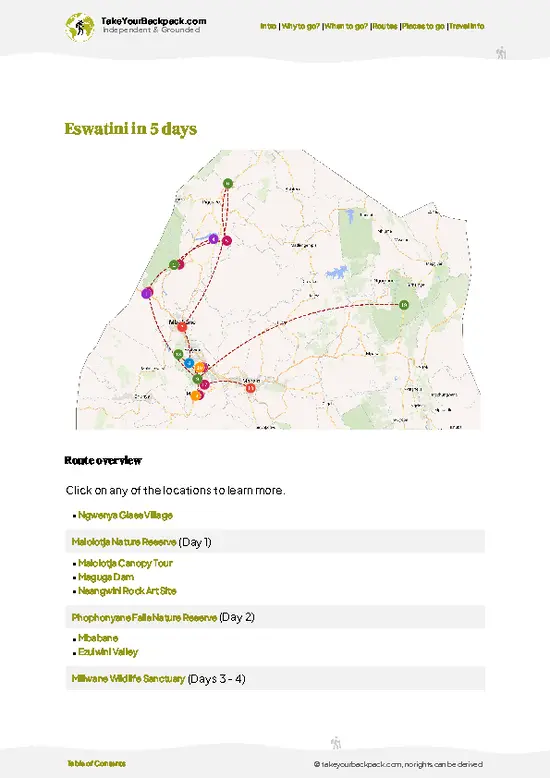
✅ Optimized 2, 3 & 5-day travel routes
✅ Cities, national parks, landmarks, beaches
✅ How to get around
✅ Offline-friendly for travel without Wi-Fi
👉 Click to see all 30+ guide features

📅 Plan smarter in minutes, not weeks
✅ Month by month travel advice
✅ Festivals & national holidays
✅ Budget expectations

🗺️ Go to the right places, skip the overrated ones
✅ Honest pros & cons of destinations
✅ Top hikes, parks & viewpoints
✅ Lesser-known places most travelers miss
✅ Clear “worth it vs skip it” guidance

🛏️ Travel smoothly without rookie mistakes
✅ Best areas to stay
✅ Transport systems explained simply
✅ Common scams & safety advice
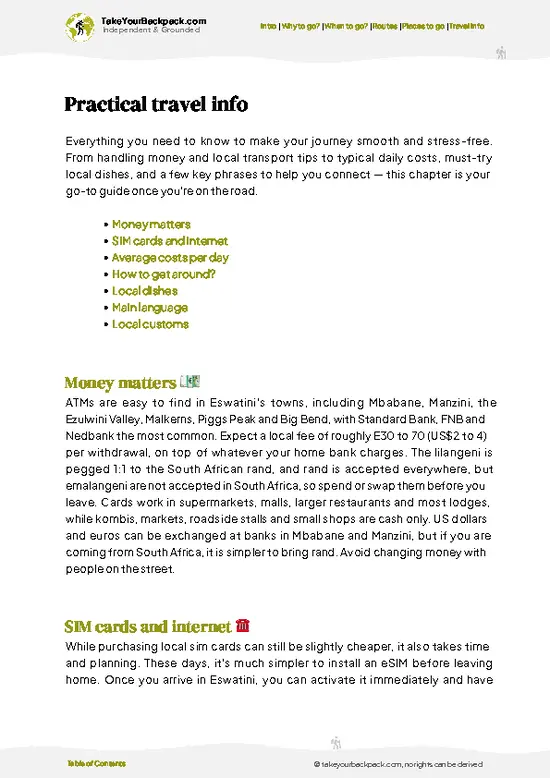
✅ SIM cards, money & practical tips

🌍 Understand the country, not just visit it
✅ Culture & traditions
✅ 52 Essential phrases & customs
✅ Festivals worth planning around
✅ Traveler-friendly historical context
✅ Insights that make places more meaningful

📱 Built for real travel conditions
✅ Fully downloadable PDF
✅ Works completely offline
✅ Optimized for phone use
✅ Useful in remote areas & buses
✅ Everything in one place
Stop searching, start planning
Get instant access to your full guide. 30‑day money-back guarantee.
+ Add another guide for just

By proceeding you agree to our terms.
Sent to your inbox immediately after payment • 100% Secure Checkout
Best Backpacking Travel Advisor 2025 tourism awardBest Backpacking
Travel Advisor
2025
What others say about Take Your Backpack Guides:
⭐⭐⭐⭐⭐
Fantastic, amazing amount of information!
⭐⭐⭐⭐⭐
My goodness this is amazing, it's what I've been looking for hats off too you!
⭐⭐⭐⭐⭐
I think this is absolutely BRILLIANT
⭐⭐⭐⭐
Very complete and informative. It's still missing places, but I gotta to commend you
⭐⭐⭐⭐⭐
This is truly amazing, thank you, can't wait to explore it with my kids!
⭐⭐⭐⭐⭐
Awesome resource, thank you!
⭐⭐⭐⭐⭐
This is amazing! Can't wait to explore the ones I haven't seen
⭐⭐⭐⭐
I love this! Well done, great idea.
⭐⭐⭐⭐⭐
Thanks for taking the time to make this gem!
⭐⭐⭐⭐⭐
This might be the best website I've ever seen.
⭐⭐⭐⭐⭐
Congratulations, and thank you so much for your work; it's incredibly valuable.
⭐⭐⭐⭐
In all seriousness I think you did a great job pointing out the important spots
⭐⭐⭐⭐⭐
10/10 very good
⭐⭐⭐⭐⭐
As someone who's only just starting to visit regularly this is awesome, thank you.
⭐⭐⭐⭐
Thank you very much! I'm going to visit my dad, it's going to be very useful!
⭐⭐⭐⭐⭐
This is really cool! We'll be travelling for the first time and this definitely come in handy.
⭐⭐⭐⭐⭐
You are now our minister of culture, congratulations 👨‍💼
⭐⭐⭐⭐⭐
Just wanted to tell you that this is a pearl! Going to follow your recommendations.
⭐⭐⭐⭐⭐
This is so cool. I'll definitely be using the resource for my travels soon.
⭐⭐⭐⭐⭐
This is very impressive! Good work.
⭐⭐⭐⭐⭐
This is an amazing and informative site. Very well done!

🛏️ Where to stay?Where to Stay in Eswatini

Eswatini has a small but solid spread of backpacker lodges, rest camps and guesthouses, with dorm beds around E200 to 350 (roughly US$11 to 19) and private rooms from about E500 (US$27). The Ezulwini Valley and neighboring Malkerns hold the best options, putting you minutes from Mlilwane, Mantenga and the craft and music scene with a quiet, safe feel, though everything is spread out and evenings revolve around your lodge bar. Mbabane is handy for banks, embassies and transport but has little after dark, while Manzini is cheaper and is the main kombi hub, at the cost of noise and streets you should avoid walking at night.

If you enjoy meeting fellow travelers, consider choosing hostels with high … read more 👉
Eswatini has a small but solid spread of backpacker lodges, rest camps and guesthouses, with dorm beds around E200 to 350 (roughly US$11 to 19) and private rooms from about E500 (US$27). The Ezulwini Valley and neighboring Malkerns hold the best options, putting you minutes from Mlilwane, Mantenga and the craft and music scene with a quiet, safe feel, though everything is spread out and evenings revolve around your lodge bar. Mbabane is handy for banks, embassies and transport but has little after dark, while Manzini is cheaper and is the main kombi hub, at the cost of noise and streets you should avoid walking at night.

If you enjoy meeting fellow travelers, consider choosing hostels with high ratings for atmosphere. On the other hand, if you prefer having your own space, a hotel might be a better option.

EswatiniMore of Eswatini

👋 Meet the founderWho’s Behind Take Your Backpack?

Johan, backpacker and founder of TakeYourBackpackHi, I’m Johan (Netherlands 🇳🇱), the creator of TakeYourBackpack. Over the past 3 decades, I’ve backpacked through 90+ countries across six continents, gaining extensive experience with independent travel, long-term trips, and overland routes.

This site is built on a combination of firsthand travel experience and carefully curated insights from other backpackers. Many guides are based on places I’ve personally visited, while others bring together tips, observations, and practical advice shared by trusted travelers I’ve met along the way.

The goal is to provide realistic, experience-driven guidance — not generic itineraries — so you can explore destinations with better context, clearer expectations, and more confidence.