×

Fiji🇫🇯 | best villagesTop-Rated 2 villages in Fiji

Villages in Fiji are working communities, not living museums, and that shapes everything. On the Yasawa and Mamanuca islands, homestays and resorts sit side by side with predictable prices. On Viti Levu and Vanua Levu, access is cheaper and the crowds thinner. Backpacking independently works best if you arrive with a sevusevu gift of kava roots and a flexible plan.

By Johan Kruseman 🇳🇱 | Updated October 20, 2026
Explore the best landmarks in Fiji

Why go?Why These village Stand Out

Roughly 80 percent of Fiji’s land is held by indigenous iTaukei communities under customary ownership, and that is why villages here are not decorative. Each one has a turaga-ni-koro (village headman) and a chief, and nothing happens without their blessing. The result is hospitality that follows protocol: you present a sevusevu of kava root, join a welcome ceremony and follow local rules on dress and behavior. Geography adds a twist. Over 300 islands scatter across warm water, so village life ranges from highland river valleys to coral-fringed atolls, and boats, not roads, often decide access. Before you choose Fiji for its villages, know that many communities now run homestays or day visits with set fees, yet Sundays are for church and rest. Visits arranged through a resort or hostel are … read more 👉
Roughly 80 percent of Fiji’s land is held by indigenous iTaukei communities under customary ownership, and that is why villages here are not decorative. Each one has a turaga-ni-koro (village headman) and a chief, and nothing happens without their blessing. The result is hospitality that follows protocol: you present a sevusevu of kava root, join a welcome ceremony and follow local rules on dress and behavior. Geography adds a twist. Over 300 islands scatter across warm water, so village life ranges from highland river valleys to coral-fringed atolls, and boats, not roads, often decide access. Before you choose Fiji for its villages, know that many communities now run homestays or day visits with set fees, yet Sundays are for church and rest. Visits arranged through a resort or hostel are smoother than turning up unannounced, so book ahead.
How the List Was Created
The list of best villages in Fiji is created based on authenticity, scenic beauty, community spirit, traditions, and overall character. If you feel a village is missing in this list, please let us know.

When to go?Best Time to Visit Fiji for villages

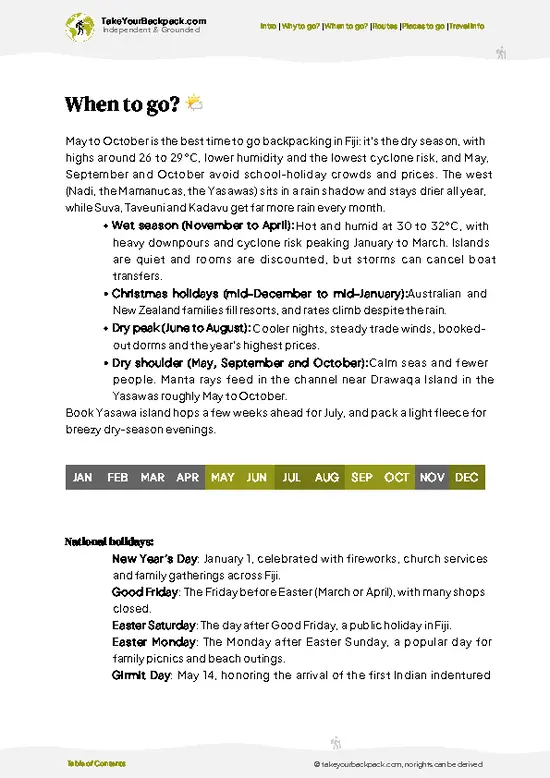
Best months: The best months for villages in Fiji are May to October, the dry season, when days sit around 25 to 29°C, humidity drops and unpaved village roads stay passable. Rain on the dry leeward sides of Viti Levu and the Yasawas can be as little as 50 to 100 mm a month, while the wetter windward coasts get more. Shoulder and peak: April and November are good shoulder months with fewer visitors and lower prices, often 10 to 20 percent below peak. July to September and the Christmas holiday are the busiest, so book island homestays and boat transfers early. Wet season: From December to March it is hotter (30 to 33°C) and cyclone-prone, with monthly rainfall easily above 300 mm in the east and north. Roads flood, boats are canceled, and rivers swell. Go then only with slack in your schedule.

village hoppingHow to Combine villages Into One Trip

How many days: A trip combining several villages in Fiji needs 10 to 14 days, with 2 to 3 nights per stop so you do not spend your whole visit on boats. Direction and hubs: Start at Nadi or Suva, then work in one direction, such as Nadi to the Yasawas by ferry (about 1.5 to 5 hours depending on how far you go), then back and along the Coral Coast to Suva (3.5 to 4 hours by road). Vanua Levu and Taveuni sit apart, reached by a 1 hour flight or a long ferry (overnight from Suva), so treat them as a separate leg. Common mistakes: Travelers pack in too many islands and miss weather-dependent ferries. Leave a spare day before any flight home, and do not plan village visits for Sundays, when most activity pauses.

The ListTop villages of Fiji

2 Kioa Island

Tuvaluan community, fatele dancing, pandanus weaving, Sunday singing

Arrange a stay with a Polynesian community from Tuvalu, where harmonized hymns, rhythmic fatele dances and woven pandanus mats set daily life apart from mainland Fiji.

fiji-city-kioa-island
© Google |
Loading the map 🌍

Expert viewExpert Commentary on villages

How many villages: I advise two to four village visits on a trip of up to two weeks. One alone feels like a tour stop, while more than four turns the ceremony into a checklist and drains your budget on transfers. Two to four gives time to settle in, learn a few bula and vinaka phrases, and join the kava circle without rushing.
Which kind: For a backpacker the best value is a homestay of one or two nights, usually F$60 to 120 (about US$27 to 55) per person with meals, over a short day visit costing F$20 to 60 (US$9 to 27) that gives less. Yasawa island stays cost more because of the boat. Villages near Suva or the Coral Coast are cheaper to reach and give the same warmth for less. Choose the remote option only if you have the time and comfort with basic rooms, cold-water washing and few power … read more 👉
How many villages: I advise two to four village visits on a trip of up to two weeks. One alone feels like a tour stop, while more than four turns the ceremony into a checklist and drains your budget on transfers. Two to four gives time to settle in, learn a few bula and vinaka phrases, and join the kava circle without rushing.
Which kind: For a backpacker the best value is a homestay of one or two nights, usually F$60 to 120 (about US$27 to 55) per person with meals, over a short day visit costing F$20 to 60 (US$9 to 27) that gives less. Yasawa island stays cost more because of the boat. Villages near Suva or the Coral Coast are cheaper to reach and give the same warmth for less. Choose the remote option only if you have the time and comfort with basic rooms, cold-water washing and few power hours.
Budget: Plan on US$35 to 70 a day including food, a village bed and local buses, and add F$20 to 50 (US$9 to 23) for boats or carriers on island legs. Bring a sevusevu of kava root, about F$20 to 40 (US$9 to 18) at a market, plus small cash for the village fund.
Respect and safety: Dress modestly with shoulders and knees covered, and remove hats and sunglasses in the village. Do not touch heads, and ask before taking photos. Wait for your host to guide you through kava. Swim only where your host says it is safe, as currents around reefs can be strong. Carry sunscreen, rain gear and a headlamp, and keep cash in small notes because there are no ATMs outside towns.

✈️ The backpacker research shortcutFiji Travel Guide

An offline-friendly backpacking guide with optimized travel routes, ranked highlights, transport advice, and the best areas to stay.
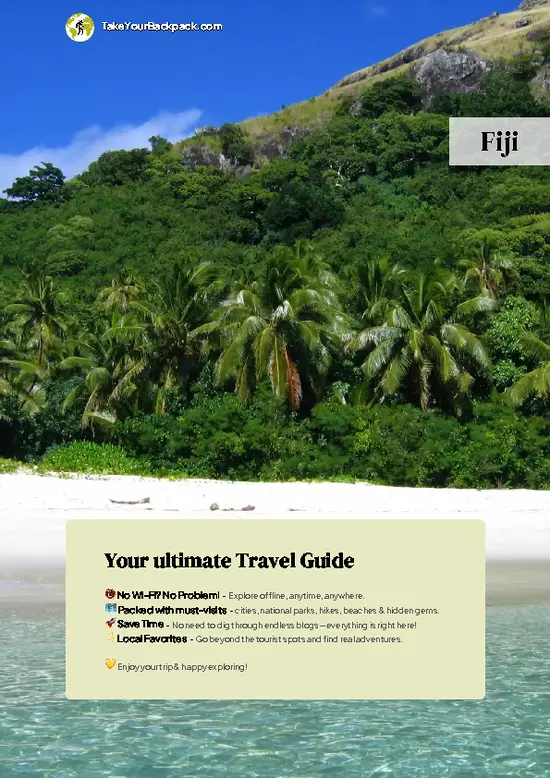
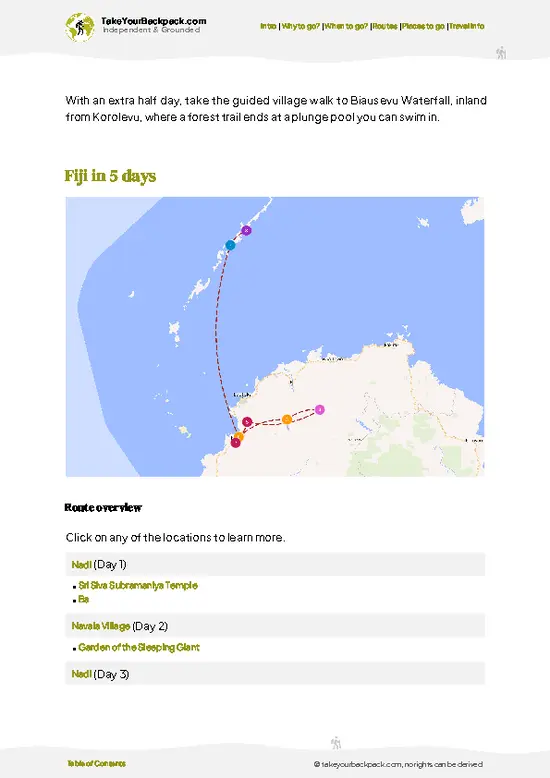
example page 0 from our offline Travel Guide for Fiji
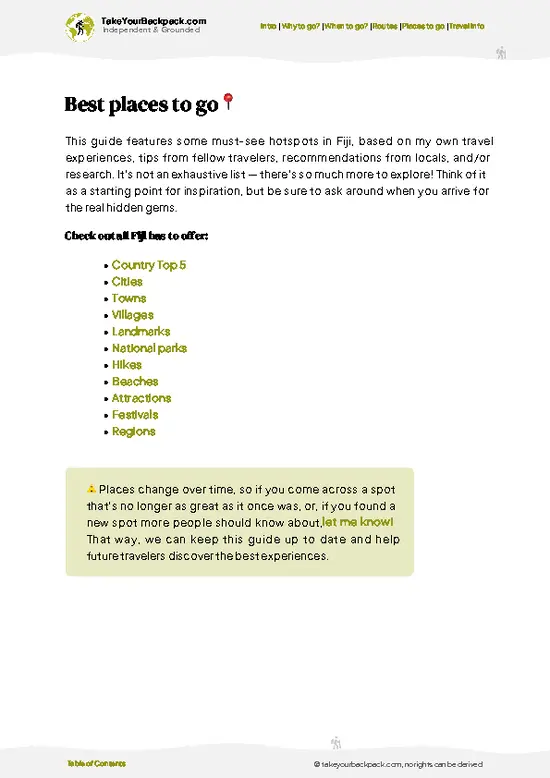
example page 1 from our offline Travel Guide for Fiji
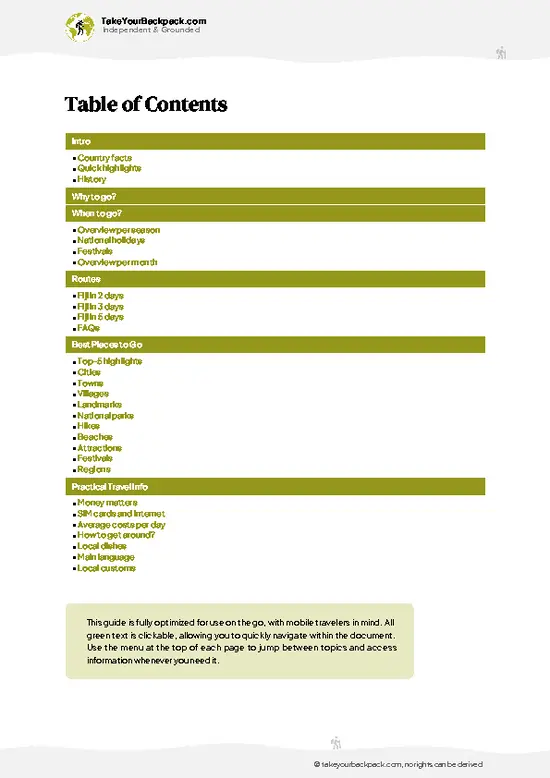
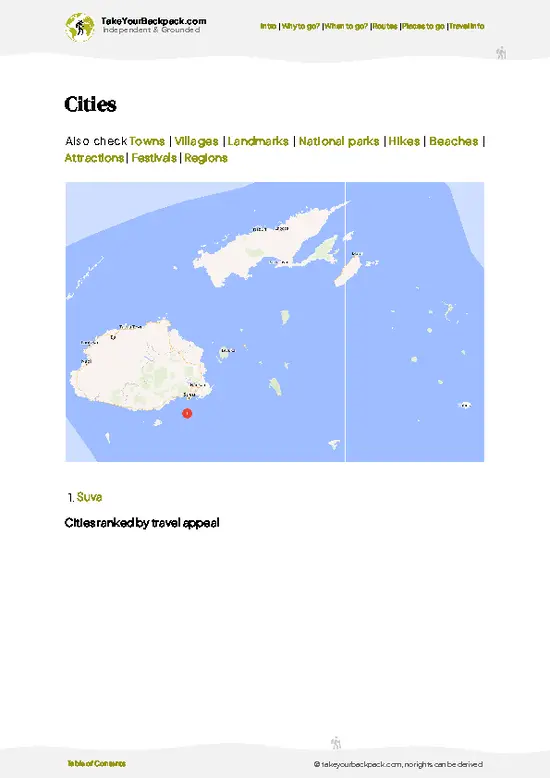
example page 2 from our offline Travel Guide for Fiji
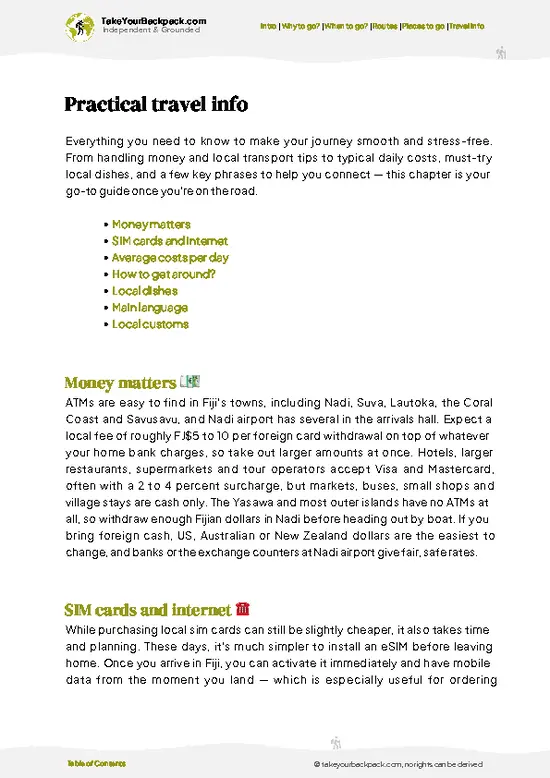
example page 3 from our offline Travel Guide for Fiji
example page 4 from our offline Travel Guide for Fiji
example page 5 from our offline Travel Guide for Fiji
example page 6 from our offline Travel Guide for Fiji
example page 7 from our offline Travel Guide for Fiji
The digital guide (159 pages) contains:
✅ 41 highlights, ranked by travel appeal
✅ Optimized 2, 3 & 5-day travel routes
✅ Cities, national parks, landmarks, beaches
✅ How to get around
✅ Offline-friendly for travel without Wi-Fi
👉 Click to see all 30+ guide features

📅 Plan smarter in minutes, not weeks
✅ Month by month travel advice
✅ Festivals & national holidays
✅ Budget expectations

🗺️ Go to the right places, skip the overrated ones
✅ Honest pros & cons of destinations
✅ Top hikes, parks & viewpoints
✅ Lesser-known places most travelers miss
✅ Clear “worth it vs skip it” guidance

🛏️ Travel smoothly without rookie mistakes
✅ Best areas to stay
✅ Transport systems explained simply
✅ Common scams & safety advice
✅ SIM cards, money & practical tips

🌍 Understand the country, not just visit it
✅ Culture & traditions
✅ 52 Essential phrases & customs
✅ Festivals worth planning around
✅ Traveler-friendly historical context
✅ Insights that make places more meaningful

📱 Built for real travel conditions
✅ Fully downloadable PDF
✅ Works completely offline
✅ Optimized for phone use
✅ Useful in remote areas & buses
✅ Everything in one place
Stop searching, start planning
Get instant access to your full guide. 30‑day money-back guarantee.
+ Add another guide for just

By proceeding you agree to our terms.
Sent to your inbox immediately after payment • 100% Secure Checkout
Best Backpacking Travel Advisor 2025 tourism awardBest Backpacking
Travel Advisor
2025
What others say about Take Your Backpack Guides:
⭐⭐⭐⭐⭐
Fantastic, amazing amount of information!
⭐⭐⭐⭐⭐
My goodness this is amazing, it's what I've been looking for hats off too you!
⭐⭐⭐⭐⭐
I think this is absolutely BRILLIANT
⭐⭐⭐⭐
Very complete and informative. It's still missing places, but I gotta to commend you
⭐⭐⭐⭐⭐
This is truly amazing, thank you, can't wait to explore it with my kids!
⭐⭐⭐⭐⭐
Awesome resource, thank you!
⭐⭐⭐⭐⭐
This is amazing! Can't wait to explore the ones I haven't seen
⭐⭐⭐⭐
I love this! Well done, great idea.
⭐⭐⭐⭐⭐
Thanks for taking the time to make this gem!
⭐⭐⭐⭐⭐
This might be the best website I've ever seen.
⭐⭐⭐⭐⭐
Congratulations, and thank you so much for your work; it's incredibly valuable.
⭐⭐⭐⭐
In all seriousness I think you did a great job pointing out the important spots
⭐⭐⭐⭐⭐
10/10 very good
⭐⭐⭐⭐⭐
As someone who's only just starting to visit regularly this is awesome, thank you.
⭐⭐⭐⭐
Thank you very much! I'm going to visit my dad, it's going to be very useful!
⭐⭐⭐⭐⭐
This is really cool! We'll be travelling for the first time and this definitely come in handy.
⭐⭐⭐⭐⭐
You are now our minister of culture, congratulations 👨‍💼
⭐⭐⭐⭐⭐
Just wanted to tell you that this is a pearl! Going to follow your recommendations.
⭐⭐⭐⭐⭐
This is so cool. I'll definitely be using the resource for my travels soon.
⭐⭐⭐⭐⭐
This is very impressive! Good work.
⭐⭐⭐⭐⭐
This is an amazing and informative site. Very well done!

🛏️ Where to stay?Best Stay Options in Fiji

Fiji has plenty of hostels, with dorm beds usually running FJ$30 to 60 (about US$13 to 27) a night, and the biggest cluster sits along Wailoaloa Beach in Nadi, roughly 10 minutes from the international airport. Wailoaloa is the easiest base for ferry departures to the Mamanuca Islands and Yasawa Islands and has a sociable bar scene, though the gray-sand beach is forgettable; out on the islands, budget resorts sell dorm beds with a compulsory meal plan, so expect FJ$100 to 200 per night with food included in exchange for clear water and very quiet evenings. On the main island, the Coral Coast near Sigatoka has calmer beachfront backpacker spots with little nightlife, while Suva offers a handful … read more 👉
Fiji has plenty of hostels, with dorm beds usually running FJ$30 to 60 (about US$13 to 27) a night, and the biggest cluster sits along Wailoaloa Beach in Nadi, roughly 10 minutes from the international airport. Wailoaloa is the easiest base for ferry departures to the Mamanuca Islands and Yasawa Islands and has a sociable bar scene, though the gray-sand beach is forgettable; out on the islands, budget resorts sell dorm beds with a compulsory meal plan, so expect FJ$100 to 200 per night with food included in exchange for clear water and very quiet evenings. On the main island, the Coral Coast near Sigatoka has calmer beachfront backpacker spots with little nightlife, while Suva offers a handful of cheap guesthouses and the liveliest weekend bars but more rain and more petty crime after dark.

If you enjoy meeting fellow travelers, consider choosing hostels with high ratings for atmosphere. On the other hand, if you prefer having your own space, a hotel might be a better option.

FijiWhere to Go Next

👋 Meet the founderWho’s Behind Take Your Backpack?

Johan, backpacker and founder of TakeYourBackpackHi, I’m Johan (Netherlands 🇳🇱), the creator of TakeYourBackpack. Over the past 3 decades, I’ve backpacked through 90+ countries across six continents, gaining extensive experience with independent travel, long-term trips, and overland routes.

This site is built on a combination of firsthand travel experience and carefully curated insights from other backpackers. Many guides are based on places I’ve personally visited, while others bring together tips, observations, and practical advice shared by trusted travelers I’ve met along the way.

The goal is to provide realistic, experience-driven guidance — not generic itineraries — so you can explore destinations with better context, clearer expectations, and more confidence.