×
French Guiana🇬🇫 | 3 days itinerary

French Guiana in 3 Days

By Johan Kruseman 🇳🇱 | Updated May 3, 2026
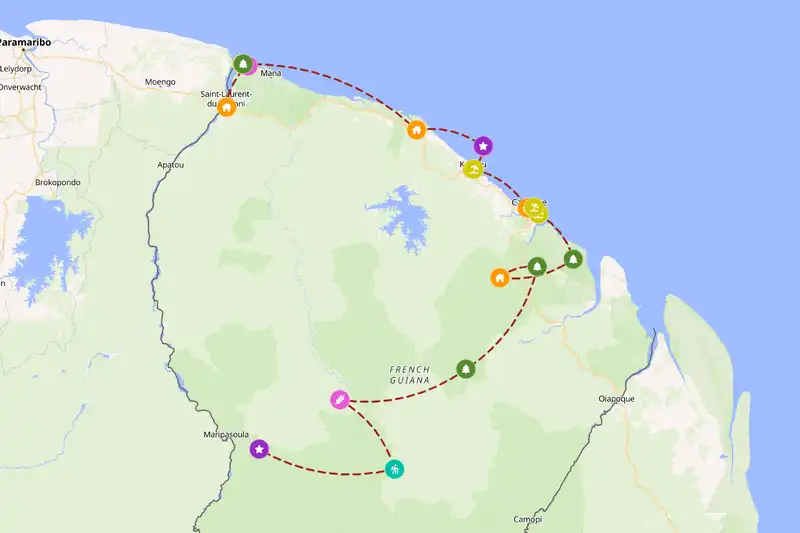
This 3-day Kourou-Îles du Salut-Cayenne route is for travelers who want a compact hit of history, space-age tech, and coastal life without feeling rushed. The pace is active but manageable, using short road hops and a single boat transfer rather than long jungle expeditions.

Day 1: Kourou & spaceport frontier

Start in Kourou, the launchpad town where French Guiana’s future-facing side lives. Spend the day at the Centre Spatial Guyanais, where you can tour launch facilities and visitor exhibits to understand why rockets leave from this patch of equatorial coastline; it’s one of the few places on earth where you can go from palm trees to launch pads in a single bike ride. In the late afternoon, decompress with a stroll along Kourou Beach, watching the light fade over the islands offshore before staying the night in town.

Day 2: Îles du Salut - prison islands & tropical calm

On Day 2, catch the boat out to the Îles du Salut, a cluster of small islands that mix heavy penal-colony history with … read more 👉
This 3-day Kourou-Îles du Salut-Cayenne route is for travelers who want a compact hit of history, space-age tech, and coastal life without feeling rushed. The pace is active but manageable, using short road hops and a single boat transfer rather than long jungle expeditions.

Day 1: Kourou & spaceport frontier

Start in Kourou, the launchpad town where French Guiana’s future-facing side lives. Spend the day at the Centre Spatial Guyanais, where you can tour launch facilities and visitor exhibits to understand why rockets leave from this patch of equatorial coastline; it’s one of the few places on earth where you can go from palm trees to launch pads in a single bike ride. In the late afternoon, decompress with a stroll along Kourou Beach, watching the light fade over the islands offshore before staying the night in town.

Day 2: Îles du Salut - prison islands & tropical calm

On Day 2, catch the boat out to the Îles du Salut, a cluster of small islands that mix heavy penal-colony history with breezy palm-fringed paths. Focus your time on the Îles du Salut Historic Site, wandering old cell blocks, overgrown ruins, and clifftop viewpoints that tell the story of France’s “bagne” era while agoutis and monkeys patrol the lawns; it’s sobering and beautiful in the same breath. After a full day exploring and swimming in designated spots, return by boat to Kourou for a second night, letting the sea crossing act as your decompression chamber.

Day 3: Cayenne markets & coastal wind-down

On Day 3, transfer by road to Cayenne for a final urban day that balances out the islands and the spaceport. Wander the old center, then dip into the Musée des Cultures Guyanaises to get a compact, well-curated overview of the Indigenous, Creole, and migrant communities that shape the territory today, which makes every face you’ve seen over the last two days click into context. If time allows before departure, swing by Cayenne Beach for a last walk along the water, trading rocket silhouettes and prison walls for kids flying kites and fishermen hauling in their catch.

As a final bonus idea, pencil in a future side trip to the remote village of Ouanary near the Brazilian border, where a lone hilltop church watches over a sleepy river mouth and dense forest.
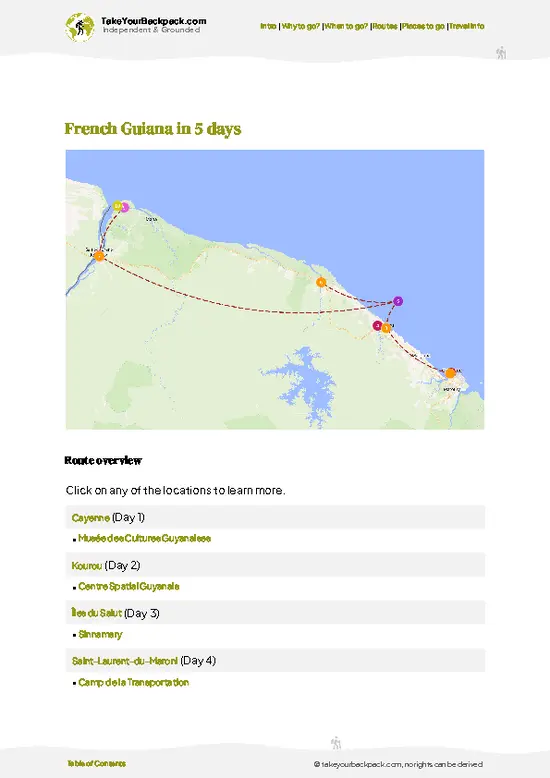
Loading the map 🌍
film
0
0
0a
Centre Spatial Guyanais
film
1
1
1a
Kourou Beach
Mickey Lecoq
film
2
2
2a
Îles du Salut
Julien Vandanjon (non Peut-Être)
film
3
3
3a
Cayenne
Serge Herzberg
film
4
4
4a
Musée des Cultures Guyanaises

🛏️ Where to stay?The Route Breakdown

✈️ The backpacker research shortcutFrench Guiana Travel Guide

An offline-friendly backpacking guide with optimized travel routes, ranked highlights, transport advice, and the best areas to stay.
example page 0 from our offline Travel Guide for French Guianaexample page 1 from our offline Travel Guide for French Guianaexample page 2 from our offline Travel Guide for French Guianaexample page 3 from our offline Travel Guide for French Guianaexample page 4 from our offline Travel Guide for French Guianaexample page 5 from our offline Travel Guide for French Guiana
The digital guide (159 pages) contains:
42 highlights, ranked by travel appeal
Optimized 2, 3 & 5-day travel routes
Best neighborhoods to stay
How to get around
Offline-friendly for travel without Wi-Fi
👉 See all 30+ guide features

📅 Plan smarter in minutes, not weeks
Month by month travel advice
Festivals & national holidays
Budget expectations

🗺️ Go to the right places, skip the overrated ones
Honest pros & cons of destinations
Top hikes, parks & viewpoints
Lesser-known places most travelers miss
Clear “worth it vs skip it” guidance

🛏️ Travel smoothly without rookie mistakes
Best areas to stay
Transport systems explained simply
Common scams & safety advice
SIM cards, money & practical tips

🌍 Understand the country, not just visit it
Culture & traditions
52 Essential phrases & customs
Festivals worth planning around
Traveler-friendly historical context
Insights that make places more meaningful

📱 Built for real travel conditions
Fully downloadable PDF
Works completely offline
Optimized for phone use
Useful in remote areas & buses
Everything in one place
Save weeks of stressful planning
Get instant access to the full guide directly. 30-day money-back guarantee.


Sent to your inbox immediately after payment • 100% Secure Checkout
Best Backpacking Travel Advisor 2025 tourism awardBest Backpacking
Travel Advisor
2025
What others say about Take Your Backpack Guides:
⭐⭐⭐⭐⭐
Fantastic, amazing amount of information!
⭐⭐⭐⭐⭐
My goodness this is amazing, it's what I've been looking for hats off too you!
⭐⭐⭐⭐⭐
I think this is absolutely BRILLIANT
⭐⭐⭐⭐
Very complete and informative. It's still missing places, but I gotta to commend you
⭐⭐⭐⭐⭐
This is truly amazing, thank you, can't wait to explore it with my kids!
⭐⭐⭐⭐⭐
Awesome resource, thank you!
⭐⭐⭐⭐⭐
This is amazing! Can't wait to explore the ones I haven't seen
⭐⭐⭐⭐
I love this! Well done, great idea.
⭐⭐⭐⭐⭐
Thanks for taking the time to make this gem!
⭐⭐⭐⭐⭐
This might be the best website I've ever seen.
⭐⭐⭐⭐⭐
Congratulations, and thank you so much for your work; it's incredibly valuable.
⭐⭐⭐⭐
In all seriousness I think you did a great job pointing out the important spots
⭐⭐⭐⭐⭐
10/10 very good
⭐⭐⭐⭐⭐
As someone who's only just starting to visit regularly this is awesome, thank you.
⭐⭐⭐⭐
Thank you very much! I'm going to visit my dad, it's going to be very useful!
⭐⭐⭐⭐⭐
This is really cool! We'll be travelling for the first time and this definitely come in handy.
⭐⭐⭐⭐⭐
You are now our minister of culture, congratulations 👨‍💼
⭐⭐⭐⭐⭐
Just wanted to tell you that this is a pearl! Going to follow your recommendations.
⭐⭐⭐⭐⭐
This is so cool. I'll definitely be using the resource for my travels soon.
⭐⭐⭐⭐⭐
This is very impressive! Good work.
⭐⭐⭐⭐⭐
This is an amazing and informative site. Very well done!

🧭 RouteGot More or Less Time?

Travel French Guiana your way — from a quick highlights trip to a slow-paced adventure.

🙋 FAQCommon Questions

Short answer: it’s doable, but French Guiana is not a classic “easy” backpacking country like Thailand or Colombia. It’s safe by regional standards, but distances are big, public transport is thin, and costs are closer to France than to South America. Independent travel works best if you’re comfortable with some uncertainty, basic French, and paying a bit more for logistics.

The good news: you don’t need tours for everything. You can explore Cayenne, Kourou, and the coastal towns on your own, book simple guesthouses, and arrange some river trips directly with local operators. ATMs, French SIM cards, and EU-style infrastructure make the basics straightforward.

The catch: the real magic is in the interior—river villages, forest camps, and the Maroni/Oyapock regions. Those usually require pre-arranged pirogue transport, local contacts, or small-group tours. Walk‑up, last‑minute backpacker options are limited, and hitchhiking is possible but not something to rely on for tight schedules.

If you treat French Guiana as a semi‑remote region of France rather than a cheap, hyper-flexible backpacker circuit, independent travel is absolutely possible and very rewarding.
For a tight backpacker trip, 5–7 days is the minimum that feels worthwhile; 10–14 days is the sweet spot if you want both coast and interior.

Rough breakdowns that actually work on the ground:

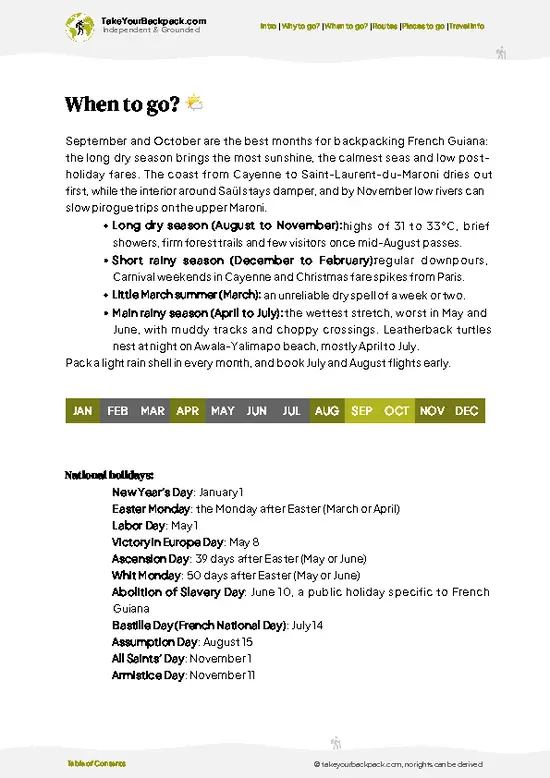
• 5–7 days (quick hit): Base yourself in Cayenne and Kourou. Do a day or overnight to Îles du Salut (Salvation Islands), explore Cayenne’s markets and colonial streets, maybe add a short forest walk or a simple river outing near Roura or Cacao. This is city + light nature, low‑stress, higher on culture than deep jungle.

• 10–12 days (balanced trip): Cayenne (2–3 days), Kourou + Îles du Salut (2–3 days), then 3–5 days for one interior focus: either a Maroni River village stay (Saint‑Laurent du Maroni area) or an organized forest lodge/river camp. This gives you time to deal with slow transport and weather delays without panic.

• 2+ weeks (deep dive): Same as above, plus a second river region (Maroni and Oyapock), more time in Amerindian or Bushinengue communities, and maybe a multi‑day jungle trek. This is where French Guiana really opens up, but it requires more money and planning.

If you’re on a tight budget, it’s better to stay a bit shorter and focus on one interior area properly than to rush across the whole territory and burn cash on constant transfers.
Technically yes, you can get around without a car, but it limits you and adds friction. Think of French Guiana as a long coastal strip with a few main towns connected by one road, plus river corridors heading inland.

What works without a car:
• Cayenne: Walkable, with local buses and plenty of shared taxis. You can base here cheaply and do day trips with arranged transport.
• Cayenne–Kourou–Saint-Laurent du Maroni: There are intercity buses and shared taxis (often from informal stands). They’re not ultra‑frequent, but they exist and are the backbone for car‑free travelers.
• Kourou to Îles du Salut: Boats run from Kourou; you just need to get to the port.

Where it gets tricky:
• Smaller villages, trailheads, and river landings: Often no public transport at all, or only at odd hours. You’ll end up paying for taxis or arranging transfers through guesthouses, which adds cost.
• Interior river travel: Pirogue transport is usually arranged in advance and priced per boat, not per seat, so solo backpackers pay more unless they join others.

If you’re comfortable with shared taxis, waiting around, and occasionally paying for a private ride, you can manage without a car. If you want maximum freedom to stop at small spots, self‑cater from supermarkets, and chase last‑minute ideas, renting a car for at least part of the trip is a big upgrade, even for budget travelers.
For a budget‑minded backpacker, these are the places that actually earn their cost and effort:

1. Cayenne
Base city, markets, and street life. You get Creole food, French pastries, and a mix of cultures in one compact place. It’s where you’ll likely land, stock up, and feel out the rhythm of the territory. Cheap eats and simple guesthouses are easiest to find here.

2. Kourou & Îles du Salut (Salvation Islands)
Kourou itself is functional, but the islands are the real draw. Old penal colony ruins, sea views, and a heavy history you can literally walk through. For the price of the boat and a basic overnight, you get one of the most atmospheric spots in the region. If you time it with a space launch, the whole area feels surreal, but even without that, the islands are worth prioritizing.

3. Saint-Laurent du Maroni & the Maroni River
This border town has another major penal colony site and is the jumping‑off point for river trips into Bushinengue and Amerindian communities. It’s less polished than Cayenne, more frontier. For backpackers, it’s a good place to feel the cross‑border energy with Suriname and arrange simple homestays or village visits if you plan ahead.

4. A forest or river camp (any one good base)
Not a single exact spot, but you should aim for at least one proper forest experience: a basic ecolodge, a river camp, or a guided overnight in the jungle. The point is to actually sleep in or near the forest, hear the insects and frogs at night, and see how life works away from the coast. This is where French Guiana stops feeling like “France in the tropics” and becomes its own thing.

5. Cacao (Hmong village, Sunday market)
If you’re around on a Sunday and can reach it, Cacao’s market is a sharp, sensory hit of local life: food stalls, produce, and a different community story than you’ll see in Cayenne. It’s a good value day trip if you’re already based on the coast.
If you’re short on time or cash, skip anything that eats days of transit without giving you a distinct new experience. French Guiana is big, but the variety is more about depth (coast vs river vs forest) than ticking off dozens of towns.

Low priority for most backpackers:

1. Trying to do both major river regions in one short trip
Doing Maroni and Oyapock in under 10–12 days usually means you spend more time in boats and shared taxis than actually experiencing village life. Pick one river system and do it properly instead of skimming both.

2. Extra coastal towns that feel similar
Small coastal settlements between Cayenne and Saint-Laurent often look and feel alike if you’re just passing through. Unless you have a specific reason (friend, project, or homestay), don’t burn days hopping between every small town. Focus on Cayenne, Kourou, and one frontier area like Saint-Laurent.

3. Deep interior expeditions that blow your budget
Multi‑day hardcore jungle expeditions with lots of gear and guides are cool, but they’re expensive and logistically heavy. If you’re on a tight budget and short on time, a simpler forest lodge or 1–2 night jungle stay gives you 70–80% of the experience for a fraction of the cost and stress.

4. Long museum crawls if you’re only in for a week
A couple of well‑chosen sites (penal colony ruins in Saint-Laurent or Îles du Salut, one space‑related visit in Kourou) are enough to anchor the history. You don’t need to chase every small museum; use that time for markets, rivers, and actual forest.

5. Over‑planning cross‑border hops just to add countries
Quick dashes into Suriname or Brazil purely to “collect” borders can chew up days with paperwork and transport. If your main goal is French Guiana and you’re short on time, keep the focus there and save the neighbors for another trip.

🇬🇫 French GuianaWhere to Go Next

Ready to build a truly unique trip? Predefined routes are perfect for first-time visitors, but there is so much more to discover. Whether you are chasing a city trip, pristine national parks, local food scenes, or quiet beaches, pick a category to design your own path.