×
Mole National Park

Ghana🇬🇭 | national parksMole National ParkWalking safaris, waterhole terrace, savanna elephants | things to do and best time to go

Explore Kakum National ParkExplore Shai Hills Resource Reserve

Backpacking in Mole
🏆 Top picknational park ranked #1
By Johan Kruseman 🇳🇱 | Updated October 15, 2026

Mole is not a place where you tick off the Big Five. There are no lions on the checklist, and the elephants are not guaranteed, which is exactly what trips people up. It sits in Ghana’s Savannah Region, near Larabanga, about 150 km (93 miles) west of Tamale. Unlike Kakum’s forest canopy walk or Kyabobo’s remote ridges in the east, Mole is open woodland you cover on foot with an armed ranger. Pros: walking safaris cost little, elephants, baboons and warthogs wander right past the motel, and crowds stay thin. Cons: the roads from Tamale are slow, public transport is unpredictable, and dry-season heat is brutal at midday. Arrive without cash and you will regret it, since the nearest ATM is in Damongo or Tamale. One dawn, I stood at the escarpment while harmattan haze turned the sun copper, the grass crackled underfoot, and a bull elephant tore bark nearby with a sound like wet canvas ripping.

Discover everything you want to know in the 📖 Ghana Travel Guide.


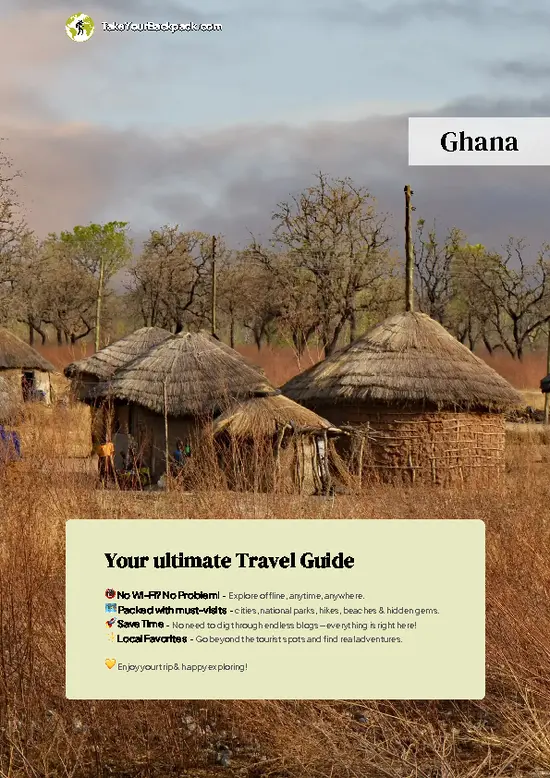
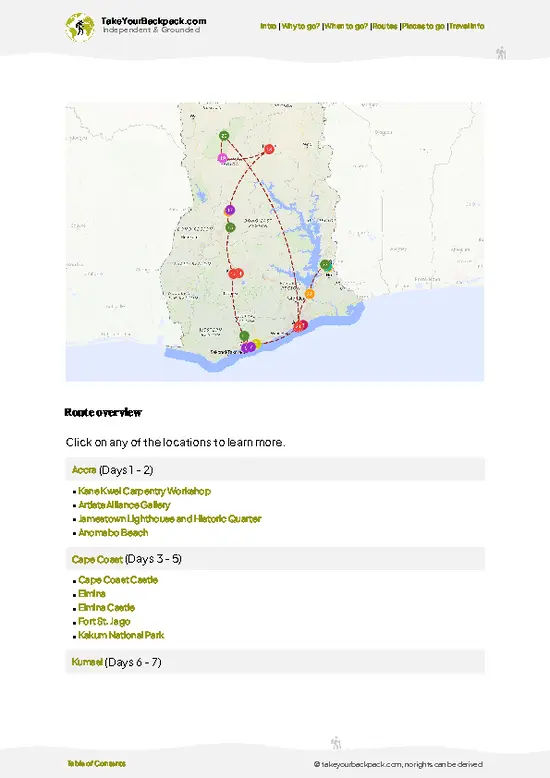
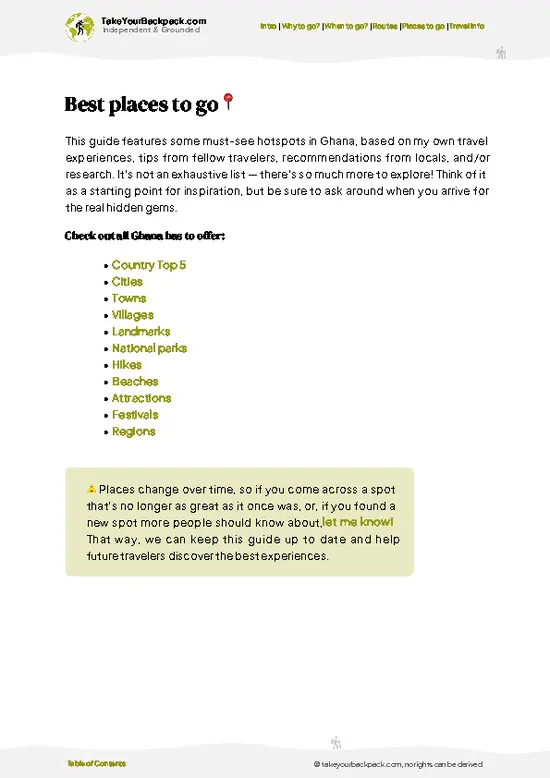
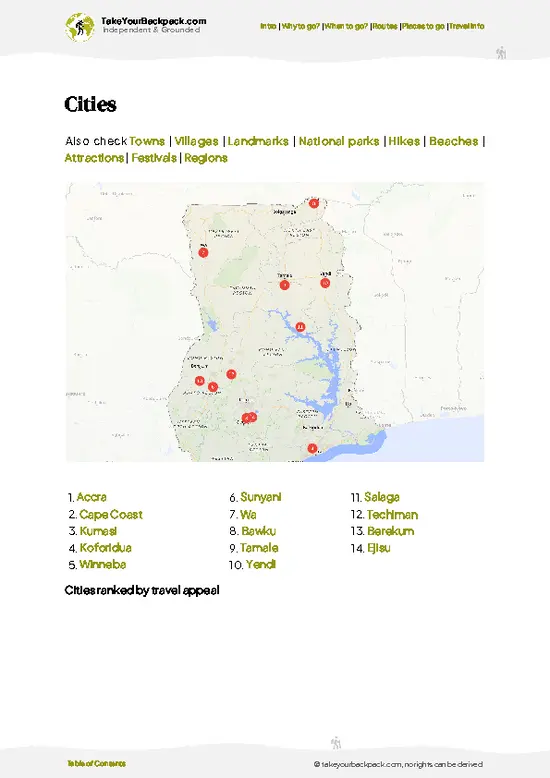
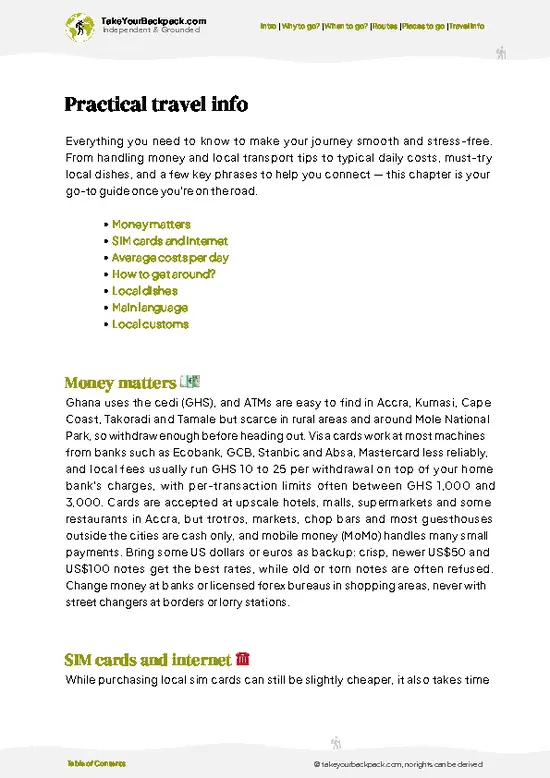
example page 0 from our offline Travel Guide for Ghana
example page 1 from our offline Travel Guide for Ghana
example page 2 from our offline Travel Guide for Ghana
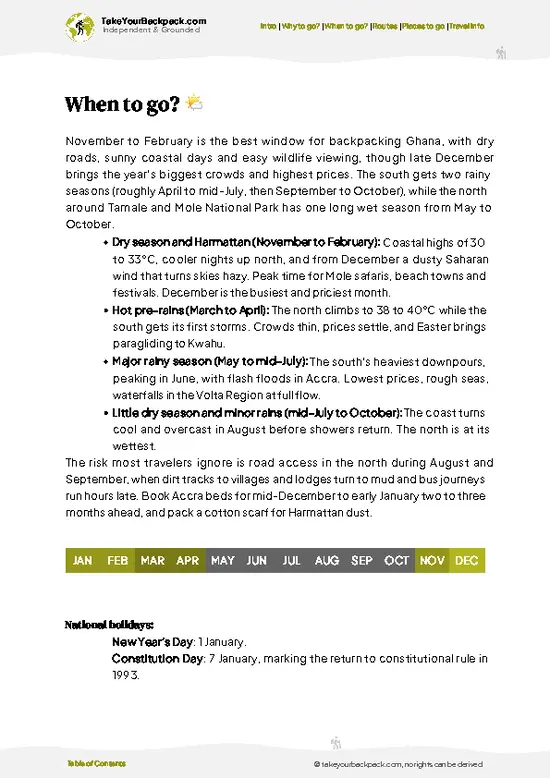
example page 3 from our offline Travel Guide for Ghana
example page 4 from our offline Travel Guide for Ghana
example page 5 from our offline Travel Guide for Ghana
example page 6 from our offline Travel Guide for Ghana
example page 7 from our offline Travel Guide for Ghana
Loading the map 🌍
CLICK TO FILTER
cities
towns
villages
landmarks
national parks
hikes
beaches
attractions
festivals
regions
SHOW COUNTRY’S BESTSHOW ALL

✨ Why go?
Ranked #1 national park in Ghana
The unique appeal for travelers

Backpackers pick Mole because it is the one place in Ghana where independent exploration of wildlife country is realistic on a small budget. You can walk in on a ranger-guided safari without hiring an operator, and the guides are park staff, so prices are fixed and modest. The park suits self-guided travelers better than package tours: arrive by bus, book a walk at the reception, and spend the rest of the day at the motel’s hilltop pool watching elephants drink at the waterhole below. Budget accommodation ranges from camping to simple rooms, with cheaper guesthouses in nearby Larabanga. Trail variety is limited, but the mix works: morning and afternoon walks, jeep drives for longer distances, and visits to the village. Add the 15th-century Larabanga Mosque and you get culture and wildlife … read more 👉
Backpackers pick Mole because it is the one place in Ghana where independent exploration of wildlife country is realistic on a small budget. You can walk in on a ranger-guided safari without hiring an operator, and the guides are park staff, so prices are fixed and modest. The park suits self-guided travelers better than package tours: arrive by bus, book a walk at the reception, and spend the rest of the day at the motel’s hilltop pool watching elephants drink at the waterhole below. Budget accommodation ranges from camping to simple rooms, with cheaper guesthouses in nearby Larabanga. Trail variety is limited, but the mix works: morning and afternoon walks, jeep drives for longer distances, and visits to the village. Add the 15th-century Larabanga Mosque and you get culture and wildlife in one stop. Few West African parks make this easy for travelers without a vehicle, and fewer still let you see elephants from your breakfast table.

💡 HighlightsKey sights and experiences for travelers

  1. Elephants at the Waterhole: Mole holds one of the largest elephant populations in Ghana. In the dry season they come to the waterhole below the motel, which you can watch from the terrace.
  2. Walking Safari: Armed rangers lead groups on foot, usually for about 1.5 to 2 hours. At ground level you hear the bush, smell the dry grass and approach animals more closely than from a vehicle.
  3. Mole Escarpment Viewpoint: The motel sits on the escarpment edge, with a long view over the savanna plain. At dawn the light is soft and the animals are active.
  4. Baboons and Warthogs: Olive baboons and warthogs wander around the motel grounds and parking area. Keep food out of sight, as baboons steal.
  5. Antelopes and Birdlife: Look for bushbuck, waterbuck, kob and hartebeest, plus hornbills, bee-eaters and over 300 recorded
… read more 👉
  1. Elephants at the Waterhole: Mole holds one of the largest elephant populations in Ghana. In the dry season they come to the waterhole below the motel, which you can watch from the terrace.
  2. Walking Safari: Armed rangers lead groups on foot, usually for about 1.5 to 2 hours. At ground level you hear the bush, smell the dry grass and approach animals more closely than from a vehicle.
  3. Mole Escarpment Viewpoint: The motel sits on the escarpment edge, with a long view over the savanna plain. At dawn the light is soft and the animals are active.
  4. Baboons and Warthogs: Olive baboons and warthogs wander around the motel grounds and parking area. Keep food out of sight, as baboons steal.
  5. Antelopes and Birdlife: Look for bushbuck, waterbuck, kob and hartebeest, plus hornbills, bee-eaters and over 300 recorded bird species. Dawn is best for both.
  6. Larabanga Mosque: Just outside the park gate, this mud-and-timber mosque in Sudano-Sahelian style is often described as dating to the 1400s, and is one of the oldest in West Africa. Entry requires a small donation and a local guide.
  7. Jeep Safari: For longer distances and a chance at lions, which are rare but present, a jeep drive covers more ground than a foot walk. It costs more but suits hot afternoons.
My first pick would be the walking safari. Nothing else in the park puts you on the same ground as an elephant, and the sounds and smells are what you will remember most.
Spotted a mistake or missing something? Contact us.

Things to do near Mole National Park

Ratings based on Tripadvisor reviews. When you book through this link, you support our work at no extra cost to you.

🌤️ When to go?Seasonal considerations and timing

The best time is the dry season from November to March, when animals gather at waterholes and ranger walks are easiest. Plan around these factors:
  • Dry Season (November to March): Days reach 32 to 38°C (90 to 100°F), nights drop to 18 to 24°C (64 to 75°F). Harmattan haze can dim views from December to February. Wildlife viewing is at its best and prices and crowds peak at Christmas.
  • Hot Season (March to April): The hottest weeks, often 36 to 40°C (97 to 104°F). Grass is burned back and elephants cluster at water. Walks start at dawn to avoid the heat.
  • Rainy Season (May to October): Temperatures sit around 25 to 33°C (77 to 91°F). Grass grows tall, animals are harder to spot, and dirt roads turn muddy. Accommodation is quieter and easier to book.
  • Daylight: Close to the equator, days run roughly
… read more 👉
The best time is the dry season from November to March, when animals gather at waterholes and ranger walks are easiest. Plan around these factors:
  • Dry Season (November to March): Days reach 32 to 38°C (90 to 100°F), nights drop to 18 to 24°C (64 to 75°F). Harmattan haze can dim views from December to February. Wildlife viewing is at its best and prices and crowds peak at Christmas.
  • Hot Season (March to April): The hottest weeks, often 36 to 40°C (97 to 104°F). Grass is burned back and elephants cluster at water. Walks start at dawn to avoid the heat.
  • Rainy Season (May to October): Temperatures sit around 25 to 33°C (77 to 91°F). Grass grows tall, animals are harder to spot, and dirt roads turn muddy. Accommodation is quieter and easier to book.
  • Daylight: Close to the equator, days run roughly 11 to 13 hours year-round, with sunrise around 6 am.
Book the first morning walk, around 7 am, since it is cooler and the animals are most active.


source: climatestotravel.comJANJanuary: excellent for travelingFEBFebruary: highly recommended for travelingMARMarch: highly recommended for travelingAPRApril: fair for travelingMAYMay: fair for travelingJUNJune: fair for travelingJULJuly: fair for travelingAUGAugust: fair for travelingSEPSeptember: fair for travelingOCTOctober: fair for travelingNOVNovember: highly recommended for travelingDECDecember: excellent for traveling
Ghana - Mole National Park

✈️ The backpacker research shortcutGhana Travel Guide

An offline-friendly backpacking guide with optimized travel routes, ranked highlights, transport advice, and the best areas to stay.
example page 0 from our offline Travel Guide for Ghana
example page 1 from our offline Travel Guide for Ghana
example page 2 from our offline Travel Guide for Ghana
example page 3 from our offline Travel Guide for Ghana
example page 4 from our offline Travel Guide for Ghana
example page 5 from our offline Travel Guide for Ghana
example page 6 from our offline Travel Guide for Ghana
example page 7 from our offline Travel Guide for Ghana
The digital guide (321 pages) contains:
✅ 105 highlights, ranked by travel appeal
✅ Optimized 5, 10 & 15-day travel routes
✅ Cities, national parks, landmarks, beaches
✅ How to get around
✅ Offline-friendly for travel without Wi-Fi
👉 Click to see all 30+ guide features

📅 Plan smarter in minutes, not weeks
✅ Month by month travel advice
✅ Festivals & national holidays
✅ Budget expectations

🗺️ Go to the right places, skip the overrated ones
✅ Honest pros & cons of destinations
✅ Top hikes, parks & viewpoints
✅ Lesser-known places most travelers miss
✅ Clear “worth it vs skip it” guidance

🛏️ Travel smoothly without rookie mistakes
✅ Best areas to stay
✅ Transport systems explained simply
✅ Common scams & safety advice
✅ SIM cards, money & practical tips

🌍 Understand the country, not just visit it
✅ Culture & traditions
✅ 52 Essential phrases & customs
✅ Festivals worth planning around
✅ Traveler-friendly historical context
✅ Insights that make places more meaningful

📱 Built for real travel conditions
✅ Fully downloadable PDF
✅ Works completely offline
✅ Optimized for phone use
✅ Useful in remote areas & buses
✅ Everything in one place
Stop searching, start planning
Get instant access to your full guide. 30‑day money-back guarantee.
+ Add another guide for just

By proceeding you agree to our terms.
Sent to your inbox immediately after payment • 100% Secure Checkout
Best Backpacking Travel Advisor 2025 tourism awardBest Backpacking
Travel Advisor
2025
What others say about Take Your Backpack Guides:
⭐⭐⭐⭐⭐
Fantastic, amazing amount of information!
⭐⭐⭐⭐⭐
My goodness this is amazing, it's what I've been looking for hats off too you!
⭐⭐⭐⭐⭐
I think this is absolutely BRILLIANT
⭐⭐⭐⭐
Very complete and informative. It's still missing places, but I gotta to commend you
⭐⭐⭐⭐⭐
This is truly amazing, thank you, can't wait to explore it with my kids!
⭐⭐⭐⭐⭐
Awesome resource, thank you!
⭐⭐⭐⭐⭐
This is amazing! Can't wait to explore the ones I haven't seen
⭐⭐⭐⭐
I love this! Well done, great idea.
⭐⭐⭐⭐⭐
Thanks for taking the time to make this gem!
⭐⭐⭐⭐⭐
This might be the best website I've ever seen.
⭐⭐⭐⭐⭐
Congratulations, and thank you so much for your work; it's incredibly valuable.
⭐⭐⭐⭐
In all seriousness I think you did a great job pointing out the important spots
⭐⭐⭐⭐⭐
10/10 very good
⭐⭐⭐⭐⭐
As someone who's only just starting to visit regularly this is awesome, thank you.
⭐⭐⭐⭐
Thank you very much! I'm going to visit my dad, it's going to be very useful!
⭐⭐⭐⭐⭐
This is really cool! We'll be travelling for the first time and this definitely come in handy.
⭐⭐⭐⭐⭐
You are now our minister of culture, congratulations 👨‍💼
⭐⭐⭐⭐⭐
Just wanted to tell you that this is a pearl! Going to follow your recommendations.
⭐⭐⭐⭐⭐
This is so cool. I'll definitely be using the resource for my travels soon.
⭐⭐⭐⭐⭐
This is very impressive! Good work.
⭐⭐⭐⭐⭐
This is an amazing and informative site. Very well done!

🛏️ Where to stay?Best areas to stay in Ghana

The best place to stay is inside the park at Mole Motel, which sits on the escarpment with a pool and views over the waterhole. It is the only full-service lodging within the park, so it is the easiest base for dawn walks. Rooms are simple but comfortable, and prices are moderate by Ghanaian standards. Camping is available inside the park at a basic site, which suits backpackers on a tight budget. Bring your own tent and food supplies, though the motel restaurant sells meals. For the cheapest beds, stay in Larabanga, about 5 km from the gate, where family guesthouses and community-run lodges offer … read more 👉
The best place to stay is inside the park at Mole Motel, which sits on the escarpment with a pool and views over the waterhole. It is the only full-service lodging within the park, so it is the easiest base for dawn walks. Rooms are simple but comfortable, and prices are moderate by Ghanaian standards. Camping is available inside the park at a basic site, which suits backpackers on a tight budget. Bring your own tent and food supplies, though the motel restaurant sells meals. For the cheapest beds, stay in Larabanga, about 5 km from the gate, where family guesthouses and community-run lodges offer basic rooms for a fraction of motel prices. The village also has the mosque and small food stalls. Transport to the park gate is by motorbike or taxi, so arrange pickup times in advance. Further afield, Damongo, about 40 km away, has more guesthouses and an ATM, while Tamale, 150 km east, has the widest range of hostels and hotels and is the main transport hub. Book the motel ahead for December to January, when it fills quickly with visitors and school groups.

👛 Costs (as of 15 October 2026)How expensive it really is

A backpacker can expect to spend about US$35 to 80 per day at Mole National Park, depending on accommodation and how many safaris you book. Prices are approximate and quoted in US dollars, though payments are made in Ghanaian cedis.
CategoryBudget RangeLocal Reality
Entrance feeUS$8 to 15 for foreign visitorsPaid at reception in cedis; rates for non-residents are higher than for Ghanaians
Walking safariUS$5 to 12Charged per person per walk, with extra for cameras
Jeep safariUS$15 to 30Often priced per vehicle or per person; shared groups cut costs
AccommodationUS$5 to 60Camping and Larabanga guesthouses are cheapest; Mole Motel rooms cost more
Local transportUS$5 to 20Tamale to Larabanga by bus or shared taxi, then a short motorbike or taxi ride to the gate
Food and suppliesUS$6 to 20Local meals
… read more 👉
A backpacker can expect to spend about US$35 to 80 per day at Mole National Park, depending on accommodation and how many safaris you book. Prices are approximate and quoted in US dollars, though payments are made in Ghanaian cedis.
CategoryBudget RangeLocal Reality
Entrance feeUS$8 to 15 for foreign visitorsPaid at reception in cedis; rates for non-residents are higher than for Ghanaians
Walking safariUS$5 to 12Charged per person per walk, with extra for cameras
Jeep safariUS$15 to 30Often priced per vehicle or per person; shared groups cut costs
AccommodationUS$5 to 60Camping and Larabanga guesthouses are cheapest; Mole Motel rooms cost more
Local transportUS$5 to 20Tamale to Larabanga by bus or shared taxi, then a short motorbike or taxi ride to the gate
Food and suppliesUS$6 to 20Local meals in Larabanga are cheap; the motel restaurant costs more; bring snacks and water
Carry enough cash before arriving, as ATMs are scarce near the park.
⚠️ Prices can change and everyone travels differently, so take this as a rough guide. Hope it helps you plan your adventure!

🥾 TrailsScenic routes and wildlife spotting in Mole

Mole covers about 4,840 square km (1,870 square miles) of Guinea savanna woodland, but visitors use only a small area near the motel. Terrain is flat to gently rolling, with laterite tracks, dry grass and seasonal streams. Difficulty is easy to moderate: heat is the challenge, not gradient. You cannot wander alone; walks are guided by armed rangers. Wildlife includes elephants, buffalo, kob, waterbuck, bushbuck, roan antelope, warthogs and baboons.
  • Walking Safari: Duration about 1.5 to 2 hours, easy, flat laterite and grass; best at 7 am or 3:30 pm.
  • Extended Walk: Often 2 to 3 hours, easy to moderate,
… read more 👉
Mole covers about 4,840 square km (1,870 square miles) of Guinea savanna woodland, but visitors use only a small area near the motel. Terrain is flat to gently rolling, with laterite tracks, dry grass and seasonal streams. Difficulty is easy to moderate: heat is the challenge, not gradient. You cannot wander alone; walks are guided by armed rangers. Wildlife includes elephants, buffalo, kob, waterbuck, bushbuck, roan antelope, warthogs and baboons.
  • Walking Safari: Duration about 1.5 to 2 hours, easy, flat laterite and grass; best at 7 am or 3:30 pm.
  • Extended Walk: Often 2 to 3 hours, easy to moderate, covers waterholes and woodland, arranged at reception.
Walking Safari: Departs from the reception near the motel. Group sizes are small, you walk in single file, and rangers set the pace and stop for animal signs.
  • Length: roughly 3 to 5 km (2 to 3 miles)
  • Duration: 1.5 to 2 hours
  • Difficulty: easy
  • Features: waterholes, elephants, antelope, birds
  • Terrain: flat dirt tracks and grass
Jeep Safari: Park vehicles go farther into the woodland.
  • Duration: about 2 hours
  • Difficulty: none, seated
  • Features: wider range of habitat, better chance of distant wildlife
  • Terrain: rough dirt tracks
Getting there: from Tamale, buses and shared taxis run to Damongo and Larabanga, taking about 3 to 4 hours, then you arrange a motorbike or taxi for the final 5 km into the park. Direct service is limited, so start early. Crowds are light outside holidays, and walks rarely exceed small groups. An entrance fee applies, payable at reception, with extra charges for walks, jeep drives and cameras. Bring cash in cedis.
⚠️ Hiking info can sometimes be outdated or inaccurate. Before you hit the trail, check the latest conditions with locals. If you do spot anything that's off, I'd love to hear from you, so I can update it for fellow travelers.

🛡️ SafetyTraveler Safety Guide

Mole is straightforward and well managed. Armed rangers lead every walk, and their instructions are simple: stay in line, keep quiet, and stop when told. Elephants are the main wildlife concern, and rangers read their behavior, so never move toward an animal for a photo. Baboons at the motel grab food and bags, so keep doors closed and snacks hidden. The main hazard is heat. From February to April temperatures pass 38°C (100°F), so carry at least 2 liters of water, wear a hat and light long sleeves, and choose dawn walks. Harmattan dust can irritate eyes and throats, so bring a scarf. In the rainy season, paths are slippery and mosquitoes are worse, so use repellent and consider malaria prophylaxis. Closed shoes help against thorns and insects. Cash is the usual gap for first-timers, since … read more 👉
Mole is straightforward and well managed. Armed rangers lead every walk, and their instructions are simple: stay in line, keep quiet, and stop when told. Elephants are the main wildlife concern, and rangers read their behavior, so never move toward an animal for a photo. Baboons at the motel grab food and bags, so keep doors closed and snacks hidden. The main hazard is heat. From February to April temperatures pass 38°C (100°F), so carry at least 2 liters of water, wear a hat and light long sleeves, and choose dawn walks. Harmattan dust can irritate eyes and throats, so bring a scarf. In the rainy season, paths are slippery and mosquitoes are worse, so use repellent and consider malaria prophylaxis. Closed shoes help against thorns and insects. Cash is the usual gap for first-timers, since card payments are unreliable and the nearest ATMs are in Damongo and Tamale.

FAQCommon questions from travelers

Two nights is the practical minimum for Mole, and three is better if you want both a walking safari and a jeep drive. Most visitors take a dawn walk on day one and an afternoon walk or jeep drive on day two. Add a half day for Larabanga Mosque, and allow a full day each way from Tamale, which is about 150 km away.
Yes, but it takes planning. Buses and shared taxis run from Tamale to Damongo or Larabanga in roughly 3 to 4 hours, then a motorbike or taxi covers the last 5 km to the gate. Once inside, safaris are on foot with rangers or in park vehicles, so you do not need your own car. Leave Tamale early, as afternoon connections are scarce.
Yes, an entrance fee is charged at reception, and foreign visitors pay more than Ghanaians, roughly US$8 to 15. Walking safaris cost about US$5 to 12 per person, jeep drives about US$15 to 30, and camera fees may apply. No advance permit is required, but you must be accompanied by a ranger on walks. Pay in Ghanaian cedis, and bring cash because card use is unreliable.
⚠️ Things can change over time, so always validate details locally before you go.

Other Ghanaian national parks near Mole

Explore more nearby:


💡 Not sure where to go next?
Create a personalized itinerary for Ghana including Mole and the places that fit your trip.

Generate my itinerary

👉 Discover all national parks

Or checkout all Ghana has to offer (think cities, towns, villages, national parks, hikes, beaches, festivals)
Country photo of Ghana

We 💚 feedbackIs it worth it?

Mole is worth the long ride for one moment: standing on foot, a few dozen meters from an elephant that ignores you completely. That is rare in West Africa. The drawback is getting there. Transport thins out after midday, ATMs are far away, and in the heat of March and April the afternoons are punishing. Pack cash, start early, and the park pays you back.

✈️ When did I visit Ghana?
Ghana I visited in December 2024, starting in Accra following the coast, then up north to Mole National park to finish in the Volta Region.

✍️ Help improve this page!
The information on this page is based on my own backpacking experience in Ghana, supplemented with up-to-date research and feedback from other travelers. Travel details can change, so if you notice anything outdated or incomplete, feel free to let me know.


🙋‍♂️ Give feedback

👋 Meet the founderWho’s Behind Take Your Backpack?

Johan, backpacker and founder of TakeYourBackpackHi, I’m Johan (Netherlands 🇳🇱), the creator of TakeYourBackpack. Over the past 3 decades, I’ve backpacked through 90+ countries across six continents, gaining extensive experience with independent travel, long-term trips, and overland routes.

This site is built on a combination of firsthand travel experience and carefully curated insights from other backpackers. Many guides are based on places I’ve personally visited, while others bring together tips, observations, and practical advice shared by trusted travelers I’ve met along the way.

The goal is to provide realistic, experience-driven guidance — not generic itineraries — so you can explore destinations with better context, clearer expectations, and more confidence.