Yes, Guadeloupe is easy to travel independently: it is French, safe by Caribbean standards, uses the euro and has good roads, though it is built for drivers and self-caterers rather than hostel hoppers.
Dorm beds barely exist, so budget €45 to 70 a night for a studio or gîte, often with a kitchen. Supermarkets keep food costs to €15 to 25 a day if you cook. Buses work well on the south coast of Grande-Terre around
Pointe-à-Pitre,
Le Gosier and
Sainte-Anne, but a rental car at €30 to 50 a day opens up Basse-Terre. Some French helps, especially in rural shops and on buses.
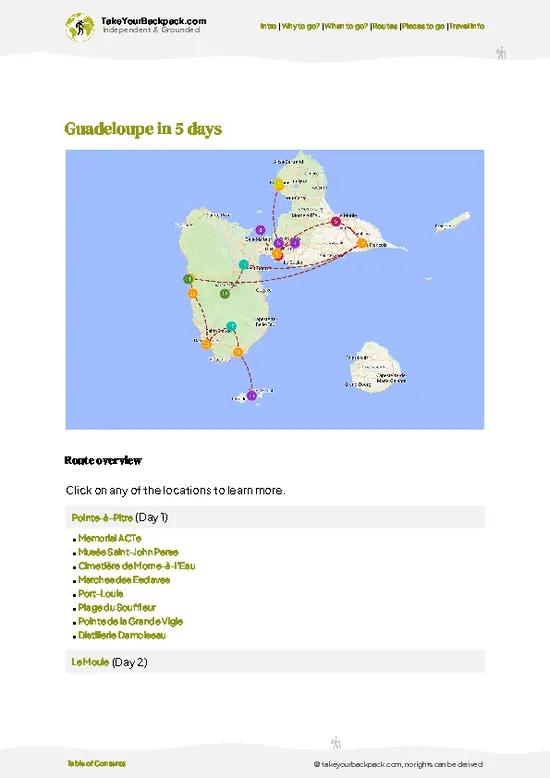
Five to seven days lets you see the best of Guadeloupe at a comfortable pace, while two or three days works if you stick to one wing of the island.
With 2 days, base on the south coast of Grande-Terre for
Pointe-à-Pitre and the beaches of
Sainte-Anne. With 3 days, focus on Basse-Terre:
Deshaies, the
Jacques Cousteau Underwater Reserve and
La Soufrière. Five days covers both wings plus a night on
Les Saintes. Add 1 to 2 days each for
Marie-Galante or
La Désirade, reached by ferries of 45 to 60 minutes from Pointe-à-Pitre and Saint-François.
You can get around Guadeloupe without a car on Grande-Terre’s south coast and to the outer islands, but Basse-Terre’s mountains and beaches are hard to reach by bus alone.
Buses between
Pointe-à-Pitre,
Le Gosier,
Sainte-Anne and Saint-François cost about €1.50 to 3 and run often by day, then fade after 6 pm and on Sundays. Ferries cover the islands: Trois-Rivières to
Les Saintes in about 20 minutes (€25 to 30 return), Pointe-à-Pitre to
Marie-Galante in about 1 hour. For
La Soufrière or the
Route de la Traversée, rent a car for a day or two at €30 to 50 a day.
The must-visits in Guadeloupe are the Memorial ACTe, La Soufrière volcano, the Jacques Cousteau Underwater Reserve, the beaches of Sainte-Anne and an overnight on Les Saintes.
The
Memorial ACTe in
Pointe-à-Pitre needs 2 to 3 hours and costs around €15.
La Soufrière is a 1.5 to 2 hour climb to 1,467 meters, best started early. Snorkel the Pigeon Islets from
Plage de Malendure for €25 to 40.
Les Saintes is a 20-minute ferry from Trois-Rivières. On Grande-Terre, add the cliffs of
Pointe de la Grande Vigie and the checkered tombs of the
Cimetière de Morne-à-l’Eau, both an easy half-day loop from Pointe-à-Pitre.
If time is short in Guadeloupe, skip the smaller museums and the far-flung islands, and spend your days on one wing of the butterfly rather than both.
The
Musée Schoelcher and
Musée Saint-John Perse in Pointe-à-Pitre are worthwhile but secondary once you have seen the Memorial ACTe.
La Désirade and the
Îles de la Petite Terre each eat a full day for boats and transfers from Saint-François. The busy small beaches of
Le Gosier can go too, since
Sainte-Anne and
Grande Anse near Deshaies are better swims. With under 3 days, drop the Basse-Terre drive, which takes 1.5 to 2 hours each way from Grande-Terre.
Yes, our itinerary-planner does exactly that. Set your trip length in days, give your interests and travel style, optionally give start- and end location and/or some mandatory stops you would like to include and the itinerary planner creates your personalized routes for Guadeloupe in seconds. Try it out!
Try the itinerary plannerv2.webp)
 Best Backpacking

