×

Guinea-Bissau🇬🇼 | best citiesWhere to Find the 2 Best cities in Guinea-Bissau

Cities in Guinea-Bissau are small, low-slung and loud in the best way: tin roofs ticking in the heat, cashew smoke, kriol shouted over crackling radios. The capital is the only place with real infrastructure, while the interior and the coast offer slower, cheaper, quieter towns. For independent travel, expect rough roads, few ATMs and almost no crowds.

By Johan Kruseman 🇳🇱 | Updated October 23, 2026
Explore the best towns in Guinea-Bissau

Why go?What Makes Them Special

Guinea-Bissau has no skyline, no metro and almost no tourist machinery, and that is the point. Its urban centers grew from Portuguese trading posts on tidal rivers, so the older quarters carry faded colonial facades, red laterite dust and the smell of mud flats at low tide. The country is flat, wet and cut by estuaries, which makes roads slow and ferries or shared taxis the usual link between places. Power cuts are routine, so evenings come lit by candles, phone torches and charcoal stoves.

Before choosing the country for its cities, know that services are thin. Cards are rarely accepted, so carry West African CFA francs in cash. French or Portuguese helps, and Kriol does the real work. In return you get unhurried streets, music drifting from open doorways and a rhythm of life that has not been packaged for visitors.
Why These Made the Cut
The list of best cities in Guinea-Bissau is created based on culture, vibe, attractions, transport ease, and local charm. If you feel a city is missing in this list, please let us know.

When to go?Best Time to Visit Guinea-Bissau for cities

Best months: The best months for cities in Guinea-Bissau are November to February, when the dry season brings clear skies, lower humidity and daytime highs around 30 to 34°C. Mornings carry a dusty haze when the Harmattan wind blows from the Sahara, softening the light to a pale gold. Roads are firm and ferries run reliably.
Shoulder and wet season: March to May turns hot and sticky, with temperatures often above 35°C and little breeze. The rains arrive from June to October, dumping 1,500 to 2,000 mm on the coast, flooding unpaved roads and turning laterite streets into red mud. Some interior routes become impassable.
Peak periods: Carnival, usually in February or March, fills the capital with drums and costumes. Book a bed early and expect prices to rise by roughly 20 to 50 percent. Outside it, crowds hardly exist.

city hoppingTips for Visiting Multiple Destinations

Trip length: A trip linking several cities in Guinea-Bissau needs 7 to 12 days, because travel eats more time than distances suggest. Start in the capital, the main transport hub, then fan out by shared taxi (toca-toca minibuses and bush taxis) toward the north or east, and loop back or exit to Senegal.
Pacing: Allow two nights per stop, three where a ferry or river crossing is involved. Journeys between regions run about 2 to 5 hours on paved stretches and can double on laterite roads in the rains. Vehicles leave only when full, often in the morning, so an afternoon departure may mean waiting in the heat with the smell of diesel and fried dough.
Common mistakes: Travelers pack too many stops and ignore tides, which govern ferry times. Build in a buffer day, carry cash for each leg and leave early to avoid roadside delays.

The ListTop cities of Guinea-Bissau

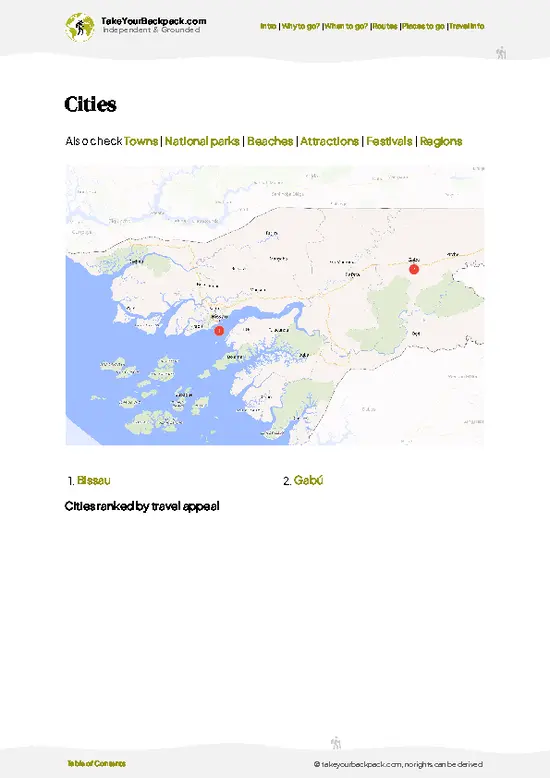
1 Bissau

Colonial fort, Bandim market, Geba estuary docks, Creole bar nights

Walk from Cabral’s mausoleum inside the old fort to the Pidjiguiti docks, then lose an hour in Bandim’s cloth, spice and cashew stalls.

2 Gabú

Fula trading town, central market, Nova Lamego quarter, evening tea grills

Start early in the central market among dried fish and indigo cloth, then follow prayer calls and charcoal smoke through red-dust Fula lanes.

Loading the map 🌍

Expert viewExpert Commentary on cities

How many cities: I advise three, four at most. Transport waits for a full vehicle, power cuts are routine and every leg costs half a day, so more stops mean more time spent on dusty roadsides than in streets. Three lets you settle into each place: the market at dawn, the grilled fish at dusk.
Which kind to prioritize: If you want nightlife, music and services, favor the capital, where bars play gumbe and Afro-beats until late. If you want colonial architecture and quiet, choose the older river-port towns, where crumbling pastel walls and rusting cranes sit beside calm water. For local life and low prices, pick an interior market town, with its smell of smoked fish, palm oil and cashew apples. Mix one of each for contrast.
Budget: Plan US$25 to 45 a day (about 15,000 to 27,000 CFA francs). Basic … read more 👉
How many cities: I advise three, four at most. Transport waits for a full vehicle, power cuts are routine and every leg costs half a day, so more stops mean more time spent on dusty roadsides than in streets. Three lets you settle into each place: the market at dawn, the grilled fish at dusk.
Which kind to prioritize: If you want nightlife, music and services, favor the capital, where bars play gumbe and Afro-beats until late. If you want colonial architecture and quiet, choose the older river-port towns, where crumbling pastel walls and rusting cranes sit beside calm water. For local life and low prices, pick an interior market town, with its smell of smoked fish, palm oil and cashew apples. Mix one of each for contrast.
Budget: Plan US$25 to 45 a day (about 15,000 to 27,000 CFA francs). Basic guesthouses run US$12 to 25 a night, a plate of rice and fish US$2 to 4, and shared taxis US$3 to 10 per leg. A local guide for a day costs roughly US$15 to 30. Museums and monuments charge small fees, usually under US$3. Cash only, so withdraw in the capital, where ATMs exist but sometimes run dry.
Safety and culture: Daytime streets feel relaxed, but after dark petty theft and poorly lit roads call for taxis, not walking. Police checkpoints are frequent: stay calm, carry a passport copy and a smile. Political tension can flare, so check your embassy’s advice before leaving. Dress modestly in Muslim-majority areas, greet people before asking anything, and ask before photographing people or government buildings. Do that and you get warmth in return: invitations to share a bowl of rice and shade under a mango tree.

✈️ The backpacker research shortcutGuinea-Bissau Travel Guide

An offline-friendly backpacking guide with optimized travel routes, ranked highlights, transport advice, and the best areas to stay.
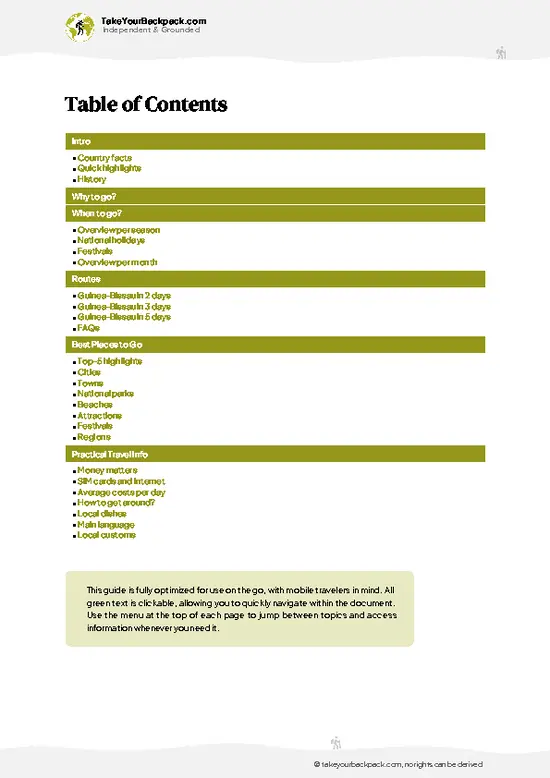
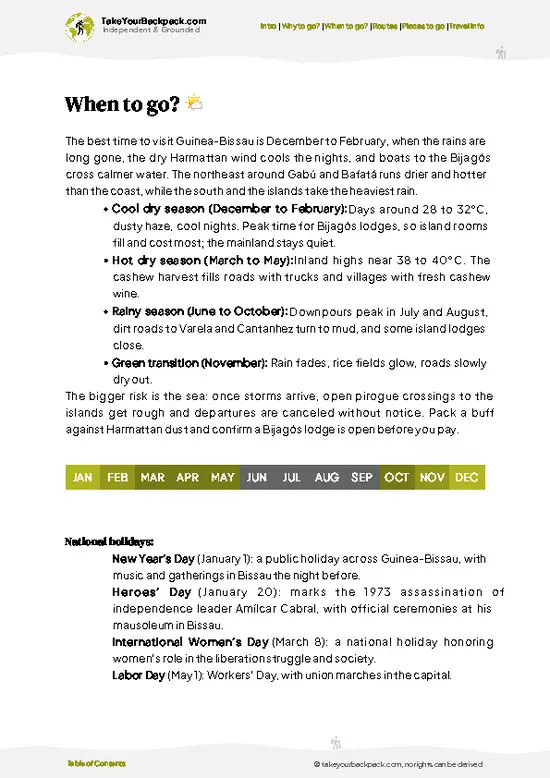
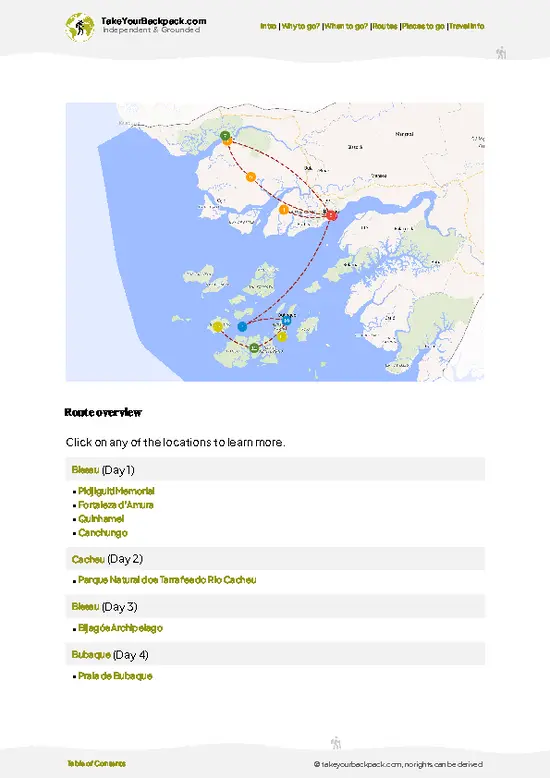
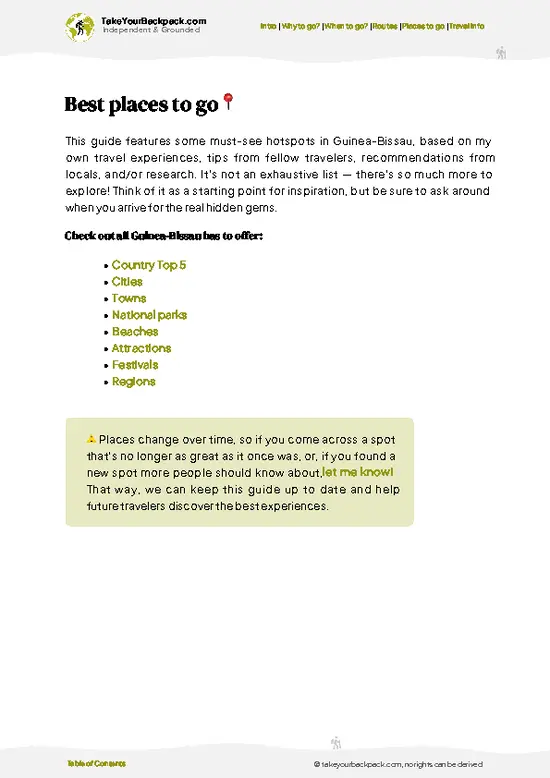
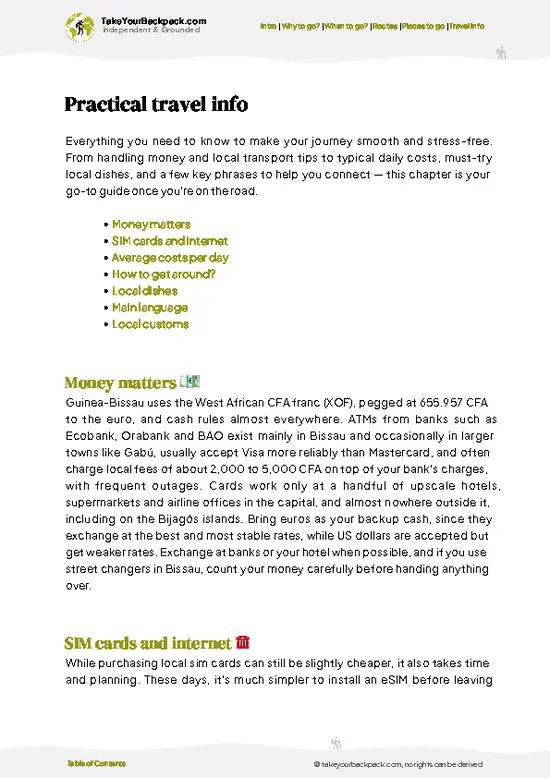
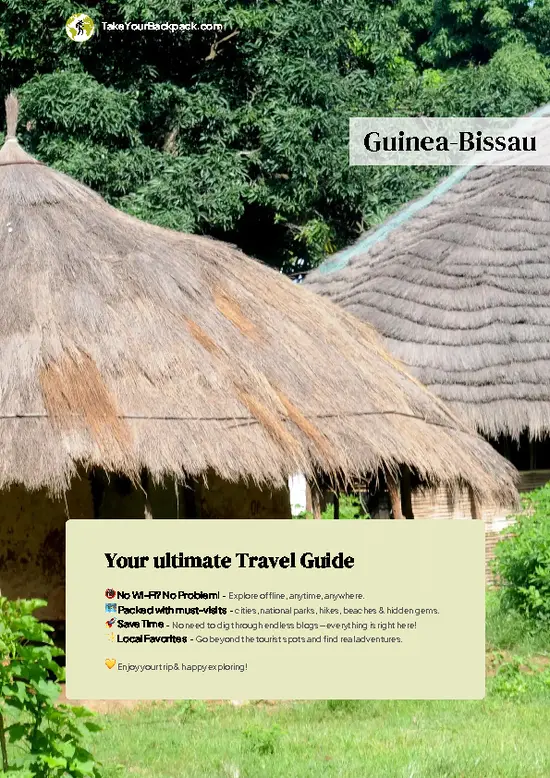
example page 0 from our offline Travel Guide for Guinea-Bissau
example page 1 from our offline Travel Guide for Guinea-Bissau
example page 2 from our offline Travel Guide for Guinea-Bissau
example page 3 from our offline Travel Guide for Guinea-Bissau
example page 4 from our offline Travel Guide for Guinea-Bissau
example page 5 from our offline Travel Guide for Guinea-Bissau
example page 6 from our offline Travel Guide for Guinea-Bissau
example page 7 from our offline Travel Guide for Guinea-Bissau
The digital guide (214 pages) contains:
✅ 48 highlights, ranked by travel appeal
✅ Optimized 2, 3 & 5-day travel routes
✅ Cities, national parks, landmarks, beaches
✅ How to get around
✅ Offline-friendly for travel without Wi-Fi
👉 Click to see all 30+ guide features

📅 Plan smarter in minutes, not weeks
✅ Month by month travel advice
✅ Festivals & national holidays
✅ Budget expectations

🗺️ Go to the right places, skip the overrated ones
✅ Honest pros & cons of destinations
✅ Top hikes, parks & viewpoints
✅ Lesser-known places most travelers miss
✅ Clear “worth it vs skip it” guidance

🛏️ Travel smoothly without rookie mistakes
✅ Best areas to stay
✅ Transport systems explained simply
✅ Common scams & safety advice
✅ SIM cards, money & practical tips

🌍 Understand the country, not just visit it
✅ Culture & traditions
✅ 52 Essential phrases & customs
✅ Festivals worth planning around
✅ Traveler-friendly historical context
✅ Insights that make places more meaningful

📱 Built for real travel conditions
✅ Fully downloadable PDF
✅ Works completely offline
✅ Optimized for phone use
✅ Useful in remote areas & buses
✅ Everything in one place
Stop searching, start planning
Get instant access to your full guide. 30‑day money-back guarantee.
+ Add another guide for just

By proceeding you agree to our terms.
Sent to your inbox immediately after payment • 100% Secure Checkout
Best Backpacking Travel Advisor 2025 tourism awardBest Backpacking
Travel Advisor
2025
What others say about Take Your Backpack Guides:
⭐⭐⭐⭐⭐
Fantastic, amazing amount of information!
⭐⭐⭐⭐⭐
My goodness this is amazing, it's what I've been looking for hats off too you!
⭐⭐⭐⭐⭐
I think this is absolutely BRILLIANT
⭐⭐⭐⭐
Very complete and informative. It's still missing places, but I gotta to commend you
⭐⭐⭐⭐⭐
This is truly amazing, thank you, can't wait to explore it with my kids!
⭐⭐⭐⭐⭐
Awesome resource, thank you!
⭐⭐⭐⭐⭐
This is amazing! Can't wait to explore the ones I haven't seen
⭐⭐⭐⭐
I love this! Well done, great idea.
⭐⭐⭐⭐⭐
Thanks for taking the time to make this gem!
⭐⭐⭐⭐⭐
This might be the best website I've ever seen.
⭐⭐⭐⭐⭐
Congratulations, and thank you so much for your work; it's incredibly valuable.
⭐⭐⭐⭐
In all seriousness I think you did a great job pointing out the important spots
⭐⭐⭐⭐⭐
10/10 very good
⭐⭐⭐⭐⭐
As someone who's only just starting to visit regularly this is awesome, thank you.
⭐⭐⭐⭐
Thank you very much! I'm going to visit my dad, it's going to be very useful!
⭐⭐⭐⭐⭐
This is really cool! We'll be travelling for the first time and this definitely come in handy.
⭐⭐⭐⭐⭐
You are now our minister of culture, congratulations 👨‍💼
⭐⭐⭐⭐⭐
Just wanted to tell you that this is a pearl! Going to follow your recommendations.
⭐⭐⭐⭐⭐
This is so cool. I'll definitely be using the resource for my travels soon.
⭐⭐⭐⭐⭐
This is very impressive! Good work.
⭐⭐⭐⭐⭐
This is an amazing and informative site. Very well done!

🛏️ Where to stay?Where to Base Yourself

Guinea-Bissau has almost no dedicated backpacker hostels, so budget travelers sleep in simple guesthouses and pensões, with a fan or air-con room usually costing 15,000 to 25,000 CFA (about US$25 to 40) a night. In Bissau, the old port quarter of Bissau Velho puts you within walking distance of the fort, the Pidjiguiti waterfront and the evening bars, but it gets noisy and deserted streets after midnight call for a taxi. The streets around Avenida Amílcar Cabral and Praça dos Heróis Nacionais offer more choice, restaurants and ATMs, while residential Santa Luzia is quieter and calmer but sits a taxi ride from the action. Out on Bubaque in the Bijagós, basic campements and beach huts are the … read more 👉
Guinea-Bissau has almost no dedicated backpacker hostels, so budget travelers sleep in simple guesthouses and pensões, with a fan or air-con room usually costing 15,000 to 25,000 CFA (about US$25 to 40) a night. In Bissau, the old port quarter of Bissau Velho puts you within walking distance of the fort, the Pidjiguiti waterfront and the evening bars, but it gets noisy and deserted streets after midnight call for a taxi. The streets around Avenida Amílcar Cabral and Praça dos Heróis Nacionais offer more choice, restaurants and ATMs, while residential Santa Luzia is quieter and calmer but sits a taxi ride from the action. Out on Bubaque in the Bijagós, basic campements and beach huts are the norm.

If you enjoy meeting fellow travelers, consider choosing hostels with high ratings for atmosphere. On the other hand, if you prefer having your own space, a hotel might be a better option.

Guinea-BissauExpand Your Journey

👋 Meet the founderWho’s Behind Take Your Backpack?

Johan, backpacker and founder of TakeYourBackpackHi, I’m Johan (Netherlands 🇳🇱), the creator of TakeYourBackpack. Over the past 3 decades, I’ve backpacked through 90+ countries across six continents, gaining extensive experience with independent travel, long-term trips, and overland routes.

This site is built on a combination of firsthand travel experience and carefully curated insights from other backpackers. Many guides are based on places I’ve personally visited, while others bring together tips, observations, and practical advice shared by trusted travelers I’ve met along the way.

The goal is to provide realistic, experience-driven guidance — not generic itineraries — so you can explore destinations with better context, clearer expectations, and more confidence.