×

Guinea🇬🇳 | best beachesExplore the 2 Best beaches in Guinea

Beaches in Guinea are working coastline first and resort strips a distant second. Expect grey-gold sand, warm brown-green Atlantic water, mangrove creeks smelling of salt mud, and fishermen hauling pirogues up the shore at dusk. Near Conakry, weekend crowds, grilled fish and loud speakers make the beaches easy and cheap to reach. Offshore on the Îles de Los, the pace drops to palm shade and a short boat ride. Farther up and down the coast, roads thin out, signs vanish and prices turn simple. For backpacking or any independent trip, the choice is between convenience near the capital and effort for emptiness elsewhere.

By Johan Kruseman 🇳🇱 | Updated October 19, 2026
Explore the best attractions in Guinea

Why go?Key Factors That Shape the Experience

Guinea suits travelers who want a beach without a tourism industry wrapped around it. The coast, called Maritime Guinea, is a low, humid stretch of mangroves, tidal flats, river mouths and sandy headlands, fed by some of the heaviest rain in West Africa. That water is why the land behind the sand is so green, and why the sea runs a murky tea color after storms instead of the clear turquoise of the Caribbean.

Infrastructure is the defining fact. There are few resorts, little organized watersports and almost no lifeguards, so what you get is local life: football on the sand, women smoking fish over driftwood fires, drumming drifting from a village. Guesthouses and basic bungalows replace big hotels, and card payments rarely work. Carry cash in Guinean francs (GNF).

Before choosing Guinea for beaches, … read more 👉
Guinea suits travelers who want a beach without a tourism industry wrapped around it. The coast, called Maritime Guinea, is a low, humid stretch of mangroves, tidal flats, river mouths and sandy headlands, fed by some of the heaviest rain in West Africa. That water is why the land behind the sand is so green, and why the sea runs a murky tea color after storms instead of the clear turquoise of the Caribbean.

Infrastructure is the defining fact. There are few resorts, little organized watersports and almost no lifeguards, so what you get is local life: football on the sand, women smoking fish over driftwood fires, drumming drifting from a village. Guesthouses and basic bungalows replace big hotels, and card payments rarely work. Carry cash in Guinean francs (GNF).

Before choosing Guinea for beaches, know that rip currents and surf are real hazards and that rain shuts down large parts of the year. Roads outside Conakry are rough, power and water can cut out, and entry requires a visa and a yellow fever certificate. Guinea is a mostly Muslim country, so modest dress away from the sand is expected. Check current government travel advisories before booking, as the political situation shifts.
Our Approach to Ranking
The list of best beaches in Guinea is created based on beauty, vibe, water quality, activities, and surrounding scenery. If you feel a beach is missing in this list, please let us know.

When to go?When to Plan Your Trip

Best months: November to April: The best months for Guinea’s beaches are November to April, when the dry season brings sunshine, calmer roads and sea that is swimmable most days. Daytime temperatures sit around 30 to 34°C on the coast, with nights near 23 to 26°C. From December to February the harmattan blows dust from the Sahara, so the light turns milky, sunsets glow orange-red and distant islands can vanish in haze. Sand gets hot underfoot by midday, so go early or late.

Shoulder months and rainy season: May and October are the shoulder months. Storms roll in by afternoon, mornings are often clear, and rates for rooms and boats can be negotiated down. From June to September the coast gets some of the heaviest rain in the world, with Conakry and Maritime Guinea seeing over 3,000 mm a year, … read more 👉
Best months: November to April: The best months for Guinea’s beaches are November to April, when the dry season brings sunshine, calmer roads and sea that is swimmable most days. Daytime temperatures sit around 30 to 34°C on the coast, with nights near 23 to 26°C. From December to February the harmattan blows dust from the Sahara, so the light turns milky, sunsets glow orange-red and distant islands can vanish in haze. Sand gets hot underfoot by midday, so go early or late.

Shoulder months and rainy season: May and October are the shoulder months. Storms roll in by afternoon, mornings are often clear, and rates for rooms and boats can be negotiated down. From June to September the coast gets some of the heaviest rain in the world, with Conakry and Maritime Guinea seeing over 3,000 mm a year, most of it in July and August. Expect days of steady downpour, brown water, stronger surf and muddy tracks that can cut off villages in the north and south of the coast.

Crowds and prices: Crowds peak on Sundays and public holidays near Conakry, when beach bars fill and prices for transport and fish go up. In dry season, boat and guesthouse costs can rise 10 to 30 percent around Christmas, New Year and Eid.

beach hoppingTips for Visiting Multiple Destinations

Plan 5 to 8 days: A trip linking several Guinean beaches needs 5 to 8 days, because getting between them eats more time than the sand does. Conakry is the hub, since flights, shared taxis and boats all start there. The coast splits into three clusters: the capital’s peninsula and the offshore Îles de Los, the northern coast toward Boffa and Boké, and the southern coast toward Forécariah and the Sierra Leone border.

Direction and time per stop: Start with the islands and the capital area, then pick one direction, either north or south, instead of both. Allow 1 to 2 nights on the islands (boats take about 30 minutes to 1.5 hours depending on the vessel) and 2 to 3 nights on a mainland stretch. Shared taxis and minibuses from Conakry reach Dubréka in 1 to 1.5 hours, Forécariah in 2.5 to 4 hours, … read more 👉
Plan 5 to 8 days: A trip linking several Guinean beaches needs 5 to 8 days, because getting between them eats more time than the sand does. Conakry is the hub, since flights, shared taxis and boats all start there. The coast splits into three clusters: the capital’s peninsula and the offshore Îles de Los, the northern coast toward Boffa and Boké, and the southern coast toward Forécariah and the Sierra Leone border.

Direction and time per stop: Start with the islands and the capital area, then pick one direction, either north or south, instead of both. Allow 1 to 2 nights on the islands (boats take about 30 minutes to 1.5 hours depending on the vessel) and 2 to 3 nights on a mainland stretch. Shared taxis and minibuses from Conakry reach Dubréka in 1 to 1.5 hours, Forécariah in 2.5 to 4 hours, and Boké in 5 to 7 hours, with long waits for vehicles to fill.

Mistakes to avoid: The common error is cramming two coasts into a short trip and spending half of it in a minibus. Choose one coast and add buffer days. Another is booking tight connections around boat departures, which depend on tide, weather and passenger numbers. Leave mornings free, travel in daylight and carry cash, since onward transport and rooms are paid in GNF.

The ListTop beaches of Guinea

1 Plage de Kassa

rocky headlands, palm-backed sands, offshore snorkeling, island guesthouses

Swim in clear waters, rest beneath palms, and discover quiet coves shaped by volcanic rock and gentle Atlantic swells.

2 Plage de Bel Air

wide tidal flats, fishing pirogues, mangrove edge, local villages

Watch fishermen launch at dawn, wander the shifting sands, and experience the interplay of river and ocean along this working coastline.

Loading the map 🌍

Expert viewPro Tips for Exploring the Best

How many beaches to visit: Three to four beach stops is the right number for most backpackers in Guinea. Each stop usually costs half a day in transit, and a swim after a bumpy ride over red-dirt roads feels better when you are not rushing to the next one. Slow time also lets you eat grilled fish from the fisherman who landed it, which beats any menu.

Which kind to choose: If you want ease and company, pick a beach close to Conakry. It is cheap, social and loud, and you can leave when you like. If you want quiet and a boat ride, choose an island beach with simple bungalows, where the reward is a calm sea and starry nights with no generator hum after lights-out. If you want emptiness, head to a remote mainland stretch, where you get long, nearly deserted sand and fishing villages, but the transport … read more 👉
How many beaches to visit: Three to four beach stops is the right number for most backpackers in Guinea. Each stop usually costs half a day in transit, and a swim after a bumpy ride over red-dirt roads feels better when you are not rushing to the next one. Slow time also lets you eat grilled fish from the fisherman who landed it, which beats any menu.

Which kind to choose: If you want ease and company, pick a beach close to Conakry. It is cheap, social and loud, and you can leave when you like. If you want quiet and a boat ride, choose an island beach with simple bungalows, where the reward is a calm sea and starry nights with no generator hum after lights-out. If you want emptiness, head to a remote mainland stretch, where you get long, nearly deserted sand and fishing villages, but the transport is slower and facilities may be a single guesthouse. Budget travelers who dislike planning should lean to the first kind. Adventurers with time can combine the second and third.

What it costs: Plan on US$25 to 45 a day (about 215,000 to 390,000 GNF). A basic room runs US$12 to 35, a plate of rice and grilled fish US$2 to 6, and shared taxis US$2 to 10 per leg. Boat trips to the islands cost roughly US$5 to 15 return by shared pirogue, and much more by private speedboat. Local guides or hosts often charge US$10 to 25 for a day, and some village beaches ask for a small fee of US$1 to 3. Bring cash; ATMs are scarce outside the capital.

Safety on the sand: The biggest risk is the sea. Rip currents and shore-break are strong, lifeguards are almost nonexistent, and swimming after storms or alone is risky. Ask fishermen where the water is safe, and stay within your depth. Leave valuables at your lodging, as petty theft is possible on busy weekend beaches. Check current travel advisories, avoid any gathering or demonstration, and carry copies of your passport and visa, since checkpoints are common.

Culture and respect: Guinea is about 85 percent Muslim, so dress modestly off the sand. Swimwear is fine at beaches used by foreigners, but cover up in villages and when passing mosques. Ask before photographing people, especially women at fish-smoking stations, and be ready to be turned down. A greeting in French (“Bonjour, ça va?”) opens more doors than anything else. Alcohol is available in Conakry bars and some guesthouses, but drinking in public in small villages causes offense. Bring malaria prophylaxis, insect repellent and a refillable bottle with a filter, as tap water is not safe to drink.

✈️ The backpacker research shortcutGuinea Travel Guide

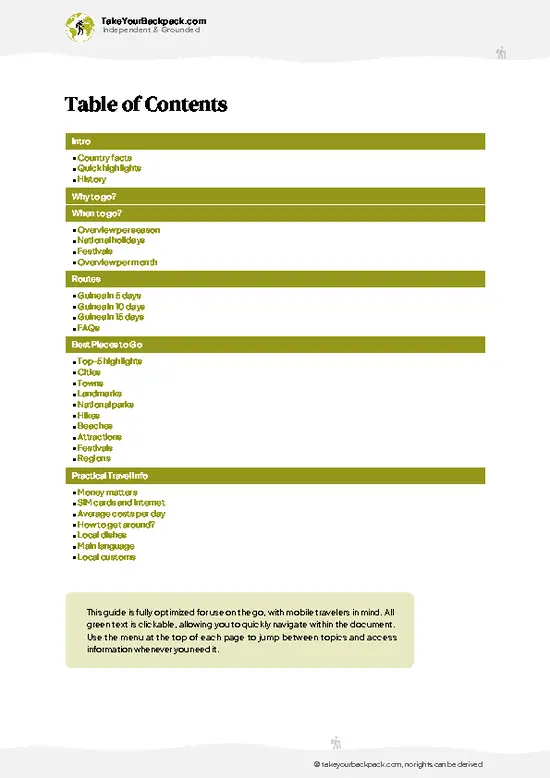
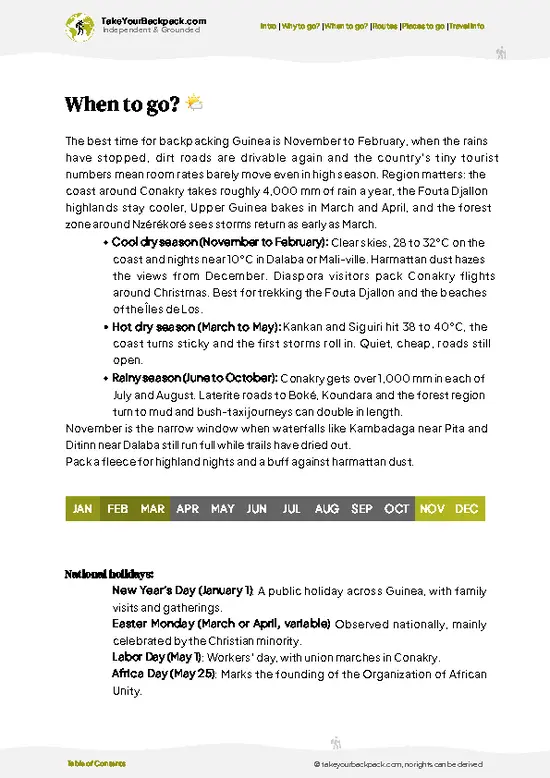
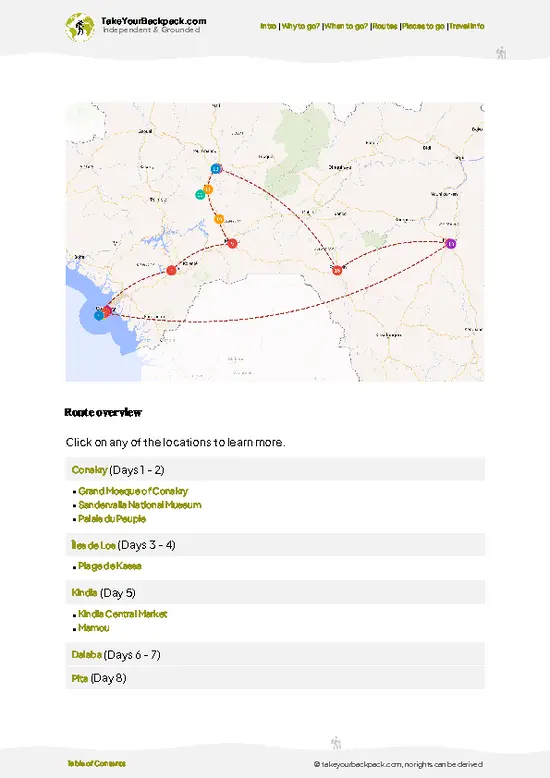
An offline-friendly backpacking guide with optimized travel routes, ranked highlights, transport advice, and the best areas to stay.
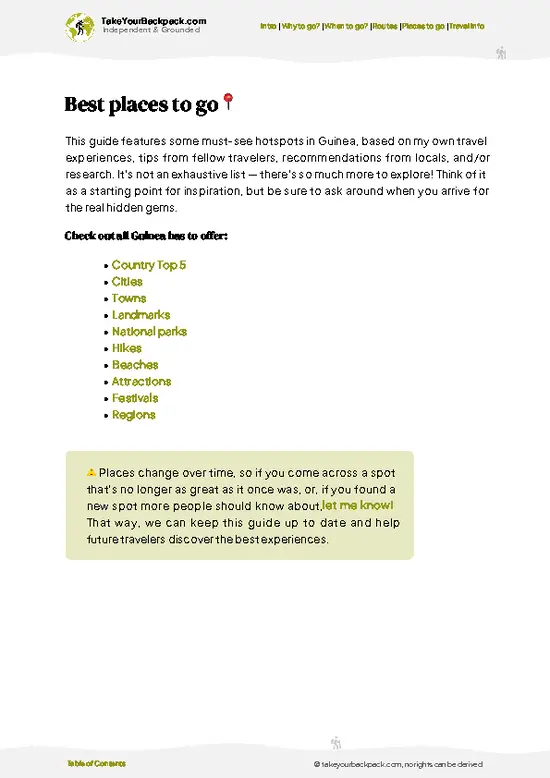
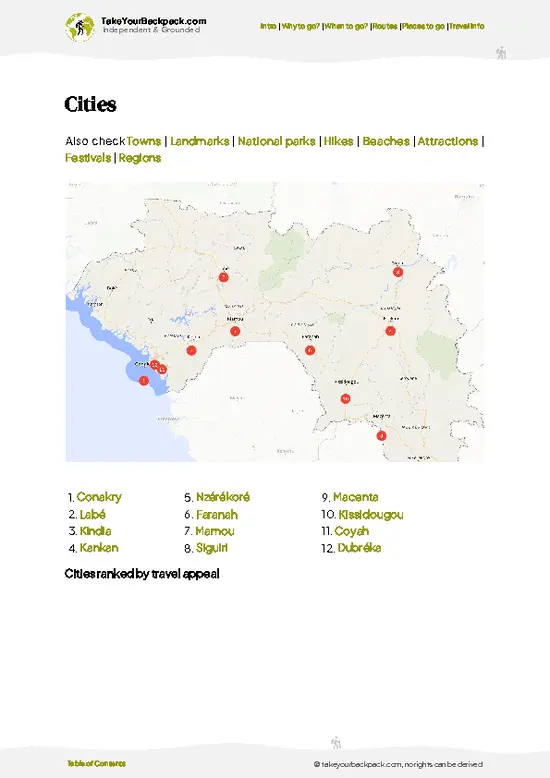
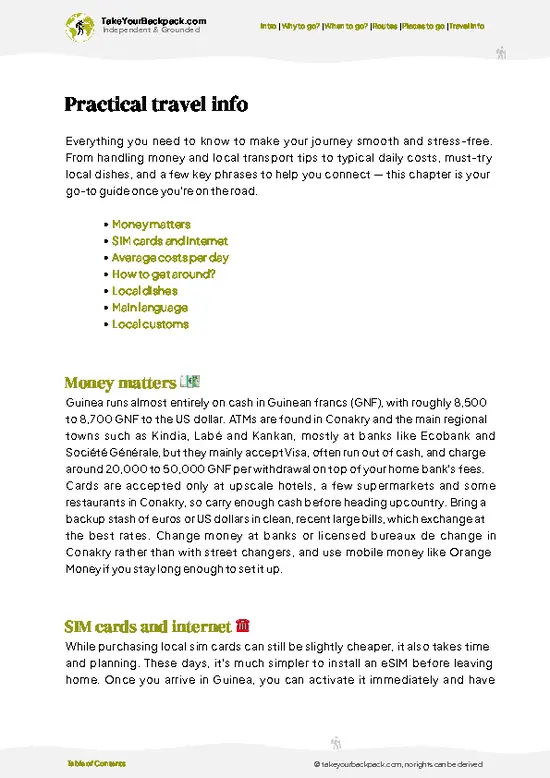
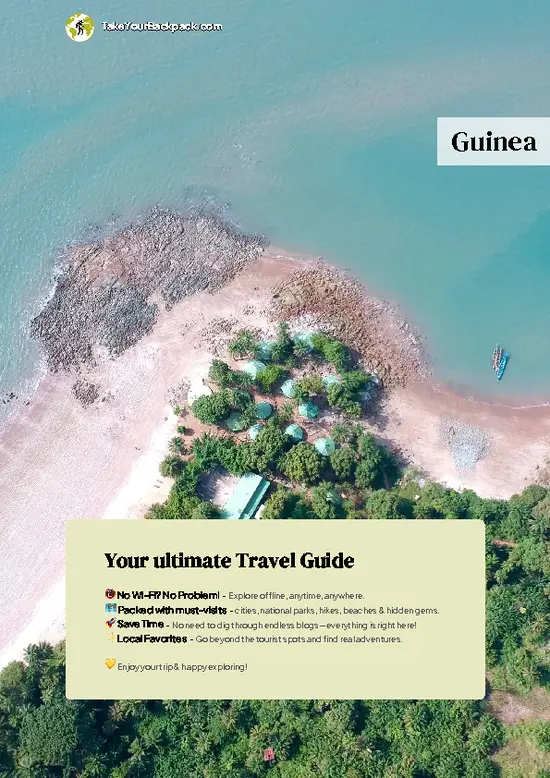
example page 0 from our offline Travel Guide for Guinea
example page 1 from our offline Travel Guide for Guinea
example page 2 from our offline Travel Guide for Guinea
example page 3 from our offline Travel Guide for Guinea
example page 4 from our offline Travel Guide for Guinea
example page 5 from our offline Travel Guide for Guinea
example page 6 from our offline Travel Guide for Guinea
example page 7 from our offline Travel Guide for Guinea
The digital guide (238 pages) contains:
✅ 53 highlights, ranked by travel appeal
✅ Optimized 5, 10 & 15-day travel routes
✅ Cities, national parks, landmarks, beaches
✅ How to get around
✅ Offline-friendly for travel without Wi-Fi
👉 Click to see all 30+ guide features

📅 Plan smarter in minutes, not weeks
✅ Month by month travel advice
✅ Festivals & national holidays
✅ Budget expectations

🗺️ Go to the right places, skip the overrated ones
✅ Honest pros & cons of destinations
✅ Top hikes, parks & viewpoints
✅ Lesser-known places most travelers miss
✅ Clear “worth it vs skip it” guidance

🛏️ Travel smoothly without rookie mistakes
✅ Best areas to stay
✅ Transport systems explained simply
✅ Common scams & safety advice
✅ SIM cards, money & practical tips

🌍 Understand the country, not just visit it
✅ Culture & traditions
✅ 52 Essential phrases & customs
✅ Festivals worth planning around
✅ Traveler-friendly historical context
✅ Insights that make places more meaningful

📱 Built for real travel conditions
✅ Fully downloadable PDF
✅ Works completely offline
✅ Optimized for phone use
✅ Useful in remote areas & buses
✅ Everything in one place
Stop searching, start planning
Get instant access to your full guide. 30‑day money-back guarantee.
+ Add another guide for just

By proceeding you agree to our terms.
Sent to your inbox immediately after payment • 100% Secure Checkout
Best Backpacking Travel Advisor 2025 tourism awardBest Backpacking
Travel Advisor
2025
What others say about Take Your Backpack Guides:
⭐⭐⭐⭐⭐
Fantastic, amazing amount of information!
⭐⭐⭐⭐⭐
My goodness this is amazing, it's what I've been looking for hats off too you!
⭐⭐⭐⭐⭐
I think this is absolutely BRILLIANT
⭐⭐⭐⭐
Very complete and informative. It's still missing places, but I gotta to commend you
⭐⭐⭐⭐⭐
This is truly amazing, thank you, can't wait to explore it with my kids!
⭐⭐⭐⭐⭐
Awesome resource, thank you!
⭐⭐⭐⭐⭐
This is amazing! Can't wait to explore the ones I haven't seen
⭐⭐⭐⭐
I love this! Well done, great idea.
⭐⭐⭐⭐⭐
Thanks for taking the time to make this gem!
⭐⭐⭐⭐⭐
This might be the best website I've ever seen.
⭐⭐⭐⭐⭐
Congratulations, and thank you so much for your work; it's incredibly valuable.
⭐⭐⭐⭐
In all seriousness I think you did a great job pointing out the important spots
⭐⭐⭐⭐⭐
10/10 very good
⭐⭐⭐⭐⭐
As someone who's only just starting to visit regularly this is awesome, thank you.
⭐⭐⭐⭐
Thank you very much! I'm going to visit my dad, it's going to be very useful!
⭐⭐⭐⭐⭐
This is really cool! We'll be travelling for the first time and this definitely come in handy.
⭐⭐⭐⭐⭐
You are now our minister of culture, congratulations 👨‍💼
⭐⭐⭐⭐⭐
Just wanted to tell you that this is a pearl! Going to follow your recommendations.
⭐⭐⭐⭐⭐
This is so cool. I'll definitely be using the resource for my travels soon.
⭐⭐⭐⭐⭐
This is very impressive! Good work.
⭐⭐⭐⭐⭐
This is an amazing and informative site. Very well done!

🛏️ Where to stay?Top Areas to Stay

Guinea has almost no true backpacker hostels, so budget travelers sleep in simple guesthouses (“auberges”) and basic hotels, typically GNF 170,000 to 350,000 (US$20 to 40) a night for a fan or air-conditioned double in Conakry, and less upcountry in Labé or Dalaba. In the capital, Kaloum puts you near the ministries, the markets and the boats to the Îles de Loos but goes quiet and dark after office hours, while Taouyah and Kipé in Ratoma have the most restaurants, beach bars and nightlife, at the cost of a long, traffic-choked ride downtown. Camayenne and Dixinn sit in between, with calmer streets along the Corniche and decent access to both ends of the peninsula.

If you enjoy meeting fellow … read more 👉
Guinea has almost no true backpacker hostels, so budget travelers sleep in simple guesthouses (“auberges”) and basic hotels, typically GNF 170,000 to 350,000 (US$20 to 40) a night for a fan or air-conditioned double in Conakry, and less upcountry in Labé or Dalaba. In the capital, Kaloum puts you near the ministries, the markets and the boats to the Îles de Loos but goes quiet and dark after office hours, while Taouyah and Kipé in Ratoma have the most restaurants, beach bars and nightlife, at the cost of a long, traffic-choked ride downtown. Camayenne and Dixinn sit in between, with calmer streets along the Corniche and decent access to both ends of the peninsula.

If you enjoy meeting fellow travelers, consider choosing hostels with high ratings for atmosphere. On the other hand, if you prefer having your own space, a hotel might be a better option.

GuineaDiscover the Country

👋 Meet the founderWho’s Behind Take Your Backpack?

Johan, backpacker and founder of TakeYourBackpackHi, I’m Johan (Netherlands 🇳🇱), the creator of TakeYourBackpack. Over the past 3 decades, I’ve backpacked through 90+ countries across six continents, gaining extensive experience with independent travel, long-term trips, and overland routes.

This site is built on a combination of firsthand travel experience and carefully curated insights from other backpackers. Many guides are based on places I’ve personally visited, while others bring together tips, observations, and practical advice shared by trusted travelers I’ve met along the way.

The goal is to provide realistic, experience-driven guidance — not generic itineraries — so you can explore destinations with better context, clearer expectations, and more confidence.