×

Guinea🇬🇳 | best citiesExplore the 12 Best cities in Guinea

Cities in Guinea are loud, humid and unpolished, and that is the appeal. The coast is dominated by Conakry, a long peninsula of traffic, charcoal smoke and fish-grilling stalls, where the Atlantic wind is the only air conditioning. Head inland and the pace changes. The cool, pine-scented Fouta Djallon highlands bring red-dirt streets and Fulani markets, Upper Guinea is dry, dusty and hot, and the forest south is green, wet and remote. Costs stay low outside the capital, but roads are rough and shared taxis fill slowly. For independent travel, expect few hostels, little signage and plenty of conversation.

By Johan Kruseman 🇳🇱 | Updated October 19, 2026
Explore the best towns in Guinea

Why go?Key Factors That Shape the Experience

Guinea is a country of river sources and highlands, and its towns grew around that geography. The Niger, Gambia and Senegal rivers all rise here, so settlements sit at markets, river crossings and plateau junctions rather than around grand monuments. French colonial planning left a few wide boulevards and faded administrative buildings, but most urban life happens on the street: Fulani, Malinke and Susu traders, tailors stitching under tin awnings, and the call to prayer over a mostly Muslim population. Life is social and loud, and people will greet you, test your French, and ask where you are going.

Before choosing Guinea for its cities, accept the infrastructure reality. Power cuts are routine, tap water is not safe to drink, and ATMs are scarce outside the capital, so carry cash in Guinean … read more 👉
Guinea is a country of river sources and highlands, and its towns grew around that geography. The Niger, Gambia and Senegal rivers all rise here, so settlements sit at markets, river crossings and plateau junctions rather than around grand monuments. French colonial planning left a few wide boulevards and faded administrative buildings, but most urban life happens on the street: Fulani, Malinke and Susu traders, tailors stitching under tin awnings, and the call to prayer over a mostly Muslim population. Life is social and loud, and people will greet you, test your French, and ask where you are going.

Before choosing Guinea for its cities, accept the infrastructure reality. Power cuts are routine, tap water is not safe to drink, and ATMs are scarce outside the capital, so carry cash in Guinean francs and euros. Roads are potholed, and in the rains they turn to red mud, so even short hops take hours. Tourism is undeveloped, which means almost no crowds and no polished services. You will often pay a small fee at police checkpoints for paperwork, and photography near government buildings, bridges and soldiers is forbidden. French is the working language. Come for texture, not comfort.
Why These Made the Cut
The list of best cities in Guinea is created based on culture, vibe, attractions, transport ease, and local charm. If you feel a city is missing in this list, please let us know.

When to go?When to Plan Your Trip

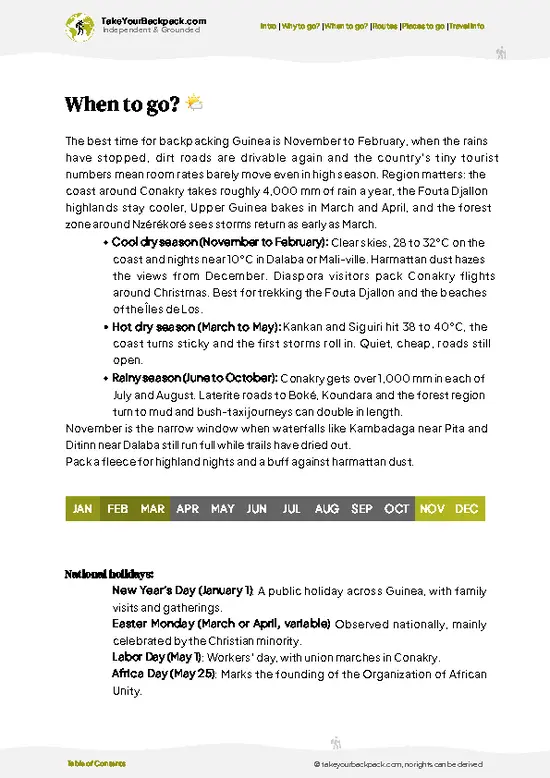
Best Months and Dry Season: The best months for cities in Guinea are November to February, when the dry season brings blue skies, little rain and cooler nights, especially on the highlands. Days on the coast sit around 30 to 33°C with lower humidity, and the harmattan wind can leave a pale dust haze over the inland towns from December. Highland nights can drop to 10 to 15°C, so a light fleece earns its place in your pack.
Shoulder Months: March to May is the shoulder season and the hottest stretch. Upper Guinea can push past 38°C in the afternoons, markets go quiet by midday, and humidity builds on the coast before the rains. November is the better edge of the dry season, with the hills still green and the roads drying out. Prices for taxis and rooms barely shift between seasons, though a few … read more 👉
Best Months and Dry Season: The best months for cities in Guinea are November to February, when the dry season brings blue skies, little rain and cooler nights, especially on the highlands. Days on the coast sit around 30 to 33°C with lower humidity, and the harmattan wind can leave a pale dust haze over the inland towns from December. Highland nights can drop to 10 to 15°C, so a light fleece earns its place in your pack.
Shoulder Months: March to May is the shoulder season and the hottest stretch. Upper Guinea can push past 38°C in the afternoons, markets go quiet by midday, and humidity builds on the coast before the rains. November is the better edge of the dry season, with the hills still green and the roads drying out. Prices for taxis and rooms barely shift between seasons, though a few budget hotels raise rates in December and January.
Rainy Season: June to October brings the heavy rains. Conakry and the coast can receive several thousand millimeters a year, among the wettest in West Africa, with August the peak. Streets flood, taxis crawl through brown water, and unpaved roads into the Fouta Djallon and the forest south become slow or impassable. The upside is lush green hills and fewer travelers, but delays are routine. Avoid the peak of the rains if you plan to move between regions.

city hoppingTips for Visiting Multiple Destinations

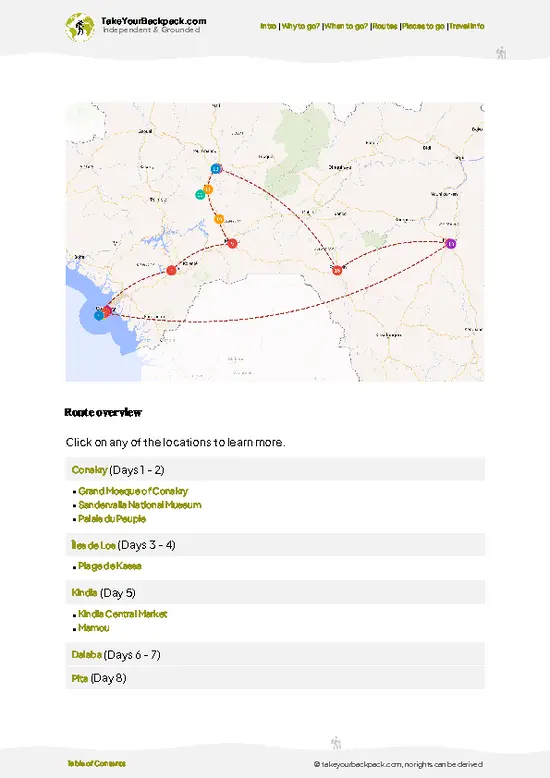
How Many Days to Allow: A trip combining several cities in Guinea needs 10 to 14 days, because the roads are slow and delays are routine. The country splits into regions that cluster naturally: the coast around Conakry, the Fouta Djallon highlands a day inland, Upper Guinea in the dry northeast, and the forest south far from everything else. Most travelers go coast to highlands to Upper Guinea, then return by the same corridor, since the main paved artery runs from Conakry through the mountains.
Time Between Regions: Allow 2 to 3 days per stop so you can see a market, adjust to the heat and recover from the road. Conakry to the highlands takes about 6 to 9 hours by shared taxi or minibus, and highland towns to Upper Guinea can take 8 to 12 hours depending on road condition and breakdowns. Vehicles … read more 👉
How Many Days to Allow: A trip combining several cities in Guinea needs 10 to 14 days, because the roads are slow and delays are routine. The country splits into regions that cluster naturally: the coast around Conakry, the Fouta Djallon highlands a day inland, Upper Guinea in the dry northeast, and the forest south far from everything else. Most travelers go coast to highlands to Upper Guinea, then return by the same corridor, since the main paved artery runs from Conakry through the mountains.
Time Between Regions: Allow 2 to 3 days per stop so you can see a market, adjust to the heat and recover from the road. Conakry to the highlands takes about 6 to 9 hours by shared taxi or minibus, and highland towns to Upper Guinea can take 8 to 12 hours depending on road condition and breakdowns. Vehicles leave when full, usually early in the morning, so arrive at the garage by 6 or 7 a.m. and expect cramped seats, diesel fumes and roadside stops for roasted corn.
Planning Mistakes: The classic error is packing in too many stops and counting on tight schedules. Build in a buffer day before any flight or border crossing. Another is traveling in the rainy season on unpaved routes, when a 150-kilometer stretch can swallow a whole day. Do not arrive after dark at a new town. Daylight arrival makes finding a room and a safe taxi far easier.

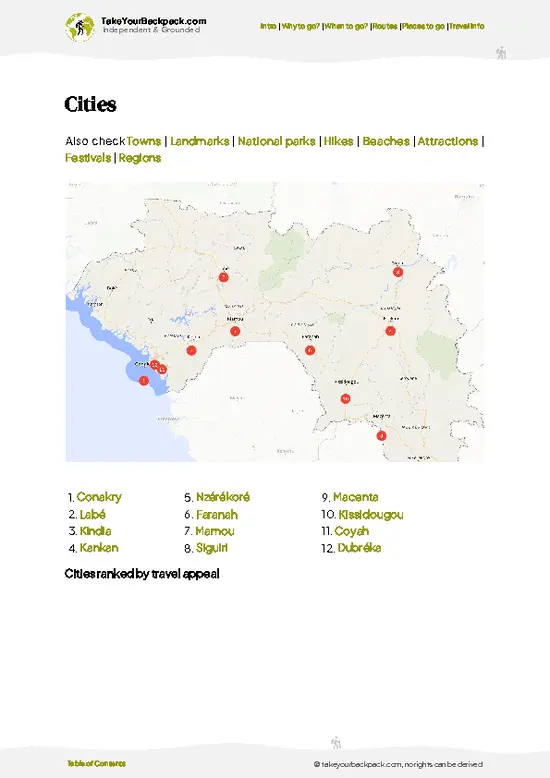
The ListTop cities of Guinea

1 Conakry

Atlantic coastline, urban sprawl, port activity, music venues

Navigate a peninsula city defined by its busy port, lively music scene, and neighborhoods stretching along the ocean’s edge.

2 Labé

Fouta Djallon plateau, Peulh heritage, cool climate

Travel to a plateau city where Peulh culture, temperate weather, and mountain views set the tone for daily life.

3 Kindia

waterfalls, agricultural center, fruit markets

Visit a city surrounded by lush farmland, known for its fresh produce, scenic cascades, and relaxed pace.

4 Kankan

savanna landscape, university town, Manding culture

Discover a city shaped by academic life, Manding traditions, and the open spaces of Guinea’s eastern plains.

5 Nzérékoré

rainforest edge, ethnic diversity, border trade

Immerse yourself in a southern city marked by forest landscapes, cross-border commerce, and a mix of local communities.

6 Faranah

Niger River bend, administrative center, rice fields

Follow the Niger’s curve through a town balancing government activity, riverside farming, and regional trade.

7 Mamou

mountain crossroads, regional markets, transport hub

Experience a city where daily life revolves around busy intersections, local trade, and the surrounding Fouta Djallon highlands.

8 Siguiri

gold mining center, Niger River, border trade

Witness the bustle of gold extraction and cross-border commerce along the Niger in Guinea’s northeastern mining hub.

9 Macenta

rainforest hills, Kpelle culture, weekly market

Experience a humid crossroads where forested slopes meet lively trade, and local traditions shape daily life in the southeast.

guinea-city-macenta
© Google |

10 Kissidougou

forest-savanna transition, coffee production, crossroads town

Sample local coffee and observe the meeting of forest and savanna in a town that links southern and central Guinea.

11 Coyah

transport junction, roadside commerce, river crossing

Pause at a busy transit point where highways, rivers, and roadside stalls converge on the route to Conakry.

12 Dubréka

mangrove estuaries, river delta, gateway to Conakry

Navigate a landscape of tidal waterways and lush wetlands, where city proximity meets the calm of Guinea’s coastal edge.

Loading the map 🌍

Expert viewPro Tips for Exploring the Best

How Many Cities to Visit: I advise three to four cities on a single trip. Guinea’s transport is slow, and each move eats most of a day in a packed shared taxi, so a fourth stop is the practical limit unless you have three weeks. Fewer stops also give you time to learn a market’s rhythm, the morning bread, the midday lull, the evening grills, rather than just passing through.
Choosing the Kind of City: Match the city to your style. If you want energy and nightlife, the coast gives you live music, beach shacks and grilled fish with onion sauce. If you want cooler air and landscapes, the highland towns offer waterfalls, red-earth lanes and long Fulani meals of rice with peanut or leaf sauce. If you want culture and music heritage, Upper Guinea’s towns are the ones for Malinke drumming and dry, … read more 👉
How Many Cities to Visit: I advise three to four cities on a single trip. Guinea’s transport is slow, and each move eats most of a day in a packed shared taxi, so a fourth stop is the practical limit unless you have three weeks. Fewer stops also give you time to learn a market’s rhythm, the morning bread, the midday lull, the evening grills, rather than just passing through.
Choosing the Kind of City: Match the city to your style. If you want energy and nightlife, the coast gives you live music, beach shacks and grilled fish with onion sauce. If you want cooler air and landscapes, the highland towns offer waterfalls, red-earth lanes and long Fulani meals of rice with peanut or leaf sauce. If you want culture and music heritage, Upper Guinea’s towns are the ones for Malinke drumming and dry, golden light over river plains. The forest south suits experienced travelers who accept slow roads and basic rooms in return for rainforest air and almost no other foreigners.
What It Costs: Budget about US$25 to 45 a day (roughly 215,000 to 390,000 Guinean francs) for a backpacker: a basic room costs US$10 to 25 outside the capital and more in Conakry, street meals US$2 to 4, and shared taxis US$5 to 20 per leg depending on distance. Add US$10 to 30 for a local guide or motorbike driver to visit a waterfall, plus small entry or village fees of US$2 to 10. Carry cash, because cards are rarely accepted and ATMs often run dry.
Safety and Etiquette: Guinea has seen political tension and demonstrations, usually concentrated in the capital, so check your government’s latest advice and avoid crowds and protest areas. Carry your passport copy, a visa copy and a yellow fever certificate, and expect police checkpoints where a calm greeting in French helps more than arguing. Dress modestly, since most cities are predominantly Muslim, and ask before photographing people, markets or anything official. Use the right hand for eating and greeting. Take malaria prophylaxis, drink only bottled or filtered water, and walk at night only in well-lit areas. The reward for the trouble is a country where people invite you to tea and the street is always talking.

✈️ The backpacker research shortcutGuinea Travel Guide

An offline-friendly backpacking guide with optimized travel routes, ranked highlights, transport advice, and the best areas to stay.
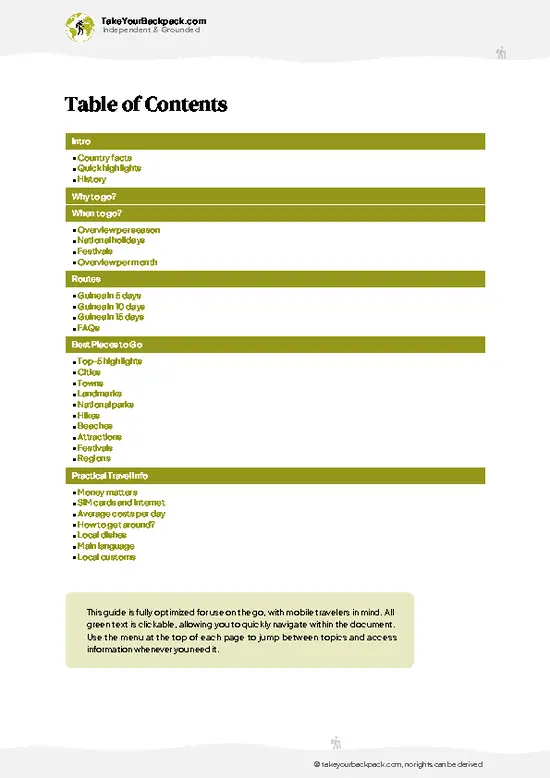
example page 0 from our offline Travel Guide for Guinea
example page 1 from our offline Travel Guide for Guinea
example page 2 from our offline Travel Guide for Guinea
example page 3 from our offline Travel Guide for Guinea
example page 4 from our offline Travel Guide for Guinea
example page 5 from our offline Travel Guide for Guinea
example page 6 from our offline Travel Guide for Guinea
example page 7 from our offline Travel Guide for Guinea
The digital guide (238 pages) contains:
✅ 53 highlights, ranked by travel appeal
✅ Optimized 5, 10 & 15-day travel routes
✅ Cities, national parks, landmarks, beaches
✅ How to get around
✅ Offline-friendly for travel without Wi-Fi
👉 Click to see all 30+ guide features

📅 Plan smarter in minutes, not weeks
✅ Month by month travel advice
✅ Festivals & national holidays
✅ Budget expectations

🗺️ Go to the right places, skip the overrated ones
✅ Honest pros & cons of destinations
✅ Top hikes, parks & viewpoints
✅ Lesser-known places most travelers miss
✅ Clear “worth it vs skip it” guidance

🛏️ Travel smoothly without rookie mistakes
✅ Best areas to stay
✅ Transport systems explained simply
✅ Common scams & safety advice
✅ SIM cards, money & practical tips

🌍 Understand the country, not just visit it
✅ Culture & traditions
✅ 52 Essential phrases & customs
✅ Festivals worth planning around
✅ Traveler-friendly historical context
✅ Insights that make places more meaningful

📱 Built for real travel conditions
✅ Fully downloadable PDF
✅ Works completely offline
✅ Optimized for phone use
✅ Useful in remote areas & buses
✅ Everything in one place
Stop searching, start planning
Get instant access to your full guide. 30‑day money-back guarantee.
+ Add another guide for just

By proceeding you agree to our terms.
Sent to your inbox immediately after payment • 100% Secure Checkout
Best Backpacking Travel Advisor 2025 tourism awardBest Backpacking
Travel Advisor
2025
What others say about Take Your Backpack Guides:
⭐⭐⭐⭐⭐
Fantastic, amazing amount of information!
⭐⭐⭐⭐⭐
My goodness this is amazing, it's what I've been looking for hats off too you!
⭐⭐⭐⭐⭐
I think this is absolutely BRILLIANT
⭐⭐⭐⭐
Very complete and informative. It's still missing places, but I gotta to commend you
⭐⭐⭐⭐⭐
This is truly amazing, thank you, can't wait to explore it with my kids!
⭐⭐⭐⭐⭐
Awesome resource, thank you!
⭐⭐⭐⭐⭐
This is amazing! Can't wait to explore the ones I haven't seen
⭐⭐⭐⭐
I love this! Well done, great idea.
⭐⭐⭐⭐⭐
Thanks for taking the time to make this gem!
⭐⭐⭐⭐⭐
This might be the best website I've ever seen.
⭐⭐⭐⭐⭐
Congratulations, and thank you so much for your work; it's incredibly valuable.
⭐⭐⭐⭐
In all seriousness I think you did a great job pointing out the important spots
⭐⭐⭐⭐⭐
10/10 very good
⭐⭐⭐⭐⭐
As someone who's only just starting to visit regularly this is awesome, thank you.
⭐⭐⭐⭐
Thank you very much! I'm going to visit my dad, it's going to be very useful!
⭐⭐⭐⭐⭐
This is really cool! We'll be travelling for the first time and this definitely come in handy.
⭐⭐⭐⭐⭐
You are now our minister of culture, congratulations 👨‍💼
⭐⭐⭐⭐⭐
Just wanted to tell you that this is a pearl! Going to follow your recommendations.
⭐⭐⭐⭐⭐
This is so cool. I'll definitely be using the resource for my travels soon.
⭐⭐⭐⭐⭐
This is very impressive! Good work.
⭐⭐⭐⭐⭐
This is an amazing and informative site. Very well done!

🛏️ Where to stay?Where to Stay in Guinea

Guinea has almost no true backpacker hostels, so budget travelers sleep in simple guesthouses (“auberges”) and basic hotels, typically GNF 170,000 to 350,000 (US$20 to 40) a night for a fan or air-conditioned double in Conakry, and less upcountry in Labé or Dalaba. In the capital, Kaloum puts you near the ministries, the markets and the boats to the Îles de Loos but goes quiet and dark after office hours, while Taouyah and Kipé in Ratoma have the most restaurants, beach bars and nightlife, at the cost of a long, traffic-choked ride downtown. Camayenne and Dixinn sit in between, with calmer streets along the Corniche and decent access to both ends of the peninsula.

If you enjoy meeting fellow … read more 👉
Guinea has almost no true backpacker hostels, so budget travelers sleep in simple guesthouses (“auberges”) and basic hotels, typically GNF 170,000 to 350,000 (US$20 to 40) a night for a fan or air-conditioned double in Conakry, and less upcountry in Labé or Dalaba. In the capital, Kaloum puts you near the ministries, the markets and the boats to the Îles de Loos but goes quiet and dark after office hours, while Taouyah and Kipé in Ratoma have the most restaurants, beach bars and nightlife, at the cost of a long, traffic-choked ride downtown. Camayenne and Dixinn sit in between, with calmer streets along the Corniche and decent access to both ends of the peninsula.

If you enjoy meeting fellow travelers, consider choosing hostels with high ratings for atmosphere. On the other hand, if you prefer having your own space, a hotel might be a better option.

GuineaMore of Guinea

👋 Meet the founderWho’s Behind Take Your Backpack?

Johan, backpacker and founder of TakeYourBackpackHi, I’m Johan (Netherlands 🇳🇱), the creator of TakeYourBackpack. Over the past 3 decades, I’ve backpacked through 90+ countries across six continents, gaining extensive experience with independent travel, long-term trips, and overland routes.

This site is built on a combination of firsthand travel experience and carefully curated insights from other backpackers. Many guides are based on places I’ve personally visited, while others bring together tips, observations, and practical advice shared by trusted travelers I’ve met along the way.

The goal is to provide realistic, experience-driven guidance — not generic itineraries — so you can explore destinations with better context, clearer expectations, and more confidence.