×

Guyana🇬🇾 | best landmarksExplore the 3 Best landmarks in Guyana

Landmarks in Guyana are mostly natural, and getting to them is part of the visit. Kaieteur Falls drops into a gorge where the air smells of wet stone and the roar carries long before you see anything. Along the coast, the picture changes: Georgetown has white timber colonial buildings with louvered shutters, sea-wall breezes and heavy heat. Costs and effort climb as you go inland, since many sites need chartered flights, river boats or rough 4x4 tracks through the Rupununi savannah. Crowds are thin almost everywhere. Independent travel works, but expect to book guides and transport in advance rather than turn up and wing it.

By Johan Kruseman 🇳🇱 | Updated October 20, 2026
Explore the best national parks in Guyana

Why go?What Makes Them Special

Guyana’s landmarks matter because so few of them have been shaped for visitors. Roughly 85 percent of the country is still forest, and most of its 800,000 or so people live on a narrow Atlantic coastal strip. That leaves the interior with no paved connections, no turnstiles and very little signage. You get the sounds of howler monkeys at dawn, the tannin-dark water of the rivers, and the damp, earthy smell of rainforest after a downpour, without the packaging found elsewhere.

The flip side is infrastructure. Interior sites are reached by small aircraft, long boat rides or bumpy trails, so a single outing can eat a full day and cost far more than the entry fee suggests. Lodges are few, often basic, and priced for packages. Mobile coverage disappears quickly beyond the coast.

History adds … read more 👉
Guyana’s landmarks matter because so few of them have been shaped for visitors. Roughly 85 percent of the country is still forest, and most of its 800,000 or so people live on a narrow Atlantic coastal strip. That leaves the interior with no paved connections, no turnstiles and very little signage. You get the sounds of howler monkeys at dawn, the tannin-dark water of the rivers, and the damp, earthy smell of rainforest after a downpour, without the packaging found elsewhere.

The flip side is infrastructure. Interior sites are reached by small aircraft, long boat rides or bumpy trails, so a single outing can eat a full day and cost far more than the entry fee suggests. Lodges are few, often basic, and priced for packages. Mobile coverage disappears quickly beyond the coast.

History adds a second layer. Dutch, British, African, Indian, Indigenous and Chinese heritage sits on the coast in wooden architecture, sugar estates, mosques, temples and churches, often weathered by salt air and humidity. Anyone choosing Guyana should be ready for independence-minded planning, patchy upkeep and limited English-language interpretation, with the payoff of places that remain quiet and unpolished.
Why These Made the Cut
The list of best unique sites in Guyana is created based on history or culture, wow factor, atmosphere, quirks, and memorability. If you feel a unique site is missing in this list, please let us know.

When to go?Optimal Periods for Travel

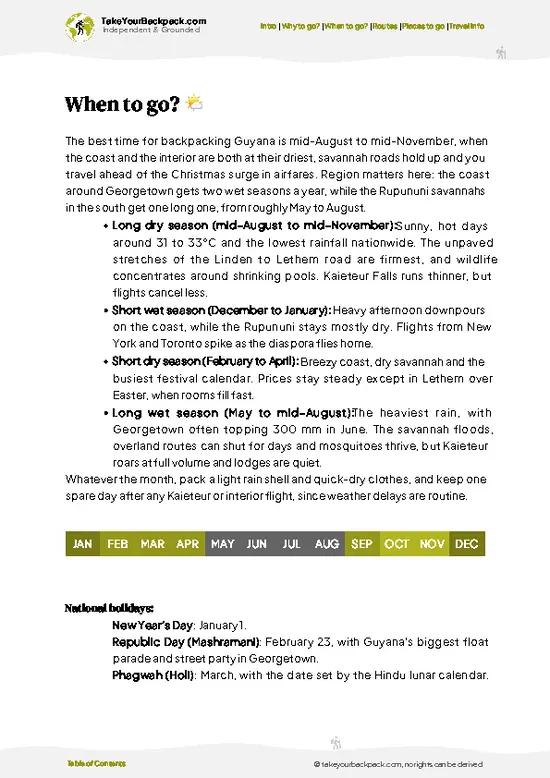
Best months for landmarks: The best months are September to November and, to a lesser degree, February to March, when the two dry seasons make river tracks passable, flights more reliable and the interior less muddy. Temperatures stay fairly constant at 24 to 32°C (75 to 90°F) on the coast and around 22 to 34°C in the savannah, so rain and humidity are what change your trip.
Wet seasons and shoulder periods: The main wet season runs from May to mid-August, with heavy downpours, 200 to 300 mm a month on the coast, red-brown rivers and tracks that turn to slick clay. The short wet season, December to January, is milder. Waterfalls flow at their fullest in the wet season, so shoulder months such as April and late August give strong water volume with fewer storms. Flights can be delayed by low … read more 👉
Best months for landmarks: The best months are September to November and, to a lesser degree, February to March, when the two dry seasons make river tracks passable, flights more reliable and the interior less muddy. Temperatures stay fairly constant at 24 to 32°C (75 to 90°F) on the coast and around 22 to 34°C in the savannah, so rain and humidity are what change your trip.
Wet seasons and shoulder periods: The main wet season runs from May to mid-August, with heavy downpours, 200 to 300 mm a month on the coast, red-brown rivers and tracks that turn to slick clay. The short wet season, December to January, is milder. Waterfalls flow at their fullest in the wet season, so shoulder months such as April and late August give strong water volume with fewer storms. Flights can be delayed by low cloud, and boat trips run slower on swollen rivers.
Regional differences: The Rupununi savannah in the south is far drier than the coast and gets its heaviest rain from May to August, when seasonal flooding can cut roads. Georgetown is humid year-round, with sea breezes at the sea wall in the evenings. Crowds are small throughout, but Christmas, Easter and Mashramani in February push up domestic flight and guesthouse demand, so book early.

unique site hoppingHow to Combine landmarks Into One Trip

How long a combined trip takes: A trip linking several landmarks needs 8 to 12 days, because interior transfers are slow and weather-dependent. The sensible plan runs from the coast inland rather than back and forth: start in Georgetown, the hub for flights and 4x4 transfers, then head to the interior and return by air.
Regional clusters and timing: Georgetown and the nearby Demerara coast suit 1 to 2 days. The Potaro and Kaieteur region is usually done as a long day trip or a lodge stay of 2 to 3 days, with flights of about 1 hour each way from Georgetown. The Rupununi savannah around Lethem and Annai needs 3 to 5 days, with a flight of roughly 1.5 hours or a rough overland journey of 12 to 20 hours by minibus or truck that can stretch longer in rain. Moving between interior regions often … read more 👉
How long a combined trip takes: A trip linking several landmarks needs 8 to 12 days, because interior transfers are slow and weather-dependent. The sensible plan runs from the coast inland rather than back and forth: start in Georgetown, the hub for flights and 4x4 transfers, then head to the interior and return by air.
Regional clusters and timing: Georgetown and the nearby Demerara coast suit 1 to 2 days. The Potaro and Kaieteur region is usually done as a long day trip or a lodge stay of 2 to 3 days, with flights of about 1 hour each way from Georgetown. The Rupununi savannah around Lethem and Annai needs 3 to 5 days, with a flight of roughly 1.5 hours or a rough overland journey of 12 to 20 hours by minibus or truck that can stretch longer in rain. Moving between interior regions often means returning to Georgetown or Lethem first.
Planning mistakes: The commonest error is packing too much in, assuming distances behave like they do on a map. Leave buffer days before international flights, because weather cancellations are routine. Another is skipping advance booking: charter seats, lodge beds and guides sell out in peak months, so reserve weeks ahead. Travelers also underestimate dust, mud and heat on long road legs, so carry water and a dry change of clothes.

The ListThe Best landmarks of Guyana

1 Kaieteur Falls

Single 226-meter drop, tea-dark Potaro River, rim bromeliads, small-plane access

Fly over unbroken rainforest to a sandstone rim where the Potaro River drops in one piece, with cock-of-the-rock birds and golden frogs nearby.

guyana-unique-site-kaieteur-falls
© Google | Randolfo Santos

2 Orinduik Falls

Red jasper shelves, Brazil border bank, rock jacuzzi pools, savannah airstrip

Land on open Pakaraima grassland, then soak in rock-pocket pools on a wide stepped cascade of jasper with Brazil on the far bank.

guyana-unique-site-orinduik-falls
© Google |

3 Kumu Falls

Black granite cascades, cold mountain pool, Kanuku foothills, village permission

Ride the dusty savannah track from Lethem, ask permission in Kumu village, then scramble across dark boulders to swim in cold water below.

Loading the map 🌍

Expert viewInsights from Locals and Experts

How many landmarks to aim for: Plan on three to five landmarks in a trip of one to two weeks. Each interior outing consumes a whole day or more once flights, boat transfers and weather delays are counted, and a longer list leaves you tired in a seat rather than standing at a view. Fewer stops also let you linger when the light changes over the water or the savannah goes gold at dusk.
Choosing between kinds: Nature-driven travelers should spend most of their time and money on interior natural sites, where the rewards are scale, noise and silence. Those curious about history can fit the Georgetown and coastal heritage sites into cheap, walkable days with wooden facades, market smells and sea-wall air. Travelers short on cash should prioritize one big interior trip and fill the rest with coast … read more 👉
How many landmarks to aim for: Plan on three to five landmarks in a trip of one to two weeks. Each interior outing consumes a whole day or more once flights, boat transfers and weather delays are counted, and a longer list leaves you tired in a seat rather than standing at a view. Fewer stops also let you linger when the light changes over the water or the savannah goes gold at dusk.
Choosing between kinds: Nature-driven travelers should spend most of their time and money on interior natural sites, where the rewards are scale, noise and silence. Those curious about history can fit the Georgetown and coastal heritage sites into cheap, walkable days with wooden facades, market smells and sea-wall air. Travelers short on cash should prioritize one big interior trip and fill the rest with coast sites. Wildlife-minded visitors should favor savanna and river landmarks where dawn boat trips and walks cost less than flights.
What it costs: Budget about US$60 to 110 a day for guesthouses, shared meals and local transport on the coast and in the savannah, and up to US$150 to 250 a day when interior flights and lodges are involved. Coastal and heritage sites are usually free or cost under US$5. Guides run about US$20 to 60 per day for local outings, while a Kaieteur-style day flight package often costs US$250 to 400 per person. Shared boats, 4x4 seats and park fees add roughly US$20 to 80 per outing. Cash in Guyanese dollars is useful, since card acceptance is patchy outside Georgetown.
Safety and etiquette: In Georgetown, avoid walking at night, keep phones out of sight and use registered taxis, as street crime is a real concern in some districts. In the interior, hire licensed guides, tell lodge staff your plans, and carry insect repellent, water and a rain layer. Trails get slippery, so footwear with grip matters near waterfalls and rocky edges. Many interior communities are Indigenous, so ask before photographing people, follow village rules and treat alcohol and gifts with care. Dress modestly at mosques, temples and churches, and remove shoes where asked. These habits keep access open and the experience calm.

✈️ The backpacker research shortcutGuyana Travel Guide

An offline-friendly backpacking guide with optimized travel routes, ranked highlights, transport advice, and the best areas to stay.
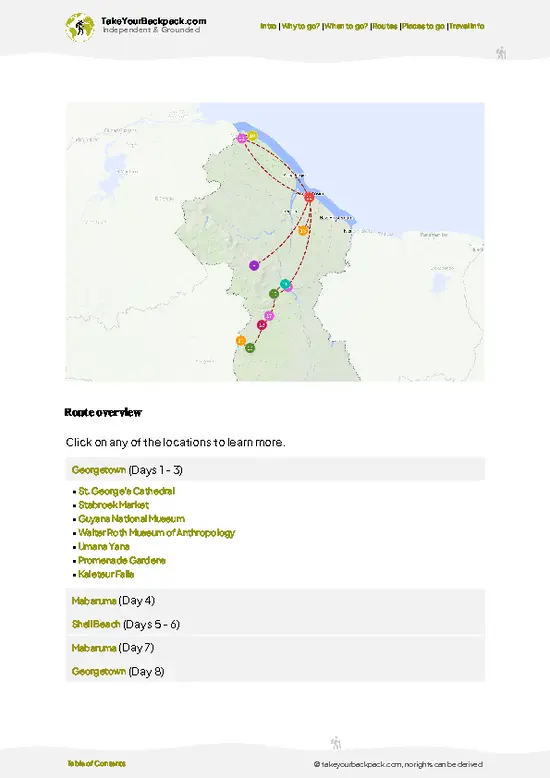
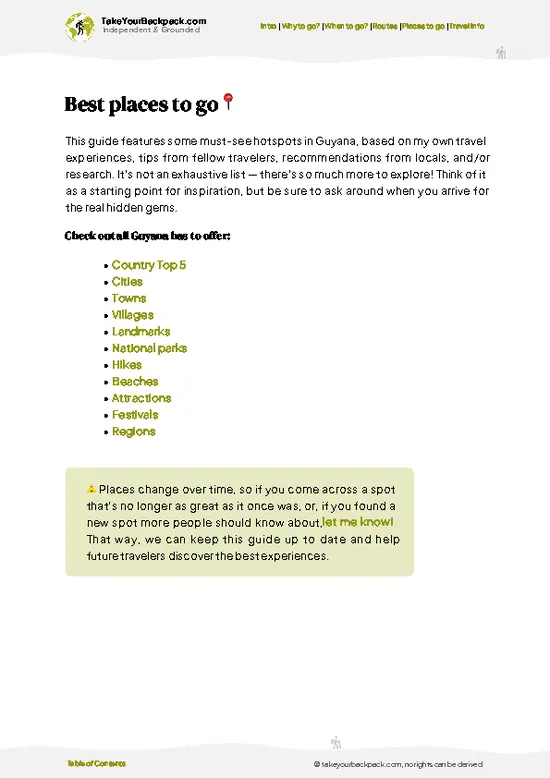
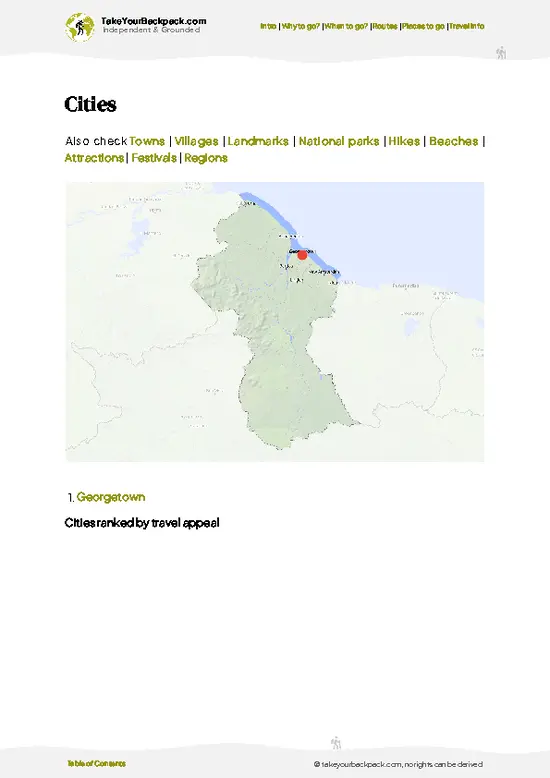
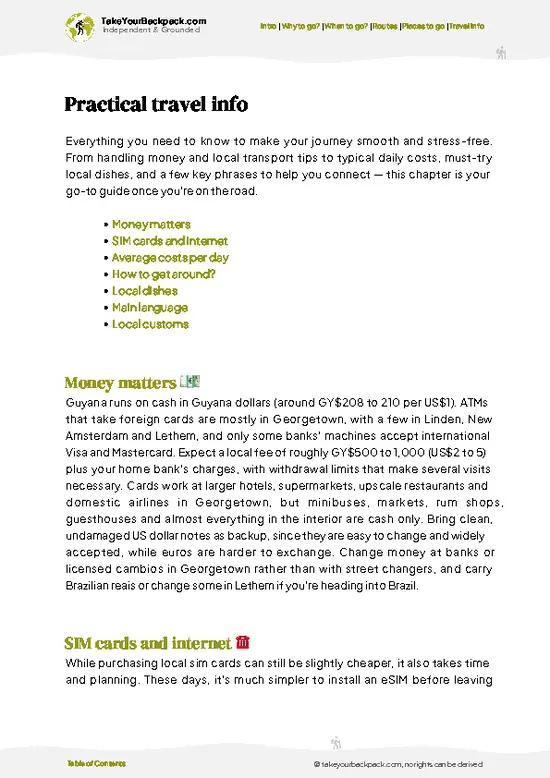
example page 0 from our offline Travel Guide for Guyana
example page 1 from our offline Travel Guide for Guyana
example page 2 from our offline Travel Guide for Guyana
example page 3 from our offline Travel Guide for Guyana
example page 4 from our offline Travel Guide for Guyana
example page 5 from our offline Travel Guide for Guyana
example page 6 from our offline Travel Guide for Guyana
example page 7 from our offline Travel Guide for Guyana
The digital guide (161 pages) contains:
✅ 43 highlights, ranked by travel appeal
✅ Optimized 5, 10 & 15-day travel routes
✅ Cities, national parks, landmarks, beaches
✅ How to get around
✅ Offline-friendly for travel without Wi-Fi
👉 Click to see all 30+ guide features

📅 Plan smarter in minutes, not weeks
✅ Month by month travel advice
✅ Festivals & national holidays
✅ Budget expectations

🗺️ Go to the right places, skip the overrated ones
✅ Honest pros & cons of destinations
✅ Top hikes, parks & viewpoints
✅ Lesser-known places most travelers miss
✅ Clear “worth it vs skip it” guidance

🛏️ Travel smoothly without rookie mistakes
✅ Best areas to stay
✅ Transport systems explained simply
✅ Common scams & safety advice
✅ SIM cards, money & practical tips

🌍 Understand the country, not just visit it
✅ Culture & traditions
✅ Local customs
✅ Festivals worth planning around
✅ Traveler-friendly historical context
✅ Insights that make places more meaningful

📱 Built for real travel conditions
✅ Fully downloadable PDF
✅ Works completely offline
✅ Optimized for phone use
✅ Useful in remote areas & buses
✅ Everything in one place
Stop searching, start planning
Get instant access to your full guide. 30‑day money-back guarantee.
+ Add another guide for just

By proceeding you agree to our terms.
Sent to your inbox immediately after payment • 100% Secure Checkout
Best Backpacking Travel Advisor 2025 tourism awardBest Backpacking
Travel Advisor
2025
What others say about Take Your Backpack Guides:
⭐⭐⭐⭐⭐
Fantastic, amazing amount of information!
⭐⭐⭐⭐⭐
My goodness this is amazing, it's what I've been looking for hats off too you!
⭐⭐⭐⭐⭐
I think this is absolutely BRILLIANT
⭐⭐⭐⭐
Very complete and informative. It's still missing places, but I gotta to commend you
⭐⭐⭐⭐⭐
This is truly amazing, thank you, can't wait to explore it with my kids!
⭐⭐⭐⭐⭐
Awesome resource, thank you!
⭐⭐⭐⭐⭐
This is amazing! Can't wait to explore the ones I haven't seen
⭐⭐⭐⭐
I love this! Well done, great idea.
⭐⭐⭐⭐⭐
Thanks for taking the time to make this gem!
⭐⭐⭐⭐⭐
This might be the best website I've ever seen.
⭐⭐⭐⭐⭐
Congratulations, and thank you so much for your work; it's incredibly valuable.
⭐⭐⭐⭐
In all seriousness I think you did a great job pointing out the important spots
⭐⭐⭐⭐⭐
10/10 very good
⭐⭐⭐⭐⭐
As someone who's only just starting to visit regularly this is awesome, thank you.
⭐⭐⭐⭐
Thank you very much! I'm going to visit my dad, it's going to be very useful!
⭐⭐⭐⭐⭐
This is really cool! We'll be travelling for the first time and this definitely come in handy.
⭐⭐⭐⭐⭐
You are now our minister of culture, congratulations 👨‍💼
⭐⭐⭐⭐⭐
Just wanted to tell you that this is a pearl! Going to follow your recommendations.
⭐⭐⭐⭐⭐
This is so cool. I'll definitely be using the resource for my travels soon.
⭐⭐⭐⭐⭐
This is very impressive! Good work.
⭐⭐⭐⭐⭐
This is an amazing and informative site. Very well done!

🛏️ Where to stay?Top Areas to Stay

Guyana has only a handful of true backpacker hostels, so most budget travelers stay in simple guesthouses and small family-run hotels in Georgetown, where a private room usually costs US$25 to 50 a night. Kingston and the streets near the seawall put you closest to restaurants, bars and weekend nightlife, while leafy Queenstown is quieter and more residential but still walkable to the center. Bel Air and Lamaha Gardens feel safer and calmer after dark at the cost of a taxi ride everywhere, and the area around Stabroek is cheap and central but best avoided once the market closes.

If you enjoy meeting fellow travelers, consider choosing hostels with high ratings for atmosphere. On the other hand, … read more 👉
Guyana has only a handful of true backpacker hostels, so most budget travelers stay in simple guesthouses and small family-run hotels in Georgetown, where a private room usually costs US$25 to 50 a night. Kingston and the streets near the seawall put you closest to restaurants, bars and weekend nightlife, while leafy Queenstown is quieter and more residential but still walkable to the center. Bel Air and Lamaha Gardens feel safer and calmer after dark at the cost of a taxi ride everywhere, and the area around Stabroek is cheap and central but best avoided once the market closes.

If you enjoy meeting fellow travelers, consider choosing hostels with high ratings for atmosphere. On the other hand, if you prefer having your own space, a hotel might be a better option.

GuyanaDiscover the Country

👋 Meet the founderWho’s Behind Take Your Backpack?

Johan, backpacker and founder of TakeYourBackpackHi, I’m Johan (Netherlands 🇳🇱), the creator of TakeYourBackpack. Over the past 3 decades, I’ve backpacked through 90+ countries across six continents, gaining extensive experience with independent travel, long-term trips, and overland routes.

This site is built on a combination of firsthand travel experience and carefully curated insights from other backpackers. Many guides are based on places I’ve personally visited, while others bring together tips, observations, and practical advice shared by trusted travelers I’ve met along the way.

The goal is to provide realistic, experience-driven guidance — not generic itineraries — so you can explore destinations with better context, clearer expectations, and more confidence.