×

Hong Kong🇭🇰 | best villagesThe Must-See villages in Hong Kong

Villages in Hong Kong are not postcard hamlets far from the city. Most are walled Hakka and Cantonese settlements, fishing communities and island clusters, and almost all sit within an hour or two of Central by MTR, bus or ferry. That makes this a rare place where independent travel needs no overnight bus or guide. The New Territories feel farming-and-ancestral-hall quiet, the outlying islands run on ferries and sea air, and the Sai Kung coast sits between hiking trails and seafood piers. Go on a weekday morning, since weekend ferries and minibuses fill by 10 a.m. Costs stay low once you leave the city: a village lunch runs about HK$50 to 90 (US$6 to 12).

By Johan Kruseman 🇳🇱 | Updated October 19, 2026
Explore the best landmarks in Hong Kong

Why go?Understanding Their Importance

Hong Kong is unusual because rural life survives inside one of the densest cities on earth. Before British rule in 1898, clans settled the New Territories, built walled villages, ancestral halls and feng shui woods, and many families still hold land under indigenous inhabitant rights. Steep, rainy hills left little farmland, so coastal fishing and hillside terraces shaped where people lived. Today the public transport network reaches nearly all of them, with the MTR, green minibuses, buses and the Outlying Islands ferries from Central doing the work. That is the big advantage: you can sleep in the city and wander a village by lunch.

Know a few things before you plan around villages. Many are working homes, not heritage attractions, so signage, cafes and toilets can be thin and some lanes … read more 👉
Hong Kong is unusual because rural life survives inside one of the densest cities on earth. Before British rule in 1898, clans settled the New Territories, built walled villages, ancestral halls and feng shui woods, and many families still hold land under indigenous inhabitant rights. Steep, rainy hills left little farmland, so coastal fishing and hillside terraces shaped where people lived. Today the public transport network reaches nearly all of them, with the MTR, green minibuses, buses and the Outlying Islands ferries from Central doing the work. That is the big advantage: you can sleep in the city and wander a village by lunch.

Know a few things before you plan around villages. Many are working homes, not heritage attractions, so signage, cafes and toilets can be thin and some lanes are private. Several old settlements are mostly empty, with younger residents gone to the city. Summer is hot, humid and typhoon-prone, which affects trails and ferries more than the villages themselves. And expect contrast over isolation: tower blocks, power lines and traffic often sit just beyond the paddy fields. Treat them as short, atmospheric stops rather than remote escapes, and you will enjoy them far more.
How the List Was Created
The list of best villages in Hong Kong is created based on authenticity, scenic beauty, community spirit, traditions, and overall character. If you feel a village is missing in this list, please let us know.


When to go?Seasonal Guide to Visiting

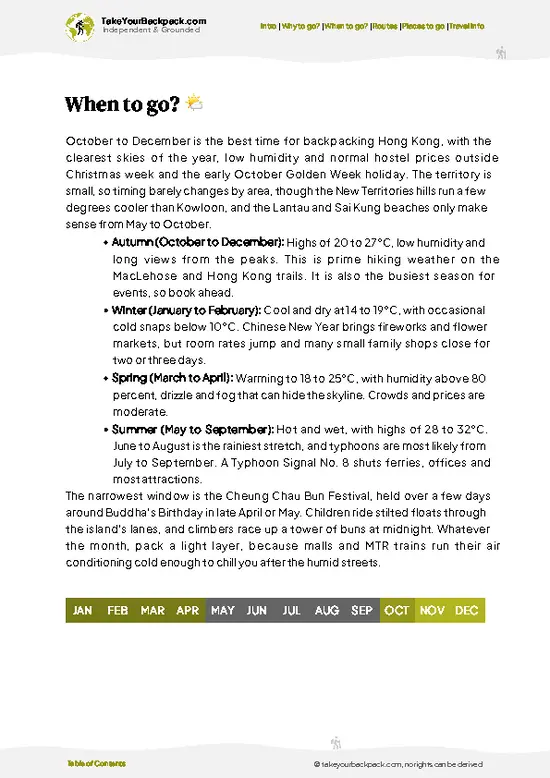
Best months and why: The best months for villages in Hong Kong are October to December, when humidity drops, skies clear and daytime highs sit around 20 to 27°C. Rainfall is light, roughly 20 to 50 mm a month, so village lanes and coastal paths stay dry and walkable. March to April is a pleasant second choice, though fog and drizzle can roll in.
Shoulder seasons and heat: January and February are cool and dry, with temperatures from about 12 to 18°C, and sometimes a cold snap near 8°C in the northern New Territories where the villages are more exposed. Pack a light layer. May starts to turn muggy, with humidity above 85 percent and monthly rain up to 300 mm.
Summer and storms: June to September brings heat of 30 to 34°C, heavy downpours and typhoon season. Outlying island ferries can be suspended … read more 👉
Best months and why: The best months for villages in Hong Kong are October to December, when humidity drops, skies clear and daytime highs sit around 20 to 27°C. Rainfall is light, roughly 20 to 50 mm a month, so village lanes and coastal paths stay dry and walkable. March to April is a pleasant second choice, though fog and drizzle can roll in.
Shoulder seasons and heat: January and February are cool and dry, with temperatures from about 12 to 18°C, and sometimes a cold snap near 8°C in the northern New Territories where the villages are more exposed. Pack a light layer. May starts to turn muggy, with humidity above 85 percent and monthly rain up to 300 mm.
Summer and storms: June to September brings heat of 30 to 34°C, heavy downpours and typhoon season. Outlying island ferries can be suspended when Signal 8 is raised, and shaded village paths feel sticky by 10 a.m. If you must travel then, start at sunrise and finish before the afternoon storms.
Crowds and prices: Weekends and public holidays bring the biggest crowds, especially around Lunar New Year (late January to February) and the Mid-Autumn period. Weekday visits keep ferries and minibuses quiet. Hotel rates in the city rise 20 to 40 percent in peak winter holidays, so book ahead.

village hoppingOptimizing Your Multi-Stop Itinerary

How many days to allow: A trip combining several villages in Hong Kong needs 3 to 5 days, because the distances are short but the transfers are fiddly. Group stops by region: the northern New Territories together, the Sai Kung and east coast together, and the outlying islands together. Base yourself in Kowloon or Hong Kong Island and make loops from there, rather than moving hotels.
Direction and timing: Start with the New Territories, since MTR and bus links are the easiest and you can find your rhythm. Move to Sai Kung next, then end with the islands, where ferries run less often and good weather matters most. Plan 1.5 to 3 hours per stop for a slow walk and a meal. The transfer from Central to most regions takes 45 to 90 minutes, and between regions often 1 to 2 hours, since you usually … read more 👉
How many days to allow: A trip combining several villages in Hong Kong needs 3 to 5 days, because the distances are short but the transfers are fiddly. Group stops by region: the northern New Territories together, the Sai Kung and east coast together, and the outlying islands together. Base yourself in Kowloon or Hong Kong Island and make loops from there, rather than moving hotels.
Direction and timing: Start with the New Territories, since MTR and bus links are the easiest and you can find your rhythm. Move to Sai Kung next, then end with the islands, where ferries run less often and good weather matters most. Plan 1.5 to 3 hours per stop for a slow walk and a meal. The transfer from Central to most regions takes 45 to 90 minutes, and between regions often 1 to 2 hours, since you usually head back through an urban hub such as Tai Po, Sha Tin or Diamond Hill first.
Planning mistakes: The classic error is stacking three villages in one day. Minibuses can run only every 15 to 30 minutes, and the last ones leave early evening, so you can get stranded. Allow two stops a day at most and check the last departure before you set off. Another mistake is treating island ferries like the MTR: schedules thin out on weekdays and the last boats go around 11 p.m. Load an Octopus card and screenshot timetables, since signal can drop in valleys.

The ListTop villages of Hong Kong

1 Sam Mun Tsai

fishing village, stilt houses, seafood markets

Wander narrow lanes lined with traditional homes and observe daily life shaped by the rhythms of the sea and local fisheries.

Loading the map 🌍

Expert viewPro Tips for Exploring the Best

How many villages to visit: Aim for four to six villages in total on a trip of 3 to 5 days. That gives enough variety to see different settlement types without turning each visit into a checklist. Two a day is the practical ceiling, since public transport between rural stops often runs every 15 to 30 minutes and walking between them takes real time.
Which kind to prioritize: If you love history and architecture, choose walled Hakka and Cantonese settlements in the New Territories, with ancestral halls and old gates. If you want coast, seafood and hiking, pick Sai Kung and fishing communities where you can combine paths with a pier lunch. If you want slow, car-free life, choose the outlying islands, which suit overnight stays. Mixing one of each gives the best sense of how Hong Kong’s countryside … read more 👉
How many villages to visit: Aim for four to six villages in total on a trip of 3 to 5 days. That gives enough variety to see different settlement types without turning each visit into a checklist. Two a day is the practical ceiling, since public transport between rural stops often runs every 15 to 30 minutes and walking between them takes real time.
Which kind to prioritize: If you love history and architecture, choose walled Hakka and Cantonese settlements in the New Territories, with ancestral halls and old gates. If you want coast, seafood and hiking, pick Sai Kung and fishing communities where you can combine paths with a pier lunch. If you want slow, car-free life, choose the outlying islands, which suit overnight stays. Mixing one of each gives the best sense of how Hong Kong’s countryside differs by region.
What it costs: Budget about US$45 to 80 a day (HK$350 to 620) for a backpacker who sleeps in a hostel dorm or budget guesthouse. Dorm beds usually cost HK$200 to 350 (US$26 to 45) in the city. Village meals cost HK$50 to 120 (US$6 to 15), and a seafood dinner HK$150 to 300 (US$19 to 38) per person. Transport is cheap with an Octopus card: MTR and bus rides run HK$5 to 30 (under US$4) each, ferries to islands HK$17 to 60 (US$2 to 8), and green minibuses HK$5 to 25 (under US$3). Most villages are free to enter. Small heritage halls and museums sometimes charge HK$0 to 20 (up to US$3), while a local guide or organized heritage walk costs about HK$250 to 500 (US$32 to 65).
Safety and etiquette: Hong Kong is very safe for solo travelers, including at night, and violent crime is rare. The practical risks are environmental: heat, sudden rain and typhoon signals, plus slippery paths. Carry at least 1.5 liters of water per person on any walk, since shops can be scarce. Watch out for wild boar and cattle in some rural areas, and never feed them. Dogs may roam village lanes, so keep your distance.
Cultural considerations: Many villages are private residential places. Keep voices low, avoid photographing people at doors or in courtyards without asking, and stay out of gated lanes. Ancestral halls and small temples are active places of worship, so dress modestly, do not touch offerings and do not point cameras at worshippers. Visit shrines quietly, especially during festivals such as Ching Ming or Chung Yeung when families return. Bring cash in small bills, as many village stalls and cafes do not take cards. In my experience, a simple smile and a quiet “m̀h’gōi” (thank you or excuse me) goes a long way.

✈️ The backpacker research shortcutHong Kong Travel Guide

An offline-friendly backpacking guide with optimized travel routes, ranked highlights, transport advice, and the best areas to stay.
example page 0 from our offline Travel Guide for Hong Kong
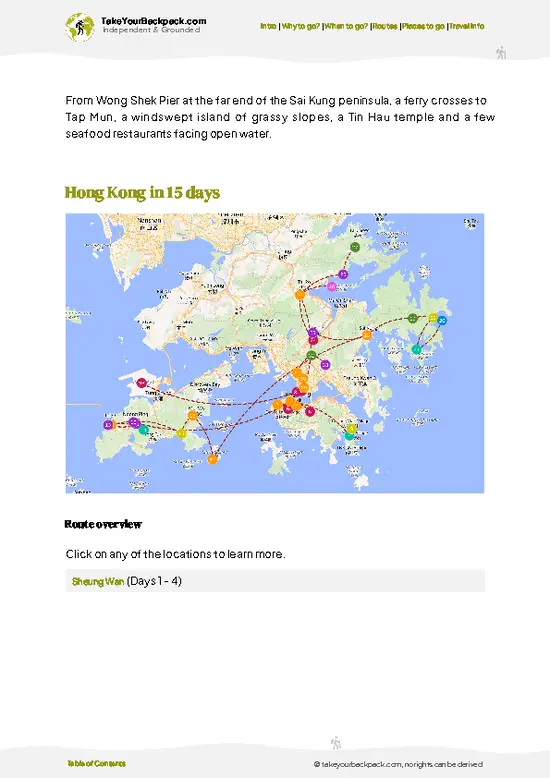
example page 1 from our offline Travel Guide for Hong Kong
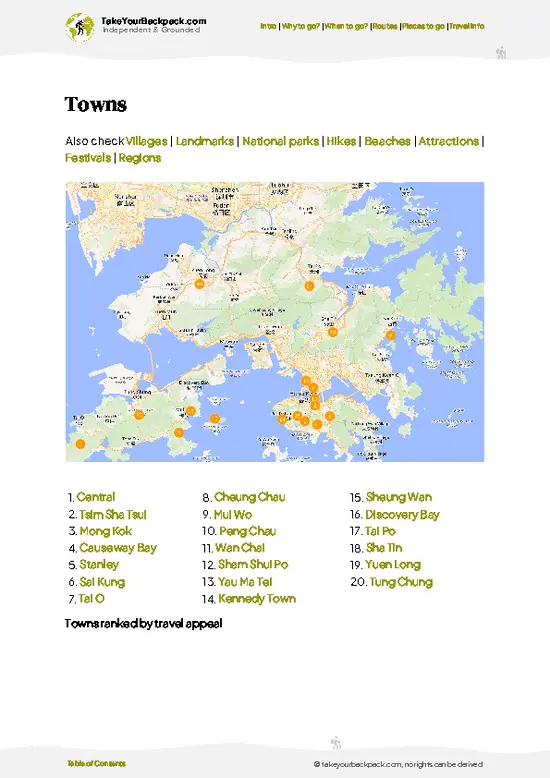
example page 2 from our offline Travel Guide for Hong Kong
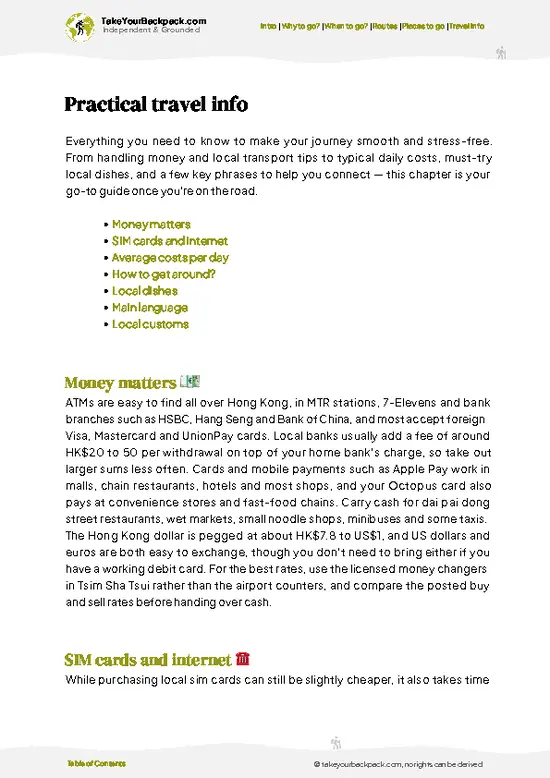
example page 3 from our offline Travel Guide for Hong Kong
example page 4 from our offline Travel Guide for Hong Kong
example page 5 from our offline Travel Guide for Hong Kong
example page 6 from our offline Travel Guide for Hong Kong
example page 7 from our offline Travel Guide for Hong Kong
The digital guide (359 pages) contains:
✅ 97 highlights, ranked by travel appeal
✅ Optimized 5, 10 & 15-day travel routes
✅ Cities, national parks, landmarks, beaches
✅ How to get around
✅ Offline-friendly for travel without Wi-Fi
👉 Click to see all 30+ guide features

📅 Plan smarter in minutes, not weeks
✅ Month by month travel advice
✅ Festivals & national holidays
✅ Budget expectations

🗺️ Go to the right places, skip the overrated ones
✅ Honest pros & cons of destinations
✅ Top hikes, parks & viewpoints
✅ Lesser-known places most travelers miss
✅ Clear “worth it vs skip it” guidance

🛏️ Travel smoothly without rookie mistakes
✅ Best areas to stay
✅ Transport systems explained simply
✅ Common scams & safety advice
✅ SIM cards, money & practical tips

🌍 Understand the country, not just visit it
✅ Culture & traditions
✅ 52 Essential phrases & customs
✅ Festivals worth planning around
✅ Traveler-friendly historical context
✅ Insights that make places more meaningful

📱 Built for real travel conditions
✅ Fully downloadable PDF
✅ Works completely offline
✅ Optimized for phone use
✅ Useful in remote areas & buses
✅ Everything in one place
Stop searching, start planning
Get instant access to your full guide. 30‑day money-back guarantee.
+ Add another guide for just

By proceeding you agree to our terms.
Sent to your inbox immediately after payment • 100% Secure Checkout
Best Backpacking Travel Advisor 2025 tourism awardBest Backpacking
Travel Advisor
2025
What others say about Take Your Backpack Guides:
⭐⭐⭐⭐⭐
Fantastic, amazing amount of information!
⭐⭐⭐⭐⭐
My goodness this is amazing, it's what I've been looking for hats off too you!
⭐⭐⭐⭐⭐
I think this is absolutely BRILLIANT
⭐⭐⭐⭐
Very complete and informative. It's still missing places, but I gotta to commend you
⭐⭐⭐⭐⭐
This is truly amazing, thank you, can't wait to explore it with my kids!
⭐⭐⭐⭐⭐
Awesome resource, thank you!
⭐⭐⭐⭐⭐
This is amazing! Can't wait to explore the ones I haven't seen
⭐⭐⭐⭐
I love this! Well done, great idea.
⭐⭐⭐⭐⭐
Thanks for taking the time to make this gem!
⭐⭐⭐⭐⭐
This might be the best website I've ever seen.
⭐⭐⭐⭐⭐
Congratulations, and thank you so much for your work; it's incredibly valuable.
⭐⭐⭐⭐
In all seriousness I think you did a great job pointing out the important spots
⭐⭐⭐⭐⭐
10/10 very good
⭐⭐⭐⭐⭐
As someone who's only just starting to visit regularly this is awesome, thank you.
⭐⭐⭐⭐
Thank you very much! I'm going to visit my dad, it's going to be very useful!
⭐⭐⭐⭐⭐
This is really cool! We'll be travelling for the first time and this definitely come in handy.
⭐⭐⭐⭐⭐
You are now our minister of culture, congratulations 👨‍💼
⭐⭐⭐⭐⭐
Just wanted to tell you that this is a pearl! Going to follow your recommendations.
⭐⭐⭐⭐⭐
This is so cool. I'll definitely be using the resource for my travels soon.
⭐⭐⭐⭐⭐
This is very impressive! Good work.
⭐⭐⭐⭐⭐
This is an amazing and informative site. Very well done!

🛏️ Where to stay?Where to Stay: Hong Kong Edition

Hong Kong has plenty of hostels and guesthouses, with dorm beds typically running HK$150 to 350 (US$20 to 45) a night and private rooms often the size of a closet. Tsim Sha Tsui puts you on the harbor promenade with the densest cluster of cheap guesthouses, though the older blocks can feel cramped and hectic, while Mong Kok and Yau Ma Tei are a bit cheaper, close to the night markets and street food, and very loud until late. On Hong Kong Island, Causeway Bay and Wan Chai keep you near shopping and the bar scene, and Sheung Wan is quieter and more local but pricier per bed, and the whole city stays very safe after dark.

If you enjoy meeting fellow travelers, consider choosing hostels with high … read more 👉
Hong Kong has plenty of hostels and guesthouses, with dorm beds typically running HK$150 to 350 (US$20 to 45) a night and private rooms often the size of a closet. Tsim Sha Tsui puts you on the harbor promenade with the densest cluster of cheap guesthouses, though the older blocks can feel cramped and hectic, while Mong Kok and Yau Ma Tei are a bit cheaper, close to the night markets and street food, and very loud until late. On Hong Kong Island, Causeway Bay and Wan Chai keep you near shopping and the bar scene, and Sheung Wan is quieter and more local but pricier per bed, and the whole city stays very safe after dark.

If you enjoy meeting fellow travelers, consider choosing hostels with high ratings for atmosphere. On the other hand, if you prefer having your own space, a hotel might be a better option.

Hong KongExplore Beyond This Category

👋 Meet the founderWho’s Behind Take Your Backpack?

Johan, backpacker and founder of TakeYourBackpackHi, I’m Johan (Netherlands 🇳🇱), the creator of TakeYourBackpack. Over the past 3 decades, I’ve backpacked through 90+ countries across six continents, gaining extensive experience with independent travel, long-term trips, and overland routes.

This site is built on a combination of firsthand travel experience and carefully curated insights from other backpackers. Many guides are based on places I’ve personally visited, while others bring together tips, observations, and practical advice shared by trusted travelers I’ve met along the way.

The goal is to provide realistic, experience-driven guidance — not generic itineraries — so you can explore destinations with better context, clearer expectations, and more confidence.