×

Israel🇮🇱 | best festivalsBest 10 festivals in Israel

Festivals in Israel are mostly city and culture events, not camping marathons. Tel Aviv brings beach-front crowds, late nights and the highest prices. Jerusalem runs on arts programs and religious calendars, and transport shuts down for Shabbat. Haifa and the Galilee are cheaper and calmer, with local audiences and little English signage. Eilat and the Negev suit music and desert gatherings, but need long transfers and heat tolerance. For backpacking or independent travel, the Tel Aviv to Jerusalem corridor is the easiest base. Skip anything that needs a rental car and a tight schedule if your budget is thin.

By Johan Kruseman 🇳🇱 | Updated October 18, 2026
Explore the best regions in Israel

Why go?Understanding Their Importance

Israel works for festivals because of compact geography, a dense calendar and a population that turns out for events. The country is roughly 400 km long, so a traveler can reach most regions within a few hours. Jewish, Muslim and Christian holy days all shape public life, so the year has far more peaks than a standard national calendar suggests. A long dry season from about April to October also keeps open-air programming reliable.

Before choosing Israel for festivals, understand the limits. It is an expensive country: food, beds and tickets cost roughly what you would pay in Western Europe, and a backpacker budget stretches thin. Shabbat (Friday afternoon to Saturday evening) halts trains and most buses, and Jewish holidays do the same. Yom Kippur brings a near total shutdown of roads and … read more 👉
Israel works for festivals because of compact geography, a dense calendar and a population that turns out for events. The country is roughly 400 km long, so a traveler can reach most regions within a few hours. Jewish, Muslim and Christian holy days all shape public life, so the year has far more peaks than a standard national calendar suggests. A long dry season from about April to October also keeps open-air programming reliable.

Before choosing Israel for festivals, understand the limits. It is an expensive country: food, beds and tickets cost roughly what you would pay in Western Europe, and a backpacker budget stretches thin. Shabbat (Friday afternoon to Saturday evening) halts trains and most buses, and Jewish holidays do the same. Yom Kippur brings a near total shutdown of roads and services. Many events are held in Hebrew, so language-heavy theater and comedy are rarely worth the ticket unless you speak it.

Security is the other factor. Event schedules can change, move or be canceled at short notice, particularly near the northern and southern borders. Check government advisories and organizer announcements shortly before you book. Large outdoor gatherings near border areas are not worth the risk or the planning effort when equivalent events run in central cities.
How the List Was Created
The list of best festivals in Israel is created based on energy, traditions, crowd experience, activities, and overall excitement. If you feel a festival is missing in this list, please let us know.

When to go?Best Time to Visit Israel for festivals

Best months: The best months for festivals in Israel are April to June and September to October, when daytime temperatures sit at 22 to 32°C and rain is rare. Tel Aviv and Jerusalem both cool down in the evening, which suits outdoor programs. Jerusalem is higher and drier, and nights in spring and autumn can drop to 12 to 16°C, so a light layer is needed.

Shoulder seasons and winter: November to March is the wet season. Most of Israel’s annual rainfall, roughly 500 to 600 mm on the coast, falls in these months, with the heaviest rain in December to February. Jerusalem averages 6 to 13°C in winter and can see snow. Open-air events are fewer, but indoor cultural programming continues and prices drop. The Galilee and Haifa are green and pleasant, though cold and wet evenings are common.

Summer … read more 👉
Best months: The best months for festivals in Israel are April to June and September to October, when daytime temperatures sit at 22 to 32°C and rain is rare. Tel Aviv and Jerusalem both cool down in the evening, which suits outdoor programs. Jerusalem is higher and drier, and nights in spring and autumn can drop to 12 to 16°C, so a light layer is needed.

Shoulder seasons and winter: November to March is the wet season. Most of Israel’s annual rainfall, roughly 500 to 600 mm on the coast, falls in these months, with the heaviest rain in December to February. Jerusalem averages 6 to 13°C in winter and can see snow. Open-air events are fewer, but indoor cultural programming continues and prices drop. The Galilee and Haifa are green and pleasant, though cold and wet evenings are common.

Summer and peak periods: July and August are hot and humid on the coast, 30 to 34°C with heavy humidity, and Eilat and the Dead Sea regularly pass 40°C. Outdoor events in the south are not worth the discomfort at midday. Plan around them with evening-only schedules.

Peak pricing follows the Jewish calendar. Passover, Sukkot and Rosh Hashanah weeks can lift hotel rates 30 to 100 percent, and sell out hostels in Jerusalem and Tel Aviv. Book at least six to eight weeks ahead for those dates, or avoid them if your budget is tight.

festival hoppingHow to Combine festivals Into One Trip

How long to allow: A trip combining several festivals in Israel needs 8 to 14 days, because transport pauses on Shabbat and holidays and the budget cannot absorb rushed bookings.

Which regions group well: The strongest cluster is Tel Aviv, Jerusalem and Haifa. Tel Aviv to Jerusalem takes 35 to 60 minutes by train or bus, and Tel Aviv to Haifa about an hour by train. A sensible direction is south to north or the reverse along the coast, with Jerusalem as a spur from Tel Aviv. Add Eilat only as a final leg, since the bus from Tel Aviv takes about 5 hours and the flight about an hour.

Allow 2 to 3 nights per stop for city festivals, and 3 or more nights in Eilat to justify the transfer. The Galilee and Acre need a separate 2 to 3 days and work best by combining buses with a Haifa base.

Planning … read more 👉
How long to allow: A trip combining several festivals in Israel needs 8 to 14 days, because transport pauses on Shabbat and holidays and the budget cannot absorb rushed bookings.

Which regions group well: The strongest cluster is Tel Aviv, Jerusalem and Haifa. Tel Aviv to Jerusalem takes 35 to 60 minutes by train or bus, and Tel Aviv to Haifa about an hour by train. A sensible direction is south to north or the reverse along the coast, with Jerusalem as a spur from Tel Aviv. Add Eilat only as a final leg, since the bus from Tel Aviv takes about 5 hours and the flight about an hour.

Allow 2 to 3 nights per stop for city festivals, and 3 or more nights in Eilat to justify the transfer. The Galilee and Acre need a separate 2 to 3 days and work best by combining buses with a Haifa base.

Planning mistakes to avoid: The most common error is ignoring Shabbat. Trains stop from Friday afternoon until Saturday evening, so schedule long transfers for Thursday or Sunday. Another is stacking festival dates with Jewish holiday weeks, when transport is limited and beds cost far more. Instead, check the Hebrew calendar before locking in flights. Finally, travelers cram in Eilat on a short trip. Skip it if you have under a week.

The ListTop festivals of Israel

1 Tel Aviv Pride Parade

beachfront march, rainbow flags, citywide parties

Walk with thousands along the Mediterranean, join spontaneous street celebrations, and experience the city’s open, energetic spirit.

2 Purim Street Party in Tel Aviv

costume parades, street DJs, city squares

Dress up and blend into a citywide masquerade, where music, dancing, and playful chaos spill through every major intersection.

3 Red Sea Jazz Festival

Eilat port, seaside stages, jazz improvisation

Listen to international and Israeli jazz artists perform by the water, with desert mountains and the Red Sea as a dramatic backdrop.

4 Haifa International Film Festival

Carmel cinemas, filmmaker panels, urban gardens

Catch premieres and Q&As in a hillside city, where screenings spill into outdoor spaces and film culture draws a diverse crowd.

5 Jerusalem Film Festival

open-air screenings, global cinema, city venues

Watch films from around the world in historic courtyards and modern theaters, with the city’s layered atmosphere shaping every screening.

6 Midburn

Negev desert, art installations, temporary community

Build and explore a pop-up city of creativity, where art, music, and radical self-expression take over the open desert for a few days.

7 Masada Opera Festival

desert amphitheater, ancient fortress, large-scale productions

Attend open-air opera at the foot of Masada, where dramatic performances echo across the desert and history feels close at hand.

8 Tamar Festival

Dead Sea cliffs, sunrise concerts, desert landscapes

Camp under the stars and catch live music at sunrise, with performances set against ancient fortresses and stark desert scenery.

9 Eilat Birds Festival

migratory birds, guided tours, desert wetlands

Spot rare species with expert guides during peak migration, exploring salt ponds and desert oases at sunrise and sunset.

10 Karmiel Dance Festival

folk dance troupes, outdoor stages, Galilee hills

See hundreds of dancers perform traditional and modern routines, with workshops and spontaneous circles filling the town’s parks.

11 Safed Klezmer Festival

mountain alleys, klezmer musicians, mystical atmosphere

Wander cobbled lanes filled with live Jewish folk music, as ancient synagogues and stone courtyards echo with late-night performances.

12 Akko Festival of Alternative Israeli Theatre

crusader halls, experimental plays, old city alleys

Watch boundary-pushing performances in ancient stone chambers, with shows spilling into courtyards and winding medieval streets.

13 Sukkot in Jerusalem

temporary huts, Western Wall gatherings, citywide processions

Walk through neighborhoods filled with decorated booths, join crowds at the Old City, and witness ancient rituals brought to life.

Think you know Israel?

Prove you’re a true local — uncover 3 lesser-known festivals in Israel that locals tend to keep to themselves.
Loading the map 🌍

Expert viewInsights from Locals and Experts

How many festivals to attend: Two to three festivals in one trip is the right number. Each one costs a full day or more once you count travel and recovery, and Shabbat and holiday closures already remove roughly one day in seven. Attempting four or more pushes you into expensive last-minute bookings and rushed bus connections. A longer trip of two weeks can handle three. A shorter one is better with a single anchor event.

Which kind to prioritize: For a first visit, pick a city arts or music event in Tel Aviv or Jerusalem. They are walkable from hostels, run late into the evening with public transport options, and many work without Hebrew. Travelers who want music and social nightlife should choose the coastal events. Culture-minded travelers get better value from Jerusalem programs and the … read more 👉
How many festivals to attend: Two to three festivals in one trip is the right number. Each one costs a full day or more once you count travel and recovery, and Shabbat and holiday closures already remove roughly one day in seven. Attempting four or more pushes you into expensive last-minute bookings and rushed bus connections. A longer trip of two weeks can handle three. A shorter one is better with a single anchor event.

Which kind to prioritize: For a first visit, pick a city arts or music event in Tel Aviv or Jerusalem. They are walkable from hostels, run late into the evening with public transport options, and many work without Hebrew. Travelers who want music and social nightlife should choose the coastal events. Culture-minded travelers get better value from Jerusalem programs and the Haifa area, where ticket prices are lower and crowds are mostly local. Desert and Eilat events suit those who already enjoy heat and long transfers. Skip anything that requires a rental car and a campsite unless you can split costs with others.

What it costs: Israel is one of the priciest countries for backpackers. Expect NIS 350 to 550 (US$95 to 150) a day covering a dorm bed (NIS 150 to 250, US$40 to 70), street food and local transport. A festival adds NIS 60 to 400 (US$16 to 110) per entry. Many city street events and open-air programs are free, while larger music events and theater are not. Guided tours attached to festivals run NIS 100 to 250 (US$27 to 68). Intercity trains and buses cost NIS 15 to 80 (US$4 to 22) per leg, so travel between cities is cheap compared with beds. Book a bed early: during holiday weeks, rates can double.

Costs and delays that catch travelers out: The first trap is Shabbat and holiday transport shutdowns. Buy a return ticket ahead and plan to be back at your base by Friday midday. Share taxis and Tel Aviv bike or scooter services still run, but prices jump. The second is booking a late, remote venue without a way home. Night transport is limited outside Tel Aviv, so confirm a shuttle or pre-book a ride. The third is paying for tickets on resale sites close to the date. Buy through the organizer or an official ticketing platform.

Safety and cultural considerations: Check government travel advisories and organizer updates in the week before each event. Schedules can shift quickly, especially near northern and southern borders, and security screening at entrances is routine, so arrive 30 to 45 minutes early with a small bag. In religious districts of Jerusalem, dress modestly and avoid photographing people on Shabbat. Alcohol is available at city events, but drink water steadily in summer heat. Carry your passport or a clear copy, and keep a charged phone for alerts.

✈️ The backpacker research shortcutIsrael Travel Guide

An offline-friendly backpacking guide with optimized travel routes, ranked highlights, transport advice, and the best areas to stay.
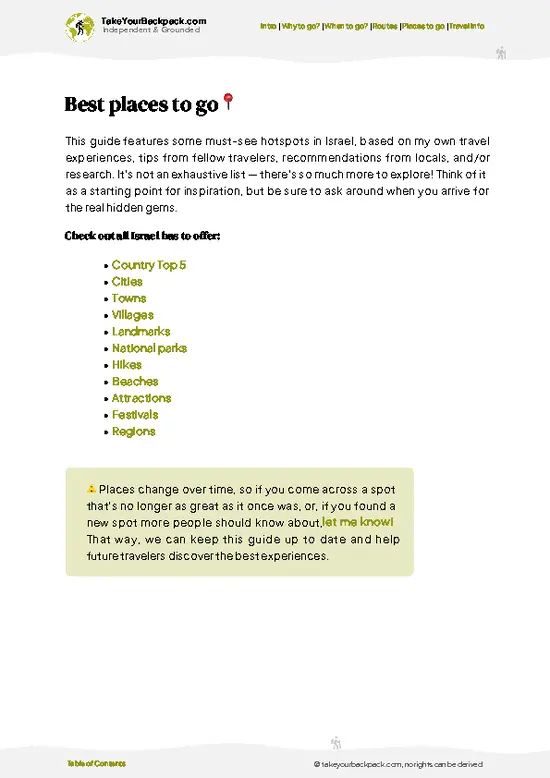
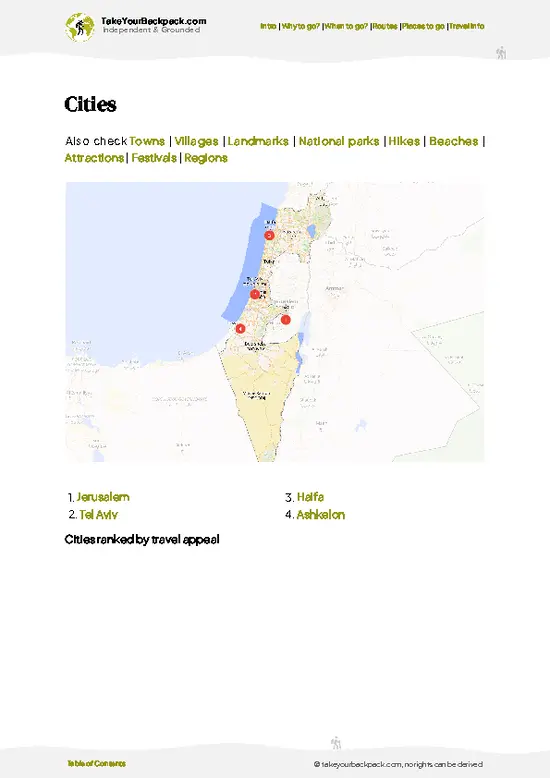
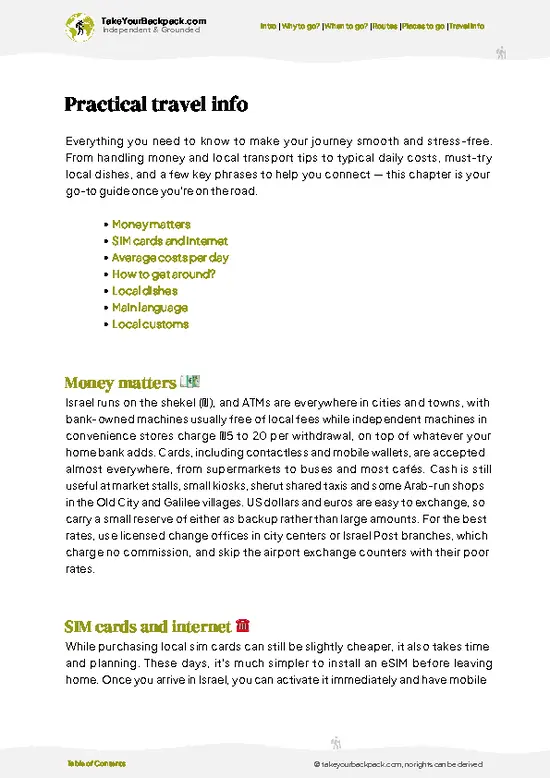
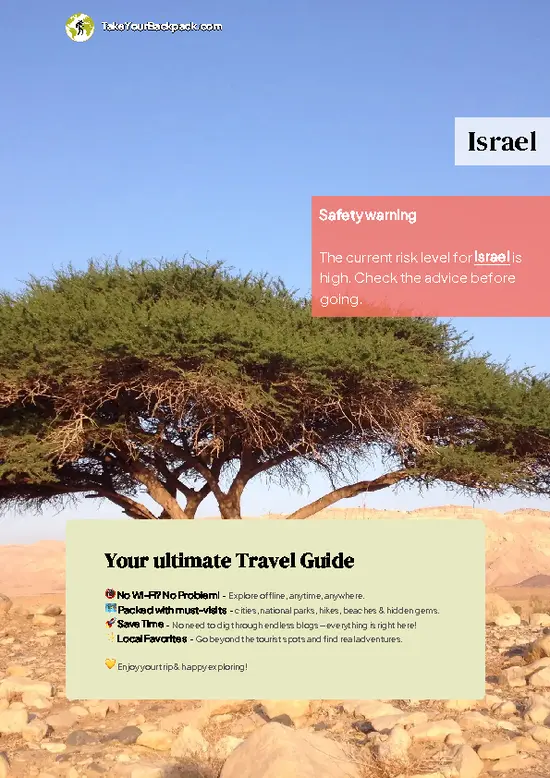
example page 0 from our offline Travel Guide for Israel
example page 1 from our offline Travel Guide for Israel
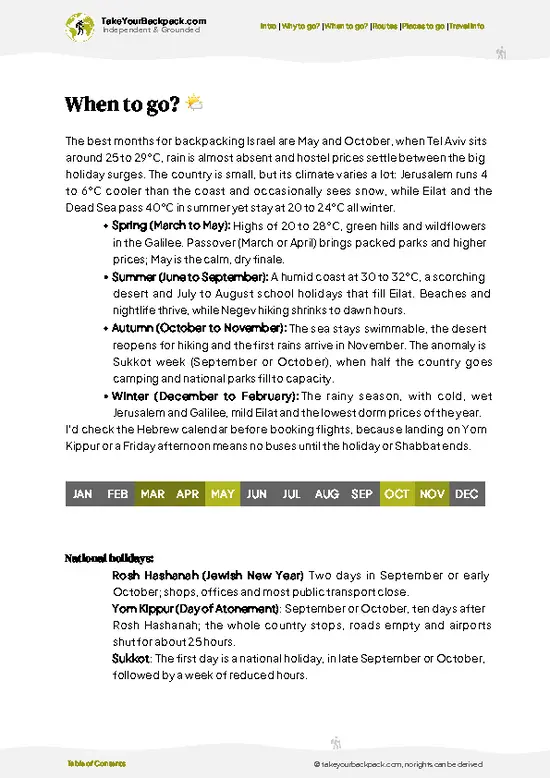
example page 2 from our offline Travel Guide for Israel
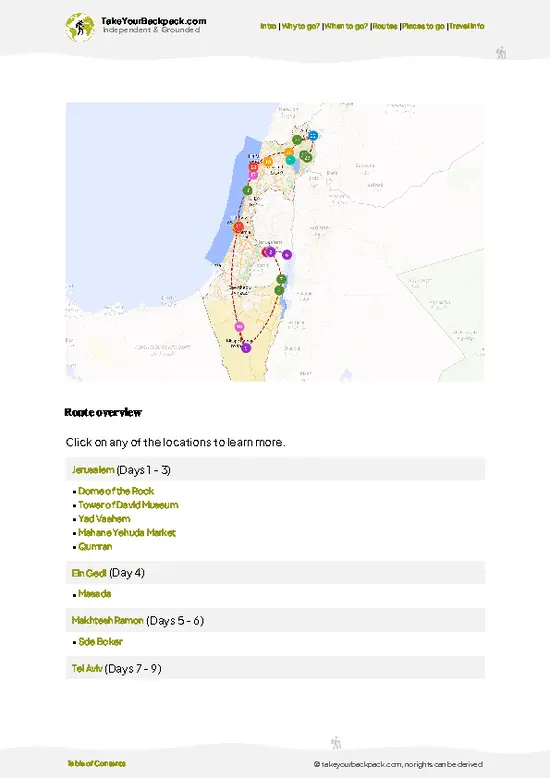
example page 3 from our offline Travel Guide for Israel
example page 4 from our offline Travel Guide for Israel
example page 5 from our offline Travel Guide for Israel
example page 6 from our offline Travel Guide for Israel
example page 7 from our offline Travel Guide for Israel
The digital guide (287 pages) contains:
✅ 77 highlights, ranked by travel appeal
✅ Optimized 5, 10 & 15-day travel routes
✅ Cities, national parks, landmarks, beaches
✅ How to get around
✅ Offline-friendly for travel without Wi-Fi
👉 Click to see all 30+ guide features

📅 Plan smarter in minutes, not weeks
✅ Month by month travel advice
✅ Festivals & national holidays
✅ Budget expectations

🗺️ Go to the right places, skip the overrated ones
✅ Honest pros & cons of destinations
✅ Top hikes, parks & viewpoints
✅ Lesser-known places most travelers miss
✅ Clear “worth it vs skip it” guidance

🛏️ Travel smoothly without rookie mistakes
✅ Best areas to stay
✅ Transport systems explained simply
✅ Common scams & safety advice
✅ SIM cards, money & practical tips

🌍 Understand the country, not just visit it
✅ Culture & traditions
✅ 52 Essential phrases & customs
✅ Festivals worth planning around
✅ Traveler-friendly historical context
✅ Insights that make places more meaningful

📱 Built for real travel conditions
✅ Fully downloadable PDF
✅ Works completely offline
✅ Optimized for phone use
✅ Useful in remote areas & buses
✅ Everything in one place
Stop searching, start planning
Get instant access to your full guide. 30‑day money-back guarantee.
+ Add another guide for just

By proceeding you agree to our terms.
Sent to your inbox immediately after payment • 100% Secure Checkout
Best Backpacking Travel Advisor 2025 tourism awardBest Backpacking
Travel Advisor
2025
What others say about Take Your Backpack Guides:
⭐⭐⭐⭐⭐
Fantastic, amazing amount of information!
⭐⭐⭐⭐⭐
My goodness this is amazing, it's what I've been looking for hats off too you!
⭐⭐⭐⭐⭐
I think this is absolutely BRILLIANT
⭐⭐⭐⭐
Very complete and informative. It's still missing places, but I gotta to commend you
⭐⭐⭐⭐⭐
This is truly amazing, thank you, can't wait to explore it with my kids!
⭐⭐⭐⭐⭐
Awesome resource, thank you!
⭐⭐⭐⭐⭐
This is amazing! Can't wait to explore the ones I haven't seen
⭐⭐⭐⭐
I love this! Well done, great idea.
⭐⭐⭐⭐⭐
Thanks for taking the time to make this gem!
⭐⭐⭐⭐⭐
This might be the best website I've ever seen.
⭐⭐⭐⭐⭐
Congratulations, and thank you so much for your work; it's incredibly valuable.
⭐⭐⭐⭐
In all seriousness I think you did a great job pointing out the important spots
⭐⭐⭐⭐⭐
10/10 very good
⭐⭐⭐⭐⭐
As someone who's only just starting to visit regularly this is awesome, thank you.
⭐⭐⭐⭐
Thank you very much! I'm going to visit my dad, it's going to be very useful!
⭐⭐⭐⭐⭐
This is really cool! We'll be travelling for the first time and this definitely come in handy.
⭐⭐⭐⭐⭐
You are now our minister of culture, congratulations 👨‍💼
⭐⭐⭐⭐⭐
Just wanted to tell you that this is a pearl! Going to follow your recommendations.
⭐⭐⭐⭐⭐
This is so cool. I'll definitely be using the resource for my travels soon.
⭐⭐⭐⭐⭐
This is very impressive! Good work.
⭐⭐⭐⭐⭐
This is an amazing and informative site. Very well done!

🛏️ Where to stay?Accommodation Highlights

Israel has a solid hostel scene, with dorm beds typically running ₪100 to 180 (about US$33 to 58) and private rooms in guesthouses from around ₪300 (US$100). In Tel Aviv, the Florentin district and the streets around Allenby and the beachfront put you near bars, street art and the sea, but expect late-night noise, while Jerusalem hostels cluster in the City Center around Jaffa Road (lively, close to the light rail and Mahane Yehuda market) and inside the Old City, which is atmospheric and steps from the holy sites but goes very quiet after dark. Haifa is calmer and cheaper, with most budget beds near the German Colony and downtown, a good pick if you want sleep over nightlife.

If you enjoy meeting … read more 👉
Israel has a solid hostel scene, with dorm beds typically running ₪100 to 180 (about US$33 to 58) and private rooms in guesthouses from around ₪300 (US$100). In Tel Aviv, the Florentin district and the streets around Allenby and the beachfront put you near bars, street art and the sea, but expect late-night noise, while Jerusalem hostels cluster in the City Center around Jaffa Road (lively, close to the light rail and Mahane Yehuda market) and inside the Old City, which is atmospheric and steps from the holy sites but goes very quiet after dark. Haifa is calmer and cheaper, with most budget beds near the German Colony and downtown, a good pick if you want sleep over nightlife.

If you enjoy meeting fellow travelers, consider choosing hostels with high ratings for atmosphere. On the other hand, if you prefer having your own space, a hotel might be a better option.

IsraelSee More of Israel

👋 Meet the founderWho’s Behind Take Your Backpack?

Johan, backpacker and founder of TakeYourBackpackHi, I’m Johan (Netherlands 🇳🇱), the creator of TakeYourBackpack. Over the past 3 decades, I’ve backpacked through 90+ countries across six continents, gaining extensive experience with independent travel, long-term trips, and overland routes.

This site is built on a combination of firsthand travel experience and carefully curated insights from other backpackers. Many guides are based on places I’ve personally visited, while others bring together tips, observations, and practical advice shared by trusted travelers I’ve met along the way.

The goal is to provide realistic, experience-driven guidance — not generic itineraries — so you can explore destinations with better context, clearer expectations, and more confidence.