×

Israel🇮🇱 | best attractionsBest 10 attractions in Israel

Attractions in Israel come in three distinct flavors, and the country is small enough that you can mix them. Jerusalem and the West Bank edge mean ancient sites, dress codes and security queues. The Mediterranean coast is expensive, polished and beach-focused, so Tel Aviv suits nightlife more than sightseeing. The Negev and Dead Sea deliver desert hikes and stargazing, cheaper but car-dependent. For independent travel, public transport works well between cities, though it stops on Shabbat. Skip anything built purely for tour buses near the Old City gates. Nature reserves and national parks give far better value, with most entries costing roughly 29 to 40 NIS (US$8 to 11).

By Johan Kruseman 🇳🇱 | Updated October 18, 2026
Explore the best festivals in Israel

Why go?Understanding Their Importance

Israel packs an unusual density of layered history into a country roughly the length of New Jersey. Three major religions, Roman, Crusader, Ottoman and Byzantine remains all sit within a few hours of each other, and the compact geography means a morning in the desert and an evening on the coast are realistic. Few countries compress this much variety into so little distance.

The infrastructure is strong. Roads are good, trains link the coast and Jerusalem, and parks are well signed and maintained. Many sites offer a multi-site pass, which saves money if you visit several national parks.

Before choosing Israel, accept two things. First, it is not cheap. Accommodation, food and entry fees run well above regional neighbors like Jordan or Egypt, so budget accordingly. Second, Shabbat shapes everything. … read more 👉
Israel packs an unusual density of layered history into a country roughly the length of New Jersey. Three major religions, Roman, Crusader, Ottoman and Byzantine remains all sit within a few hours of each other, and the compact geography means a morning in the desert and an evening on the coast are realistic. Few countries compress this much variety into so little distance.

The infrastructure is strong. Roads are good, trains link the coast and Jerusalem, and parks are well signed and maintained. Many sites offer a multi-site pass, which saves money if you visit several national parks.

Before choosing Israel, accept two things. First, it is not cheap. Accommodation, food and entry fees run well above regional neighbors like Jordan or Egypt, so budget accordingly. Second, Shabbat shapes everything. From Friday afternoon to Saturday evening, public transport largely stops in Jewish areas and many sites close early on Friday. Plan around it rather than fight it.

Security checks are routine at many sites and travel advisories change by region, so check current guidance for the north and the Gaza border area. If you want easy, inexpensive, low-effort sightseeing, other countries serve you better. If you want depth and variety in a small space, Israel is hard to beat.
Why These Made the Cut
The list of best attractions in Israel is created based on cultural significance or entertainment value. If you feel a attraction is missing in this list, please let us know.

When to go?Best Time to Visit Israel for attractions

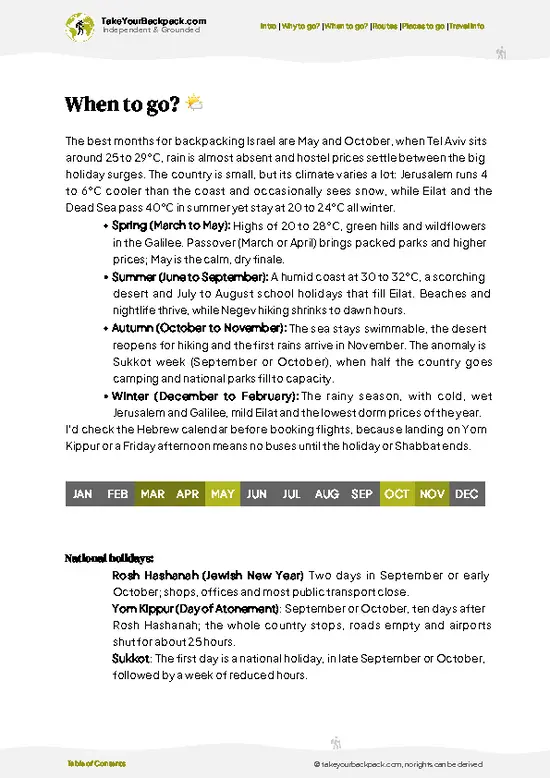
Best months: The best months for attractions in Israel are March to May and October to November, when daytime temperatures sit around 20 to 28°C and outdoor sites are comfortable to walk. Rain is nearly absent from May to September, and the wet season runs roughly November to March.
Summer and winter: July and August bring 30 to 35°C along the coast and Jerusalem, with humidity that makes midday sightseeing miserable. The Dead Sea and Negev climb above 40°C, so hiking there in summer is not worth the risk. Go at dawn or skip it.

December to February is cool, with Jerusalem at 6 to 12°C and occasional snow. Tel Aviv is mild at 14 to 19°C. The Dead Sea and Eilat stay pleasant at 20 to 25°C, making them the strongest winter choices. Flash floods can close desert trails after heavy rain.
Crowds … read more 👉
Best months: The best months for attractions in Israel are March to May and October to November, when daytime temperatures sit around 20 to 28°C and outdoor sites are comfortable to walk. Rain is nearly absent from May to September, and the wet season runs roughly November to March.
Summer and winter: July and August bring 30 to 35°C along the coast and Jerusalem, with humidity that makes midday sightseeing miserable. The Dead Sea and Negev climb above 40°C, so hiking there in summer is not worth the risk. Go at dawn or skip it.

December to February is cool, with Jerusalem at 6 to 12°C and occasional snow. Tel Aviv is mild at 14 to 19°C. The Dead Sea and Eilat stay pleasant at 20 to 25°C, making them the strongest winter choices. Flash floods can close desert trails after heavy rain.
Crowds and prices: Peak periods that matter are Passover (March or April), Sukkot and Rosh Hashanah (September or October), and the Christian Christmas and Easter weeks in Jerusalem. During these, hotel prices can rise 30 to 50% and domestic crowds fill parks and beaches. Jewish holidays also halt transport on the eve and day of major festivals, especially Yom Kippur, when nearly everything closes. Check the calendar before booking.

attraction hoppingHow to Combine attractions Into One Trip

Trip length: A trip combining several attractions in Israel needs 8 to 12 days, and 10 gives a comfortable pace without rushing between regions.
Grouping and direction: Three clusters work best. Tel Aviv and the coast link easily with the north, Jerusalem with the Dead Sea sit about 1 to 1.5 hours apart, and the Negev with Eilat form the southern leg. A sensible direction is north to south: start on the coast, move to Jerusalem, drop to the Dead Sea, then continue to the Negev. Tel Aviv to Jerusalem takes about 30 minutes by fast train or 1 hour by bus. Jerusalem to Eilat is 4 to 5 hours by bus. Domestic flights from Tel Aviv to Eilat take about 1 hour.
Time per stop: Give Jerusalem 3 to 4 days, Tel Aviv 2 to 3, the Dead Sea region 1 to 2 and the Negev 2 to 3. Northern Galilee needs 2 to 3 days … read more 👉
Trip length: A trip combining several attractions in Israel needs 8 to 12 days, and 10 gives a comfortable pace without rushing between regions.
Grouping and direction: Three clusters work best. Tel Aviv and the coast link easily with the north, Jerusalem with the Dead Sea sit about 1 to 1.5 hours apart, and the Negev with Eilat form the southern leg. A sensible direction is north to south: start on the coast, move to Jerusalem, drop to the Dead Sea, then continue to the Negev. Tel Aviv to Jerusalem takes about 30 minutes by fast train or 1 hour by bus. Jerusalem to Eilat is 4 to 5 hours by bus. Domestic flights from Tel Aviv to Eilat take about 1 hour.
Time per stop: Give Jerusalem 3 to 4 days, Tel Aviv 2 to 3, the Dead Sea region 1 to 2 and the Negev 2 to 3. Northern Galilee needs 2 to 3 days if added.
Planning mistakes: The most common error is ignoring Shabbat. Buses and trains stop from Friday afternoon until Saturday evening, so do not schedule long transfers then. Another is trying to cover the whole country in a week. That means 5 to 6 hours in transit and little time on site. Cut the north or south instead. Finally, travelers underestimate distances in the desert, where buses are infrequent. Rent a car for the Negev or book organized transport.

The ListTop attractions of Israel

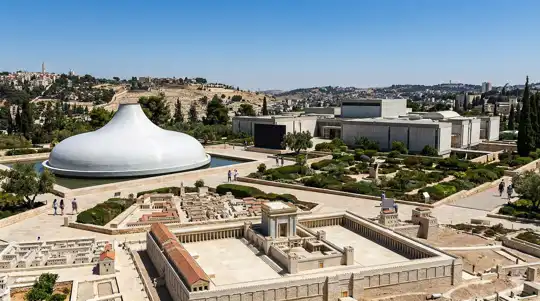
1 Israel Museum

Dead Sea Scrolls, archaeology wing, contemporary art, sculpture garden

Examine ancient manuscripts, archaeological finds, and modern artworks in a campus that balances historical depth with creative expression.

Israel - Israel Museum

2 Yad Vashem

Holocaust memorial, archival documents, remembrance halls, survivor testimonies

Reflect on personal histories and collective memory through exhibits that document the Holocaust’s impact on individuals and communities.

Israel - Yad Vashem

3 Western Wall Tunnels

subterranean passages, Herodian stones, ritual spaces, guided tours

Descend beneath Jerusalem’s Old City to walk along massive stone walls, revealing hidden chambers and centuries-old construction techniques.

4 Caesarea National Park Archaeological Site

Roman amphitheater, ancient harbor, mosaics, seaside ruins

Walk among remnants of Roman engineering, coastal fortifications, and archaeological layers that reveal centuries of Mediterranean settlement.

5 Bahá’í Gardens

tiered gardens, Templar houses, panoramic views, UNESCO site

Ascend landscaped terraces and explore 19th-century architecture, with city and bay vistas framed by meticulously maintained gardens.

6 Jaffa Old Port and Flea Market

stone alleyways, antique shops, Mediterranean harbor, artisan stalls

Wander through a maze of historic streets, browse eclectic market goods, and watch fishing boats dock along the waterfront.

7 Mahane Yehuda Market

fresh produce, bakeries, nightlife bars, graffiti art

Navigate a lively market that transforms from daytime food hub to evening social scene, blending culinary variety with urban street art.

8 Carmel Market

produce stalls, street food, local spices, bustling alleys

Sample regional flavors and observe daily commerce in a dense network of vendors, where culinary traditions and urban life intersect.

9 Tower of David Museum

citadel ramparts, city panoramas, archaeological finds, timeline exhibits

Climb ancient fortifications and explore layered exhibitions that chart Jerusalem’s changing rulers, religions, and urban landscape.

10 Tel Aviv Museum of Art

modernist architecture, Israeli artists, international collections, rotating exhibitions

View diverse works spanning local and global art scenes, set within a building known for its geometric design and changing displays.

11 ANU – Museum of the Jewish People

global diaspora, cultural identity, interactive exhibits, personal stories

Trace the evolution of Jewish communities worldwide through multimedia displays, rare artifacts, and narratives that highlight diversity and resilience.

12 Palmach Museum

immersive exhibits, underground movement, wartime stories, multimedia journey

Follow the experiences of Palmach fighters through a sequence of interactive rooms, using personal accounts and audiovisual storytelling.

13 Eretz Israel Museum

archaeological digs, ethnography, ancient coins, craft workshops

Discover Israel’s material culture through curated galleries and outdoor excavation sites that connect artifacts to everyday life across eras.

14 Bloomfield Science Museum

hands-on experiments, family activities, physics displays, technology zones

Engage with interactive installations that encourage curiosity about science, offering practical demonstrations and themed zones for all ages.

Think you know Israel?

Prove you’re a true local — uncover 4 lesser-known attractions in Israel that locals tend to keep to themselves.
Loading the map 🌍

Expert viewInsights from Locals and Experts

How many attractions: Plan 8 to 12 major attractions across a 10-day trip, roughly one main stop per day with a lighter second. More than that and you spend the day in queues, security lines and transit. Israel’s sites are intense, and most visitors tire by day six if every day is packed.
Prioritizing by travel style: History-focused travelers should put money and time into Jerusalem and archaeological parks. Hikers and budget travelers get the best value from nature reserves and the Negev, where entry is cheap and scenery is free. Beach and nightlife seekers should accept that Tel Aviv is mostly about atmosphere, not ticketed sights. Skip the paid rooftop and souvenir-heavy tours aimed at cruise groups. They cost more and show less.
Budget: Expect US$80 to 130 a day for a backpacker staying … read more 👉
How many attractions: Plan 8 to 12 major attractions across a 10-day trip, roughly one main stop per day with a lighter second. More than that and you spend the day in queues, security lines and transit. Israel’s sites are intense, and most visitors tire by day six if every day is packed.
Prioritizing by travel style: History-focused travelers should put money and time into Jerusalem and archaeological parks. Hikers and budget travelers get the best value from nature reserves and the Negev, where entry is cheap and scenery is free. Beach and nightlife seekers should accept that Tel Aviv is mostly about atmosphere, not ticketed sights. Skip the paid rooftop and souvenir-heavy tours aimed at cruise groups. They cost more and show less.
Budget: Expect US$80 to 130 a day for a backpacker staying in hostels and eating falafel and shawarma, rising to US$150 to 200 with private rooms. National park entries typically cost 29 to 40 NIS (US$8 to 11). Guided tours of Jerusalem and the West Bank run 100 to 200 NIS (US$27 to 55) per person, while private guides charge 600 to 1,200 NIS (US$165 to 330) a day. A Rav-Kav transport card helps with buses and trains, with a Tel Aviv to Jerusalem trip costing about 16 to 22 NIS (US$4 to 6). Buy a multi-site national parks pass if you plan more than three parks, as it typically saves money.
Costs and delays that catch people out: Taxis are the biggest drain. Insist on the meter or use a ride app, as unmetered airport and Old City rides can cost double. Tourist restaurants near major sites charge 30 to 50% more than streets one block away. Allow 20 to 45 minutes for security at some sites and book timed tickets where required. Friday afternoon closures and Shabbat bring unexpected shutdowns, so buy food and cash ahead.
Safety and cultural considerations: Check current government travel advisories before going, especially for the north, Gaza border area and West Bank, and follow local guidance on closures. Carry your passport for checkpoints and security checks. Dress modestly at religious sites: covered shoulders and knees, and a head covering where required. Photography is restricted at some holy places and on Shabbat in observant neighborhoods. Do not argue with security staff. Keep questions polite and answers short.

✈️ The backpacker research shortcutIsrael Travel Guide

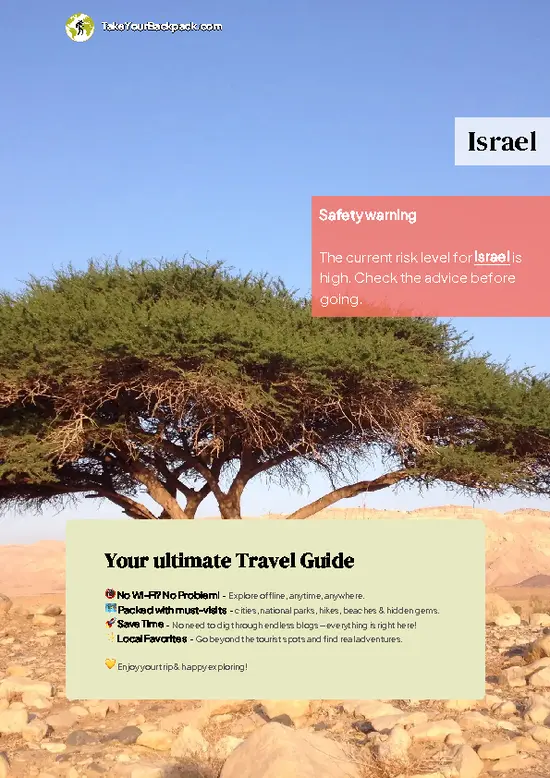
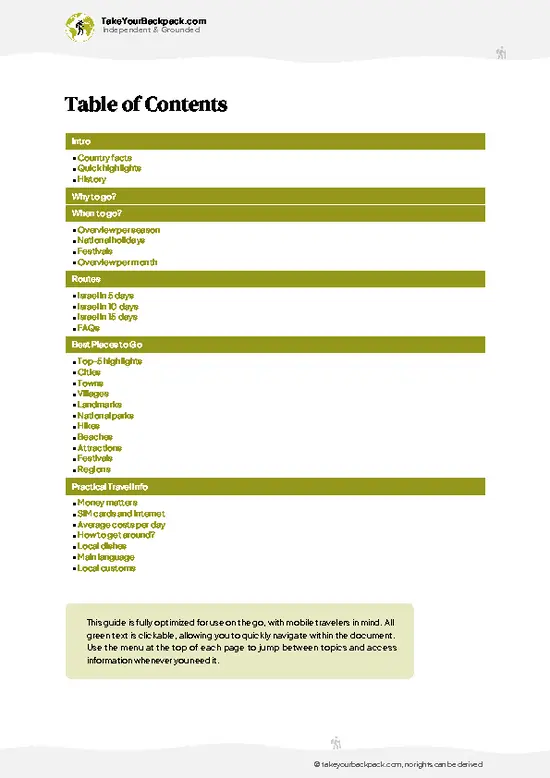
An offline-friendly backpacking guide with optimized travel routes, ranked highlights, transport advice, and the best areas to stay.
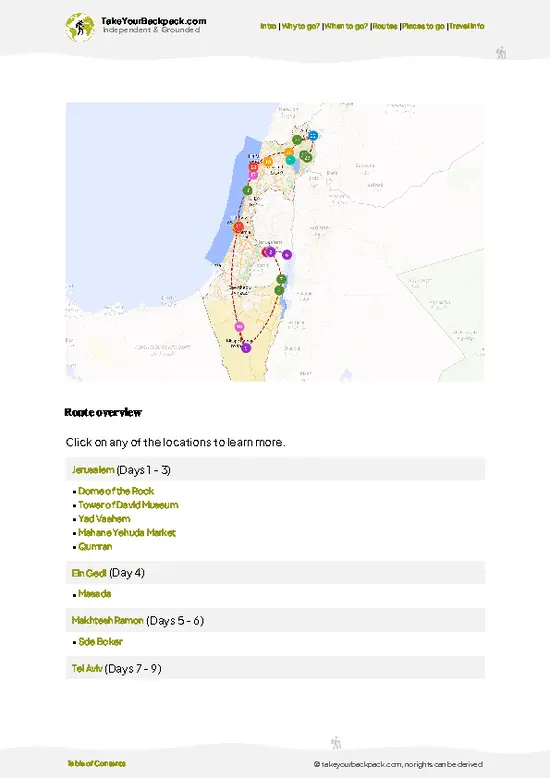
example page 0 from our offline Travel Guide for Israel
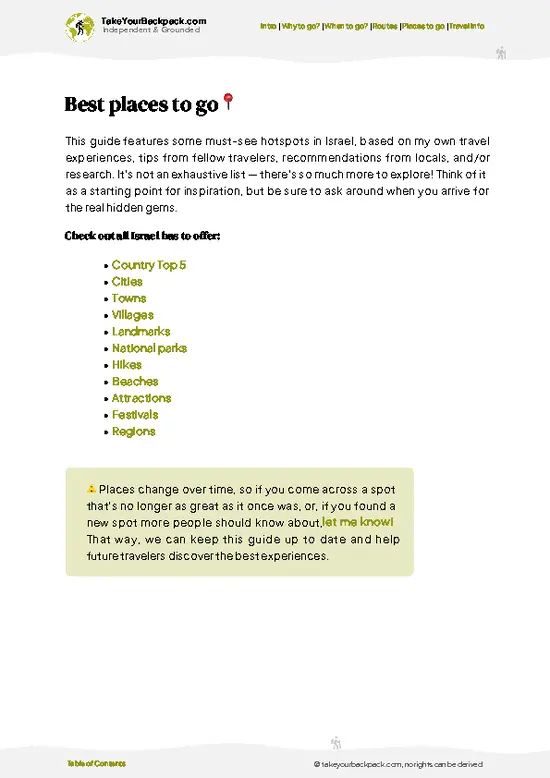
example page 1 from our offline Travel Guide for Israel
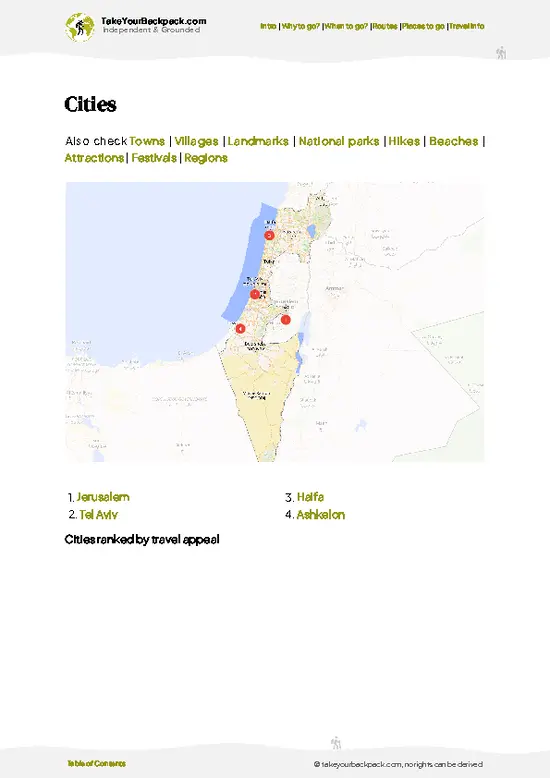
example page 2 from our offline Travel Guide for Israel
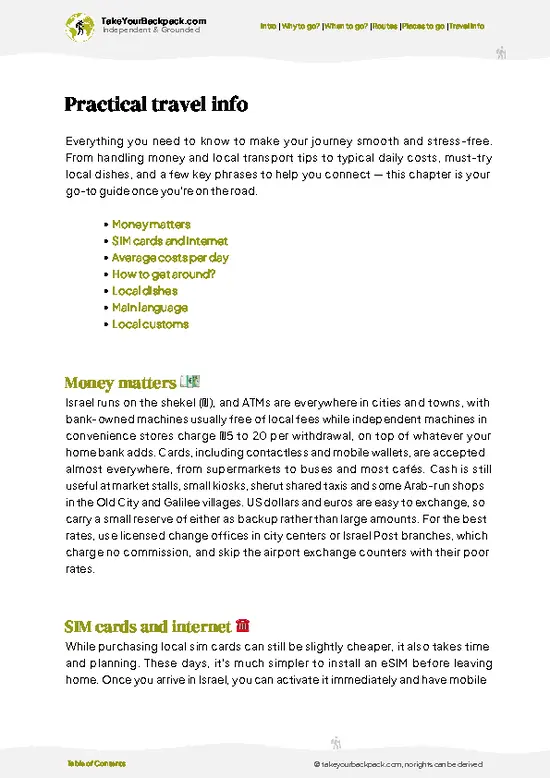
example page 3 from our offline Travel Guide for Israel
example page 4 from our offline Travel Guide for Israel
example page 5 from our offline Travel Guide for Israel
example page 6 from our offline Travel Guide for Israel
example page 7 from our offline Travel Guide for Israel
The digital guide (287 pages) contains:
✅ 77 highlights, ranked by travel appeal
✅ Optimized 5, 10 & 15-day travel routes
✅ Cities, national parks, landmarks, beaches
✅ How to get around
✅ Offline-friendly for travel without Wi-Fi
👉 Click to see all 30+ guide features

📅 Plan smarter in minutes, not weeks
✅ Month by month travel advice
✅ Festivals & national holidays
✅ Budget expectations

🗺️ Go to the right places, skip the overrated ones
✅ Honest pros & cons of destinations
✅ Top hikes, parks & viewpoints
✅ Lesser-known places most travelers miss
✅ Clear “worth it vs skip it” guidance

🛏️ Travel smoothly without rookie mistakes
✅ Best areas to stay
✅ Transport systems explained simply
✅ Common scams & safety advice
✅ SIM cards, money & practical tips

🌍 Understand the country, not just visit it
✅ Culture & traditions
✅ 52 Essential phrases & customs
✅ Festivals worth planning around
✅ Traveler-friendly historical context
✅ Insights that make places more meaningful

📱 Built for real travel conditions
✅ Fully downloadable PDF
✅ Works completely offline
✅ Optimized for phone use
✅ Useful in remote areas & buses
✅ Everything in one place
Stop searching, start planning
Get instant access to your full guide. 30‑day money-back guarantee.
+ Add another guide for just

By proceeding you agree to our terms.
Sent to your inbox immediately after payment • 100% Secure Checkout
Best Backpacking Travel Advisor 2025 tourism awardBest Backpacking
Travel Advisor
2025
What others say about Take Your Backpack Guides:
⭐⭐⭐⭐⭐
Fantastic, amazing amount of information!
⭐⭐⭐⭐⭐
My goodness this is amazing, it's what I've been looking for hats off too you!
⭐⭐⭐⭐⭐
I think this is absolutely BRILLIANT
⭐⭐⭐⭐
Very complete and informative. It's still missing places, but I gotta to commend you
⭐⭐⭐⭐⭐
This is truly amazing, thank you, can't wait to explore it with my kids!
⭐⭐⭐⭐⭐
Awesome resource, thank you!
⭐⭐⭐⭐⭐
This is amazing! Can't wait to explore the ones I haven't seen
⭐⭐⭐⭐
I love this! Well done, great idea.
⭐⭐⭐⭐⭐
Thanks for taking the time to make this gem!
⭐⭐⭐⭐⭐
This might be the best website I've ever seen.
⭐⭐⭐⭐⭐
Congratulations, and thank you so much for your work; it's incredibly valuable.
⭐⭐⭐⭐
In all seriousness I think you did a great job pointing out the important spots
⭐⭐⭐⭐⭐
10/10 very good
⭐⭐⭐⭐⭐
As someone who's only just starting to visit regularly this is awesome, thank you.
⭐⭐⭐⭐
Thank you very much! I'm going to visit my dad, it's going to be very useful!
⭐⭐⭐⭐⭐
This is really cool! We'll be travelling for the first time and this definitely come in handy.
⭐⭐⭐⭐⭐
You are now our minister of culture, congratulations 👨‍💼
⭐⭐⭐⭐⭐
Just wanted to tell you that this is a pearl! Going to follow your recommendations.
⭐⭐⭐⭐⭐
This is so cool. I'll definitely be using the resource for my travels soon.
⭐⭐⭐⭐⭐
This is very impressive! Good work.
⭐⭐⭐⭐⭐
This is an amazing and informative site. Very well done!

🛏️ Where to stay?Top Places to Consider Staying

Israel has a solid hostel scene, with dorm beds typically running ₪100 to 180 (about US$33 to 58) and private rooms in guesthouses from around ₪300 (US$100). In Tel Aviv, the Florentin district and the streets around Allenby and the beachfront put you near bars, street art and the sea, but expect late-night noise, while Jerusalem hostels cluster in the City Center around Jaffa Road (lively, close to the light rail and Mahane Yehuda market) and inside the Old City, which is atmospheric and steps from the holy sites but goes very quiet after dark. Haifa is calmer and cheaper, with most budget beds near the German Colony and downtown, a good pick if you want sleep over nightlife.

If you enjoy meeting … read more 👉
Israel has a solid hostel scene, with dorm beds typically running ₪100 to 180 (about US$33 to 58) and private rooms in guesthouses from around ₪300 (US$100). In Tel Aviv, the Florentin district and the streets around Allenby and the beachfront put you near bars, street art and the sea, but expect late-night noise, while Jerusalem hostels cluster in the City Center around Jaffa Road (lively, close to the light rail and Mahane Yehuda market) and inside the Old City, which is atmospheric and steps from the holy sites but goes very quiet after dark. Haifa is calmer and cheaper, with most budget beds near the German Colony and downtown, a good pick if you want sleep over nightlife.

If you enjoy meeting fellow travelers, consider choosing hostels with high ratings for atmosphere. On the other hand, if you prefer having your own space, a hotel might be a better option.

IsraelMore Places Across Israel

👋 Meet the founderWho’s Behind Take Your Backpack?

Johan, backpacker and founder of TakeYourBackpackHi, I’m Johan (Netherlands 🇳🇱), the creator of TakeYourBackpack. Over the past 3 decades, I’ve backpacked through 90+ countries across six continents, gaining extensive experience with independent travel, long-term trips, and overland routes.

This site is built on a combination of firsthand travel experience and carefully curated insights from other backpackers. Many guides are based on places I’ve personally visited, while others bring together tips, observations, and practical advice shared by trusted travelers I’ve met along the way.

The goal is to provide realistic, experience-driven guidance — not generic itineraries — so you can explore destinations with better context, clearer expectations, and more confidence.