×

Israel🇮🇱 | best landmarksBest 5 landmarks in Israel

Landmarks in Israel are mostly layers of history stacked on top of each other: ancient ruins, Crusader walls, Ottoman markets, and Bahai gardens, often within an hour of each other. The country is small, so access is easy, but the experience changes sharply by region. Jerusalem is crowded, security-heavy and deeply religious. The Galilee and coast are calmer, with national park ruins and easy parking. The Negev and Dead Sea are empty, hot and rewarding for independent travelers willing to hike. Backpackers should skip anything that is only a gift shop and a bus tour. Back the sites with real history and a short walk.

By Johan Kruseman 🇳🇱 | Updated October 18, 2026
Explore the best national parks in Israel

Why go?Understanding Their Importance

Israel packs an unusual density of layered history into an area roughly the size of New Jersey. Canaanite, Roman, Byzantine, Crusader and Ottoman remains sit within a short drive of each other, and three major religions treat the same ground as sacred. That makes the country excellent for travelers who want depth over sheer scale. It is poor for anyone expecting vast, empty monuments.

Infrastructure helps. Roads are good, the national parks authority runs well-signposted sites, and a multi-park pass cuts costs if you visit several. Distances are short, so you rarely lose a day to transit.

Know the limits before you commit. Many sites are religious places with dress rules, restricted hours and closures for the Sabbath and holidays. Friday afternoon through Saturday, public transport largely … read more 👉
Israel packs an unusual density of layered history into an area roughly the size of New Jersey. Canaanite, Roman, Byzantine, Crusader and Ottoman remains sit within a short drive of each other, and three major religions treat the same ground as sacred. That makes the country excellent for travelers who want depth over sheer scale. It is poor for anyone expecting vast, empty monuments.

Infrastructure helps. Roads are good, the national parks authority runs well-signposted sites, and a multi-park pass cuts costs if you visit several. Distances are short, so you rarely lose a day to transit.

Know the limits before you commit. Many sites are religious places with dress rules, restricted hours and closures for the Sabbath and holidays. Friday afternoon through Saturday, public transport largely stops and some sites shut or run reduced hours. Security checks are routine and add queue time. Prices are high by regional standards, and a lot of the value is in the context, so a guide or good audio app matters more here than at sites where the structure speaks for itself. Summer heat in the south and Dead Sea area also limits how much you can do outdoors. Travelers who want quick photo stops will find it expensive. Travelers who like to read, climb and ask questions get the most from it.
Behind the Scenes of Selection
The list of best unique sites in Israel is created based on history or culture, wow factor, atmosphere, quirks, and memorability. If you feel a unique site is missing in this list, please let us know.

When to go?Best Time to Visit Israel for landmarks

Best Months: The best months for landmarks in Israel are March to May and October to November, when daytime temperatures sit around 20 to 28°C and outdoor ruins are comfortable to walk. Rain is rare in these windows, apart from the odd early spring shower.

Summer and Winter: June to September is hard on exposed sites. Jerusalem reaches 30 to 33°C, Tel Aviv is humid, and the Negev and Dead Sea often exceed 38 to 40°C. Visit the south at opening time and be done by late morning. Skip midday hikes entirely.

December to February is cool and wet. Jerusalem drops to 5 to 12°C with most of the 500 to 600 mm annual rainfall, and the Galilee can be cold and muddy. The Dead Sea and Negev stay pleasant, which makes winter the right time for the south.

Crowds and Prices: Peak crowds and the highest … read more 👉
Best Months: The best months for landmarks in Israel are March to May and October to November, when daytime temperatures sit around 20 to 28°C and outdoor ruins are comfortable to walk. Rain is rare in these windows, apart from the odd early spring shower.

Summer and Winter: June to September is hard on exposed sites. Jerusalem reaches 30 to 33°C, Tel Aviv is humid, and the Negev and Dead Sea often exceed 38 to 40°C. Visit the south at opening time and be done by late morning. Skip midday hikes entirely.

December to February is cool and wet. Jerusalem drops to 5 to 12°C with most of the 500 to 600 mm annual rainfall, and the Galilee can be cold and muddy. The Dead Sea and Negev stay pleasant, which makes winter the right time for the south.

Crowds and Prices: Peak crowds and the highest hotel prices land around Easter, Passover (usually March or April) and the autumn Jewish holidays of Rosh Hashanah, Yom Kippur and Sukkot (September to October). Rooms can cost 30 to 60 percent more, and Yom Kippur shuts almost everything, including public transport. Avoid those dates or plan around them. July and August bring domestic school-holiday crowds at coastal and northern parks.

unique site hoppingHow to Combine landmarks Into One Trip

Trip Length and Direction: A trip combining several landmarks in Israel needs 7 to 10 days, and 5 days is the minimum that avoids rushing. The country is compact, so the limiting factor is not distance but how much each stop absorbs.

Three clusters work well. The Jerusalem area (with Bethlehem and Judean Desert sites) needs 2 to 3 days. The Dead Sea, Masada and Negev need 2 days. The north, covering Galilee, Acre and Haifa, needs 2 to 3 days. Starting in Tel Aviv and moving to Jerusalem, then south, then north along the coast or back through the Galilee, avoids backtracking. Reverse it if you fly into Ben Gurion and want the heat of the south early in cooler months.

Time and Transfers: Allow 2 to 4 hours at major archaeological sites and a full day for the Old City of Jerusalem. Tel Aviv … read more 👉
Trip Length and Direction: A trip combining several landmarks in Israel needs 7 to 10 days, and 5 days is the minimum that avoids rushing. The country is compact, so the limiting factor is not distance but how much each stop absorbs.

Three clusters work well. The Jerusalem area (with Bethlehem and Judean Desert sites) needs 2 to 3 days. The Dead Sea, Masada and Negev need 2 days. The north, covering Galilee, Acre and Haifa, needs 2 to 3 days. Starting in Tel Aviv and moving to Jerusalem, then south, then north along the coast or back through the Galilee, avoids backtracking. Reverse it if you fly into Ben Gurion and want the heat of the south early in cooler months.

Time and Transfers: Allow 2 to 4 hours at major archaeological sites and a full day for the Old City of Jerusalem. Tel Aviv to Jerusalem takes 40 to 90 minutes by train or bus. Jerusalem to the Dead Sea is about 1 to 1.5 hours, and Jerusalem to the Galilee 2.5 to 3 hours.

Common Mistakes: The biggest is ignoring Shabbat: plan the Old City and Muslim and Christian quarters for Friday or Saturday, and move between regions on Sunday. Another is squeezing the Dead Sea and Negev into one day trip by public bus, which wastes hours. Rent a car for the south, or join a small tour. Do not schedule more than two major sites in one day.

The ListTop landmarks of Israel

1 Dome of the Rock

golden dome, sacred platform, Islamic artistry

Stand at the heart of Jerusalem’s spiritual crossroads, where intricate mosaics and centuries-old rituals define a place of layered devotion.

Israel&Palestine - Dome of the Rock (Qubbat aṣ-Ṣaḵra)

2 Makhtesh Ramon

erosion crater, desert vistas, geological formations

Descend into a vast natural amphitheater, where shifting colors and exposed rock layers reveal the desert’s ancient geological story.

israel-unique-site-makhtesh-ramon
© Google |

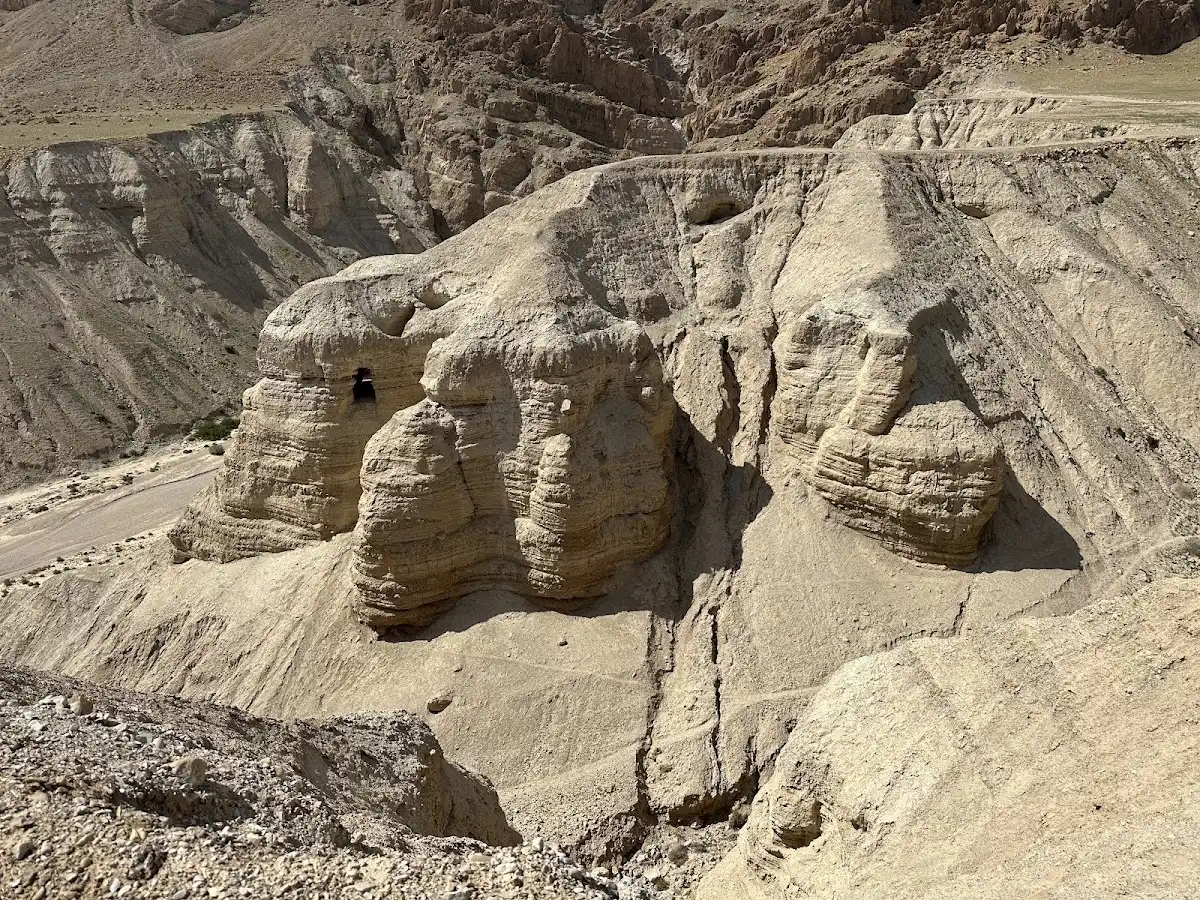
3 Qumran

desert caves, ancient manuscripts, archaeological site

Trace the footsteps of early scribes among wind-carved cliffs and discover the fragile texts that reshaped understanding of ancient beliefs.

israel-unique-site-qumran
© Google |

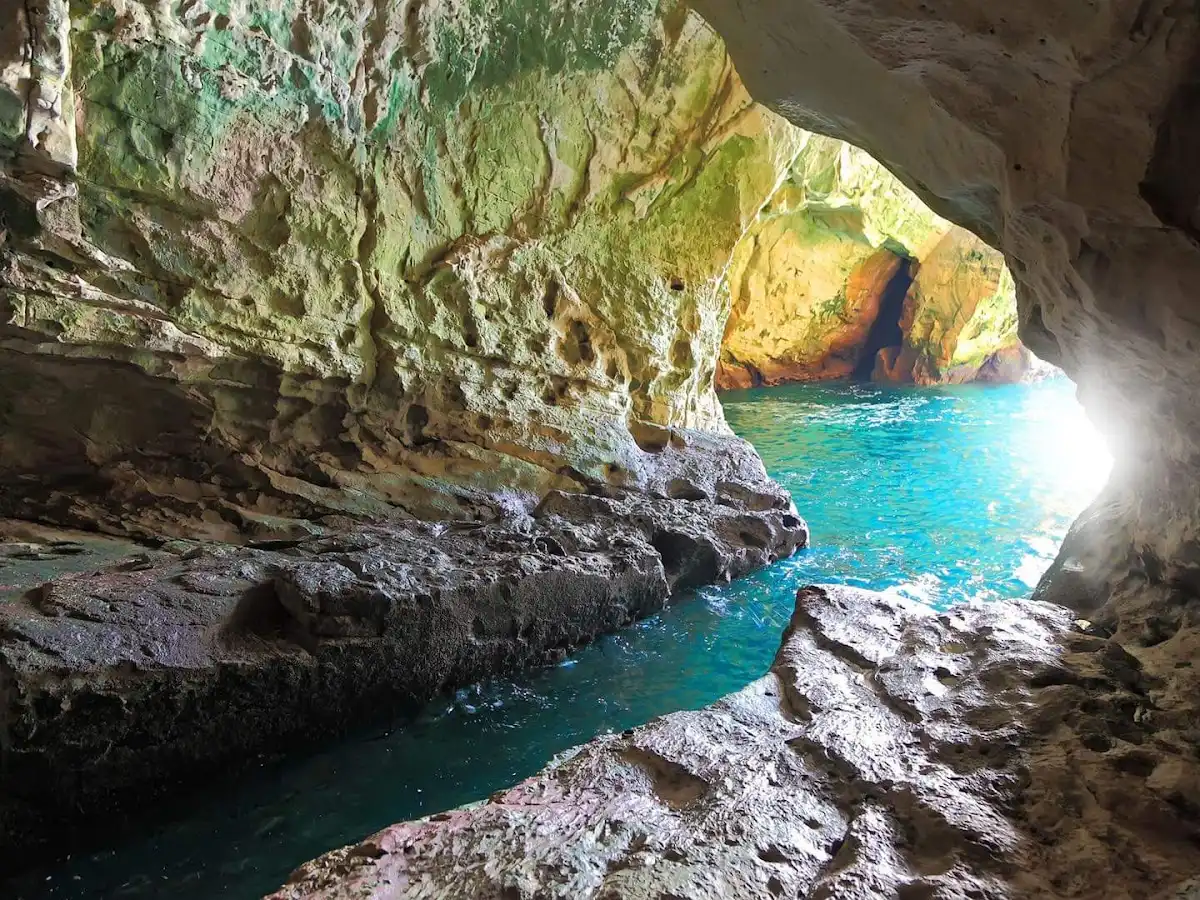
4 Rosh Hanikra

limestone grottoes, sea cliffs, border viewpoint

Venture through tunnels carved by waves, gaze across turquoise waters, and glimpse the meeting point of land and sea at Israel’s northern edge.

israel-unique-site-rosh-hanikra
© Google |

5 Shuni Fortress

Roman amphitheater, spring-fed pools, rural ruins

Wander through remnants of Roman entertainment and cool off by natural springs, surrounded by countryside that echoes with layered history.

Loading the map 🌍

Expert viewInsights from Locals and Experts

How Many to Visit: Plan on 6 to 8 landmarks over a one-to-two-week trip. Israel's sites are dense in context, so more than two big ones in a day blurs together, and security checks and heat eat time. Fewer, with a good guide or audio tour, beats a checklist.

Choosing by Travel Style: History-focused travelers should put Jerusalem and a Roman or Crusader coastal site first. Hikers and desert lovers get more from the Negev and Judean Desert, where sites are quiet and you can walk without a group. Travelers short on cash should favor national parks and free religious sites over private attractions. Skip anything that sells itself as a replica or a themed experience, since the real places are close enough.

What It Costs: Budget US$80 to 130 a day for a mid-range backpacker covering hostels or … read more 👉
How Many to Visit: Plan on 6 to 8 landmarks over a one-to-two-week trip. Israel's sites are dense in context, so more than two big ones in a day blurs together, and security checks and heat eat time. Fewer, with a good guide or audio tour, beats a checklist.

Choosing by Travel Style: History-focused travelers should put Jerusalem and a Roman or Crusader coastal site first. Hikers and desert lovers get more from the Negev and Judean Desert, where sites are quiet and you can walk without a group. Travelers short on cash should favor national parks and free religious sites over private attractions. Skip anything that sells itself as a replica or a themed experience, since the real places are close enough.

What It Costs: Budget US$80 to 130 a day for a mid-range backpacker covering hostels or simple rooms (US$35 to 70 a night), street food, and transport. Add NIS 30 to 90 (about US$8 to 25) per paid national park entry. A multi-site pass pays off after three or four parks. Guides run roughly US$25 to 60 for a half-day group tour or US$150 to 300 for a private guide. Intercity buses and trains cost NIS 15 to 50 (US$4 to 14) per leg. Taxis from remote sites are expensive, so check return transport before heading to desert locations.

Mistakes That Cost You: The most expensive error is booking around Shabbat and holidays without checking. Transport stops from Friday afternoon to Saturday evening, and a missed bus can mean a pricey taxi. Another is hiking in heat: carry 3 to 4 liters of water for desert sites and start before 8 a.m. Buying tickets from street sellers at busy sites also drains money; use official ticket offices or the parks app.

Safety and Etiquette: Dress modestly at religious sites: shoulders and knees covered, and a scarf or kippah where required. Photography is restricted in some prayer areas, and during Shabbat in religious neighborhoods. Expect bag checks and metal detectors at the Old City and many entrances, so travel light and carry your passport. Check your government's travel advisory and local news before visiting areas near borders, the West Bank or Gaza vicinity, since conditions change quickly and some sites close without notice. Use licensed guides, and tip them 10 to 15 percent for a good tour. In mixed neighborhoods, be respectful, avoid political arguments, and keep to marked paths.

✈️ The backpacker research shortcutIsrael Travel Guide

An offline-friendly backpacking guide with optimized travel routes, ranked highlights, transport advice, and the best areas to stay.
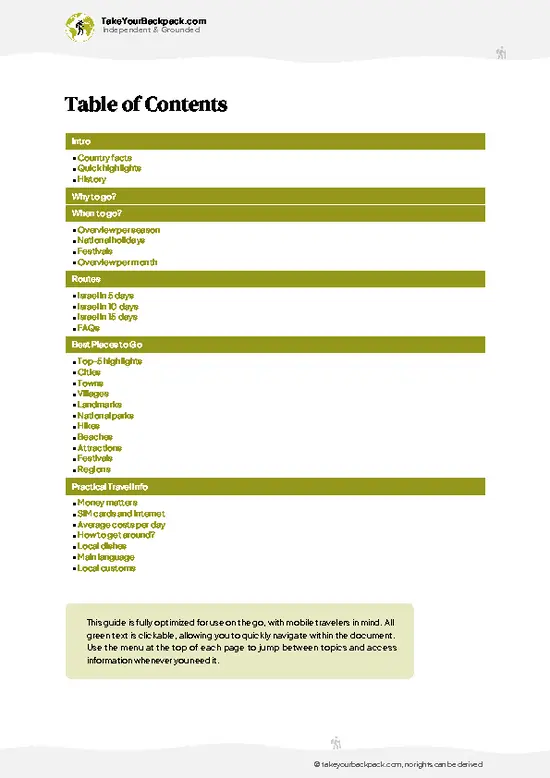
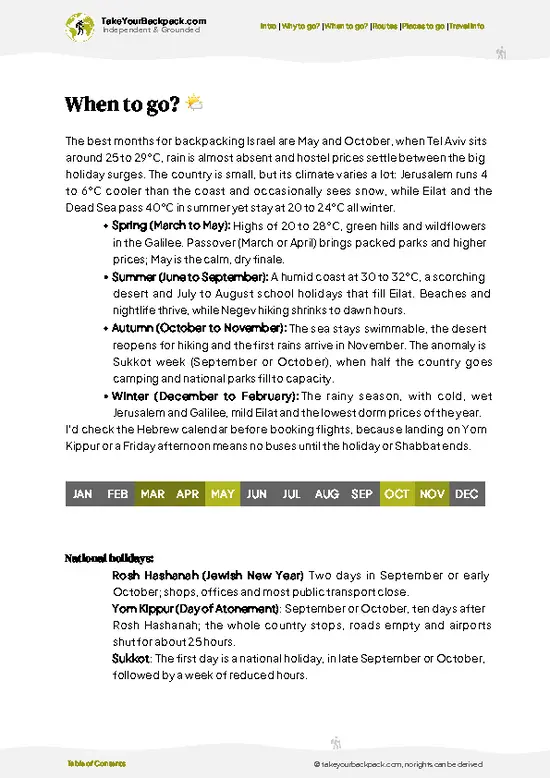
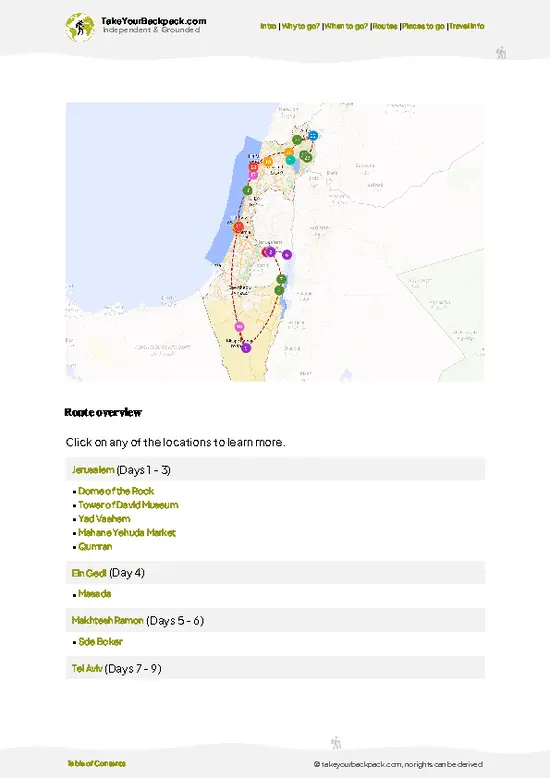
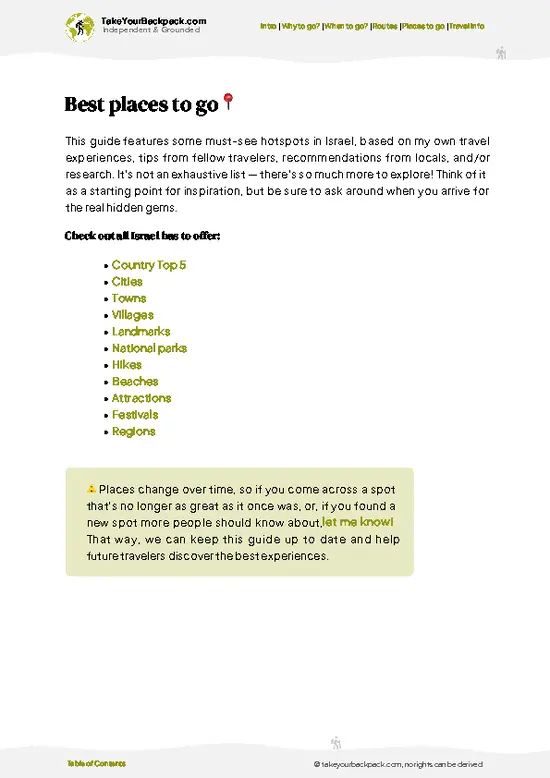
example page 0 from our offline Travel Guide for Israel
example page 1 from our offline Travel Guide for Israel
example page 2 from our offline Travel Guide for Israel
example page 3 from our offline Travel Guide for Israel
example page 4 from our offline Travel Guide for Israel
example page 5 from our offline Travel Guide for Israel
example page 6 from our offline Travel Guide for Israel
example page 7 from our offline Travel Guide for Israel
The digital guide (287 pages) contains:
✅ 77 highlights, ranked by travel appeal
✅ Optimized 5, 10 & 15-day travel routes
✅ Cities, national parks, landmarks, beaches
✅ How to get around
✅ Offline-friendly for travel without Wi-Fi
👉 Click to see all 30+ guide features

📅 Plan smarter in minutes, not weeks
✅ Month by month travel advice
✅ Festivals & national holidays
✅ Budget expectations

🗺️ Go to the right places, skip the overrated ones
✅ Honest pros & cons of destinations
✅ Top hikes, parks & viewpoints
✅ Lesser-known places most travelers miss
✅ Clear “worth it vs skip it” guidance

🛏️ Travel smoothly without rookie mistakes
✅ Best areas to stay
✅ Transport systems explained simply
✅ Common scams & safety advice
✅ SIM cards, money & practical tips

🌍 Understand the country, not just visit it
✅ Culture & traditions
✅ 52 Essential phrases & customs
✅ Festivals worth planning around
✅ Traveler-friendly historical context
✅ Insights that make places more meaningful

📱 Built for real travel conditions
✅ Fully downloadable PDF
✅ Works completely offline
✅ Optimized for phone use
✅ Useful in remote areas & buses
✅ Everything in one place
Stop searching, start planning
Get instant access to your full guide. 30‑day money-back guarantee.
+ Add another guide for just

By proceeding you agree to our terms.
Sent to your inbox immediately after payment • 100% Secure Checkout
Best Backpacking Travel Advisor 2025 tourism awardBest Backpacking
Travel Advisor
2025
What others say about Take Your Backpack Guides:
⭐⭐⭐⭐⭐
Fantastic, amazing amount of information!
⭐⭐⭐⭐⭐
My goodness this is amazing, it's what I've been looking for hats off too you!
⭐⭐⭐⭐⭐
I think this is absolutely BRILLIANT
⭐⭐⭐⭐
Very complete and informative. It's still missing places, but I gotta to commend you
⭐⭐⭐⭐⭐
This is truly amazing, thank you, can't wait to explore it with my kids!
⭐⭐⭐⭐⭐
Awesome resource, thank you!
⭐⭐⭐⭐⭐
This is amazing! Can't wait to explore the ones I haven't seen
⭐⭐⭐⭐
I love this! Well done, great idea.
⭐⭐⭐⭐⭐
Thanks for taking the time to make this gem!
⭐⭐⭐⭐⭐
This might be the best website I've ever seen.
⭐⭐⭐⭐⭐
Congratulations, and thank you so much for your work; it's incredibly valuable.
⭐⭐⭐⭐
In all seriousness I think you did a great job pointing out the important spots
⭐⭐⭐⭐⭐
10/10 very good
⭐⭐⭐⭐⭐
As someone who's only just starting to visit regularly this is awesome, thank you.
⭐⭐⭐⭐
Thank you very much! I'm going to visit my dad, it's going to be very useful!
⭐⭐⭐⭐⭐
This is really cool! We'll be travelling for the first time and this definitely come in handy.
⭐⭐⭐⭐⭐
You are now our minister of culture, congratulations 👨‍💼
⭐⭐⭐⭐⭐
Just wanted to tell you that this is a pearl! Going to follow your recommendations.
⭐⭐⭐⭐⭐
This is so cool. I'll definitely be using the resource for my travels soon.
⭐⭐⭐⭐⭐
This is very impressive! Good work.
⭐⭐⭐⭐⭐
This is an amazing and informative site. Very well done!

🛏️ Where to stay?Accommodation Highlights

Israel has a solid hostel scene, with dorm beds typically running ₪100 to 180 (about US$33 to 58) and private rooms in guesthouses from around ₪300 (US$100). In Tel Aviv, the Florentin district and the streets around Allenby and the beachfront put you near bars, street art and the sea, but expect late-night noise, while Jerusalem hostels cluster in the City Center around Jaffa Road (lively, close to the light rail and Mahane Yehuda market) and inside the Old City, which is atmospheric and steps from the holy sites but goes very quiet after dark. Haifa is calmer and cheaper, with most budget beds near the German Colony and downtown, a good pick if you want sleep over nightlife.

If you enjoy meeting … read more 👉
Israel has a solid hostel scene, with dorm beds typically running ₪100 to 180 (about US$33 to 58) and private rooms in guesthouses from around ₪300 (US$100). In Tel Aviv, the Florentin district and the streets around Allenby and the beachfront put you near bars, street art and the sea, but expect late-night noise, while Jerusalem hostels cluster in the City Center around Jaffa Road (lively, close to the light rail and Mahane Yehuda market) and inside the Old City, which is atmospheric and steps from the holy sites but goes very quiet after dark. Haifa is calmer and cheaper, with most budget beds near the German Colony and downtown, a good pick if you want sleep over nightlife.

If you enjoy meeting fellow travelers, consider choosing hostels with high ratings for atmosphere. On the other hand, if you prefer having your own space, a hotel might be a better option.

IsraelSee More of Israel

👋 Meet the founderWho’s Behind Take Your Backpack?

Johan, backpacker and founder of TakeYourBackpackHi, I’m Johan (Netherlands 🇳🇱), the creator of TakeYourBackpack. Over the past 3 decades, I’ve backpacked through 90+ countries across six continents, gaining extensive experience with independent travel, long-term trips, and overland routes.

This site is built on a combination of firsthand travel experience and carefully curated insights from other backpackers. Many guides are based on places I’ve personally visited, while others bring together tips, observations, and practical advice shared by trusted travelers I’ve met along the way.

The goal is to provide realistic, experience-driven guidance — not generic itineraries — so you can explore destinations with better context, clearer expectations, and more confidence.