×

Israel🇮🇱 | best villagesBest 3 villages in Israel

Villages in Israel are not postcard hamlets with a pub and a church. They are kibbutzim, moshavim, Druze and Arab hill towns, and artist or wine communities, and the kind you pick shapes your trip. The Galilee and Golan have the best atmosphere and the thickest cluster, but guesthouses run US$100 to 200 a night, so costs bite. The Negev is cheaper and emptier, yet buses are sparse. Villages near Jerusalem and the Carmel are easy by bus but crowded on weekends. For backpacking or independent travel, skip the polished tourist-only enclaves and choose working communities with a shared meal or a market.

By Johan Kruseman 🇳🇱 | Updated October 18, 2026
Explore the best landmarks in Israel

Why go?Understanding Their Importance

Israel packs three thousand years of layered history into a country about the size of New Jersey, so a village here can sit on Crusader stone, Ottoman terraces or a 1930s kibbutz plan within the same hour's drive. That density is the draw. Settlement forms are the other: the collective kibbutz and the cooperative moshav exist almost nowhere else, and Druze and Arab communities keep traditions that differ sharply from Jewish rural life.

The Mediterranean climate shapes everything. Olive groves, vineyards and stone terraces dominate the north, while the south is desert where villages are few and spread out. Roads are good, but public transport is the weak point. Intercity buses reach towns, not hamlets, and almost nothing runs from Friday afternoon to Saturday evening during Shabbat. Plan around … read more 👉
Israel packs three thousand years of layered history into a country about the size of New Jersey, so a village here can sit on Crusader stone, Ottoman terraces or a 1930s kibbutz plan within the same hour's drive. That density is the draw. Settlement forms are the other: the collective kibbutz and the cooperative moshav exist almost nowhere else, and Druze and Arab communities keep traditions that differ sharply from Jewish rural life.

The Mediterranean climate shapes everything. Olive groves, vineyards and stone terraces dominate the north, while the south is desert where villages are few and spread out. Roads are good, but public transport is the weak point. Intercity buses reach towns, not hamlets, and almost nothing runs from Friday afternoon to Saturday evening during Shabbat. Plan around that or you will sit still for a day.

Know two more things before committing. Prices are high by regional standards, and many rural stays are built for couples and families with cars, not for dorm hunters. Also, some border areas in the north and near Gaza change with security conditions, so check current government advice. If you want cheap, spontaneous, bus-only travel, a few well-chosen villages work. A long village-only trip does not.
How the List Was Created
The list of best villages in Israel is created based on authenticity, scenic beauty, community spirit, traditions, and overall character. If you feel a village is missing in this list, please let us know.

When to go?Best Time to Visit Israel for villages

Best months: The best months are April to May and October to early November, when daytime highs sit around 22 to 29°C in the Galilee and Judean hills and walking between terraces and orchards is comfortable. Spring brings wildflowers and green hillsides, and autumn brings olive and grape harvests.
Shoulder and low seasons: March and late November are workable but changeable. Rain is possible, with the north receiving most of Israel's roughly 500 to 900 mm a year, nearly all of it between November and March. Winter (December to February) is cool, 8 to 17°C in the hills, and Golan villages can get cold nights and occasional snow. It is cheap, with guesthouse rates often 20 to 30 percent below spring, but muddy trails and short days cut what you can see.
Summer and the Negev: July and August are … read more 👉
Best months: The best months are April to May and October to early November, when daytime highs sit around 22 to 29°C in the Galilee and Judean hills and walking between terraces and orchards is comfortable. Spring brings wildflowers and green hillsides, and autumn brings olive and grape harvests.
Shoulder and low seasons: March and late November are workable but changeable. Rain is possible, with the north receiving most of Israel's roughly 500 to 900 mm a year, nearly all of it between November and March. Winter (December to February) is cool, 8 to 17°C in the hills, and Golan villages can get cold nights and occasional snow. It is cheap, with guesthouse rates often 20 to 30 percent below spring, but muddy trails and short days cut what you can see.
Summer and the Negev: July and August are not worth the time for village hopping in the south. The Negev and Dead Sea area hit 35 to 42°C, shade is thin, and midday sightseeing is miserable. The Galilee and Golan are bearable at 28 to 34°C, but domestic holidaymakers push prices up by 30 to 50 percent.
Peak periods: Passover (March or April), Sukkot (September or October) and Jewish New Year fill rural guesthouses and raise rates. Book weeks ahead or travel just outside those dates. Fridays and Saturdays are busy everywhere in the north.

village hoppingHow to Combine villages Into One Trip

How long you need: A trip linking several villages needs 7 to 10 days. Fewer than that and you spend it on roads. Group stops by region: the Galilee and Golan form one tight cluster, the Judean hills and Jerusalem area another, and the Negev stands alone.
Direction and hubs: Travel south to north or north to south in a single sweep, not back and forth. Flying into Tel Aviv suits a loop that heads to Jerusalem first, then up the Jordan Valley to the Galilee, and finishes in the north before returning by train from Haifa or Akko. Hubs matter: Jerusalem, Tiberias, Safed, Karmiel and Beersheba are where buses connect. Tel Aviv to the Galilee takes about 2 to 3 hours, Jerusalem to Tiberias about 3 hours, and Tel Aviv to Beersheba about 1 to 1.5 hours.
Time per stop: Allow half a day to one night … read more 👉
How long you need: A trip linking several villages needs 7 to 10 days. Fewer than that and you spend it on roads. Group stops by region: the Galilee and Golan form one tight cluster, the Judean hills and Jerusalem area another, and the Negev stands alone.
Direction and hubs: Travel south to north or north to south in a single sweep, not back and forth. Flying into Tel Aviv suits a loop that heads to Jerusalem first, then up the Jordan Valley to the Galilee, and finishes in the north before returning by train from Haifa or Akko. Hubs matter: Jerusalem, Tiberias, Safed, Karmiel and Beersheba are where buses connect. Tel Aviv to the Galilee takes about 2 to 3 hours, Jerusalem to Tiberias about 3 hours, and Tel Aviv to Beersheba about 1 to 1.5 hours.
Time per stop: Allow half a day to one night per village. Two nights suit only a place with a farm stay, cooking class or trail network you actually plan to use.
Planning mistakes: The first is ignoring Shabbat. Buses and trains largely stop from Friday afternoon until Saturday evening, so build a rest stop or a rental car into that window. The second is cramming too many hamlets into one day because they look close on a map. Local buses to villages run a few times daily, so check timetables or hire a car for the Galilee and Golan. The third is crossing regions daily. Pick a base per region and day trip out.

The ListTop villages of Israel

1 Ein Hod

artist studios, Mediterranean hillside, sculpture gardens

Wander among open workshops and outdoor installations, meeting residents who blend creative work with daily life in a mountain setting.

2 Sde Boker

Desert kibbutz, Ben-Gurion’s home, Negev landscapes, hiking trails

Walk through a working kibbutz, visit Ben-Gurion’s modest house, and set out on footpaths into the stark Negev wilderness.

israel-city-sde-boker
© Google |

3 Kfar Hanokdim

Bedouin tents, camel rides, desert hospitality, palm groves

Experience traditional Bedouin life, sleep under the stars, and wake to the silence of the Judean desert’s wide open spaces.

israel-city-kfar-hanokdim
© Google |
Loading the map 🌍

Expert viewInsights from Locals and Experts

How many villages: Plan for four to six villages on a trip of one to two weeks. That gives you at least one of each kind without hurried arrivals. Beyond six, the stone lanes, olive presses and guesthouses start to blur, and you pay for transport rather than time.
Which kind to prioritize: If you want culture and food, choose a Druze or Arab village and eat a home meal. For history and hiking, pick a hill village on a trail network. For farm life and cheap beds, look at kibbutz or moshav guesthouses and volunteer programs. For art and wine, go to the artist and winery communities. Skip villages that are only a row of gift shops and a parking lot, since you will pay a premium for little.
What it costs: Budget US$80 to 130 a day if you use hostels, buses and street food, and US$150 to 250 with … read more 👉
How many villages: Plan for four to six villages on a trip of one to two weeks. That gives you at least one of each kind without hurried arrivals. Beyond six, the stone lanes, olive presses and guesthouses start to blur, and you pay for transport rather than time.
Which kind to prioritize: If you want culture and food, choose a Druze or Arab village and eat a home meal. For history and hiking, pick a hill village on a trail network. For farm life and cheap beds, look at kibbutz or moshav guesthouses and volunteer programs. For art and wine, go to the artist and winery communities. Skip villages that are only a row of gift shops and a parking lot, since you will pay a premium for little.
What it costs: Budget US$80 to 130 a day if you use hostels, buses and street food, and US$150 to 250 with guesthouses and a rental car. Israel is not cheap. Rural guesthouse rooms run roughly US$90 to 220 a night, with dorm beds in the few hostels near villages around US$30 to 50. A home-cooked village meal costs about US$20 to 40. Most village lanes are free to walk. Museums, wineries and olive-press tastings charge about US$5 to 25, guided walks US$25 to 60, and car rental about US$40 to 70 a day plus fuel, which is among the pricier in the region.
Costs and delays that catch you out: Buses to villages are infrequent, and missing the last one means a taxi at US$40 to 100. Check the final departure before you go, or rent a car for the Galilee and Golan. Shabbat halts most public transport and closes many shops and restaurants from Friday afternoon, so buy food and book a ride before then. Guesthouse prices jump at holidays and summer weekends, so book early or travel midweek. Many rural places also accept cash only or add service fees, so carry some shekels.
Safety and cultural considerations: Check current security advice before heading to the north near Lebanon, the Golan border areas and the Gaza envelope, because conditions change and some areas close. Follow local instructions and know where the nearest shelter is. In religious and traditional communities, dress modestly, covering shoulders and knees, and ask before photographing people. In Druze and Arab villages, accept hospitality warmly but do not walk into homes uninvited. Avoid driving or lighting fires on Shabbat in religious areas. Carry water and sun protection for walks, because summer heat is the most common problem.

✈️ The backpacker research shortcutIsrael Travel Guide

An offline-friendly backpacking guide with optimized travel routes, ranked highlights, transport advice, and the best areas to stay.
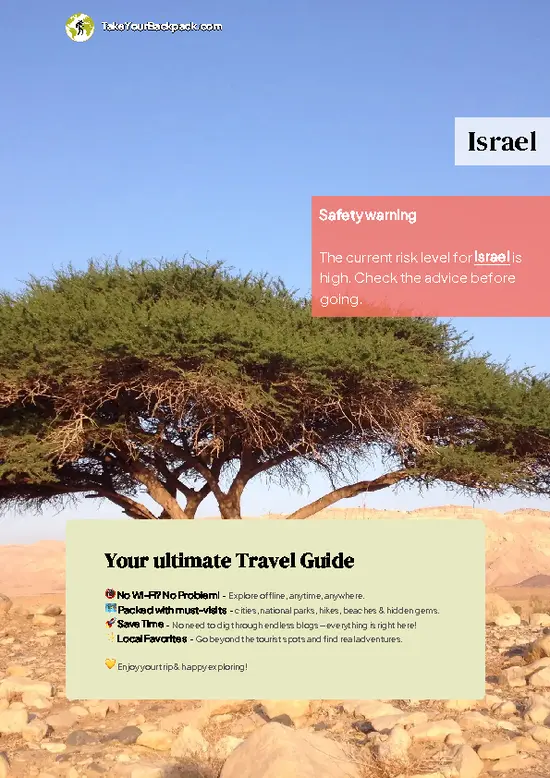
example page 0 from our offline Travel Guide for Israel
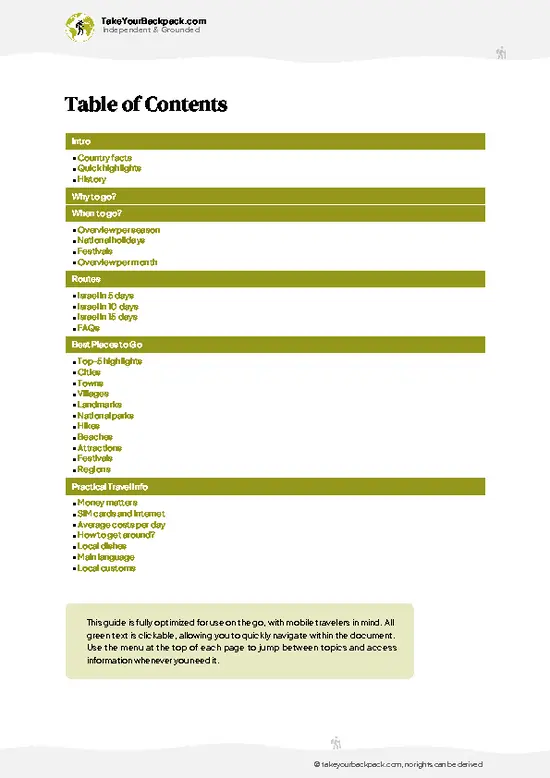
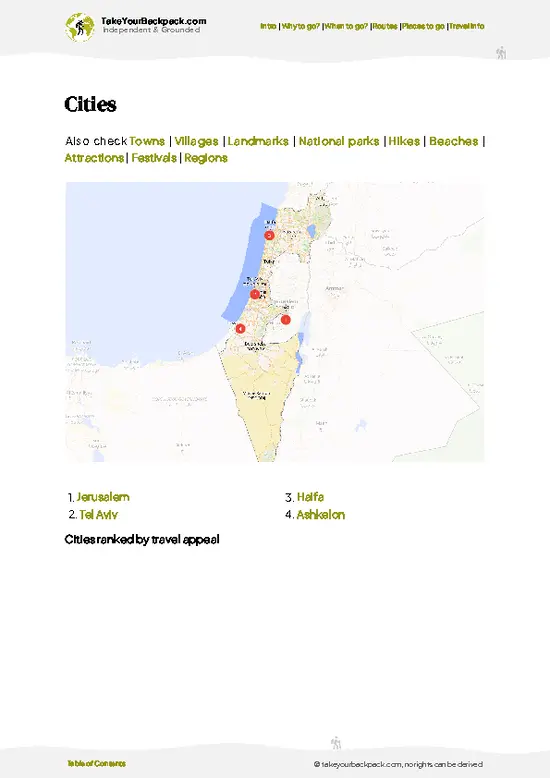
example page 1 from our offline Travel Guide for Israel
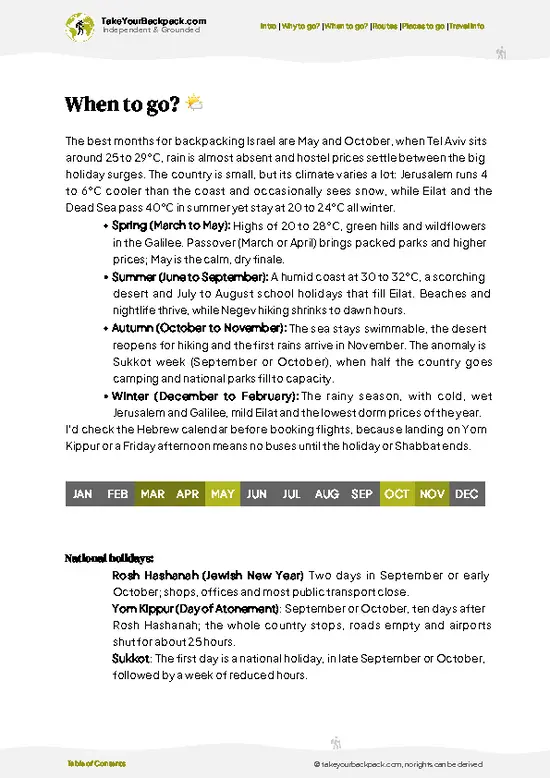
example page 2 from our offline Travel Guide for Israel
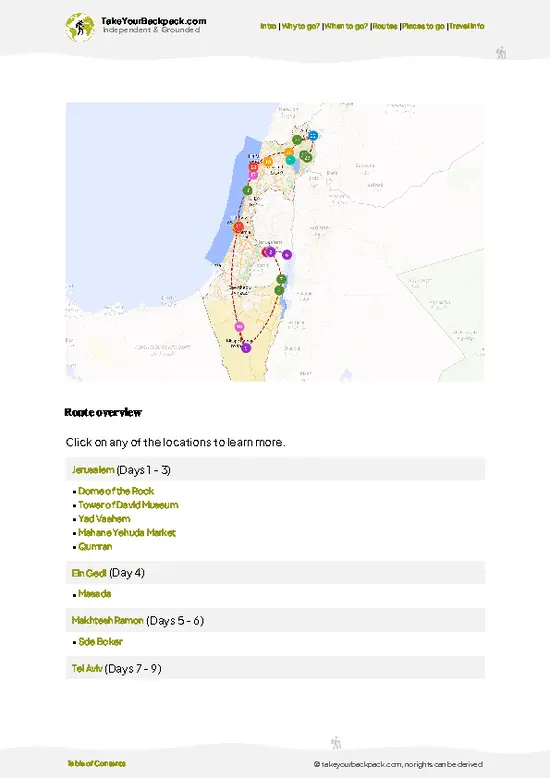
example page 3 from our offline Travel Guide for Israel
example page 4 from our offline Travel Guide for Israel
example page 5 from our offline Travel Guide for Israel
example page 6 from our offline Travel Guide for Israel
example page 7 from our offline Travel Guide for Israel
The digital guide (287 pages) contains:
✅ 77 highlights, ranked by travel appeal
✅ Optimized 5, 10 & 15-day travel routes
✅ Cities, national parks, landmarks, beaches
✅ How to get around
✅ Offline-friendly for travel without Wi-Fi
👉 Click to see all 30+ guide features

📅 Plan smarter in minutes, not weeks
✅ Month by month travel advice
✅ Festivals & national holidays
✅ Budget expectations

🗺️ Go to the right places, skip the overrated ones
✅ Honest pros & cons of destinations
✅ Top hikes, parks & viewpoints
✅ Lesser-known places most travelers miss
✅ Clear “worth it vs skip it” guidance

🛏️ Travel smoothly without rookie mistakes
✅ Best areas to stay
✅ Transport systems explained simply
✅ Common scams & safety advice
✅ SIM cards, money & practical tips

🌍 Understand the country, not just visit it
✅ Culture & traditions
✅ 52 Essential phrases & customs
✅ Festivals worth planning around
✅ Traveler-friendly historical context
✅ Insights that make places more meaningful

📱 Built for real travel conditions
✅ Fully downloadable PDF
✅ Works completely offline
✅ Optimized for phone use
✅ Useful in remote areas & buses
✅ Everything in one place
Stop searching, start planning
Get instant access to your full guide. 30‑day money-back guarantee.
+ Add another guide for just

By proceeding you agree to our terms.
Sent to your inbox immediately after payment • 100% Secure Checkout
Best Backpacking Travel Advisor 2025 tourism awardBest Backpacking
Travel Advisor
2025
What others say about Take Your Backpack Guides:
⭐⭐⭐⭐⭐
Fantastic, amazing amount of information!
⭐⭐⭐⭐⭐
My goodness this is amazing, it's what I've been looking for hats off too you!
⭐⭐⭐⭐⭐
I think this is absolutely BRILLIANT
⭐⭐⭐⭐
Very complete and informative. It's still missing places, but I gotta to commend you
⭐⭐⭐⭐⭐
This is truly amazing, thank you, can't wait to explore it with my kids!
⭐⭐⭐⭐⭐
Awesome resource, thank you!
⭐⭐⭐⭐⭐
This is amazing! Can't wait to explore the ones I haven't seen
⭐⭐⭐⭐
I love this! Well done, great idea.
⭐⭐⭐⭐⭐
Thanks for taking the time to make this gem!
⭐⭐⭐⭐⭐
This might be the best website I've ever seen.
⭐⭐⭐⭐⭐
Congratulations, and thank you so much for your work; it's incredibly valuable.
⭐⭐⭐⭐
In all seriousness I think you did a great job pointing out the important spots
⭐⭐⭐⭐⭐
10/10 very good
⭐⭐⭐⭐⭐
As someone who's only just starting to visit regularly this is awesome, thank you.
⭐⭐⭐⭐
Thank you very much! I'm going to visit my dad, it's going to be very useful!
⭐⭐⭐⭐⭐
This is really cool! We'll be travelling for the first time and this definitely come in handy.
⭐⭐⭐⭐⭐
You are now our minister of culture, congratulations 👨‍💼
⭐⭐⭐⭐⭐
Just wanted to tell you that this is a pearl! Going to follow your recommendations.
⭐⭐⭐⭐⭐
This is so cool. I'll definitely be using the resource for my travels soon.
⭐⭐⭐⭐⭐
This is very impressive! Good work.
⭐⭐⭐⭐⭐
This is an amazing and informative site. Very well done!

🛏️ Where to stay?Top Areas to Stay

Israel has a solid hostel scene, with dorm beds typically running ₪100 to 180 (about US$33 to 58) and private rooms in guesthouses from around ₪300 (US$100). In Tel Aviv, the Florentin district and the streets around Allenby and the beachfront put you near bars, street art and the sea, but expect late-night noise, while Jerusalem hostels cluster in the City Center around Jaffa Road (lively, close to the light rail and Mahane Yehuda market) and inside the Old City, which is atmospheric and steps from the holy sites but goes very quiet after dark. Haifa is calmer and cheaper, with most budget beds near the German Colony and downtown, a good pick if you want sleep over nightlife.

If you enjoy meeting … read more 👉
Israel has a solid hostel scene, with dorm beds typically running ₪100 to 180 (about US$33 to 58) and private rooms in guesthouses from around ₪300 (US$100). In Tel Aviv, the Florentin district and the streets around Allenby and the beachfront put you near bars, street art and the sea, but expect late-night noise, while Jerusalem hostels cluster in the City Center around Jaffa Road (lively, close to the light rail and Mahane Yehuda market) and inside the Old City, which is atmospheric and steps from the holy sites but goes very quiet after dark. Haifa is calmer and cheaper, with most budget beds near the German Colony and downtown, a good pick if you want sleep over nightlife.

If you enjoy meeting fellow travelers, consider choosing hostels with high ratings for atmosphere. On the other hand, if you prefer having your own space, a hotel might be a better option.

IsraelDiscover the Country

👋 Meet the founderWho’s Behind Take Your Backpack?

Johan, backpacker and founder of TakeYourBackpackHi, I’m Johan (Netherlands 🇳🇱), the creator of TakeYourBackpack. Over the past 3 decades, I’ve backpacked through 90+ countries across six continents, gaining extensive experience with independent travel, long-term trips, and overland routes.

This site is built on a combination of firsthand travel experience and carefully curated insights from other backpackers. Many guides are based on places I’ve personally visited, while others bring together tips, observations, and practical advice shared by trusted travelers I’ve met along the way.

The goal is to provide realistic, experience-driven guidance — not generic itineraries — so you can explore destinations with better context, clearer expectations, and more confidence.