×

Kazakhstan🇰🇿 | best regionsYour Guide to the 5 Best regions in Kazakhstan

Kazakhstan is the ninth-largest country on Earth, and its regions behave like separate countries stitched together by long train lines and longer horizons. The south pairs snowy Tian Shan ranges with the country’s most walkable cities, easy access and the busiest hostels. The east and the Altai pull in hikers who want empty trails and cool air. The west runs on oil money, with higher prices and fewer travelers, while the vast central steppe and the desert interior reward independent travel with silence and real distance. Costs swing too: Almaty and Astana charge city prices, rural stops run far cheaper. Pick a region by terrain, then match it to your tolerance for 8-hour drives, shared taxis and zero English. Pack boldly and go.

By Johan Kruseman 🇳🇱 | Updated October 19, 2026
Explore the best cities in Kazakhstan

Why go?Why Travelers Love These Spots

Kazakhstan runs on scale. Its area is about 2.7 million square kilometers, roughly the size of Western Europe, yet only around 20 million people live in it. That means regions are separated by deserts, steppe and mountain ranges rather than by a short bus hop, and every border-to-border move is a commitment. The payoff is variety: glacier-fed mountains, salt flats, canyons, caspian coastline and rolling grassland all sit inside one visa-free passport stamp for many nationalities (citizens of the EU, US, UK and many others usually get stays of 30 days or more, with rules worth checking before departure).

History shapes what you meet. Nomadic Kazakh culture built on horses, yurts and open grazing ground, then the Silk Road and Soviet era layered on top: crumbling space-age infrastructure, planned … read more 👉
Kazakhstan runs on scale. Its area is about 2.7 million square kilometers, roughly the size of Western Europe, yet only around 20 million people live in it. That means regions are separated by deserts, steppe and mountain ranges rather than by a short bus hop, and every border-to-border move is a commitment. The payoff is variety: glacier-fed mountains, salt flats, canyons, caspian coastline and rolling grassland all sit inside one visa-free passport stamp for many nationalities (citizens of the EU, US, UK and many others usually get stays of 30 days or more, with rules worth checking before departure).

History shapes what you meet. Nomadic Kazakh culture built on horses, yurts and open grazing ground, then the Silk Road and Soviet era layered on top: crumbling space-age infrastructure, planned cities and Russian-speaking communities coexist with Kazakh-language rural life. Russian works almost everywhere as a common language, Kazakh dominates in the countryside, and English is thin outside the big cities.

Infrastructure is uneven. Night trains and domestic flights (Almaty, Astana, Shymkent and Aktau are the main hubs) link the big points cheaply, while the rest depends on shared taxis, marshrutkas and hired drivers. Roads can be superb near cities and rough gravel elsewhere. Continental climate brings brutal swings, with winters of minus 20°C or colder on the steppe and summers above 35°C in the south and desert.

Go in expecting distance, slow logistics and warm hospitality. Regions here are not a quick sampler. They are a chain of big, distinct landscapes, and the traveler who plans a few of them well comes away with far more than one who tries to tick them all.
Evaluating the Top Choices
The list of best regions in Kazakhstan is created based on landscapes, local culture, attractions, vibes, and overall appeal. If you feel a region is missing in this list, please let us know.

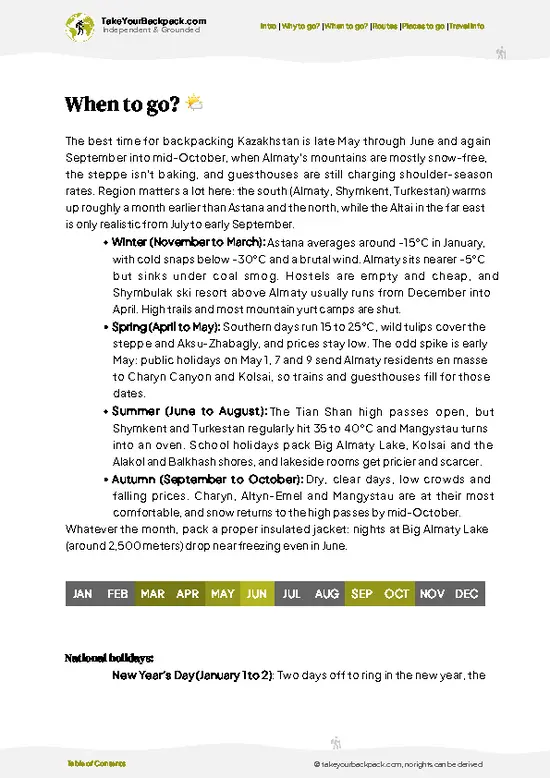
When to go?Timing Your Visit for the Best Experience

Best months: The best months for Kazakhstan’s regions are June to September for mountains and the north, and April to May plus September to October for the south and desert, because those windows give mild days (roughly 15 to 28°C) without the heat or deep cold of the extremes. Get moving in these windows and trails, roads and yurt camps are all open.

Summer: July and August bring the high mountains into play: Tian Shan and Altai trails are snow-free, lakes warm up to swimmable at lower elevations, and alpine meadows fill with flowers. Nights above 2,500 meters still drop near freezing. In the south and in the Caspian lowlands, midsummer pushes past 35 to 40°C, so desert and canyon visits need dawn starts. Expect peak prices and full guesthouses in July and August around popular lake and … read more 👉
Best months: The best months for Kazakhstan’s regions are June to September for mountains and the north, and April to May plus September to October for the south and desert, because those windows give mild days (roughly 15 to 28°C) without the heat or deep cold of the extremes. Get moving in these windows and trails, roads and yurt camps are all open.

Summer: July and August bring the high mountains into play: Tian Shan and Altai trails are snow-free, lakes warm up to swimmable at lower elevations, and alpine meadows fill with flowers. Nights above 2,500 meters still drop near freezing. In the south and in the Caspian lowlands, midsummer pushes past 35 to 40°C, so desert and canyon visits need dawn starts. Expect peak prices and full guesthouses in July and August around popular lake and mountain areas, with rates for rooms and drivers often 20 to 40 percent above shoulder season.

Shoulder seasons: Spring (April to May) turns the steppe green and the southern foothills bright with tulips, typically in April. Rain peaks in spring in the south, and high passes may still hold snow into early June. September and early October offer clear skies, golden foliage, harvest food and thinner crowds, with lower prices. By late October, northern and eastern nights fall below freezing.

Winter: From November to March, the steppe, north and center see minus 15 to minus 30°C and wind that makes it feel colder, with some roads and rural guesthouses closing or slowing. Winter suits ski areas near Almaty, which usually run from December to March, and city stays, but it rules out most remote trekking and camping. Rainfall is low across most of the country, with deserts under 150 millimeters a year and mountains far wetter, so dry days dominate outside spring.

region hoppingSuggested Travel Strategies

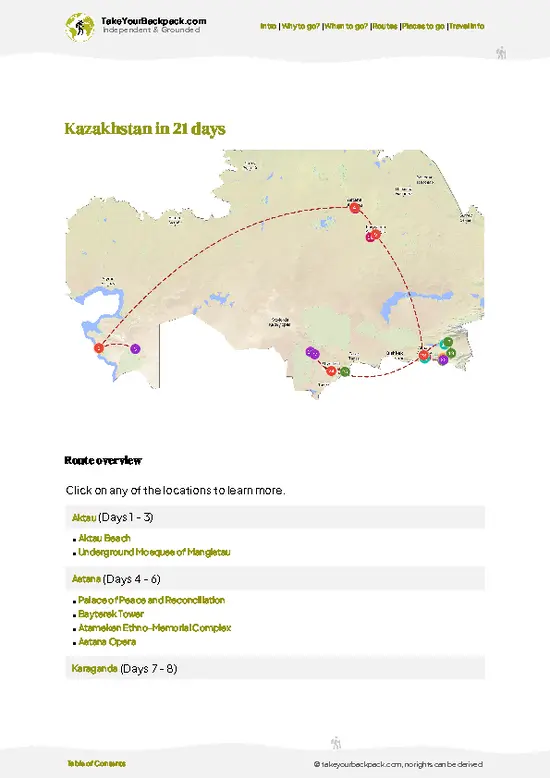
Trip length: A trip combining several regions in Kazakhstan needs 14 to 21 days, because distances are huge and the connecting legs eat whole days. Two weeks handles two or three regions comfortably, while three weeks lets you add a remote one without sprinting.

Grouping and direction: Cluster by geography. The south and southeast share the Almaty hub, so mountain, canyon and lake areas there link by road in 2 to 6 hours. The west around Aktau sits alone beside the Caspian, so treat it as a separate chapter reached by flight or a long train. The north and center connect through Astana, with the east reached by train or flight from Almaty or Astana. A sensible direction runs Astana to the east or center, then south to Almaty, or the reverse, finishing where international flights are cheapest. … read more 👉
Trip length: A trip combining several regions in Kazakhstan needs 14 to 21 days, because distances are huge and the connecting legs eat whole days. Two weeks handles two or three regions comfortably, while three weeks lets you add a remote one without sprinting.

Grouping and direction: Cluster by geography. The south and southeast share the Almaty hub, so mountain, canyon and lake areas there link by road in 2 to 6 hours. The west around Aktau sits alone beside the Caspian, so treat it as a separate chapter reached by flight or a long train. The north and center connect through Astana, with the east reached by train or flight from Almaty or Astana. A sensible direction runs Astana to the east or center, then south to Almaty, or the reverse, finishing where international flights are cheapest. A one-way open-jaw ticket saves 1 to 2 lost days of backtracking.

Time per stop and transfers: Give each region 3 to 5 days: one day to arrive and settle, then two or three for hikes, drives and rest. Remote areas deserve 4 to 5 days since access roads eat time. Between hubs, flights take 1.5 to 2.5 hours (Almaty to Astana about 1.5 to 2 hours), overnight trains 12 to 20 hours (Almaty to Astana runs around 12 to 14), and shared taxis or drivers cover 3 to 8 hours on the shorter hops. Book trains and flights early in summer, since seats fill.

Common planning mistakes: The classic error is reading the map like Europe: a thumb-width on screen can mean 8 to 10 hours of road. Plan no more than one long transfer in any three days. Another is stacking mountain days straight after a night train, which leaves you wrecked; schedule an easy day. Travelers also underestimate rough roads and slow border or checkpoint stops, so keep one spare day per week. Finally, skipping bookings for rural drivers or yurt stays in July and August leaves you stuck; reserve ahead and keep cash for remote stretches.

The ListMust-Visit regions in Kazakhstan

1 Zhetysu Region

River deltas, apple orchards, mountain passes

Travel through a region where fertile valleys meet rugged heights, revealing agricultural traditions and varied natural backdrops.

2 Western Tien-Shan

Alpine valleys, juniper forests, endemic flora

Ascend into high-altitude landscapes marked by diverse plant life, deep gorges, and mountain scenery shaped by shifting weather.

3 Zaisan Lake

Freshwater basin, sandy shores, migratory birds

Watch birdlife gather along broad, open water, with steppe meeting lake and local fishing shaping daily rhythms on the shoreline.

4 Tarbagatai region

Rolling foothills, wildflower meadows, petroglyph sites

Hike through undulating terrain dotted with ancient rock art, seasonal blooms, and grazing livestock in a quiet, pastoral setting.

5 Bukhtarma

Reservoir shores, pine forests, remote villages

Experience tranquil lakeside landscapes, scattered settlements, and forested hills that offer solitude and a slower rhythm of rural life.

Loading the map 🌍

Expert viewTips and Advice from Travelers

How many regions to visit: Visit two or three regions on a first trip, four at most if you have a month. Distances here are measured in half-days on the road, not hours, so every extra region costs a full day of transit plus a day to recover. Three regions in 14 to 18 days leave time for lingering over a village dinner instead of watching the odometer. The gain is depth: you actually learn the rhythm of a place, from the morning bazaar to the evening tea.

Choosing by travel style: First-timers and budget travelers do best with the mountain and city south, where hostels, cafes, marshrutkas and day tours are plentiful and English is easier to find. Hikers and campers should prioritize the high mountain areas, where trails run through spruce forest to alpine lakes, often with nobody else on … read more 👉
How many regions to visit: Visit two or three regions on a first trip, four at most if you have a month. Distances here are measured in half-days on the road, not hours, so every extra region costs a full day of transit plus a day to recover. Three regions in 14 to 18 days leave time for lingering over a village dinner instead of watching the odometer. The gain is depth: you actually learn the rhythm of a place, from the morning bazaar to the evening tea.

Choosing by travel style: First-timers and budget travelers do best with the mountain and city south, where hostels, cafes, marshrutkas and day tours are plentiful and English is easier to find. Hikers and campers should prioritize the high mountain areas, where trails run through spruce forest to alpine lakes, often with nobody else on the path. Culture seekers get the most from Soviet-era cities and Kazakh rural life, with yurt stays, kumis and horseback rides. Adventure travelers who like emptiness choose the desert and steppe, where you drive across chalk canyons and salt flats and see sky from edge to edge. Comfort-first travelers can stay near the capital and big cities, trading wilderness for easy logistics.

What it costs: Budget US$30 to 50 a day as a backpacker: hostel dorm beds at about US$8 to 15, guesthouse rooms at US$20 to 40, meals at US$4 to 10 in local cafes, and shared transport at US$2 to 15 per leg. Mid-range travel lands at US$60 to 100 a day. Add per-visit costs: national park entry often costs a few US dollars, a private driver for a remote day runs US$60 to 120 (split it across a group), guided multi-day treks cost US$50 to 100 a day all-in, and yurt camp half-board is around US$25 to 50. Domestic flights run US$30 to 90 if booked early, and prices are quoted in Kazakhstani tenge, so carry some cash for rural areas where cards fail.

Safety on the ground: Kazakhstan is generally safe for independent travelers, with low violent crime and helpful strangers. Expect police document checks, so carry your passport copy and registration slip where required, and stay polite. Roads are the main hazard: long stretches have livestock, potholes and fast trucks, so avoid driving at night. In the mountains, weather turns quickly, so check forecasts, tell your guesthouse your route and carry layers even in July. Bears, ticks and river crossings call for local advice. Avoid photographing military sites and border zones, and confirm permits for areas near borders; some need them in advance. Winter driving and trekking need proper gear and experienced guides.

Cultural manners: Hospitality is serious here. Accept tea and bread when offered, and remove shoes at the door. Learn a few Russian phrases, which open more doors than English, and a handful of Kazakh words earn big smiles. Dress modestly in villages, though cities are relaxed. Ask before photographing people, particularly older women and herders. Bargain gently at bazaars, not at fixed-price shops. Alcohol is common, and refusing a toast is fine if you do so warmly. Tipping 10 percent in restaurants is appreciated. Your reward is invitations to a family table, plates of beshbarmak and stories shared over tea.

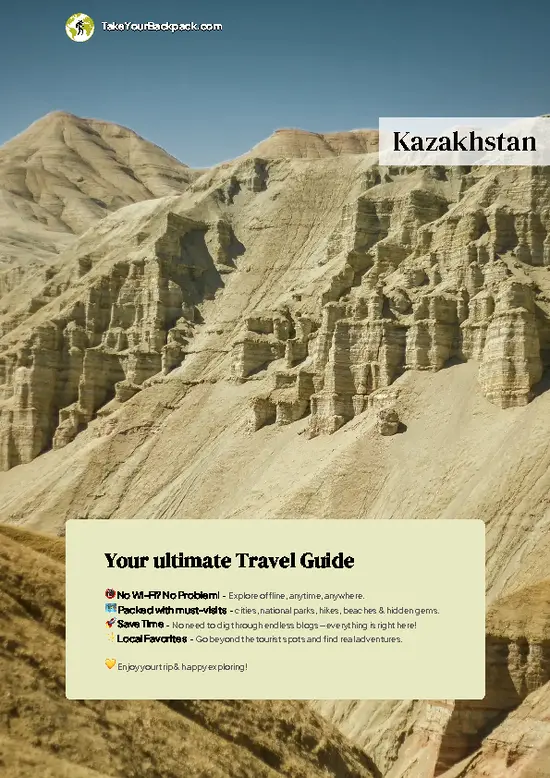
✈️ The backpacker research shortcutKazakhstan Travel Guide

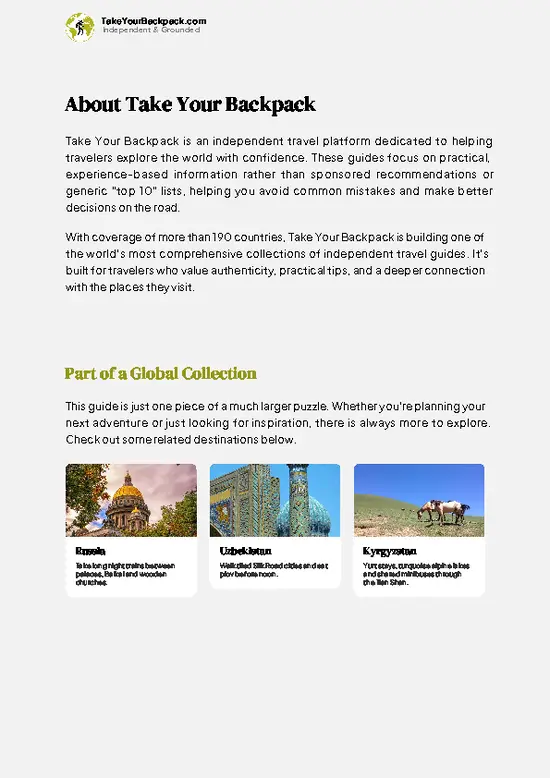
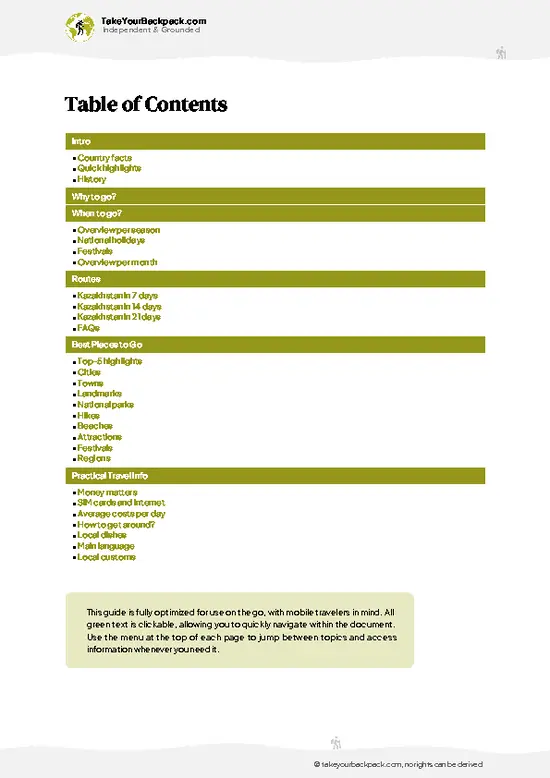
An offline-friendly backpacking guide with optimized travel routes, ranked highlights, transport advice, and the best areas to stay.
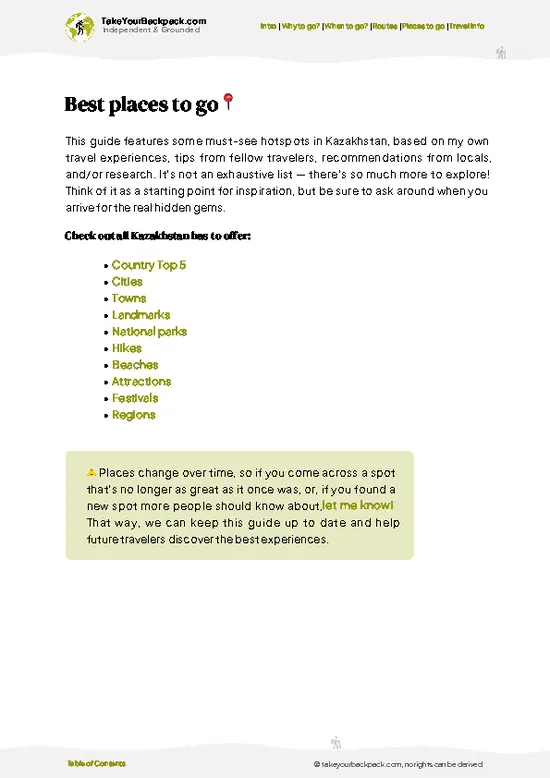
example page 0 from our offline Travel Guide for Kazakhstan
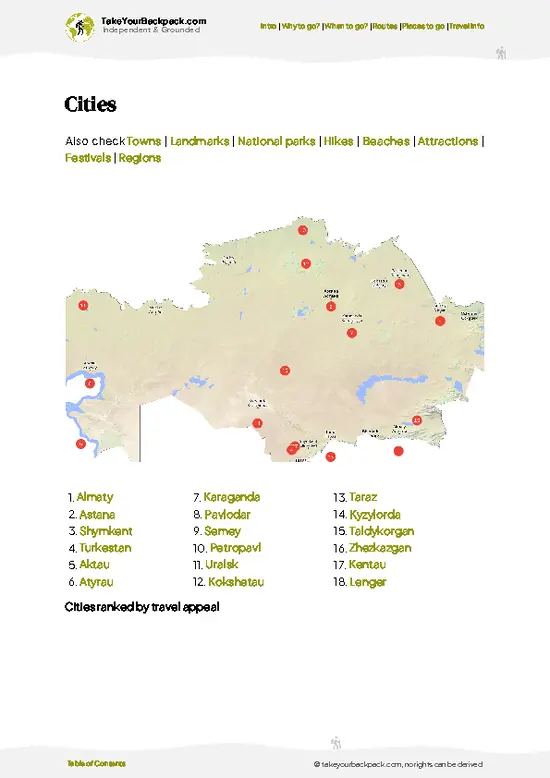
example page 1 from our offline Travel Guide for Kazakhstan
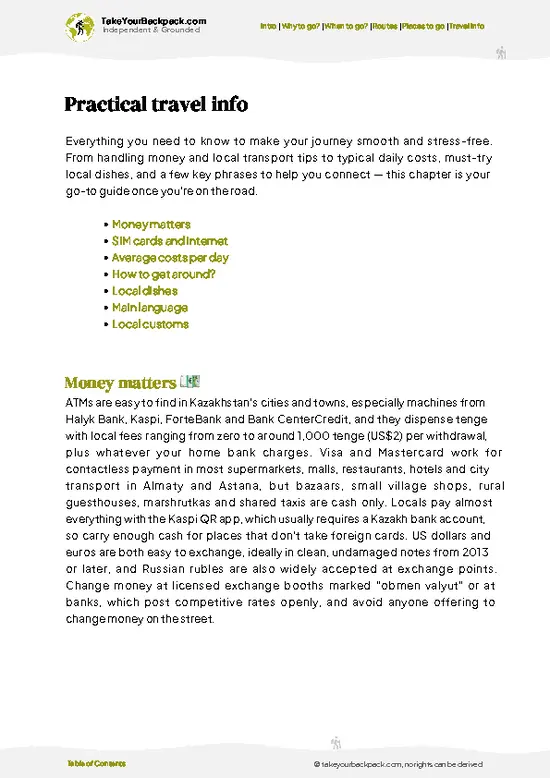
example page 2 from our offline Travel Guide for Kazakhstan
example page 3 from our offline Travel Guide for Kazakhstan
example page 4 from our offline Travel Guide for Kazakhstan
example page 5 from our offline Travel Guide for Kazakhstan
example page 6 from our offline Travel Guide for Kazakhstan
example page 7 from our offline Travel Guide for Kazakhstan
The digital guide (376 pages) contains:
✅ 98 highlights, ranked by travel appeal
✅ Optimized 7, 14 & 21-day travel routes
✅ Cities, national parks, landmarks, beaches
✅ How to get around
✅ Offline-friendly for travel without Wi-Fi
👉 Click to see all 30+ guide features

📅 Plan smarter in minutes, not weeks
✅ Month by month travel advice
✅ Festivals & national holidays
✅ Budget expectations

🗺️ Go to the right places, skip the overrated ones
✅ Honest pros & cons of destinations
✅ Top hikes, parks & viewpoints
✅ Lesser-known places most travelers miss
✅ Clear “worth it vs skip it” guidance

🛏️ Travel smoothly without rookie mistakes
✅ Best areas to stay
✅ Transport systems explained simply
✅ Common scams & safety advice
✅ SIM cards, money & practical tips

🌍 Understand the country, not just visit it
✅ Culture & traditions
✅ 52 Essential phrases & customs
✅ Festivals worth planning around
✅ Traveler-friendly historical context
✅ Insights that make places more meaningful

📱 Built for real travel conditions
✅ Fully downloadable PDF
✅ Works completely offline
✅ Optimized for phone use
✅ Useful in remote areas & buses
✅ Everything in one place
Stop searching, start planning
Get instant access to your full guide. 30‑day money-back guarantee.
+ Add another guide for just

By proceeding you agree to our terms.
Sent to your inbox immediately after payment • 100% Secure Checkout
Best Backpacking Travel Advisor 2025 tourism awardBest Backpacking
Travel Advisor
2025
What others say about Take Your Backpack Guides:
⭐⭐⭐⭐⭐
Fantastic, amazing amount of information!
⭐⭐⭐⭐⭐
My goodness this is amazing, it's what I've been looking for hats off too you!
⭐⭐⭐⭐⭐
I think this is absolutely BRILLIANT
⭐⭐⭐⭐
Very complete and informative. It's still missing places, but I gotta to commend you
⭐⭐⭐⭐⭐
This is truly amazing, thank you, can't wait to explore it with my kids!
⭐⭐⭐⭐⭐
Awesome resource, thank you!
⭐⭐⭐⭐⭐
This is amazing! Can't wait to explore the ones I haven't seen
⭐⭐⭐⭐
I love this! Well done, great idea.
⭐⭐⭐⭐⭐
Thanks for taking the time to make this gem!
⭐⭐⭐⭐⭐
This might be the best website I've ever seen.
⭐⭐⭐⭐⭐
Congratulations, and thank you so much for your work; it's incredibly valuable.
⭐⭐⭐⭐
In all seriousness I think you did a great job pointing out the important spots
⭐⭐⭐⭐⭐
10/10 very good
⭐⭐⭐⭐⭐
As someone who's only just starting to visit regularly this is awesome, thank you.
⭐⭐⭐⭐
Thank you very much! I'm going to visit my dad, it's going to be very useful!
⭐⭐⭐⭐⭐
This is really cool! We'll be travelling for the first time and this definitely come in handy.
⭐⭐⭐⭐⭐
You are now our minister of culture, congratulations 👨‍💼
⭐⭐⭐⭐⭐
Just wanted to tell you that this is a pearl! Going to follow your recommendations.
⭐⭐⭐⭐⭐
This is so cool. I'll definitely be using the resource for my travels soon.
⭐⭐⭐⭐⭐
This is very impressive! Good work.
⭐⭐⭐⭐⭐
This is an amazing and informative site. Very well done!

🛏️ Where to stay?Where to Base Yourself

Hostels and budget guesthouses are easy to find in Kazakhstan, with dorm beds in the big cities typically running 4,000 to 8,000 tenge (about US$8 to 16) and simple private rooms from roughly 12,000 tenge (US$24). In Almaty, the leafy grid around Zhibek Zholy (the pedestrian “Arbat”) and Panfilov Park puts you within walking distance of the Green Bazaar, metro stations and the bars along Panfilov Street, though some cheaper places sit in older Soviet blocks with thin walls and street noise. The streets just south toward Abay Avenue are quieter and closer to the mountain buses. In Astana, the Right Bank old center near the train station has the cheapest beds and calm, safe streets, while the … read more 👉
Hostels and budget guesthouses are easy to find in Kazakhstan, with dorm beds in the big cities typically running 4,000 to 8,000 tenge (about US$8 to 16) and simple private rooms from roughly 12,000 tenge (US$24). In Almaty, the leafy grid around Zhibek Zholy (the pedestrian “Arbat”) and Panfilov Park puts you within walking distance of the Green Bazaar, metro stations and the bars along Panfilov Street, though some cheaper places sit in older Soviet blocks with thin walls and street noise. The streets just south toward Abay Avenue are quieter and closer to the mountain buses. In Astana, the Right Bank old center near the train station has the cheapest beds and calm, safe streets, while the Left Bank is pricier and closer to Baiterek and the modern sights, but nightlife is thin and distances between blocks are long.

If you enjoy meeting fellow travelers, consider choosing hostels with high ratings for atmosphere. On the other hand, if you prefer having your own space, a hotel might be a better option.

KazakhstanExpand Your Journey

👋 Meet the founderWho’s Behind Take Your Backpack?

Johan, backpacker and founder of TakeYourBackpackHi, I’m Johan (Netherlands 🇳🇱), the creator of TakeYourBackpack. Over the past 3 decades, I’ve backpacked through 90+ countries across six continents, gaining extensive experience with independent travel, long-term trips, and overland routes.

This site is built on a combination of firsthand travel experience and carefully curated insights from other backpackers. Many guides are based on places I’ve personally visited, while others bring together tips, observations, and practical advice shared by trusted travelers I’ve met along the way.

The goal is to provide realistic, experience-driven guidance — not generic itineraries — so you can explore destinations with better context, clearer expectations, and more confidence.