×

Kazakhstan🇰🇿 | best national parksYour Guide to the 10 Best national parks in Kazakhstan

Hiking, camping and bumping along dirt tracks define the national parks in Kazakhstan. They are huge, thinly visited and wildly varied, covering alpine lakes and glaciated ranges in the southeast, red canyons and desert in the south, pine-fringed lakes and granite outcrops in the north, and the Altai in the far east. Expect few signs, few crowds and a lot of space.
The southeast near Almaty is the easiest to reach, with day trips, guesthouses and weekend traffic in summer. The north is gentler and busier with Kazakh families. The east is remote and cheaper, but it needs border-zone permits and serious time. For backpackers, independent travel works best with shared taxis, hitched rides or a rented car, and yurt stays fill the gaps between towns. Pick your region first, then chase the trail.

By Johan Kruseman 🇳🇱 | Updated October 19, 2026
Explore the best hikes in Kazakhstan

Why go?Why Travelers Love These Spots

Kazakhstan is the ninth-largest country on Earth, and that scale shapes everything about its parks. Distances are measured in hundreds of kilometers, population is thin outside a few cities, and large tracts of steppe, desert and mountain remain close to untouched. Few countries let you walk from a semi-arid canyon floor to a glacial valley within a day or two of driving, and that range of ecosystems is the real draw.
The Soviet era left a particular legacy. Protected land was long managed as strict scientific reserves, closed to casual visitors, and the national park system is the more recent, more open layer built on top. Tourism infrastructure is therefore still young. Trails are often unmarked, English signage is rare, and visitor centers may be a ranger hut with a ticket window. That is … read more 👉
Kazakhstan is the ninth-largest country on Earth, and that scale shapes everything about its parks. Distances are measured in hundreds of kilometers, population is thin outside a few cities, and large tracts of steppe, desert and mountain remain close to untouched. Few countries let you walk from a semi-arid canyon floor to a glacial valley within a day or two of driving, and that range of ecosystems is the real draw.
The Soviet era left a particular legacy. Protected land was long managed as strict scientific reserves, closed to casual visitors, and the national park system is the more recent, more open layer built on top. Tourism infrastructure is therefore still young. Trails are often unmarked, English signage is rare, and visitor centers may be a ranger hut with a ticket window. That is part of the fun, but it rewards preparation: download offline maps, carry cash in tenge and learn a few Russian phrases, since Russian works more widely than English in rural areas.
Transport is the other big fact. Trains and buses link major cities, but reaching park gates usually means a rented car, a driver or shared taxis. Roads to some of the best spots are rough gravel that turns to mud after rain. Costs stay low by international standards, with guesthouses, homestays and yurt camps often priced well under Western European rates.
Two more things matter before you commit. Border-zone parks require permits for foreigners that need advance arranging, and the climate swings hard between seasons, so a trip planned for the wrong month will hit snow, heat or mosquitoes. Go with that in mind and the country opens up fast.
Behind the Scenes of Selection
The list of best national parks in Kazakhstan is created based on landscapes, wildlife, adventure opportunities, facilities, and overall experience. If you feel a national park is missing in this list, please let us know.

When to go?Timing Your Visit for the Best Experience

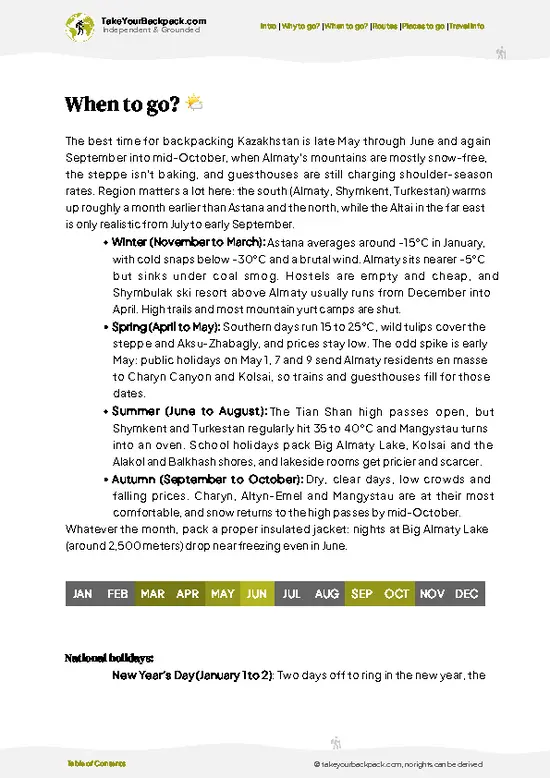
Best months for Kazakhstan’s parks: The best months are late May to June and September to early October, when mountain trails are mostly snow-free, desert heat is bearable and day temperatures in the southeast sit around 15 to 28°C. Those windows deliver long daylight, green valleys in spring and gold poplars in autumn.
Summer: peak season and heat: July and August are the high season for mountain lakes and alpine routes. Highs in the Almaty foothills reach 28 to 33°C, while high-altitude camps stay cool and nights can drop near freezing. Desert and canyon areas in the south can hit 35 to 40°C by midday, so start walking at dawn. Thunderstorms roll through the mountains on summer afternoons. Guesthouse and yurt prices in popular areas often rise 20 to 50 percent on summer weekends, and bookings … read more 👉
Best months for Kazakhstan’s parks: The best months are late May to June and September to early October, when mountain trails are mostly snow-free, desert heat is bearable and day temperatures in the southeast sit around 15 to 28°C. Those windows deliver long daylight, green valleys in spring and gold poplars in autumn.
Summer: peak season and heat: July and August are the high season for mountain lakes and alpine routes. Highs in the Almaty foothills reach 28 to 33°C, while high-altitude camps stay cool and nights can drop near freezing. Desert and canyon areas in the south can hit 35 to 40°C by midday, so start walking at dawn. Thunderstorms roll through the mountains on summer afternoons. Guesthouse and yurt prices in popular areas often rise 20 to 50 percent on summer weekends, and bookings fill ahead of time.
Shoulder seasons: April to mid-May brings wildflowers and tulips on the southern steppe and foothills, but higher passes may still hold snow, and rain turns dirt roads to mud. October is crisp, dry and quiet, with daytime highs of 8 to 15°C and prices easing. Many yurt camps and seasonal guesthouses start closing by mid-October.
Winter and the north: From November to March, temperatures in the north drop to -15 to -25°C and some lake areas see heavy snow. Winter suits ski touring and snowshoeing near Almaty, but backpacking in the high ranges is for experienced winter campers only. In the north, summer highs of 20 to 26°C come with mosquitoes in June and July, so a head net is smart. The east, around the Altai, has a short hiking window from late June to early September.

national park hoppingSuggested Travel Strategies

How long a multi-park trip takes: A trip combining several national parks in Kazakhstan needs 10 to 14 days at minimum, and 3 weeks if you want the east or the north as well. Distances, not trail length, eat the schedule.
Regions that cluster well: The southeast around Almaty is the natural core. Mountain, canyon and desert parks sit within roughly 3 to 6 hours’ drive of the city, and a loop out and back returns you to Almaty’s airport and bus links. Allow 2 to 3 days per stop, and 3 to 4 for any park where you want to hike overnight. The north near Astana is a separate cluster: fly Almaty to Astana (about 1.5 hours), then drive roughly 3 hours to the lakes. Give it 2 to 3 days. The far east needs its own trip, flying Almaty to Oskemen (about 2 hours) followed by 6 to 8 hours on the road, and … read more 👉
How long a multi-park trip takes: A trip combining several national parks in Kazakhstan needs 10 to 14 days at minimum, and 3 weeks if you want the east or the north as well. Distances, not trail length, eat the schedule.
Regions that cluster well: The southeast around Almaty is the natural core. Mountain, canyon and desert parks sit within roughly 3 to 6 hours’ drive of the city, and a loop out and back returns you to Almaty’s airport and bus links. Allow 2 to 3 days per stop, and 3 to 4 for any park where you want to hike overnight. The north near Astana is a separate cluster: fly Almaty to Astana (about 1.5 hours), then drive roughly 3 hours to the lakes. Give it 2 to 3 days. The far east needs its own trip, flying Almaty to Oskemen (about 2 hours) followed by 6 to 8 hours on the road, and 4 to 5 days on the ground once you arrive.
Direction of travel: Start in Almaty to acclimatize and sort cash, SIM cards and permits. Head to the lower, hotter desert and canyon areas first in shoulder season, then climb into the alpine zone once your legs are settled. In midsummer, reverse that: do the high ground early and the hot lowlands in the cooler dawn hours of the end of the trip. Fly for the north and east instead of overlanding, since the steppe road runs 1,000 km or more.
Planning mistakes to avoid: The first is cramming too many stops into too few days. Road speeds average 40 to 60 km/h on gravel, so a 200 km leg can swallow a half day. Budget buffer time. The second is skipping permits: border-zone areas need paperwork arranged days or weeks ahead, so apply before booking transport. The third is relying on public buses between park gates. Share a taxi, hire a driver for a few days, or rent a 4x4 and split the cost.

The ListMust-Visit national parks in Kazakhstan

1 Altyn Emel National Park

singing dunes, chalk mountains, wild horses

Walk among shifting sand dunes that emit a low hum, then cross open plains to see ancient petroglyphs and grazing kulan.

2 Charyn Canyon National Park

deep canyon, red cliffs, desert flora

Descend into a dramatic gorge carved by the Charyn River, where layered rock walls and rare plants define the arid scenery.

3 Kolsai Lakes National Park

mountain lakes, spruce forests, hiking trails

Trek between turquoise lakes linked by forested paths, with opportunities for camping and spotting golden eagles overhead.

kazakhstan-national-park-kolsai-lakes-national-park
© Google |

4 Ile-Alatau National Park

glacial valleys, alpine meadows, waterfalls

Ascend forested trails to reach high-altitude meadows, passing waterfalls and glaciers beneath the peaks of the Zailiyskiy Alatau.

kazakhstan-national-park-ile-alatau-national-park
© Google |

5 Burabay National Park

blue lakes, forested slopes, rock formations

Paddle across deep lakes, climb pine-covered hills, and explore oddly shaped granite boulders scattered throughout the landscape.

6 Katon-Karagay National Park

Altai peaks, taiga forests, glacial rivers

Venture into remote valleys where taiga forests meet alpine tundra, following rivers fed by glaciers and watching for elk or bears.

7 Bayanaul National Park

granite hills, pine forests, clear lakes

Swim in cool lakes framed by rocky outcrops and wander through forests that shelter roe deer and rare birds of prey.

kazakhstan-national-park-bayanaul-national-park
© Google |

8 Karkaraly National Park

pine-covered mountains, granite cliffs, forest lakes

Camp beside tranquil lakes set among pine forests and hike granite ridges that offer sweeping views of the Kazakh uplands.

kazakhstan-national-park-karkaraly-national-park
© Google |

9 Zhongar-Alatau National Park

glaciated peaks, wildflower meadows, river valleys

Cross flower-filled slopes and deep valleys beneath dramatic mountains, with rivers carving through a landscape shaped by glaciers.

10 Sairam-Ugam National Park

alpine meadows, juniper forests, petroglyphs, snow-capped peaks

Hike through mountain valleys lined with wildflowers, spot ancient rock carvings, and watch ibex graze beneath the Tien Shan summits.

11 Aksu-Zhabagly Nature Reserve

mountain foothills, wild tulips, rare wildlife

Hike through juniper valleys and alpine meadows to spot endemic plants and glimpse ibex or snow leopards in rugged terrain.

12 Korgalzhyn Nature Reserve

steppe lakes, pink flamingos, wetland expanses

Witness vast wetlands dotted with nesting flamingos and other waterbirds, set against endless steppe and open sky.

13 Markakol State Nature Reserve

mountain lake, larch forests, rare fish

Travel to a secluded alpine lake surrounded by larch woods, where endemic fish species thrive in cold, clear water.

14 West Altai State Nature Reserve

mixed forests, mountain ridges, rare flora

Traverse dense woods and ascend to alpine meadows where unique plant species and sweeping mountain vistas await.

15 Akzhayik State Nature Reserve

river delta, reed beds, migratory birds

Observe seasonal bird migrations and explore wetlands where the Ural River meets the Caspian, supporting diverse aquatic and avian life.

16 Alakol State Nature Reserve

salt lakes, steppe islands, waterfowl colonies

Visit isolated lakes surrounded by arid steppe, where pelicans and flamingos gather on remote shores during nesting season.

17 Buiratau National Park

rolling hills, birch groves, steppe vistas

Trek across undulating grasslands and birch woodlands, encountering marmots and panoramic views over the Central Kazakhstan plateau.

18 Karatau Nature Reserve

limestone ridges, endemic plants, arid canyons

Traverse dry canyons and rocky slopes, searching for rare flora unique to the Karatau Mountains and observing ancient geological layers.

19 Naurzum Nature Reserve

steppe lakes, salt pans, bird migration

Watch flocks of rare birds gather at seasonal lakes and cross open grasslands that stretch to the horizon.

20 Ustyurt Nature Reserve

chalk cliffs, clay deserts, plateau escarpments

Traverse stark plateaus and gaze over sheer white cliffs that drop into vast, empty desert stretching far into the distance.

Think you know Kazakhstan?

Prove you’re a true local — uncover 10 lesser-known national parks in Kazakhstan that locals tend to keep to themselves.
Loading the map 🌍

Expert viewTips and Advice from Travelers

How many parks to visit: Visit three to four parks on a typical two-week trip. Distances are long and trailheads are far from paved roads, so cramming in more turns the trip into a car tour. Three or four lets you spend a full day on foot in each, with a buffer for weather and rough tracks. You get the dawn light on a canyon wall, or a lake that turns turquoise once the sun clears the ridge, instead of a blur through a windshield.
Choosing by type and travel style: Hikers and campers should put mountain parks first: multi-day routes, alpine lakes and horses on the passes. Photographers and short-trip travelers get the best return from canyon and desert parks, where scenery is dramatic from a viewpoint, and a day is enough. Families and anyone wanting a soft landing suit the northern lake parks, … read more 👉
How many parks to visit: Visit three to four parks on a typical two-week trip. Distances are long and trailheads are far from paved roads, so cramming in more turns the trip into a car tour. Three or four lets you spend a full day on foot in each, with a buffer for weather and rough tracks. You get the dawn light on a canyon wall, or a lake that turns turquoise once the sun clears the ridge, instead of a blur through a windshield.
Choosing by type and travel style: Hikers and campers should put mountain parks first: multi-day routes, alpine lakes and horses on the passes. Photographers and short-trip travelers get the best return from canyon and desert parks, where scenery is dramatic from a viewpoint, and a day is enough. Families and anyone wanting a soft landing suit the northern lake parks, with easy paths, cabins and cafés. Hard-core adventurers with 3 weeks should go east to the Altai, where you have empty valleys, river crossings and horse treks. Each kind pays off differently, so pick the one that matches your legs and your calendar.
What it costs: Plan on US$25 to 45 a day for a backpacker who shares transport and sleeps in guesthouses or yurt camps, and US$50 to 80 with a private driver. Entry fees are modest, usually 1,000 to 5,000 tenge (US$2 to 10) per person, with extra charges for vehicles and camping in some parks. A guesthouse bed runs 8,000 to 20,000 tenge (US$16 to 40), and a yurt stay with dinner and breakfast often costs 15,000 to 30,000 tenge (US$30 to 60). A shared taxi from Almaty to a park gate costs roughly 4,000 to 10,000 tenge (US$8 to 20) a seat, while a full car with driver runs 40,000 to 80,000 tenge (US$80 to 160) per day. A guide or horse for a mountain day adds 15,000 to 40,000 tenge (US$30 to 80). Expect US$40 to 120 per park visit all in, depending on whether you drive yourself and how deep you go. Carry cash, since card terminals are scarce outside towns, and the dinner you eat by a woodstove costs less than a city coffee in Western Europe.
Safety on the ground: Mountain weather turns fast. Clear mornings give way to afternoon storms, and temperatures can plunge 15 degrees in an hour, so carry a shell and start early. Rivers swell with afternoon snowmelt, so cross in the morning. Ticks are active from spring to early summer in foothills and forests, so use repellent and check your skin each evening. Tell your guesthouse where you are headed, since mobile coverage vanishes in valleys. Dirt roads wash out after rain, and a car with low clearance can get stuck for hours. Brown bears, wolves and wild boar live in remote parks, so store food properly and avoid hiking at dusk. Stray dogs near herder camps can be aggressive, so keep a stick or trekking pole handy. Border-zone parks require permits for foreigners, and carrying your passport at all times is routine, with checkpoints on some roads.
Cultural manners: Hospitality in Kazakhstan is real. A herder may invite you into a yurt for tea, bread and fermented mare’s milk (kumys). Accept at least a sip, take off your shoes, and avoid stepping on the threshold. Ask before photographing people or livestock. Dress modestly in villages, though shorts on the trail are fine. Pack out all litter, as bins are rare, and use only established fire rings. Learning “rakhmet” (thank you) earns smiles, and Russian greetings work everywhere.

✈️ The backpacker research shortcutKazakhstan Travel Guide

An offline-friendly backpacking guide with optimized travel routes, ranked highlights, transport advice, and the best areas to stay.
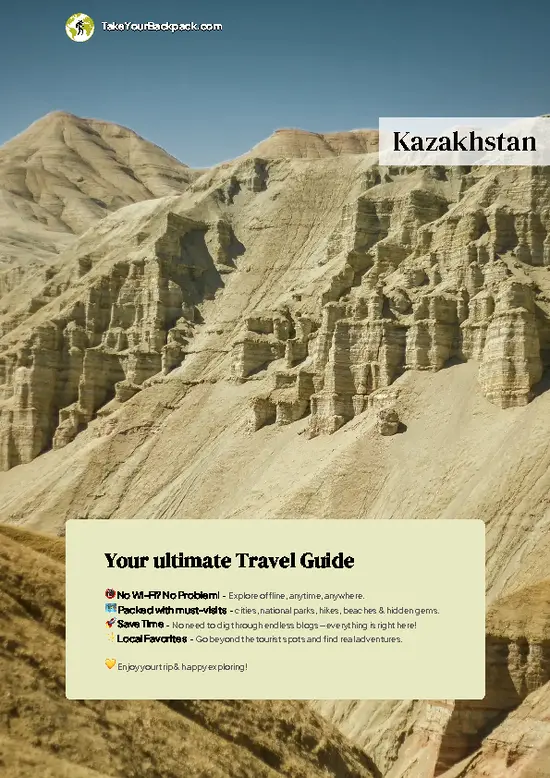
example page 0 from our offline Travel Guide for Kazakhstan
example page 1 from our offline Travel Guide for Kazakhstan
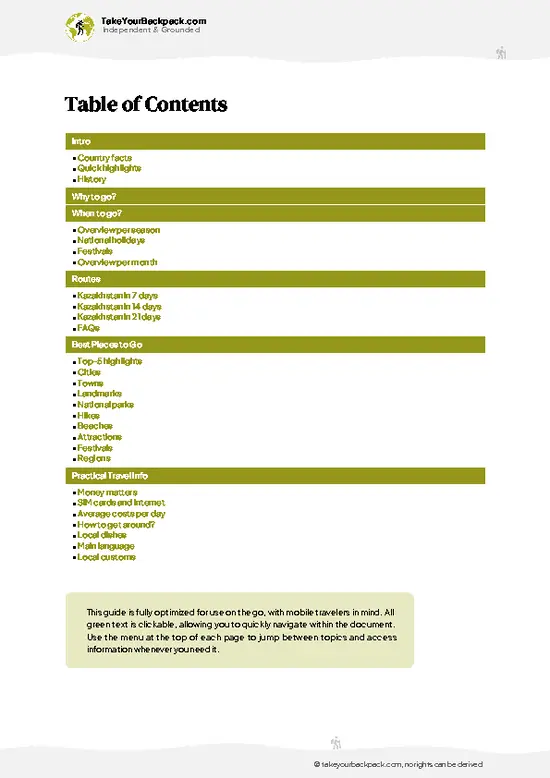
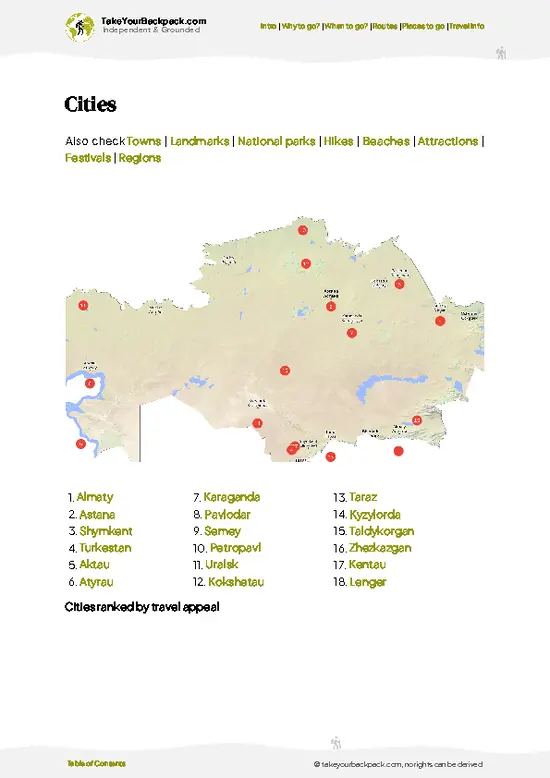
example page 2 from our offline Travel Guide for Kazakhstan
example page 3 from our offline Travel Guide for Kazakhstan
example page 4 from our offline Travel Guide for Kazakhstan
example page 5 from our offline Travel Guide for Kazakhstan
example page 6 from our offline Travel Guide for Kazakhstan
example page 7 from our offline Travel Guide for Kazakhstan
The digital guide (376 pages) contains:
✅ 98 highlights, ranked by travel appeal
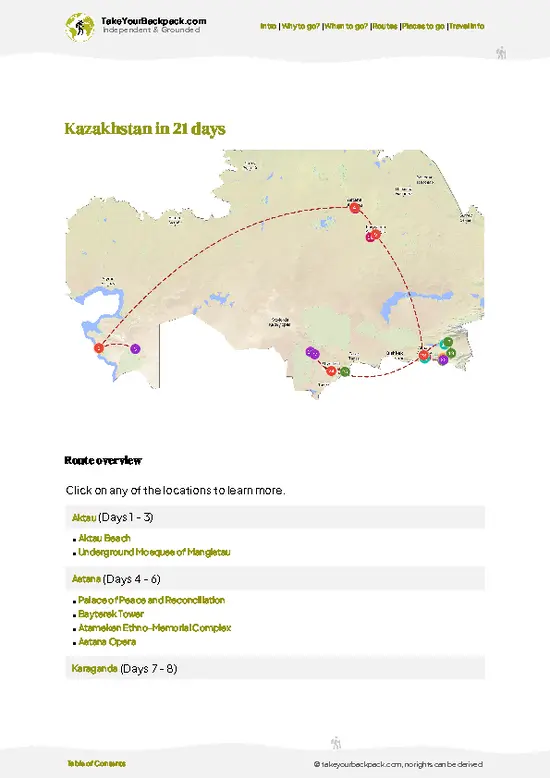
✅ Optimized 7, 14 & 21-day travel routes
✅ Cities, national parks, landmarks, beaches
✅ How to get around
✅ Offline-friendly for travel without Wi-Fi
👉 Click to see all 30+ guide features

📅 Plan smarter in minutes, not weeks
✅ Month by month travel advice
✅ Festivals & national holidays
✅ Budget expectations

🗺️ Go to the right places, skip the overrated ones
✅ Honest pros & cons of destinations
✅ Top hikes, parks & viewpoints
✅ Lesser-known places most travelers miss
✅ Clear “worth it vs skip it” guidance

🛏️ Travel smoothly without rookie mistakes
✅ Best areas to stay
✅ Transport systems explained simply
✅ Common scams & safety advice
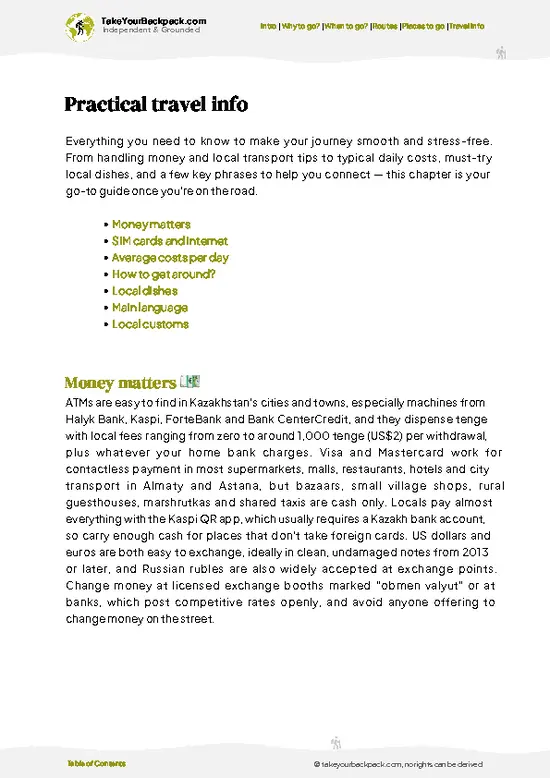
✅ SIM cards, money & practical tips

🌍 Understand the country, not just visit it
✅ Culture & traditions
✅ 52 Essential phrases & customs
✅ Festivals worth planning around
✅ Traveler-friendly historical context
✅ Insights that make places more meaningful

📱 Built for real travel conditions
✅ Fully downloadable PDF
✅ Works completely offline
✅ Optimized for phone use
✅ Useful in remote areas & buses
✅ Everything in one place
Stop searching, start planning
Get instant access to your full guide. 30‑day money-back guarantee.
+ Add another guide for just

By proceeding you agree to our terms.
Sent to your inbox immediately after payment • 100% Secure Checkout
Best Backpacking Travel Advisor 2025 tourism awardBest Backpacking
Travel Advisor
2025
What others say about Take Your Backpack Guides:
⭐⭐⭐⭐⭐
Fantastic, amazing amount of information!
⭐⭐⭐⭐⭐
My goodness this is amazing, it's what I've been looking for hats off too you!
⭐⭐⭐⭐⭐
I think this is absolutely BRILLIANT
⭐⭐⭐⭐
Very complete and informative. It's still missing places, but I gotta to commend you
⭐⭐⭐⭐⭐
This is truly amazing, thank you, can't wait to explore it with my kids!
⭐⭐⭐⭐⭐
Awesome resource, thank you!
⭐⭐⭐⭐⭐
This is amazing! Can't wait to explore the ones I haven't seen
⭐⭐⭐⭐
I love this! Well done, great idea.
⭐⭐⭐⭐⭐
Thanks for taking the time to make this gem!
⭐⭐⭐⭐⭐
This might be the best website I've ever seen.
⭐⭐⭐⭐⭐
Congratulations, and thank you so much for your work; it's incredibly valuable.
⭐⭐⭐⭐
In all seriousness I think you did a great job pointing out the important spots
⭐⭐⭐⭐⭐
10/10 very good
⭐⭐⭐⭐⭐
As someone who's only just starting to visit regularly this is awesome, thank you.
⭐⭐⭐⭐
Thank you very much! I'm going to visit my dad, it's going to be very useful!
⭐⭐⭐⭐⭐
This is really cool! We'll be travelling for the first time and this definitely come in handy.
⭐⭐⭐⭐⭐
You are now our minister of culture, congratulations 👨‍💼
⭐⭐⭐⭐⭐
Just wanted to tell you that this is a pearl! Going to follow your recommendations.
⭐⭐⭐⭐⭐
This is so cool. I'll definitely be using the resource for my travels soon.
⭐⭐⭐⭐⭐
This is very impressive! Good work.
⭐⭐⭐⭐⭐
This is an amazing and informative site. Very well done!

🛏️ Where to stay?Best Stay Options in Kazakhstan

Hostels and budget guesthouses are easy to find in Kazakhstan, with dorm beds in the big cities typically running 4,000 to 8,000 tenge (about US$8 to 16) and simple private rooms from roughly 12,000 tenge (US$24). In Almaty, the leafy grid around Zhibek Zholy (the pedestrian “Arbat”) and Panfilov Park puts you within walking distance of the Green Bazaar, metro stations and the bars along Panfilov Street, though some cheaper places sit in older Soviet blocks with thin walls and street noise. The streets just south toward Abay Avenue are quieter and closer to the mountain buses. In Astana, the Right Bank old center near the train station has the cheapest beds and calm, safe streets, while the … read more 👉
Hostels and budget guesthouses are easy to find in Kazakhstan, with dorm beds in the big cities typically running 4,000 to 8,000 tenge (about US$8 to 16) and simple private rooms from roughly 12,000 tenge (US$24). In Almaty, the leafy grid around Zhibek Zholy (the pedestrian “Arbat”) and Panfilov Park puts you within walking distance of the Green Bazaar, metro stations and the bars along Panfilov Street, though some cheaper places sit in older Soviet blocks with thin walls and street noise. The streets just south toward Abay Avenue are quieter and closer to the mountain buses. In Astana, the Right Bank old center near the train station has the cheapest beds and calm, safe streets, while the Left Bank is pricier and closer to Baiterek and the modern sights, but nightlife is thin and distances between blocks are long.

If you enjoy meeting fellow travelers, consider choosing hostels with high ratings for atmosphere. On the other hand, if you prefer having your own space, a hotel might be a better option.

KazakhstanWhere to Go Next

👋 Meet the founderWho’s Behind Take Your Backpack?

Johan, backpacker and founder of TakeYourBackpackHi, I’m Johan (Netherlands 🇳🇱), the creator of TakeYourBackpack. Over the past 3 decades, I’ve backpacked through 90+ countries across six continents, gaining extensive experience with independent travel, long-term trips, and overland routes.

This site is built on a combination of firsthand travel experience and carefully curated insights from other backpackers. Many guides are based on places I’ve personally visited, while others bring together tips, observations, and practical advice shared by trusted travelers I’ve met along the way.

The goal is to provide realistic, experience-driven guidance — not generic itineraries — so you can explore destinations with better context, clearer expectations, and more confidence.