×

Kazakhstan🇰🇿 | best citiesYour Guide to the 10 Best cities in Kazakhstan

Kazakhstan is the ninth-largest country on earth, and its cities behave like islands in a steppe ocean. Expect wide Soviet-planned boulevards, glass towers rising from grassland, mosques and Orthodox churches sharing a skyline, and Russian spoken as often as Kazakh. Regions change everything. The south-east is green, mountain-backed and the easiest to explore on foot, with cafés, bazaars and trailheads close to downtown. The north and center feel planned, spacious and colder, with prices that climb in the capital. The west runs on oil money, so hotels cost more, while the south brings Silk Road shrines, hot dry summers and a slower pace. Distances are huge, so independent travelers should pick a region and travel overland by train rather than chase every dot on the map. Pack layers, learn a few Russian phrases and head out.

By Johan Kruseman 🇳🇱 | Updated October 19, 2026
Explore the best towns in Kazakhstan

Why go?Why Travelers Love These Spots

Kazakhstan is a country of distance, and that shapes every city in it. Settlements here sit hundreds of kilometers apart, linked by railway lines, caravan routes and Soviet industrial planning. The result is a set of urban centers with very different personalities rather than one continuous urban culture.
History layers the map. Nomadic herders left tombs and shrines but few permanent towns, so many cities grew from Russian forts, Silk Road oases, Stalin-era exile and labor camps, or Cold War industry. You see this in the grid streets, the monumental squares and the residential blocks painted in pastel colors. Post-independence money, especially from oil, gas and minerals, added mirrored towers, new mosques and one capital built almost from scratch on the steppe.
Climate is extreme. Winters … read more 👉
Kazakhstan is a country of distance, and that shapes every city in it. Settlements here sit hundreds of kilometers apart, linked by railway lines, caravan routes and Soviet industrial planning. The result is a set of urban centers with very different personalities rather than one continuous urban culture.
History layers the map. Nomadic herders left tombs and shrines but few permanent towns, so many cities grew from Russian forts, Silk Road oases, Stalin-era exile and labor camps, or Cold War industry. You see this in the grid streets, the monumental squares and the residential blocks painted in pastel colors. Post-independence money, especially from oil, gas and minerals, added mirrored towers, new mosques and one capital built almost from scratch on the steppe.
Climate is extreme. Winters in the north can drop below minus 30°C, while southern summers pass 35°C. That makes cities more than backdrops: they are places to warm up, eat well and rest between trips into mountains or desert.
Infrastructure is better than many first-timers expect. Trains are comfortable and cheap, domestic flights cover long gaps, ride-hailing apps work in major cities, and contactless payment is widespread. Outside the main centers, English is limited, and signage often appears in Kazakh and Russian only.
Before choosing Kazakhstan for its cities, accept that it rewards variety over density. Do not expect medieval old towns packed into walkable lanes. Expect big-scale contrasts: Soviet monuments beside modern skylines, bazaars selling horse sausage and dried curds, and café culture that thrives despite harsh winters. Visa-free entry for many nationalities, commonly up to 30 days, keeps the border simple.
Why These Made the Cut
The list of best cities in Kazakhstan is created based on culture, vibe, attractions, transport ease, and local charm. If you feel a city is missing in this list, please let us know.

When to go?Timing Your Visit for the Best Experience

Best months for city travel: The best months for Kazakhstan’s cities are May to June and September to early October, when daytime temperatures usually sit between 15°C and 28°C and long daylight stretches make wandering easy. Spring brings blossom and green hills in the south-east, while early autumn adds golden light and fewer crowds.
Summer: July and August turn the south and west into furnaces, often 35°C to 42°C, so sightseeing shifts to early mornings and evenings. The north and center stay more moderate, typically 22°C to 32°C, though thunderstorms can roll in fast. Summer is peak season for domestic holidays and mountain trips, so expect hotel prices to rise about 10 to 30 percent in popular cities. Hostel dorms stay modest, usually US$8 to 15.
Winter: November to March is cold and dark … read more 👉
Best months for city travel: The best months for Kazakhstan’s cities are May to June and September to early October, when daytime temperatures usually sit between 15°C and 28°C and long daylight stretches make wandering easy. Spring brings blossom and green hills in the south-east, while early autumn adds golden light and fewer crowds.
Summer: July and August turn the south and west into furnaces, often 35°C to 42°C, so sightseeing shifts to early mornings and evenings. The north and center stay more moderate, typically 22°C to 32°C, though thunderstorms can roll in fast. Summer is peak season for domestic holidays and mountain trips, so expect hotel prices to rise about 10 to 30 percent in popular cities. Hostel dorms stay modest, usually US$8 to 15.
Winter: November to March is cold and dark early. In the north and center, January averages roughly minus 10°C to minus 20°C, with cold snaps far lower, and strong wind makes it feel worse. The south-east is milder, around minus 5°C to 3°C, and good for ski access plus skating rinks and warm cafés. Winter is also the cheapest time, with some hotels dropping rates 15 to 30 percent. Pack proper boots, thermal layers and a windproof coat.
Shoulder seasons and holidays: March to April brings slush, rain and unpredictable temperatures, around 0°C to 15°C. Late October cools quickly, with first snow possible in the north. Rainfall is low overall, usually under 400 mm a year in most urban areas, with the wettest spells in spring.
Nauryz, around March 21 to 23, brings public events, yurts and free concerts, but banks, some museums and many shops close for a day or more. Book trains and rooms early around it, and again around the national holidays in December and early January.

city hoppingSuggested Travel Strategies

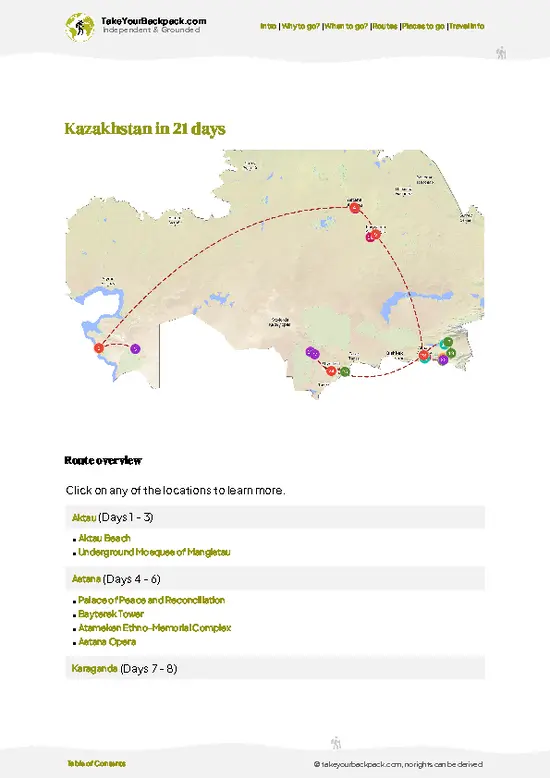
How long to allow: A trip linking several Kazakhstan cities needs 10 to 21 days, and two to three weeks is comfortable if you cross regions. Stay within one region and 7 to 10 days is enough.
Which regions group well: The south-east works as a compact base, with ride-hail transfers and day trips to canyons, lakes and mountain valleys. The south, around Shymkent and Turkistan, pairs well with it because overnight trains and flights connect the hubs. The center and north, anchored by the capital, work as a separate cluster. The west, around the Caspian, is the outlier: it makes sense only if you have extra days and are happy to fly.
A sensible direction is south-east to south, then fly or take a long train north, or the reverse if you want to finish somewhere with winter-proof comforts. Many travelers … read more 👉
How long to allow: A trip linking several Kazakhstan cities needs 10 to 21 days, and two to three weeks is comfortable if you cross regions. Stay within one region and 7 to 10 days is enough.
Which regions group well: The south-east works as a compact base, with ride-hail transfers and day trips to canyons, lakes and mountain valleys. The south, around Shymkent and Turkistan, pairs well with it because overnight trains and flights connect the hubs. The center and north, anchored by the capital, work as a separate cluster. The west, around the Caspian, is the outlier: it makes sense only if you have extra days and are happy to fly.
A sensible direction is south-east to south, then fly or take a long train north, or the reverse if you want to finish somewhere with winter-proof comforts. Many travelers start and end in the largest airport hub for cheap onward flights.
Time per stop and transfers: Allow 2 to 4 nights in a major city and 1 to 2 nights in a smaller stop. Flights between main hubs take about 1.5 to 3 hours. Trains are slower: overnight rides often run 12 to 20 hours between the south and the capital, and some routes run longer. Book a sleeper berth (platzkart is cheapest, kupe is more private) a few days ahead, or earlier in summer. Shared taxis and buses handle shorter regional hops of 2 to 5 hours.
Planning mistakes to avoid: The most common error is underestimating distance. Kazakhstan looks compact on a world map, but connecting three regions by road can eat days. Fly the longest gaps and use trains for overnight efficiency. Another mistake is packing every stop into one week, which leaves only transit and no time to see anything. Choose two regions and give each room. Travelers also forget seasonal timing: winter closures and summer heat can reshape what is realistic, so match your route to the weather.

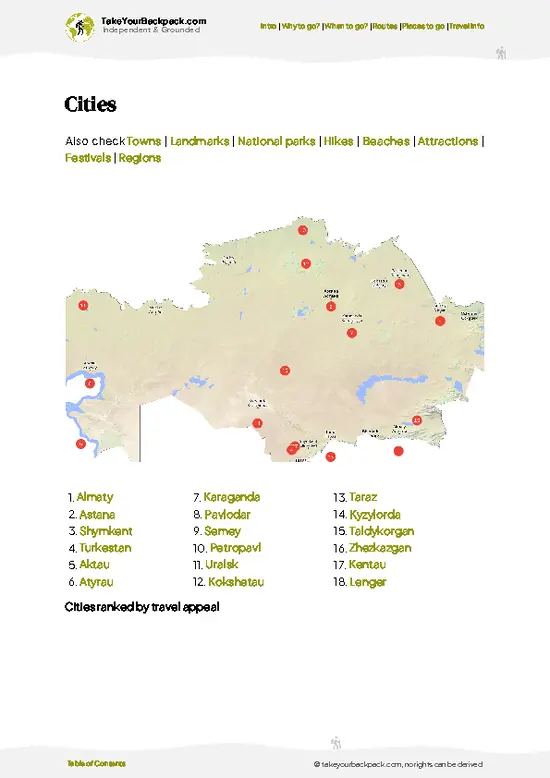
The ListMust-Visit cities in Kazakhstan

1 Almaty

Mountain backdrop, leafy avenues, café scene

Cycle beneath snow-capped peaks, sample local produce at bustling markets, and unwind in parks that anchor daily life in the country’s largest city.

kazakhstan-city-almaty
© Google |

2 Astana

Futuristic skyline, government quarter, wide boulevards

Navigate striking architecture, cross vast open spaces, and observe how modern design shapes the rhythms of Kazakhstan’s planned capital.

3 Shymkent

Bazaar culture, southern crossroads, urban sprawl

Browse lively markets, taste regional dishes, and witness the energetic flow of people in one of Kazakhstan’s fastest-growing cities.

4 Turkestan

Mausoleum complex, pilgrimage site, Silk Road heritage

Stand before centuries-old monuments, observe religious gatherings, and sense the deep historical layers that draw visitors year-round.

5 Aktau

Caspian shoreline, desert cliffs, port city

Walk along windswept beaches, watch ships come and go, and experience the unique blend of sea and steppe at Kazakhstan’s western edge.

kazakhstan-city-aktau
© Google |

6 Atyrau

Oil hub, Ural river, Europe-Asia divide

Cross the river that marks a continental boundary, see the influence of the energy sector, and notice the city’s unique east-west character.

7 Karaganda

Mining legacy, Soviet mosaics, industrial outskirts

Trace the city’s coal-mining roots, explore neighborhoods shaped by industry, and find reminders of twentieth-century history in unexpected corners.

8 Pavlodar

Industrial river port, tram network, northern plains

Ride vintage trams, watch barges on the Irtysh, and observe how industry and transport define daily routines in this northern city.

9 Semey

Literary history, Irtysh river, Soviet relics

Visit museums dedicated to writers, stroll along the riverbank, and notice the city’s layered identity shaped by both culture and politics.

10 Petropavl

Northern border city, birch forests, Tsarist architecture

Stroll through tree-lined streets, spot remnants of imperial-era buildings, and notice the Russian influence in food and language.

11 Uralsk

Russian borderland, old merchant houses, leafy streets

Wander past ornate facades, sense the blend of cultures, and experience a quieter rhythm near the western edge of Kazakhstan.

12 Kokshetau

Lakes region, pine forests, provincial center

Venture into nearby nature reserves, enjoy quiet lakeside walks, and experience a slower pace in this northern administrative hub.

13 Taraz

Ancient ruins, mausoleums, Central Asian crossroads

Walk among archaeological sites, discover traces of caravan routes, and see how the past shapes the present in this compact city.

14 Kyzylorda

Syr Darya river, steppe city, rice fields

Follow the river through open plains, see how agriculture shapes daily life, and notice the influence of Central Asian traditions.

15 Taldykorgan

Regional center, foothill landscapes, agricultural markets

Explore local produce stalls, watch daily life unfold against a backdrop of low hills, and experience a quieter alternative to larger cities.

16 Zhezkazgan

copper mining, steppe city, Soviet mosaics

Experience a mining town surrounded by endless steppe, where industrial heritage and Soviet-era art shape the urban landscape.

17 Kentau

mining town, desert edge, industrial ruins

Explore a settlement at the transition from steppe to desert, where abandoned factories and relics of extraction define the scenery.

18 Lenger

foothill town, apple orchards, archaeological sites

Sample local fruit and explore ancient settlements in a lowland town framed by gentle hills and agricultural landscapes.

Think you know Kazakhstan?

Prove you’re a true local — uncover 8 lesser-known cities in Kazakhstan that locals tend to keep to themselves.
Loading the map 🌍

Expert viewTips and Advice from Travelers

How many cities to visit: I advise three to four cities on a first trip of two to three weeks. That number allows two or three nights each, a day trip or two, and enough slack for the long distances that define Kazakhstan. Add a fifth and you spend more time on trains, in airports and in queues than on streets. The reward of slowing down is real: a morning at a bazaar, a long lunch of beshbarmak or manti, and an evening walking wide boulevards where families gather as the heat drops.
Which kind of city for which traveler: Choose by temperament. Mountain-edge cities suit hikers and café people, with cheap taxis to trailheads and plenty of English-friendly hostels. Planned modern cities suit architecture fans and winter travelers, offering indoor museums, big malls and futuristic skylines that … read more 👉
How many cities to visit: I advise three to four cities on a first trip of two to three weeks. That number allows two or three nights each, a day trip or two, and enough slack for the long distances that define Kazakhstan. Add a fifth and you spend more time on trains, in airports and in queues than on streets. The reward of slowing down is real: a morning at a bazaar, a long lunch of beshbarmak or manti, and an evening walking wide boulevards where families gather as the heat drops.
Which kind of city for which traveler: Choose by temperament. Mountain-edge cities suit hikers and café people, with cheap taxis to trailheads and plenty of English-friendly hostels. Planned modern cities suit architecture fans and winter travelers, offering indoor museums, big malls and futuristic skylines that glow after dark. Silk Road and shrine cities suit history seekers, with mud-brick complexes, tiled domes and pilgrims moving quietly through courtyards. Industrial and oil-linked cities suit those chasing the unusual, though you pay more and see fewer sights. Mix one from two categories rather than three of the same.
What it costs: Budget travelers manage on US$30 to 50 a day in most cities, covering a hostel dorm (US$8 to 15), street food and cafeteria meals (US$3 to 8), and local transport. Midrange comfort runs US$60 to 110 a day with a private hotel room, restaurant dinners and ride-hailing. Expect higher rates in the capital and the west.
Per visit, museums and mausoleums typically charge around US$1 to 8. Guides for a few hours cost about US$20 to 50. Metro and bus rides are well under US$1, and city taxis for short rides usually run US$2 to 6. Long-distance trains range from about US$10 to 40 depending on class and distance, while domestic flights vary widely, often US$30 to 120 when booked ahead.
Safety and culture on the ground: Kazakh cities are generally safe, and you can walk the center at night in most places without worry. Watch for pickpockets in crowded bazaars and on overnight trains, and keep valuables close in your berth. Road crossings demand attention, since drivers can be fast and pedestrian right-of-way is loosely honored. Use ride-hailing apps rather than unmarked cabs to avoid price games.
Register your stay if the rules require it for your nationality, and carry a passport copy, since police checks happen occasionally. Carry some cash, because smaller bazaars and shared taxis still run on it.
Culturally, the country is relaxed and mostly secular. Dress modestly at shrines and mosques, remove shoes where others do, and accept tea when offered. Photographing government buildings, military sites and border infrastructure can cause trouble, so skip them. A few Russian words go a long way, and a smile at a shopkeeper often buys you a free sample of dried cheese.

✈️ The backpacker research shortcutKazakhstan Travel Guide

An offline-friendly backpacking guide with optimized travel routes, ranked highlights, transport advice, and the best areas to stay.
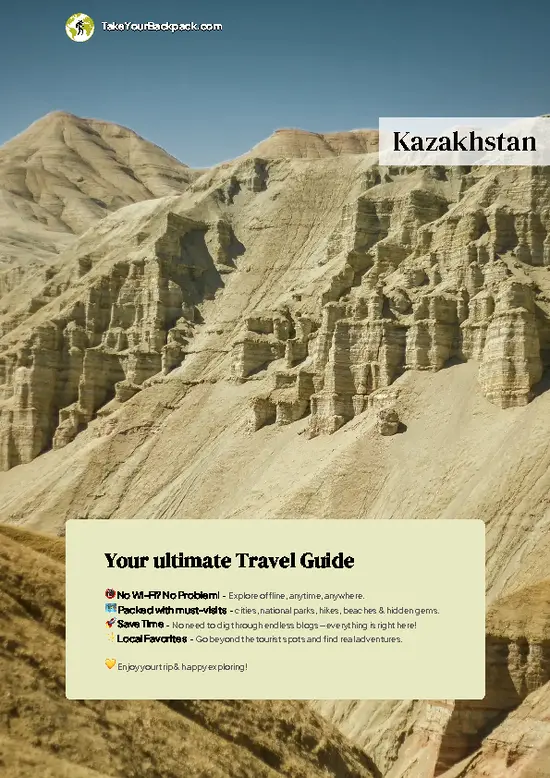
example page 0 from our offline Travel Guide for Kazakhstan
example page 1 from our offline Travel Guide for Kazakhstan
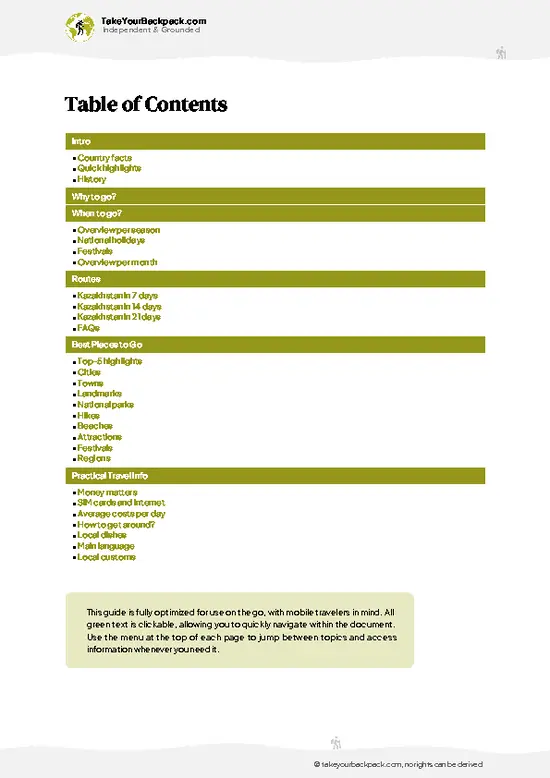
example page 2 from our offline Travel Guide for Kazakhstan
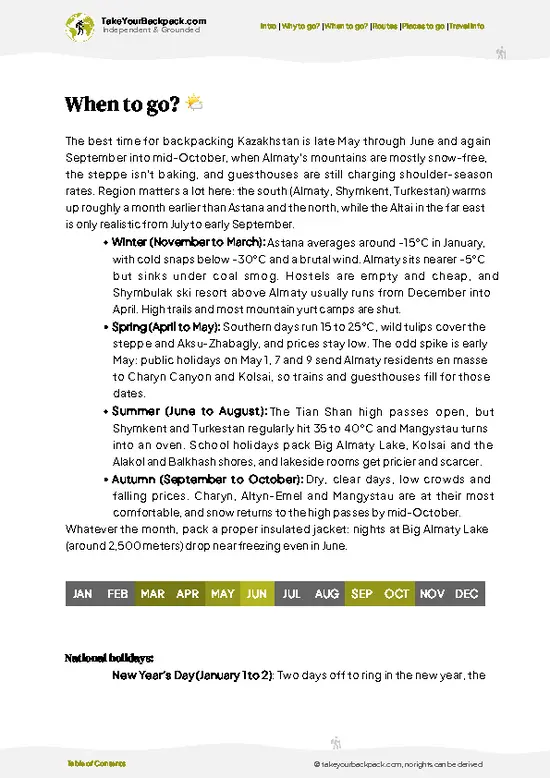
example page 3 from our offline Travel Guide for Kazakhstan
example page 4 from our offline Travel Guide for Kazakhstan
example page 5 from our offline Travel Guide for Kazakhstan
example page 6 from our offline Travel Guide for Kazakhstan
example page 7 from our offline Travel Guide for Kazakhstan
The digital guide (376 pages) contains:
✅ 98 highlights, ranked by travel appeal
✅ Optimized 7, 14 & 21-day travel routes
✅ Cities, national parks, landmarks, beaches
✅ How to get around
✅ Offline-friendly for travel without Wi-Fi
👉 Click to see all 30+ guide features

📅 Plan smarter in minutes, not weeks
✅ Month by month travel advice
✅ Festivals & national holidays
✅ Budget expectations

🗺️ Go to the right places, skip the overrated ones
✅ Honest pros & cons of destinations
✅ Top hikes, parks & viewpoints
✅ Lesser-known places most travelers miss
✅ Clear “worth it vs skip it” guidance

🛏️ Travel smoothly without rookie mistakes
✅ Best areas to stay
✅ Transport systems explained simply
✅ Common scams & safety advice
✅ SIM cards, money & practical tips

🌍 Understand the country, not just visit it
✅ Culture & traditions
✅ 52 Essential phrases & customs
✅ Festivals worth planning around
✅ Traveler-friendly historical context
✅ Insights that make places more meaningful

📱 Built for real travel conditions
✅ Fully downloadable PDF
✅ Works completely offline
✅ Optimized for phone use
✅ Useful in remote areas & buses
✅ Everything in one place
Stop searching, start planning
Get instant access to your full guide. 30‑day money-back guarantee.
+ Add another guide for just

By proceeding you agree to our terms.
Sent to your inbox immediately after payment • 100% Secure Checkout
Best Backpacking Travel Advisor 2025 tourism awardBest Backpacking
Travel Advisor
2025
What others say about Take Your Backpack Guides:
⭐⭐⭐⭐⭐
Fantastic, amazing amount of information!
⭐⭐⭐⭐⭐
My goodness this is amazing, it's what I've been looking for hats off too you!
⭐⭐⭐⭐⭐
I think this is absolutely BRILLIANT
⭐⭐⭐⭐
Very complete and informative. It's still missing places, but I gotta to commend you
⭐⭐⭐⭐⭐
This is truly amazing, thank you, can't wait to explore it with my kids!
⭐⭐⭐⭐⭐
Awesome resource, thank you!
⭐⭐⭐⭐⭐
This is amazing! Can't wait to explore the ones I haven't seen
⭐⭐⭐⭐
I love this! Well done, great idea.
⭐⭐⭐⭐⭐
Thanks for taking the time to make this gem!
⭐⭐⭐⭐⭐
This might be the best website I've ever seen.
⭐⭐⭐⭐⭐
Congratulations, and thank you so much for your work; it's incredibly valuable.
⭐⭐⭐⭐
In all seriousness I think you did a great job pointing out the important spots
⭐⭐⭐⭐⭐
10/10 very good
⭐⭐⭐⭐⭐
As someone who's only just starting to visit regularly this is awesome, thank you.
⭐⭐⭐⭐
Thank you very much! I'm going to visit my dad, it's going to be very useful!
⭐⭐⭐⭐⭐
This is really cool! We'll be travelling for the first time and this definitely come in handy.
⭐⭐⭐⭐⭐
You are now our minister of culture, congratulations 👨‍💼
⭐⭐⭐⭐⭐
Just wanted to tell you that this is a pearl! Going to follow your recommendations.
⭐⭐⭐⭐⭐
This is so cool. I'll definitely be using the resource for my travels soon.
⭐⭐⭐⭐⭐
This is very impressive! Good work.
⭐⭐⭐⭐⭐
This is an amazing and informative site. Very well done!

🛏️ Where to stay?Top Places to Consider Staying

Hostels and budget guesthouses are easy to find in Kazakhstan, with dorm beds in the big cities typically running 4,000 to 8,000 tenge (about US$8 to 16) and simple private rooms from roughly 12,000 tenge (US$24). In Almaty, the leafy grid around Zhibek Zholy (the pedestrian “Arbat”) and Panfilov Park puts you within walking distance of the Green Bazaar, metro stations and the bars along Panfilov Street, though some cheaper places sit in older Soviet blocks with thin walls and street noise. The streets just south toward Abay Avenue are quieter and closer to the mountain buses. In Astana, the Right Bank old center near the train station has the cheapest beds and calm, safe streets, while the … read more 👉
Hostels and budget guesthouses are easy to find in Kazakhstan, with dorm beds in the big cities typically running 4,000 to 8,000 tenge (about US$8 to 16) and simple private rooms from roughly 12,000 tenge (US$24). In Almaty, the leafy grid around Zhibek Zholy (the pedestrian “Arbat”) and Panfilov Park puts you within walking distance of the Green Bazaar, metro stations and the bars along Panfilov Street, though some cheaper places sit in older Soviet blocks with thin walls and street noise. The streets just south toward Abay Avenue are quieter and closer to the mountain buses. In Astana, the Right Bank old center near the train station has the cheapest beds and calm, safe streets, while the Left Bank is pricier and closer to Baiterek and the modern sights, but nightlife is thin and distances between blocks are long.

If you enjoy meeting fellow travelers, consider choosing hostels with high ratings for atmosphere. On the other hand, if you prefer having your own space, a hotel might be a better option.

KazakhstanMore Places Across Kazakhstan

👋 Meet the founderWho’s Behind Take Your Backpack?

Johan, backpacker and founder of TakeYourBackpackHi, I’m Johan (Netherlands 🇳🇱), the creator of TakeYourBackpack. Over the past 3 decades, I’ve backpacked through 90+ countries across six continents, gaining extensive experience with independent travel, long-term trips, and overland routes.

This site is built on a combination of firsthand travel experience and carefully curated insights from other backpackers. Many guides are based on places I’ve personally visited, while others bring together tips, observations, and practical advice shared by trusted travelers I’ve met along the way.

The goal is to provide realistic, experience-driven guidance — not generic itineraries — so you can explore destinations with better context, clearer expectations, and more confidence.