×

Kazakhstan🇰🇿 | best landmarksYour Guide to the 8 Best landmarks in Kazakhstan

Landmarks in Kazakhstan come at a scale that rewrites your sense of distance. This is the ninth-largest country on Earth, so a mausoleum, a rocky canyon and a space-age capital skyline can sit days of travel apart. Expect two broad kinds: Silk Road and Islamic heritage in the south, around Turkistan and Almaty, and Soviet-era and futuristic architecture in Astana, plus steppe and desert sites in the west and center. The south draws steady domestic pilgrims but few foreign crowds, and entry fees are low, often under US$3 to 5. The west, around Mangystau, rewards you with empty canyons and chalk cliffs, yet roads are rough and you will want a shared 4x4 or driver. Astana is polished, easy and pricier. For independent travel, trains and buses link the main hubs cheaply, so you can pick a theme, book a seat and start moving. Choose heritage, otherworldly landscapes or modern spectacle, then go chase it.

By Johan Kruseman 🇳🇱 | Updated October 19, 2026
Explore the best national parks in Kazakhstan

Why go?Why Travelers Love These Spots

Kazakhstan hands you landmarks shaped by nomadic history, not by stone cities alone. For centuries the steppe peoples moved with their herds, so the country has fewer grand palaces than Uzbekistan and more burial monuments, underground mosques and ritual sites scattered across open land. The Silk Road left its mark mainly in the south, where oasis towns grew rich on trade. Then the Soviet era added missile ranges, labor-camp memorials and the space launch site at Baikonur, while the post-1991 capital, Astana, sprouted bold towers designed by international architects. Few countries stack so many layers of history on one map.

Geography is the other force. The sheer size means attractions are spread thin, and the best natural monuments sit in deserts, canyons and mountain ranges far from towns. … read more 👉
Kazakhstan hands you landmarks shaped by nomadic history, not by stone cities alone. For centuries the steppe peoples moved with their herds, so the country has fewer grand palaces than Uzbekistan and more burial monuments, underground mosques and ritual sites scattered across open land. The Silk Road left its mark mainly in the south, where oasis towns grew rich on trade. Then the Soviet era added missile ranges, labor-camp memorials and the space launch site at Baikonur, while the post-1991 capital, Astana, sprouted bold towers designed by international architects. Few countries stack so many layers of history on one map.

Geography is the other force. The sheer size means attractions are spread thin, and the best natural monuments sit in deserts, canyons and mountain ranges far from towns. That is the draw for the adventurous and the limit for the hurried. Infrastructure is improving: fast Talgo trains and domestic flights connect major cities, and ride-hailing apps work in the large ones. Out in the countryside, signage in English is thin, public transport is sparse, and you will rely on shared taxis, homestays and hired drivers.

Before you choose Kazakhstan for landmarks, accept that you trade density for space. You will spend more hours getting to sites than standing at them, and many sites have no ticket booth or guide at all. Russian is widely spoken and Kazakh is the official language, so a few phrases in either help enormously. Visa-free entry applies to many nationalities for up to 30 days, which makes a loose, flexible plan easy to pull off. Come for emptiness, scale and surprise.
How the List Was Created
The list of best unique sites in Kazakhstan is created based on history or culture, wow factor, atmosphere, quirks, and memorability. If you feel a unique site is missing in this list, please let us know.

When to go?Timing Your Visit for the Best Experience

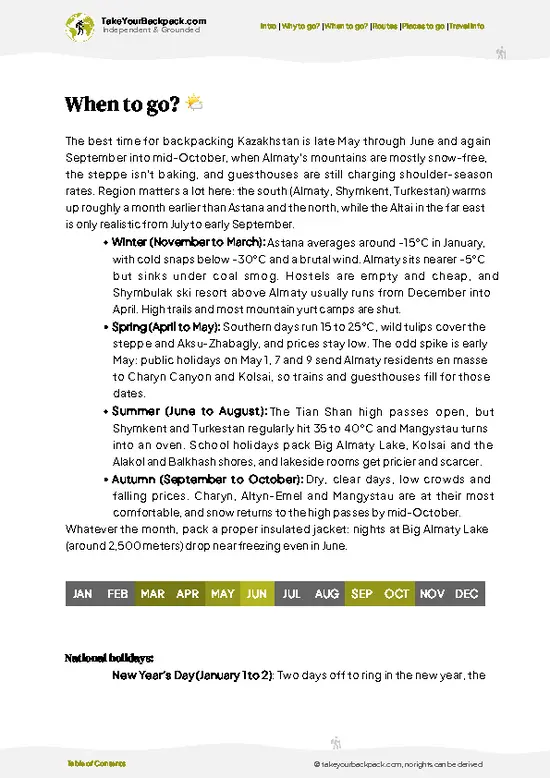
Best months: May to June and September to early October are the best months for landmarks in Kazakhstan, because daytime temperatures sit around 15 to 28°C and the steppe turns green in spring or gold in autumn. Roads are dry, light is crisp and heat does not drain you on exposed sites.

Summer: July and August push the south and west hard. Turkistan and the Mangystau desert regularly pass 35 to 40°C, with little shade at open-air sites, so start at sunrise and stop by noon. Almaty stays more bearable at roughly 25 to 30°C, and the high Tian Shan foothills cool things further. Domestic tourism peaks in these months, so book trains and guesthouses in advance, and expect prices to rise 15 to 30% in popular areas.

Shoulder seasons: April and late October bring unsettled weather, with rain and … read more 👉
Best months: May to June and September to early October are the best months for landmarks in Kazakhstan, because daytime temperatures sit around 15 to 28°C and the steppe turns green in spring or gold in autumn. Roads are dry, light is crisp and heat does not drain you on exposed sites.

Summer: July and August push the south and west hard. Turkistan and the Mangystau desert regularly pass 35 to 40°C, with little shade at open-air sites, so start at sunrise and stop by noon. Almaty stays more bearable at roughly 25 to 30°C, and the high Tian Shan foothills cool things further. Domestic tourism peaks in these months, so book trains and guesthouses in advance, and expect prices to rise 15 to 30% in popular areas.

Shoulder seasons: April and late October bring unsettled weather, with rain and cold snaps, though crowds vanish and accommodation costs fall. Rainfall is low across most of the country, often 150 to 350 mm a year in the steppe and desert, with Almaty wetter, especially in spring. Mud can turn unpaved tracks to the western canyons into traps, so avoid them after rain.

Winter: November to March is hard on a landmark tour. Astana averages around -10 to -15°C in January and can drop to -30°C, with biting wind across the flat terrain. The upside is empty sites and the cheapest rooms, and Almaty is milder at roughly -5 to 0°C. Some desert tracks and mountain access roads close or become unsafe, and daylight is short. Visit the capital’s indoor and heated attractions if you come then, and keep the remote west for warmer months.

unique site hoppingSuggested Travel Strategies

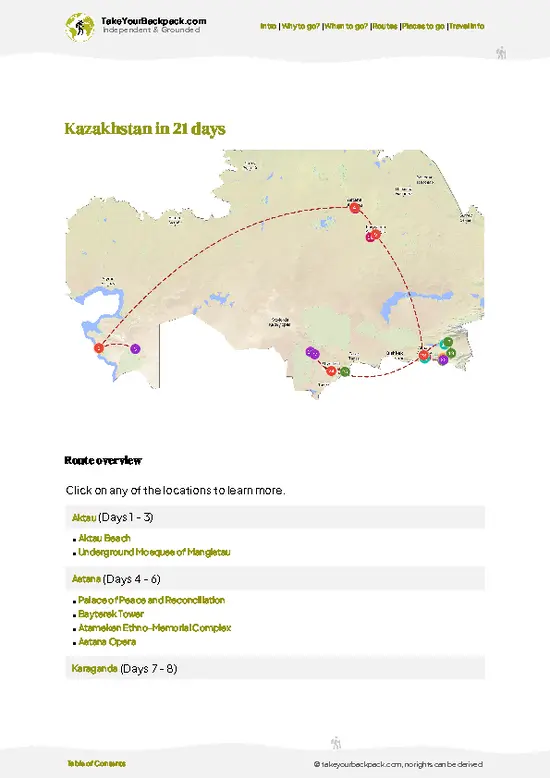
How long to allow: A trip combining several landmarks in Kazakhstan needs 10 to 21 days, depending on whether you stay in one region or cross the country. Distances are huge, so the first job is choosing your clusters.

Grouping regions: The south works as one block: Almaty, the nearby canyons and mountains, then Taraz and Turkistan along the old Silk Road corridor. Shymkent is the transport hub that ties these together. The capital region, centered on Astana, pairs well with the north and center, and a train from Almaty takes roughly 12 to 14 hours on the Talgo, or a flight about 1 hour 30 minutes. The far west, around Aktau and Mangystau, stands alone and is best handled as its own 4 to 5 day loop, flying in from Almaty or Astana in about 3 hours.

Direction and pacing: Travel from Almaty … read more 👉
How long to allow: A trip combining several landmarks in Kazakhstan needs 10 to 21 days, depending on whether you stay in one region or cross the country. Distances are huge, so the first job is choosing your clusters.

Grouping regions: The south works as one block: Almaty, the nearby canyons and mountains, then Taraz and Turkistan along the old Silk Road corridor. Shymkent is the transport hub that ties these together. The capital region, centered on Astana, pairs well with the north and center, and a train from Almaty takes roughly 12 to 14 hours on the Talgo, or a flight about 1 hour 30 minutes. The far west, around Aktau and Mangystau, stands alone and is best handled as its own 4 to 5 day loop, flying in from Almaty or Astana in about 3 hours.

Direction and pacing: Travel from Almaty south-west to Turkistan, then fly or take an overnight train onward to Astana, and finish with the west if time allows. Almaty to Shymkent by train or bus takes about 8 to 12 hours, and Shymkent to Turkistan is around 2 hours by road. Plan 1 to 2 days for city landmarks, a half day to a full day for each heritage site, and 2 to 3 days for each desert or canyon region, because you will lose hours to unpaved roads.

Mistakes to sidestep: The biggest error is cramming too many distant stops into one week. Travelers also assume a map shows quick links, when a 300 km leg can take 6 hours. Another slip is booking overnight trains late; seats on popular routes sell out days ahead in summer. Instead, pick two regions, fly the longest gaps and use night trains to save a hotel bill. Add buffer days for weather and for delayed shared taxis, which often wait until they fill.

The ListMust-Visit landmarks in Kazakhstan

1 Baikonur Cosmodrome

space launch pads, Soviet-era relics, restricted access

Witness rocket launches and explore the legacy of human spaceflight at a remote facility shaped by Cold War ambition and secrecy.

2 Mausoleum of Khoja Ahmed Yasawi

Timurid architecture, vast brick dome, pilgrimage site

Stand beneath monumental vaults and explore a spiritual complex that anchors religious tradition and Central Asian architectural innovation.

3 Lake Kaindy

submerged forest, turquoise mountain lake, sunken trees

Hike through alpine forest to a surreal lake where upright tree trunks rise from clear water, creating an otherworldly landscape.

kazakhstan-unique-site-lake-kaindy
© Google |

4 Petroglyphs of Tamgaly

Bronze Age carvings, open-air rock art, sacred valley

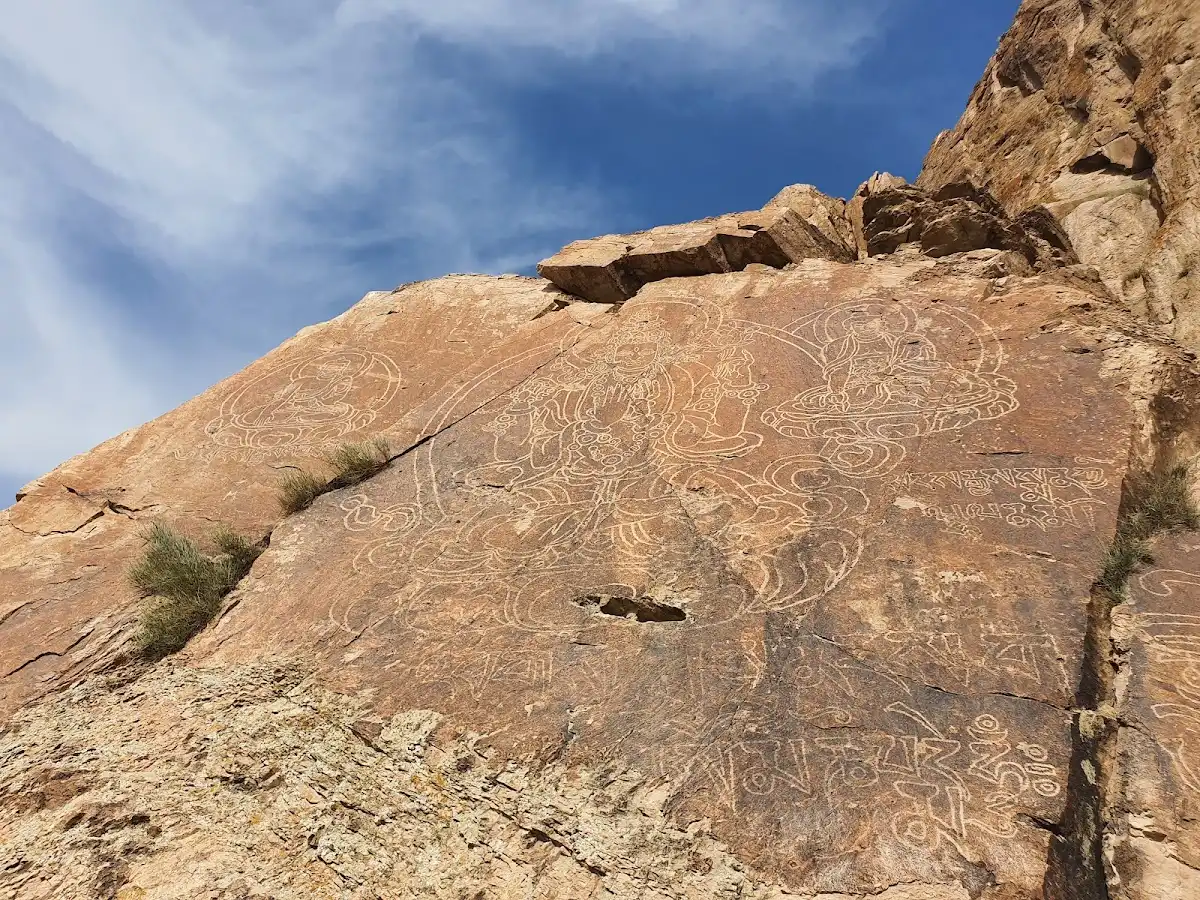
Trace ancient rituals and daily life through thousands of petroglyphs etched into sunlit rocks across a remote steppe landscape.

kazakhstan-unique-site-petroglyphs-of-tamgaly
© Google |

5 Underground Mosques of Mangistau

subterranean chambers, rock-hewn sanctuaries, arid plateau

Descend into hand-carved prayer halls hidden beneath the steppe, revealing centuries of spiritual practice and adaptation to harsh terrain.

6 Mausoleum of Aisha Bibi

carved terracotta tiles, 12th-century tomb, love legend

Admire intricate geometric patterns and reflect on centuries-old stories at a mausoleum blending architectural detail with local folklore.

7 Sauran

fortified city ruins, mudbrick walls, Silk Road crossroads

Walk among weathered ramparts and deserted streets where traders and travelers once passed through a key medieval outpost.

8 Turgen Waterfall

cascading falls, forested gorge, alpine meadow

Follow forest trails to a multi-tiered waterfall set in a lush valley, with cool spray and wildflowers in summer.

kazakhstan-unique-site-turgen-waterfall
© Google |
Loading the map 🌍

Expert viewTips and Advice from Travelers

How many to see: Aim for 6 to 8 landmarks across a trip of two to three weeks. That number leaves time for the long transfers between sites, and it stops you from turning a country of vast open spaces into a checklist of blurry photos. Fewer, longer visits give you the quiet moments: wind across empty steppe, the call to prayer echoing off tiled domes, tea shared at a roadside stall.

What to prioritize: If history grabs you, put the Silk Road heritage sites first and add a Soviet-era memorial or two. Those are walkable, cheap and easy by public transport. If you chase landscapes, commit to the western deserts and canyons and the mountains near Almaty, and accept that you will need a driver or a seat in a shared 4x4 tour. If you love architecture and people-watching, spend time in Astana, … read more 👉
How many to see: Aim for 6 to 8 landmarks across a trip of two to three weeks. That number leaves time for the long transfers between sites, and it stops you from turning a country of vast open spaces into a checklist of blurry photos. Fewer, longer visits give you the quiet moments: wind across empty steppe, the call to prayer echoing off tiled domes, tea shared at a roadside stall.

What to prioritize: If history grabs you, put the Silk Road heritage sites first and add a Soviet-era memorial or two. Those are walkable, cheap and easy by public transport. If you chase landscapes, commit to the western deserts and canyons and the mountains near Almaty, and accept that you will need a driver or a seat in a shared 4x4 tour. If you love architecture and people-watching, spend time in Astana, where wide boulevards, glass towers and a waterfront promenade make for easy city exploring. Mix one of each kind and you will never tire of the pace.

What it costs: Budget US$30 to 50 a day for a comfortable backpacker rhythm, using hostels at around US$10 to 20 a bed, local cafés for meals at US$4 to 8 and trains or buses for transfers. Entry fees at heritage sites typically run US$1 to 6 a person, with extra charges for cameras at a few. A local guide costs roughly US$20 to 50 for a few hours. Desert and canyon trips are the big spend: a shared 4x4 day tour tends to run US$40 to 80 a person, or US$100 to 200 for a private vehicle split among a group. Budget US$50 to 80 a day if you plan a lot of off-road driving.

Safety on the ground: Roads outside the cities can be rough, and driving at night is risky because of livestock, potholes and poor lighting. Carry plenty of water, a power bank and cash in tenge, since cards are rare at remote stops. Cell coverage fades in the desert, so download offline maps and tell your guesthouse where you are headed. Summer heat on open ground causes real dehydration, so wear a hat and set out early. The reward is a landscape with no fences, no queues and sky that feels endless.

Cultural manners: Many heritage sites are active places of worship. Cover your shoulders and knees, remove shoes where asked and keep your voice low near tombs and mosques. Ask before photographing people, particularly women and pilgrims at prayer. Some sites tied to the military or space program restrict photography, and a few border zones need permits, so ask your guide or hostel before you aim your lens. Respect is returned with warmth: hosts often press tea and bread on visitors, and accepting turns a quick stop into a conversation.

Smart habits: Learn a handful of Russian phrases, such as “spasibo” for thank you and “skolko stoit” for how much, and they will smooth every exchange. Agree prices with drivers before you set off. Register with your embassy if your country offers it, and keep a photocopy of your passport. Treat each landmark as a doorway into everyday life, and you will leave with stories as rich as the sights themselves.

✈️ The backpacker research shortcutKazakhstan Travel Guide

An offline-friendly backpacking guide with optimized travel routes, ranked highlights, transport advice, and the best areas to stay.
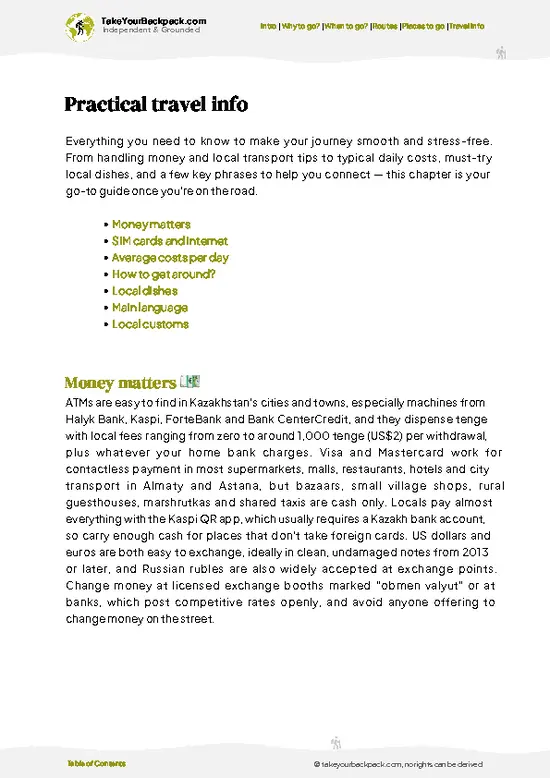
example page 0 from our offline Travel Guide for Kazakhstan
example page 1 from our offline Travel Guide for Kazakhstan
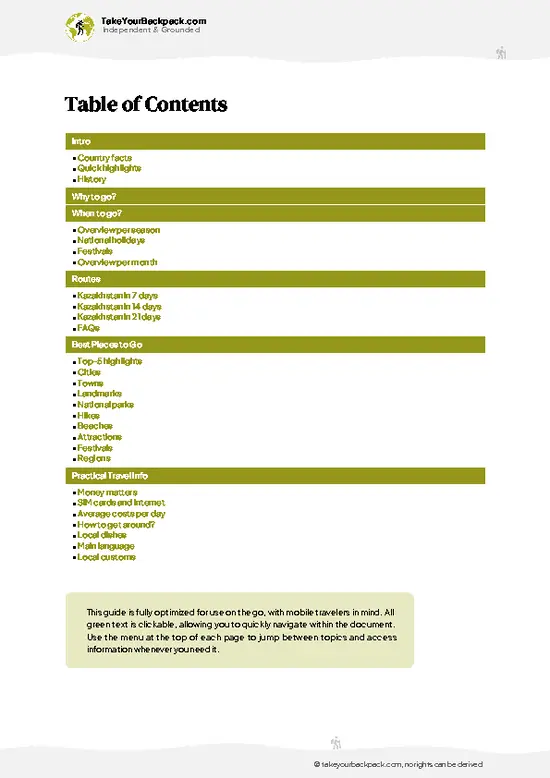
example page 2 from our offline Travel Guide for Kazakhstan
example page 3 from our offline Travel Guide for Kazakhstan
example page 4 from our offline Travel Guide for Kazakhstan
example page 5 from our offline Travel Guide for Kazakhstan
example page 6 from our offline Travel Guide for Kazakhstan
example page 7 from our offline Travel Guide for Kazakhstan
The digital guide (376 pages) contains:
✅ 98 highlights, ranked by travel appeal
✅ Optimized 7, 14 & 21-day travel routes
✅ Cities, national parks, landmarks, beaches
✅ How to get around
✅ Offline-friendly for travel without Wi-Fi
👉 Click to see all 30+ guide features

📅 Plan smarter in minutes, not weeks
✅ Month by month travel advice
✅ Festivals & national holidays
✅ Budget expectations

🗺️ Go to the right places, skip the overrated ones
✅ Honest pros & cons of destinations
✅ Top hikes, parks & viewpoints
✅ Lesser-known places most travelers miss
✅ Clear “worth it vs skip it” guidance

🛏️ Travel smoothly without rookie mistakes
✅ Best areas to stay
✅ Transport systems explained simply
✅ Common scams & safety advice
✅ SIM cards, money & practical tips

🌍 Understand the country, not just visit it
✅ Culture & traditions
✅ 52 Essential phrases & customs
✅ Festivals worth planning around
✅ Traveler-friendly historical context
✅ Insights that make places more meaningful

📱 Built for real travel conditions
✅ Fully downloadable PDF
✅ Works completely offline
✅ Optimized for phone use
✅ Useful in remote areas & buses
✅ Everything in one place
Stop searching, start planning
Get instant access to your full guide. 30‑day money-back guarantee.
+ Add another guide for just

By proceeding you agree to our terms.
Sent to your inbox immediately after payment • 100% Secure Checkout
Best Backpacking Travel Advisor 2025 tourism awardBest Backpacking
Travel Advisor
2025
What others say about Take Your Backpack Guides:
⭐⭐⭐⭐⭐
Fantastic, amazing amount of information!
⭐⭐⭐⭐⭐
My goodness this is amazing, it's what I've been looking for hats off too you!
⭐⭐⭐⭐⭐
I think this is absolutely BRILLIANT
⭐⭐⭐⭐
Very complete and informative. It's still missing places, but I gotta to commend you
⭐⭐⭐⭐⭐
This is truly amazing, thank you, can't wait to explore it with my kids!
⭐⭐⭐⭐⭐
Awesome resource, thank you!
⭐⭐⭐⭐⭐
This is amazing! Can't wait to explore the ones I haven't seen
⭐⭐⭐⭐
I love this! Well done, great idea.
⭐⭐⭐⭐⭐
Thanks for taking the time to make this gem!
⭐⭐⭐⭐⭐
This might be the best website I've ever seen.
⭐⭐⭐⭐⭐
Congratulations, and thank you so much for your work; it's incredibly valuable.
⭐⭐⭐⭐
In all seriousness I think you did a great job pointing out the important spots
⭐⭐⭐⭐⭐
10/10 very good
⭐⭐⭐⭐⭐
As someone who's only just starting to visit regularly this is awesome, thank you.
⭐⭐⭐⭐
Thank you very much! I'm going to visit my dad, it's going to be very useful!
⭐⭐⭐⭐⭐
This is really cool! We'll be travelling for the first time and this definitely come in handy.
⭐⭐⭐⭐⭐
You are now our minister of culture, congratulations 👨‍💼
⭐⭐⭐⭐⭐
Just wanted to tell you that this is a pearl! Going to follow your recommendations.
⭐⭐⭐⭐⭐
This is so cool. I'll definitely be using the resource for my travels soon.
⭐⭐⭐⭐⭐
This is very impressive! Good work.
⭐⭐⭐⭐⭐
This is an amazing and informative site. Very well done!

🛏️ Where to stay?Where to Stay: Kazakhstan Edition

Hostels and budget guesthouses are easy to find in Kazakhstan, with dorm beds in the big cities typically running 4,000 to 8,000 tenge (about US$8 to 16) and simple private rooms from roughly 12,000 tenge (US$24). In Almaty, the leafy grid around Zhibek Zholy (the pedestrian “Arbat”) and Panfilov Park puts you within walking distance of the Green Bazaar, metro stations and the bars along Panfilov Street, though some cheaper places sit in older Soviet blocks with thin walls and street noise. The streets just south toward Abay Avenue are quieter and closer to the mountain buses. In Astana, the Right Bank old center near the train station has the cheapest beds and calm, safe streets, while the … read more 👉
Hostels and budget guesthouses are easy to find in Kazakhstan, with dorm beds in the big cities typically running 4,000 to 8,000 tenge (about US$8 to 16) and simple private rooms from roughly 12,000 tenge (US$24). In Almaty, the leafy grid around Zhibek Zholy (the pedestrian “Arbat”) and Panfilov Park puts you within walking distance of the Green Bazaar, metro stations and the bars along Panfilov Street, though some cheaper places sit in older Soviet blocks with thin walls and street noise. The streets just south toward Abay Avenue are quieter and closer to the mountain buses. In Astana, the Right Bank old center near the train station has the cheapest beds and calm, safe streets, while the Left Bank is pricier and closer to Baiterek and the modern sights, but nightlife is thin and distances between blocks are long.

If you enjoy meeting fellow travelers, consider choosing hostels with high ratings for atmosphere. On the other hand, if you prefer having your own space, a hotel might be a better option.

KazakhstanExplore Beyond This Category

👋 Meet the founderWho’s Behind Take Your Backpack?

Johan, backpacker and founder of TakeYourBackpackHi, I’m Johan (Netherlands 🇳🇱), the creator of TakeYourBackpack. Over the past 3 decades, I’ve backpacked through 90+ countries across six continents, gaining extensive experience with independent travel, long-term trips, and overland routes.

This site is built on a combination of firsthand travel experience and carefully curated insights from other backpackers. Many guides are based on places I’ve personally visited, while others bring together tips, observations, and practical advice shared by trusted travelers I’ve met along the way.

The goal is to provide realistic, experience-driven guidance — not generic itineraries — so you can explore destinations with better context, clearer expectations, and more confidence.