×

Kenya🇰🇪 | best regionsEssential 3 regions to Explore in Kenya

Kenya sorts itself into regions with sharp edges, and each one changes how you travel. The Indian Ocean coast runs hot, humid and Swahili-flavored, with cheap guesthouses and easy matatu hops. The savanna parks in the southwest and the Rift Valley lakes deliver the wildlife, but park fees turn a casual budget into a calculated one. The central highlands around Mount Kenya run cool, green and farm-heavy, with tea, coffee and climbing at a fraction of safari prices. The arid north swaps crowds for distance, rough tracks and a lot of planning. Costs, comfort and transport vary wildly, so pick by style first. Independent travelers can reach most of the south by bus, shared minibus and the Nairobi to Mombasa train, while remote areas demand time, patience or a shared vehicle. Go for contrast, because Kenya offers it in a single week.

By Johan Kruseman 🇳🇱 | Updated October 18, 2026
Explore the best cities in Kenya

Why go?Why Travelers Love These Spots

Kenya packs an unusual range of landscapes into one country, and the reason is geography. The equator crosses the middle of it, the Great Rift Valley splits it north to south, and altitude swings from sea level to the 5,199 meter summit of Mount Kenya. Climb or drop a few hundred meters and the temperature, vegetation and farming change with you. That is why a single trip can include palm-fringed beaches, alpine moorland, soda lakes and semi-desert.

History and culture add another layer. More than 40 ethnic groups live here, from Kikuyu farmers in the highlands to Maasai and Samburu herders and Swahili communities on the coast, so the atmosphere shifts as sharply as the terrain. Swahili and English are both widely spoken, which makes independent travel far easier than in many neighboring … read more 👉
Kenya packs an unusual range of landscapes into one country, and the reason is geography. The equator crosses the middle of it, the Great Rift Valley splits it north to south, and altitude swings from sea level to the 5,199 meter summit of Mount Kenya. Climb or drop a few hundred meters and the temperature, vegetation and farming change with you. That is why a single trip can include palm-fringed beaches, alpine moorland, soda lakes and semi-desert.

History and culture add another layer. More than 40 ethnic groups live here, from Kikuyu farmers in the highlands to Maasai and Samburu herders and Swahili communities on the coast, so the atmosphere shifts as sharply as the terrain. Swahili and English are both widely spoken, which makes independent travel far easier than in many neighboring countries.

Infrastructure is uneven, and it pays to know that before you choose. The south is well connected: Nairobi is the hub, the standard gauge railway links it with Mombasa, and matatus reach nearly every town. Roads in the north and west thin out, journeys run long, and distances look shorter on a map than they feel on a bus.

Money matters too. Conservation fees for national parks are charged in US dollars and are among the highest in Africa, so wildlife regions cost far more than the highlands or coast. Non-resident park fees run roughly US$50 to 90 a day at many parks, and well above that at the most famous ones. Plan around that gap and Kenya becomes very doable on a backpacker budget, with a few well-chosen splurges.
How the List Was Created
The list of best regions in Kenya is created based on landscapes, local culture, attractions, vibes, and overall appeal. If you feel a region is missing in this list, please let us know.

When to go?When to Plan Your Trip

Best months for Kenya’s regions: The best months are July to October and January to February, when the dry spells keep roads passable, trails firm and wildlife gathered around water. These dry seasons suit nearly every part of the country, and they are the periods to aim for if you want to cover a lot of ground.
Rain and shoulder seasons: Kenya has two rainy seasons. The long rains fall from roughly March to May and bring the heaviest downpours, with mud, slow roads and some lodges and camps closing or dropping rates. The short rains arrive around November and December and are lighter, often brief afternoon storms. March to May is the cheapest time, with accommodation discounts of 20 to 40 percent common outside the main hubs, but dirt tracks in the parks and the north can turn impassable.
Regional … read more 👉
Best months for Kenya’s regions: The best months are July to October and January to February, when the dry spells keep roads passable, trails firm and wildlife gathered around water. These dry seasons suit nearly every part of the country, and they are the periods to aim for if you want to cover a lot of ground.
Rain and shoulder seasons: Kenya has two rainy seasons. The long rains fall from roughly March to May and bring the heaviest downpours, with mud, slow roads and some lodges and camps closing or dropping rates. The short rains arrive around November and December and are lighter, often brief afternoon storms. March to May is the cheapest time, with accommodation discounts of 20 to 40 percent common outside the main hubs, but dirt tracks in the parks and the north can turn impassable.
Regional differences: Altitude rewrites the thermometer. The coast sits around 28 to 33°C most of the year, humid from March to June and breezier from June to October. Nairobi and the highlands are mild, with daytime highs of 22 to 27°C and chilly nights of 10 to 14°C. Mount Kenya drops below freezing at night near the summit, and the best climbing windows are January to February and August to September. The arid north stays hot and dry, often above 35°C by day, and its tracks get hammered by sudden rain.
Peak periods and prices: Peak season for wildlife areas runs from July to October, when the wildebeest migration crosses the Mara and lodge prices climb sharply, often 30 to 50 percent above low season. Book ahead for July and August. December and January bring local holiday crowds to the coast, so beach guesthouses fill and rates jump. Shoulder months like June, late October and February give a good balance of dry weather and sane prices.

region hoppingSuggested Travel Strategies

How many days to allow: A trip combining several regions in Kenya needs 10 to 21 days, with two weeks the practical minimum for three distinct areas. Anything shorter turns into a blur of bus stations.
Which regions pair well: Nairobi is the natural hub, so build outward from it. The highlands, Rift Valley lakes and wildlife parks cluster in the southwest and center, and each sits within a half day of the capital. The coast pairs with Nairobi through the railway to Mombasa, which takes about 5 to 6 hours. Starting in the west or highlands and finishing on the coast works well, because you end on a beach after the rougher travel, and the Mombasa and Nairobi airports both have international flights for onward travel.
Time per stop and transfers: Give each stop 3 to 5 days, or 2 to 3 for the quick … read more 👉
How many days to allow: A trip combining several regions in Kenya needs 10 to 21 days, with two weeks the practical minimum for three distinct areas. Anything shorter turns into a blur of bus stations.
Which regions pair well: Nairobi is the natural hub, so build outward from it. The highlands, Rift Valley lakes and wildlife parks cluster in the southwest and center, and each sits within a half day of the capital. The coast pairs with Nairobi through the railway to Mombasa, which takes about 5 to 6 hours. Starting in the west or highlands and finishing on the coast works well, because you end on a beach after the rougher travel, and the Mombasa and Nairobi airports both have international flights for onward travel.
Time per stop and transfers: Give each stop 3 to 5 days, or 2 to 3 for the quick ones. Transfers from Nairobi usually take 2 to 4 hours to the highlands and Rift Valley lakes, 5 to 7 hours by road to the main wildlife parks in the southwest, and 8 to 10 hours by road to the far west. Flights to Mombasa, Kisumu or the airstrips cut those times sharply, though they add cost. The north needs extra days, as 10 hour drives on rough roads are normal.
Planning mistakes to avoid: The biggest error is underestimating distances, since Kenyan roads are often slow, with potholes and heavy truck traffic. Allow a buffer day before any international flight. Another is cramming too many parks into one week, which leaves you with long drives and little time on foot. Pick fewer places and stay longer. Also avoid traveling overland after dark, when road conditions and safety both worsen, and book park transport early in July to September, because shared safari seats fill quickly.

The ListHighly Recommended regions of Kenya

1 Kenya Lake System in the Great Rift Valley

alkaline lakes, flamingo flocks, volcanic landscapes, fossil sites

Witness shifting lake shores, dramatic escarpments, and rare wildlife in a region where geology and biodiversity intersect at every turn.

kenya-region-kenya-lake-system-in-the-great-rift-valley
© Google |

2 Lamu Island

Swahili architecture, dhow harbors, car-free lanes, UNESCO heritage

Wander narrow alleys, discover centuries-old traditions, and experience a pace of life shaped by tides and ancient trade.

kenya-region-lamu-island
© Google |

3 Tana River Delta

papyrus swamps, tidal creeks, coastal forests, endemic primates

Navigate a mosaic of wetlands and mangroves, encountering unique species and traditional communities shaped by the river’s seasonal rhythms.

Loading the map 🌍

Expert viewPro Tips for Exploring the Best

How many regions to visit: I advise three regions on a first trip, and four only if you have three weeks. Kenya’s distances are large, transfers eat entire days, and every extra region costs you a day or more in transit with nothing to show for it. Three lets you settle in, learn the rhythm of local transport, and still have contrast. Two is better than five.
Choosing between kinds of regions: Match the kind of region to your travel style. Wildlife areas deliver Kenya’s headline experience, but they cost the most and often depend on guided vehicles. Highlands and lakes give hiking, cycling and cultural contact at low cost and with easy transport. The coast is the cheapest place to slow down, and the arid north suits adventurers with time, flexibility and a tolerance for rough travel. For most … read more 👉
How many regions to visit: I advise three regions on a first trip, and four only if you have three weeks. Kenya’s distances are large, transfers eat entire days, and every extra region costs you a day or more in transit with nothing to show for it. Three lets you settle in, learn the rhythm of local transport, and still have contrast. Two is better than five.
Choosing between kinds of regions: Match the kind of region to your travel style. Wildlife areas deliver Kenya’s headline experience, but they cost the most and often depend on guided vehicles. Highlands and lakes give hiking, cycling and cultural contact at low cost and with easy transport. The coast is the cheapest place to slow down, and the arid north suits adventurers with time, flexibility and a tolerance for rough travel. For most backpackers, one wildlife region, one highland or lake area and one coastal stay gives the best value: you spend big once, then recover your budget in the other two.
What it costs: Budget US$35 to 60 a day in the highlands and coast, covering a dorm or basic guesthouse at US$10 to 25, local meals at US$3 to 8, and matatus or buses at US$2 to 10 per leg. A wildlife region changes the numbers. Park entry for non-residents runs roughly US$50 to 90 a day at many parks, and more at the best known ones, plus a vehicle and guide. A shared budget safari costs about US$100 to 200 a person per day, while camping and group departures sit at the low end. A self-drive or shared hire car splits cost well if you find companions. A single park visit of two to three days usually costs US$250 to 600 all in, so decide early whether that is your one splurge. Mount Kenya climbs run about US$400 to 900 for a guided multi-day trek, as guides and porters are compulsory.
Time, money and comfort in practice: Public transport saves money but costs hours. A matatu is cheap and quick to find, though seats are tight and departures wait until the vehicle fills. Private shuttles and the railway cost more and are far more comfortable, and the train is the best-value upgrade on the longest southern route. Flights save a day but burn US$60 to 150. For most backpackers, buses and the train on the main corridors with one flight to reach a remote area give the most for the least.
Safety and culture: Kenya is welcoming, but check government travel advisories before heading to the north and the areas near the Somali border, which carry security warnings. In cities, keep phones out of sight, avoid walking after dark, and use ride apps instead of street taxis. Never travel overland at night. On the coast and in Muslim communities, cover shoulders and knees in towns and during the holy month of Ramadan. Always ask before photographing people, especially Maasai and Samburu, and expect to pay a small fee for it. Carry cash for rural areas, since mobile money (M-Pesa) works almost everywhere and is what locals use. Malaria is present in low-lying areas, so take prophylaxis, and carry a yellow fever certificate if you arrive from an affected country.

✈️ The backpacker research shortcutKenya Travel Guide

An offline-friendly backpacking guide with optimized travel routes, ranked highlights, transport advice, and the best areas to stay.
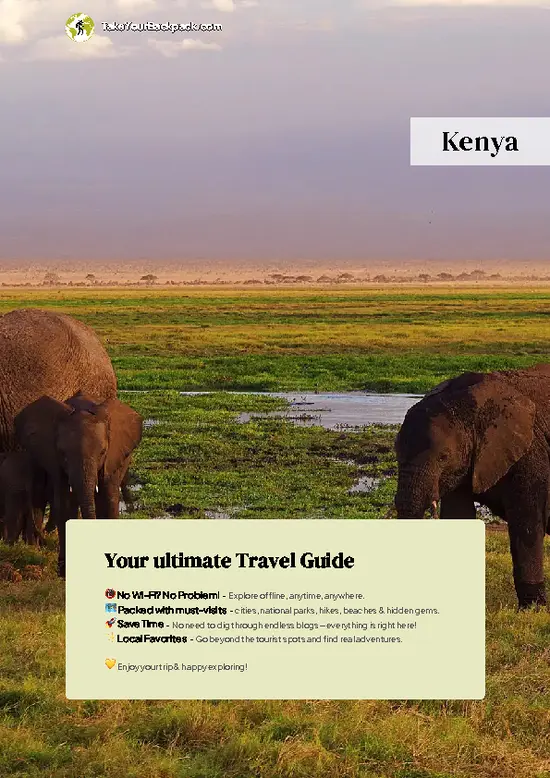
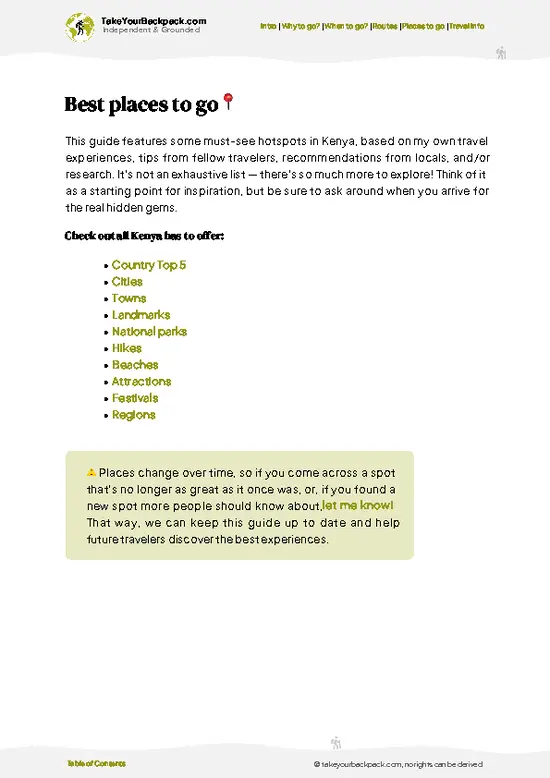
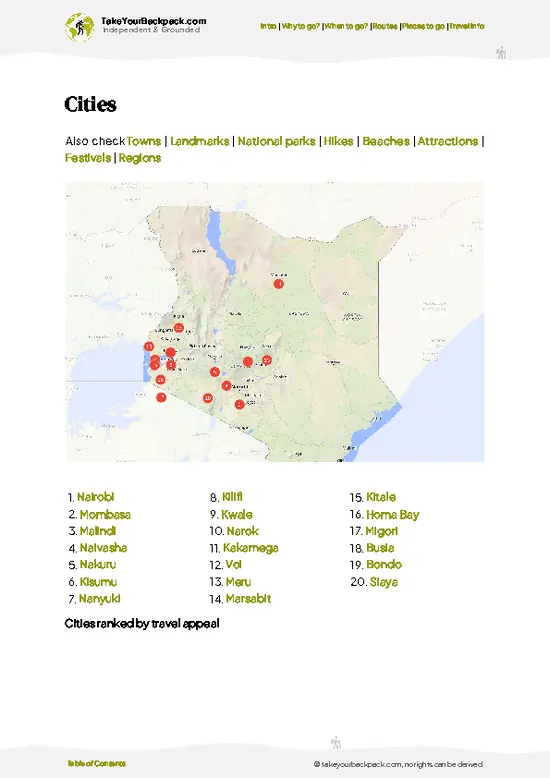
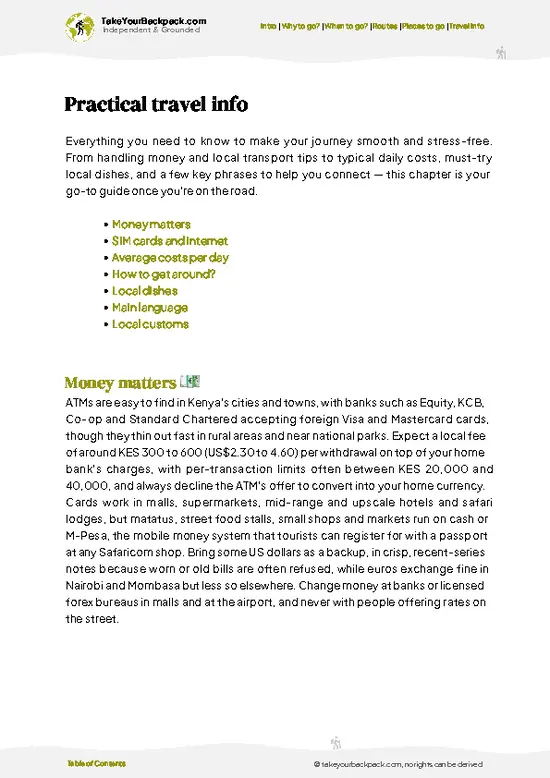
example page 0 from our offline Travel Guide for Kenya
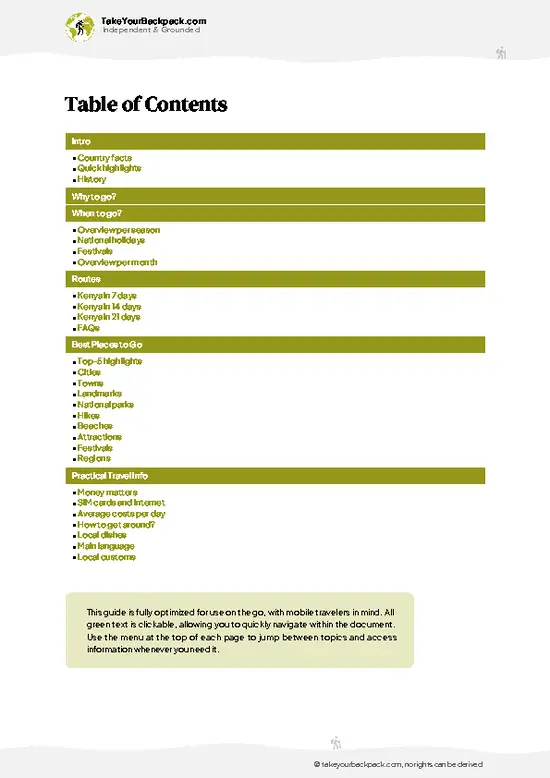
example page 1 from our offline Travel Guide for Kenya
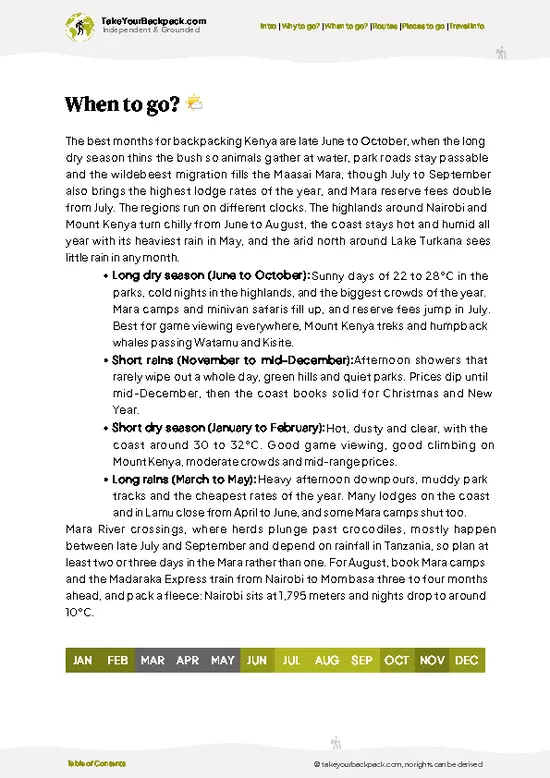
example page 2 from our offline Travel Guide for Kenya
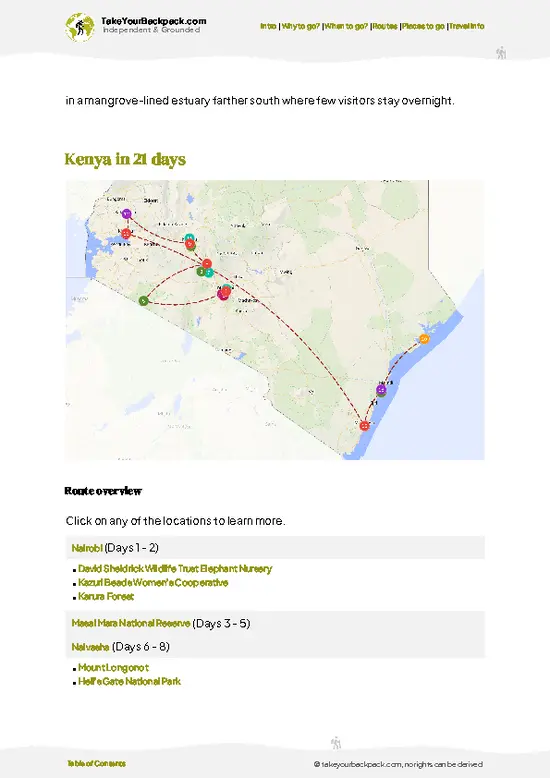
example page 3 from our offline Travel Guide for Kenya
example page 4 from our offline Travel Guide for Kenya
example page 5 from our offline Travel Guide for Kenya
example page 6 from our offline Travel Guide for Kenya
example page 7 from our offline Travel Guide for Kenya
The digital guide (365 pages) contains:
✅ 96 highlights, ranked by travel appeal
✅ Optimized 7, 14 & 21-day travel routes
✅ Cities, national parks, landmarks, beaches
✅ How to get around
✅ Offline-friendly for travel without Wi-Fi
👉 Click to see all 30+ guide features

📅 Plan smarter in minutes, not weeks
✅ Month by month travel advice
✅ Festivals & national holidays
✅ Budget expectations

🗺️ Go to the right places, skip the overrated ones
✅ Honest pros & cons of destinations
✅ Top hikes, parks & viewpoints
✅ Lesser-known places most travelers miss
✅ Clear “worth it vs skip it” guidance

🛏️ Travel smoothly without rookie mistakes
✅ Best areas to stay
✅ Transport systems explained simply
✅ Common scams & safety advice
✅ SIM cards, money & practical tips

🌍 Understand the country, not just visit it
✅ Culture & traditions
✅ 52 Essential phrases & customs
✅ Festivals worth planning around
✅ Traveler-friendly historical context
✅ Insights that make places more meaningful

📱 Built for real travel conditions
✅ Fully downloadable PDF
✅ Works completely offline
✅ Optimized for phone use
✅ Useful in remote areas & buses
✅ Everything in one place
Stop searching, start planning
Get instant access to your full guide. 30‑day money-back guarantee.
+ Add another guide for just

By proceeding you agree to our terms.
Sent to your inbox immediately after payment • 100% Secure Checkout
Best Backpacking Travel Advisor 2025 tourism awardBest Backpacking
Travel Advisor
2025
What others say about Take Your Backpack Guides:
⭐⭐⭐⭐⭐
Fantastic, amazing amount of information!
⭐⭐⭐⭐⭐
My goodness this is amazing, it's what I've been looking for hats off too you!
⭐⭐⭐⭐⭐
I think this is absolutely BRILLIANT
⭐⭐⭐⭐
Very complete and informative. It's still missing places, but I gotta to commend you
⭐⭐⭐⭐⭐
This is truly amazing, thank you, can't wait to explore it with my kids!
⭐⭐⭐⭐⭐
Awesome resource, thank you!
⭐⭐⭐⭐⭐
This is amazing! Can't wait to explore the ones I haven't seen
⭐⭐⭐⭐
I love this! Well done, great idea.
⭐⭐⭐⭐⭐
Thanks for taking the time to make this gem!
⭐⭐⭐⭐⭐
This might be the best website I've ever seen.
⭐⭐⭐⭐⭐
Congratulations, and thank you so much for your work; it's incredibly valuable.
⭐⭐⭐⭐
In all seriousness I think you did a great job pointing out the important spots
⭐⭐⭐⭐⭐
10/10 very good
⭐⭐⭐⭐⭐
As someone who's only just starting to visit regularly this is awesome, thank you.
⭐⭐⭐⭐
Thank you very much! I'm going to visit my dad, it's going to be very useful!
⭐⭐⭐⭐⭐
This is really cool! We'll be travelling for the first time and this definitely come in handy.
⭐⭐⭐⭐⭐
You are now our minister of culture, congratulations 👨‍💼
⭐⭐⭐⭐⭐
Just wanted to tell you that this is a pearl! Going to follow your recommendations.
⭐⭐⭐⭐⭐
This is so cool. I'll definitely be using the resource for my travels soon.
⭐⭐⭐⭐⭐
This is very impressive! Good work.
⭐⭐⭐⭐⭐
This is an amazing and informative site. Very well done!

🛏️ Where to stay?Top Areas to Stay

Kenya has a solid spread of hostels, backpacker guesthouses and campsites, with dorm beds typically running KSh 1,500 to 2,500 (about US$12 to 20) and campsites cheaper still. In Nairobi, Westlands has the most nightlife, restaurants and transport links but gets loud on weekends, leafy Kilimani and Kileleshwa are quieter and feel safer to walk at dusk, and Karen and Langata put you close to the national park and giraffe sanctuary at the cost of long, traffic-choked rides into town. The cheap lodgings of the CBD save money but are unpleasant after dark, while on the coast Diani and Lamu Old Town offer the best beach and old-town budget stays, and Naivasha lakeside campsites are the classic low-cost … read more 👉
Kenya has a solid spread of hostels, backpacker guesthouses and campsites, with dorm beds typically running KSh 1,500 to 2,500 (about US$12 to 20) and campsites cheaper still. In Nairobi, Westlands has the most nightlife, restaurants and transport links but gets loud on weekends, leafy Kilimani and Kileleshwa are quieter and feel safer to walk at dusk, and Karen and Langata put you close to the national park and giraffe sanctuary at the cost of long, traffic-choked rides into town. The cheap lodgings of the CBD save money but are unpleasant after dark, while on the coast Diani and Lamu Old Town offer the best beach and old-town budget stays, and Naivasha lakeside campsites are the classic low-cost base in the Rift Valley.

If you enjoy meeting fellow travelers, consider choosing hostels with high ratings for atmosphere. On the other hand, if you prefer having your own space, a hotel might be a better option.

KenyaDiscover the Country

👋 Meet the founderWho’s Behind Take Your Backpack?

Johan, backpacker and founder of TakeYourBackpackHi, I’m Johan (Netherlands 🇳🇱), the creator of TakeYourBackpack. Over the past 3 decades, I’ve backpacked through 90+ countries across six continents, gaining extensive experience with independent travel, long-term trips, and overland routes.

This site is built on a combination of firsthand travel experience and carefully curated insights from other backpackers. Many guides are based on places I’ve personally visited, while others bring together tips, observations, and practical advice shared by trusted travelers I’ve met along the way.

The goal is to provide realistic, experience-driven guidance — not generic itineraries — so you can explore destinations with better context, clearer expectations, and more confidence.