×

Kenya🇰🇪 | best citiesEssential 10 cities to Explore in Kenya

Kenya’s cities pulse with a unique energy, each offering distinct flavors of culture, transport, and nightlife. From the bustling streets of Nairobi, where modern skyscrapers meet vibrant markets, to the laid-back charm of Lamu, the choices you make shape your backpacking adventure. Major hubs like Mombasa provide rich coastal experiences, while smaller towns like Nakuru offer a glimpse into local life and wildlife.

Understanding regional nuances is crucial. The dry season brings crowds and higher prices, while the rainy season can lead to quieter streets and lower costs. Your choice of city directly impacts your budget, safety, and ease of travel. For instance, Nairobi’s extensive transport network contrasts sharply with the more limited options in smaller towns. Each city invites you to immerse yourself in its unique vibe, making the right choice essential for a fulfilling experience.

By Johan Kruseman 🇳🇱 | Updated June 14, 2026
Explore the best towns in Kenya

Why go?Why Travelers Love These Spots

Kenya’s cities pulse with a cultural diversity that sets them apart from urban centers in other countries. Each city is a mosaic of ethnic groups, languages, and traditions, reflecting the nation’s rich history and regional identities. This diversity shapes not only the social fabric but also the culinary landscape, art scenes, and festivals, offering travelers a vibrant tapestry of experiences.

Historically, Kenya has been a crossroads for trade and migration, influencing its urban development. Cities like Nairobi and Mombasa have evolved as vital hubs, connecting various regions and cultures. The transport networks are robust, with roads, railways, and airports facilitating movement. However, this accessibility comes with trade-offs. While it’s easy to hop from one city to another, the … read more 👉
Kenya’s cities pulse with a cultural diversity that sets them apart from urban centers in other countries. Each city is a mosaic of ethnic groups, languages, and traditions, reflecting the nation’s rich history and regional identities. This diversity shapes not only the social fabric but also the culinary landscape, art scenes, and festivals, offering travelers a vibrant tapestry of experiences.

Historically, Kenya has been a crossroads for trade and migration, influencing its urban development. Cities like Nairobi and Mombasa have evolved as vital hubs, connecting various regions and cultures. The transport networks are robust, with roads, railways, and airports facilitating movement. However, this accessibility comes with trade-offs. While it’s easy to hop from one city to another, the deeper, more immersive experiences often lie off the beaten path, requiring time and effort to explore.

The climatic conditions also play a role in shaping urban life. Coastal cities boast warm, humid weather, while inland areas experience cooler temperatures. This variation affects not just daily life but also the types of activities and experiences available. Travelers must weigh the benefits of comfort against the desire for exploration.

Kenya’s cities are well-suited for those seeking a blend of modernity and tradition, yet they can also be overwhelming. The bustling markets and crowded streets may deter some, while others find them exhilarating. Understanding these dynamics is crucial. The choice between time and depth of exploration can significantly impact the quality of the experience. Opting for a slower pace allows for richer interactions, while a faster itinerary might sacrifice those moments for the sake of seeing more. Ultimately, the journey through Kenya’s cities is as much about the exploration as it is about the destinations themselves.
Behind the Scenes of Selection
The list of best cities in Kenya is created based on culture, vibe, attractions, transport ease, and local charm. If you feel a city is missing in this list, please let us know.

When to go?When to Plan Your Trip

Seasonality plays a crucial role in shaping the experience of visiting cities in Kenya. The country experiences two main seasons: the dry season and the rainy season. The dry season, typically from June to October, offers warm temperatures and clear skies. This is when many travelers flock to urban areas, drawn by the pleasant weather and vibrant street life. However, this peak period brings larger crowds and higher prices, especially in popular locales.

Shoulder seasons, like late April to early June and late October to early December, present a different scenario. During these months, the weather remains relatively mild, but the crowds thin out. Travelers can enjoy a more intimate experience with local culture, albeit with the risk of occasional rain. Costs often drop, making this an appealing … read more 👉
Seasonality plays a crucial role in shaping the experience of visiting cities in Kenya. The country experiences two main seasons: the dry season and the rainy season. The dry season, typically from June to October, offers warm temperatures and clear skies. This is when many travelers flock to urban areas, drawn by the pleasant weather and vibrant street life. However, this peak period brings larger crowds and higher prices, especially in popular locales.

Shoulder seasons, like late April to early June and late October to early December, present a different scenario. During these months, the weather remains relatively mild, but the crowds thin out. Travelers can enjoy a more intimate experience with local culture, albeit with the risk of occasional rain. Costs often drop, making this an appealing time for budget-conscious explorers. Yet, the trade-off lies in potentially missing out on key cultural events that often occur during peak times.

Rainy season, from March to May and November to December, can deter some visitors due to heavy downpours. However, this period also brings lush landscapes and fewer tourists. Cities may feel quieter, allowing for a deeper connection with local rhythms. The trade-off here is the unpredictability of weather; while it might rain, the vibrant atmosphere can be worth the gamble.

Understanding these seasonal dynamics is essential for planning. Each season offers unique experiences, but the choice between comfort, cost, and cultural immersion can significantly impact the journey. Balancing these factors will lead to a more rewarding exploration of Kenya’s urban landscapes.

city hoppingSuggested Travel Strategies

Kenya’s Transport Networks
Kenya’s transport system is a mix of well-trodden roads and bustling air routes. Major cities like Nairobi, Mombasa, and Kisumu serve as hubs, making them ideal starting points. Use Nairobi as your launchpad. From there, you can easily access other regions. Mombasa, with its coastal allure, is just a short flight or a long bus ride away. Kisumu, on the shores of Lake Victoria, can be reached by road or air, depending on your pace.

Regional Clustering
Cluster your stops by region to maximize efficiency. Start in Nairobi, then head south to Mombasa. After soaking in the coastal vibes, travel west to Kisumu. This sequence minimizes backtracking and keeps travel time manageable. Each leg should take no more than a few hours by air or a full day by road.

Time Allocationread more 👉
Kenya’s Transport Networks
Kenya’s transport system is a mix of well-trodden roads and bustling air routes. Major cities like Nairobi, Mombasa, and Kisumu serve as hubs, making them ideal starting points. Use Nairobi as your launchpad. From there, you can easily access other regions. Mombasa, with its coastal allure, is just a short flight or a long bus ride away. Kisumu, on the shores of Lake Victoria, can be reached by road or air, depending on your pace.

Regional Clustering
Cluster your stops by region to maximize efficiency. Start in Nairobi, then head south to Mombasa. After soaking in the coastal vibes, travel west to Kisumu. This sequence minimizes backtracking and keeps travel time manageable. Each leg should take no more than a few hours by air or a full day by road.

Time Allocation
Plan for at least two to three days in each city. This allows for exploration without feeling rushed. If time is tight, prioritize key experiences over quantity. A day in Nairobi can be spent visiting the Giraffe Centre and the Nairobi National Park, while Mombasa deserves time for its beaches and Swahili culture.

Common Planning Mistakes
Avoid cramming too many cities into a short timeframe. This leads to exhaustion and missed opportunities. Also, don’t underestimate travel times; road conditions can vary. Flexibility is crucial.

Trade-Offs
Speed often sacrifices depth. A quick stop in a city might mean missing its essence. Budget constraints can limit comfort, but investing in a good hotel can enhance your experience. Weigh the effort against the reward: a long bus ride may lead to a hidden local experience, while a flight offers convenience but less immersion. Choose wisely to create a trip that resonates.

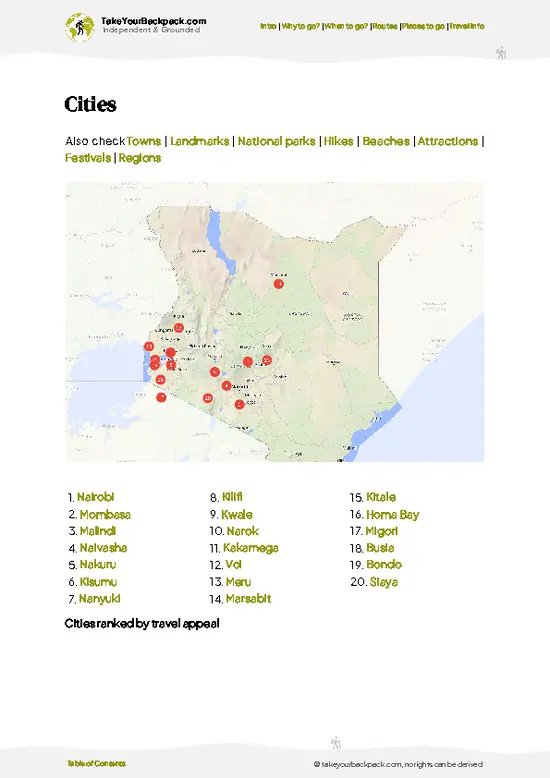
The ListHighly Recommended cities of Kenya

1 Nairobi

urban center, national park, cultural institutions

Balance city energy with wildlife encounters, museums, and a mix of neighborhoods that reflect Kenya’s diversity.

2 Mombasa

Indian Ocean port, Old Town, Swahili cuisine

Stroll through narrow alleys, sample coastal dishes, and watch ships come and go in Kenya’s historic port city.

3 Nanyuki

Mount Kenya views, British settler legacy, equator marker

Start your ascent to Mount Kenya or unwind in a town where colonial-era architecture meets modern safari staging and equatorial novelty.

4 Kisumu

Lake Victoria port, fish markets, Dunga wetlands

Experience lakeside life in western Kenya’s largest city, where fresh fish and waterfront sunsets shape the local scene.

5 Voi

Tsavo gateway, railway junction, market bustle

Catch the pulse of a busy transport hub, then branch out to Tsavo’s wild landscapes or sample local life in the central market.

6 Naivasha

freshwater lake, geothermal springs, flower farms

Base yourself by the lake for birdwatching, boat trips, and easy access to volcanic landscapes and local horticulture.

kenya-city-naivasha v1
© Google |

7 Nakuru

lakefront city, flamingo gatherings, Rift Valley escarpment

Watch wildlife along the lake’s edge, then wander into a city where local markets and Rift Valley views shape daily life.

8 Marsabit

Crater lakes, Borana culture, arid highlands

Experience a remote town surrounded by volcanic hills, where Borana traditions and crater lakes shape daily rhythms and rare wildlife sightings.

9 Eldoret

athletics training, wheat fields, Nandi hills

Experience a highland city where world-class runners train, and rural landscapes meet a lively urban center with a strong agricultural backbone.

10 Kilifi

coastal town, creek estuary, Swahili architecture

Wander through a laid-back coastal town, where mangroves meet the sea and centuries-old buildings line quiet streets.

11 Kwale

Shimba Hills, coastal hinterland, Digo culture

Explore a region of rolling hills and forest reserves, with a strong local identity and easy access to the southern coast.

kenya-city-kwale v1
© Google |

12 Narok

Maasai culture, Maasai Mara access, open grasslands

Start your safari journey here, where Maasai heritage and the promise of wildlife encounters define the town’s rhythm.

kenya-city-narok
© Google |

13 Machakos

hilly terrain, Akamba culture, sculpture parks

Navigate rolling hills and creative spaces, where local traditions and art blend with a relaxed pace just outside Nairobi.

14 Meru

tea farms, Nyambene hills, gateway to Mount Kenya

Travel through lush farmland and foothills, using Meru as a base for exploring the eastern slopes of Mount Kenya and local markets.

15 Kitale

agricultural hub, Saiwa Swamp, Kitale Museum

Visit a town surrounded by farmland and forest, with easy access to unique wetlands and a museum focused on regional heritage.

16 Limuru

Tea estates, rolling hills, cool mornings

Walk through misty plantations and sample fresh tea in a town defined by its lush slopes and proximity to Nairobi’s urban edge.

17 Kakamega

rainforest reserve, Luhya traditions, gold mining history

Walk beneath ancient trees in Kenya’s only rainforest, then explore a town shaped by cultural roots and a mining past.

18 Isiolo

crossroads town, arid landscapes, Samburu influence

Pass through a trading hub where northern cultures meet, and the landscape shifts from savannah to semi-desert.

19 Migori

Sugar plantations, Luo culture, border proximity

Travelers find a crossroads of cultures and commerce, with easy access to Tanzania and a landscape shaped by agriculture and river valleys.

20 Bomet

tea estates, rolling hills, rural trading center

Travel through green hills dotted with tea farms, and pause in a town that serves as a hub for the surrounding countryside.

21 Busia

border crossing, cross-border trade, Lake Victoria proximity

Navigate a busy border town where Kenyan and Ugandan cultures mix, and the lake’s influence is never far away.

22 Bondo

Lake Victoria access, university town, Luo traditions

Experience lakeside culture and academic life in a town where fishing, education, and Luo heritage shape the local scene.

23 Homa Bay

lakefront town, fishing communities, Ruma National Park

Relax by the water’s edge, explore fishing villages, and venture into nearby savannah for wildlife viewing.

24 Mwingi

Kitui plains, dryland farming, transit stop

Pause in a practical town serving travelers heading east, where dryland agriculture and local commerce dominate the landscape.

25 Mandera

tri-border location, arid plains, Somali influence

Experience a remote town at Kenya’s northern tip, where cultures converge and the landscape is defined by dry, open spaces.

26 Kajiado

Maasai settlements, open savannah, livestock markets

Move through a region where pastoral life dominates, and Maasai culture is visible in daily routines and local gatherings.

27 Thika

pineapple plantations, industrial estates, Chania Falls

Discover a city defined by its agricultural output, industrial growth, and the steady flow of rivers and waterfalls nearby.

28 Wajir

Semi-arid plains, Somali influence, seasonal laghas

Navigate a remote outpost where dry riverbeds and Somali culture set the tone for travel in Kenya’s northeastern frontier.

29 Kitui

semi-arid scenery, basket weaving, local markets

Experience a town where traditional crafts and dryland farming shape daily life, set against a backdrop of rugged hills.

30 Baringo

freshwater lake, birdwatching, Tugen hills

Spot rare birds along the lakeshore, and use the town as a base for exploring volcanic hills and island communities.

31 Ruiru

satellite town, coffee estates, Thika superhighway

Stay in a fast-growing suburb with easy Nairobi access, surrounded by coffee farms and new residential developments.

32 Siaya

rural landscapes, Luo heritage, Yala Swamp

Travel through a region shaped by wetlands and tradition, where local life centers on agriculture and community ties.

Think you know Kenya?

Prove you’re a true local — uncover 22 lesser-known cities in Kenya that locals tend to keep to themselves.
Loading the map 🌍

Expert viewPro Tips for Exploring the Best

Transport Hubs
Kenya’s transport network is a patchwork of bustling hubs, each with its own rhythm. Nairobi stands as the primary gateway, where the hum of matatus—shared minibuses—fills the air. These are your ticket to the city’s pulse, but they can be chaotic. If you’re in a hurry, consider the train service; it’s a smoother ride, though it may not reach every destination. The trade-off? Speed versus immersion. While matatus offer a local experience, they can eat up time if you’re not familiar with the routes.

In smaller cities, public transport can be less reliable. Expect to wait longer for buses or matatus, which can stretch your itinerary. If you’re keen on visiting several cities, factor in travel time. You might sacrifice comfort for speed, but the stories you gather along the … read more 👉
Transport Hubs
Kenya’s transport network is a patchwork of bustling hubs, each with its own rhythm. Nairobi stands as the primary gateway, where the hum of matatus—shared minibuses—fills the air. These are your ticket to the city’s pulse, but they can be chaotic. If you’re in a hurry, consider the train service; it’s a smoother ride, though it may not reach every destination. The trade-off? Speed versus immersion. While matatus offer a local experience, they can eat up time if you’re not familiar with the routes.

In smaller cities, public transport can be less reliable. Expect to wait longer for buses or matatus, which can stretch your itinerary. If you’re keen on visiting several cities, factor in travel time. You might sacrifice comfort for speed, but the stories you gather along the way are worth it.

Urban Pacing
Kenya’s cities move at different speeds. Nairobi is frenetic, while others like Kisumu or Mombasa offer a more laid-back vibe. If you’re looking to dive deep into local life, choose a slower pace. Spend a few days in one city, absorbing the culture, sampling street food, and chatting with locals. This approach enriches your experience but demands more time.

If you’re on a tight schedule, you might opt to skim the surface of multiple cities. This means less immersion but more sights. The trade-off here is depth versus breadth. You’ll see more, but you may miss the nuances that make each city unique.

Local Costs
Budgeting in Kenya can be tricky. Costs vary widely between urban centers and rural areas. In cities, you’ll find a range of accommodations from budget hostels to mid-range hotels. Eating local is a great way to save money while enjoying authentic cuisine. Street food is not only cheap but also a cultural experience.

However, if you’re planning to hop between cities, transportation costs can add up quickly. The trade-off? A tighter budget might mean fewer cities or a more luxurious stay in one. If you’re willing to splurge a bit, you can enjoy a more comfortable experience, but it may limit your exploration.

Exploring More Cities Quickly
The allure of visiting multiple cities is strong. You can check off boxes on your travel list, but this approach often leads to a superficial understanding of the culture. If you’re determined to see as much as possible, plan your route carefully. Use domestic flights for longer distances to save time, but be prepared for higher costs.

Alternatively, if you take the bus or train, you’ll experience the landscape and local life, but it will demand more time and patience. The trade-off here is efficiency versus experience. You’ll see more, but you might miss out on the stories that unfold in a single city.

Deeper Immersion
If you want to truly connect with the local culture, consider spending more time in fewer cities. This allows you to engage with the community, learn about traditions, and even pick up a bit of the language. Local markets, festivals, and community events can provide rich experiences that quick visits simply can’t offer.

However, this approach requires a commitment to slow travel. You’ll need to adjust your expectations and be open to spontaneity. The trade-off is the potential for unexpected adventures versus the structured itinerary of a fast-paced trip.

Safety & Cultural Considerations
Safety is paramount in any travel plan. While Kenya is generally safe for tourists, urban areas can have higher crime rates. Stay aware of your surroundings, especially in crowded places. Engaging with locals can enhance your experience, but be respectful of cultural norms.

Understanding local customs can also help you navigate social situations. For instance, greetings are important in Kenyan culture. A simple “Jambo” can go a long way. The trade-off here is between comfort and cultural immersion. You might feel more at ease sticking to tourist areas, but you’ll miss out on the authentic interactions that enrich your journey.

In summary, Kenya offers a spectrum of experiences, each with its own set of trade-offs. Whether you choose to explore multiple cities quickly or dive deep into a few, the key is to align your choices with your travel goals. Embrace the journey, and let the rhythm of Kenya guide you.

✈️ The backpacker research shortcutKenya Travel Guide

An offline-friendly backpacking guide with optimized travel routes, ranked highlights, transport advice, and the best areas to stay.
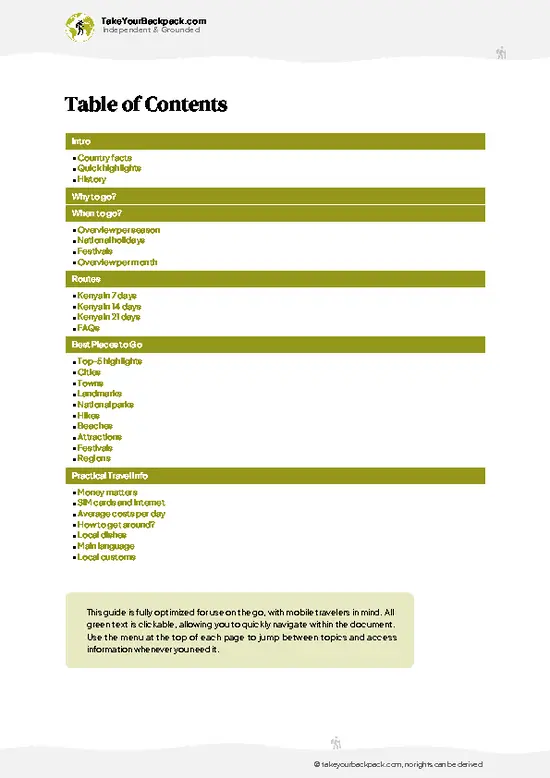
example page 0 from our offline Travel Guide for Kenya
example page 1 from our offline Travel Guide for Kenya
example page 2 from our offline Travel Guide for Kenya
example page 3 from our offline Travel Guide for Kenya
example page 4 from our offline Travel Guide for Kenya
example page 5 from our offline Travel Guide for Kenya
example page 6 from our offline Travel Guide for Kenya
example page 7 from our offline Travel Guide for Kenya
The digital guide (429 pages) contains:
114 highlights, ranked by travel appeal
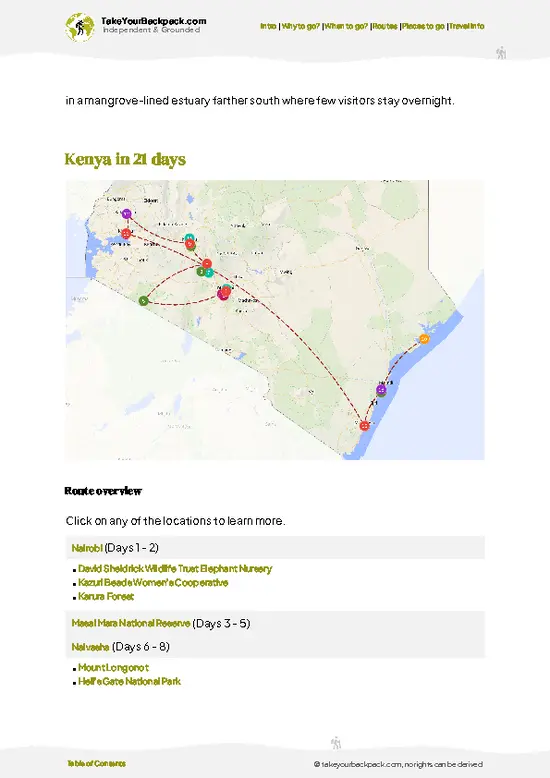
Optimized 7, 14 & 21-day travel routes
Cities, national parks, landmarks, beaches
How to get around
Offline-friendly for travel without Wi-Fi
👉 Click to see all 30+ guide features

📅 Plan smarter in minutes, not weeks
Month by month travel advice
Festivals & national holidays
Budget expectations

🗺️ Go to the right places, skip the overrated ones
Honest pros & cons of destinations
Top hikes, parks & viewpoints
Lesser-known places most travelers miss
Clear “worth it vs skip it” guidance

🛏️ Travel smoothly without rookie mistakes
Best areas to stay
Transport systems explained simply
Common scams & safety advice
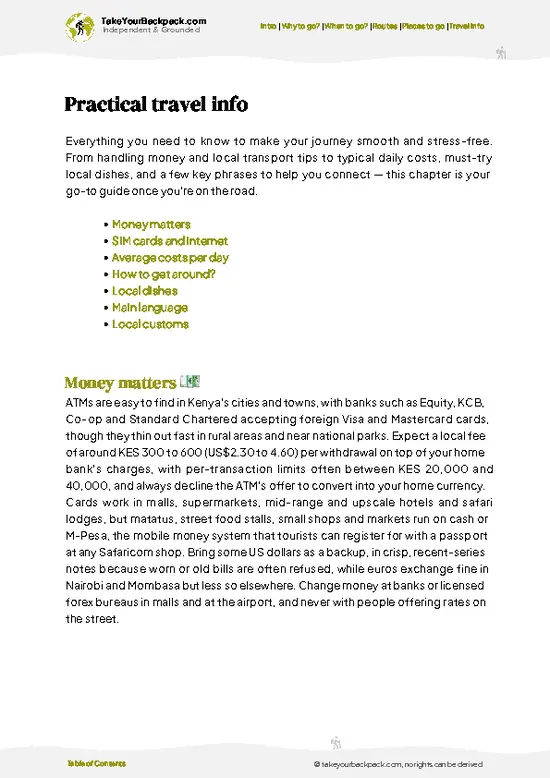
SIM cards, money & practical tips

🌍 Understand the country, not just visit it
Culture & traditions
52 Essential phrases & customs
Festivals worth planning around
Traveler-friendly historical context
Insights that make places more meaningful

📱 Built for real travel conditions
Fully downloadable PDF
Works completely offline
Optimized for phone use
Useful in remote areas & buses
Everything in one place
Save weeks of stressful planning
Get instant access to your full guide. 30‑day money-back guarantee.


By proceeding you agree to our terms.
Sent to your inbox immediately after payment • 100% Secure Checkout
Best Backpacking Travel Advisor 2025 tourism awardBest Backpacking
Travel Advisor
2025
What others say about Take Your Backpack Guides:
⭐⭐⭐⭐⭐
Fantastic, amazing amount of information!
⭐⭐⭐⭐⭐
My goodness this is amazing, it's what I've been looking for hats off too you!
⭐⭐⭐⭐⭐
I think this is absolutely BRILLIANT
⭐⭐⭐⭐
Very complete and informative. It's still missing places, but I gotta to commend you
⭐⭐⭐⭐⭐
This is truly amazing, thank you, can't wait to explore it with my kids!
⭐⭐⭐⭐⭐
Awesome resource, thank you!
⭐⭐⭐⭐⭐
This is amazing! Can't wait to explore the ones I haven't seen
⭐⭐⭐⭐
I love this! Well done, great idea.
⭐⭐⭐⭐⭐
Thanks for taking the time to make this gem!
⭐⭐⭐⭐⭐
This might be the best website I've ever seen.
⭐⭐⭐⭐⭐
Congratulations, and thank you so much for your work; it's incredibly valuable.
⭐⭐⭐⭐
In all seriousness I think you did a great job pointing out the important spots
⭐⭐⭐⭐⭐
10/10 very good
⭐⭐⭐⭐⭐
As someone who's only just starting to visit regularly this is awesome, thank you.
⭐⭐⭐⭐
Thank you very much! I'm going to visit my dad, it's going to be very useful!
⭐⭐⭐⭐⭐
This is really cool! We'll be travelling for the first time and this definitely come in handy.
⭐⭐⭐⭐⭐
You are now our minister of culture, congratulations 👨‍💼
⭐⭐⭐⭐⭐
Just wanted to tell you that this is a pearl! Going to follow your recommendations.
⭐⭐⭐⭐⭐
This is so cool. I'll definitely be using the resource for my travels soon.
⭐⭐⭐⭐⭐
This is very impressive! Good work.
⭐⭐⭐⭐⭐
This is an amazing and informative site. Very well done!

🛏️ Where to stay?Where to Stay: Kenya Edition

Yes — Kenya has plenty of hostels and budget accommodation concentrated in major hubs: Nairobi (Westlands for nightlife and many hostels, CBD for the cheapest central options, Kilimani for quieter budget stays), Mombasa (Old Town for beach access and cheap guesthouses, Nyali for quieter beachside options), coastal towns (Diani, Watamu, Malindi) for beach hostels and dive bases, and lake/park gateways (Naivasha, Narok/Maasai Mara gate) for camping and low-cost lodges.
Westlands gives nightlife and transport links but watch petty theft after dark; the CBD is ultra-central and cheap but less safe at night; Kilimani is quieter with good local food; Old Town and Diani put beaches and activities … read more 👉
Yes — Kenya has plenty of hostels and budget accommodation concentrated in major hubs: Nairobi (Westlands for nightlife and many hostels, CBD for the cheapest central options, Kilimani for quieter budget stays), Mombasa (Old Town for beach access and cheap guesthouses, Nyali for quieter beachside options), coastal towns (Diani, Watamu, Malindi) for beach hostels and dive bases, and lake/park gateways (Naivasha, Narok/Maasai Mara gate) for camping and low-cost lodges.
Westlands gives nightlife and transport links but watch petty theft after dark; the CBD is ultra-central and cheap but less safe at night; Kilimani is quieter with good local food; Old Town and Diani put beaches and activities on the doorstep but get touristy and can be isolated without transport; Nyali and Watamu are more relaxed and family-friendly; Naivasha and Narok are practical bases for parks but need planned transfers and offer more basic facilities.

If you enjoy meeting fellow travelers, consider choosing hostels with high ratings for atmosphere. On the other hand, if you prefer having your own space, a hotel might be a better option.

KenyaExplore Beyond This Category

👋 Meet the founderWho’s Behind Take Your Backpack?

Johan, backpacker and founder of TakeYourBackpackHi, I’m Johan (Netherlands 🇳🇱), the creator of TakeYourBackpack. Over the past decade, I’ve backpacked through 80+ countries across six continents, gaining extensive experience with independent travel, long-term trips, and overland routes.

This site is built on a combination of firsthand travel experience and carefully curated insights from other backpackers. Many guides are based on places I’ve personally visited, while others bring together tips, observations, and practical advice shared by trusted travelers I’ve met along the way.

The goal is to provide realistic, experience-driven guidance — not generic itineraries — so you can explore destinations with better context, clearer expectations, and more confidence.

Get full Kenya guide •
Instant download • 114 highlights • Full Offline guide