×

Kenya🇰🇪 | best national parksEssential 10 national parks to Explore in Kenya

Kenya’s national parks run from open savanna to alpine peaks, and the experience changes sharply with each region. The southern parks near Nairobi and the coast deliver big-sky plains, huge elephant herds and the easiest road access. Rift Valley parks are smaller and cheaper, and some let you walk or cycle among zebra and giraffe. Mountain parks in the highlands trade game drives for hiking, cold nights and thin air. Fees, crowds and difficulty shift with every step: the famous savanna names draw minibus traffic in peak months, while the quieter, remoter parks leave you almost alone. Independent travel works best where public transport reaches the gate, and many parks still need a hired vehicle or a shared tour. Pick your kind of landscape first, then match it to your budget and your appetite for rough roads.

By Johan Kruseman 🇳🇱 | Updated October 18, 2026
Explore the best hikes in Kenya

Why go?Why Travelers Love These Spots

Kenya sits on the equator, straddles the Great Rift Valley and rises from a hot coastal plain to a 5,199 meter glaciated summit. That vertical range packs savanna, volcanic lakes, dry thornbush, forest and snow into one country, and wildlife follows every habitat. Protection also has deep roots: Kenya set aside its first national park in 1946, and the Kenya Wildlife Service now manages the parks, with wildlife conservation a pillar of the tourism economy. That means decades of experienced guides, ranger patrols and a mature safari industry, all within reach of an international airport in Nairobi.

Kenya is also unusually friendly to the independent traveler. Nairobi has a major airport and a train link to the coast. Camping inside parks is possible, and budget tours run on a competitive market. … read more 👉
Kenya sits on the equator, straddles the Great Rift Valley and rises from a hot coastal plain to a 5,199 meter glaciated summit. That vertical range packs savanna, volcanic lakes, dry thornbush, forest and snow into one country, and wildlife follows every habitat. Protection also has deep roots: Kenya set aside its first national park in 1946, and the Kenya Wildlife Service now manages the parks, with wildlife conservation a pillar of the tourism economy. That means decades of experienced guides, ranger patrols and a mature safari industry, all within reach of an international airport in Nairobi.

Kenya is also unusually friendly to the independent traveler. Nairobi has a major airport and a train link to the coast. Camping inside parks is possible, and budget tours run on a competitive market. Cultural context matters too. Many landscapes sit beside Maasai, Samburu and other pastoralist lands, so wildlife and livestock share the open country, and community conservancies often border the parks.

Know the downsides before you commit. Entry fees are priced in US dollars, with higher rates for non-residents, and they climb in peak months. Gate payments are largely cashless, so bring a card or mobile money setup. Distances are long and many park roads turn to mud in the rains. Public transport rarely enters the parks, so you will need a vehicle, a tour or a driver. Malaria is present in lowland parks, and you should take advice on prophylaxis and bring repellent. Come prepared and Kenya rewards you with wildlife density that few countries match.
Our Approach to Ranking
The list of best national parks in Kenya is created based on landscapes, wildlife, adventure opportunities, facilities, and overall experience. If you feel a national park is missing in this list, please let us know.

When to go?When to Plan Your Trip

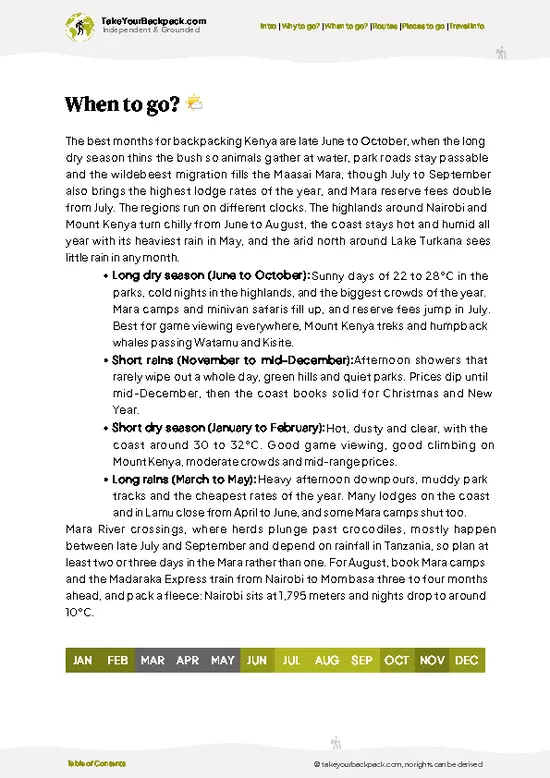
Best months for Kenya’s national parks: The best months are June to October and January to February, because the dry weather thins the vegetation and pushes animals to rivers and waterholes, so you see far more and the roads stay firm. Days on the savanna run 24 to 30°C, and nights at altitude fall to 8 to 14°C, so pack a fleece. The coast stays hot at 28 to 32°C and humid year-round.Rains and shoulder seasons: Kenya has two wet seasons. The long rains fall from late March to May, often 150 to 250 mm a month in the highlands and central regions, and they bring slick black-cotton soil tracks, closed roads and some lodges shutting for maintenance. The short rains come from November to mid-December and are lighter, usually brief afternoon downpours. November and early December make a smart shoulder … read more 👉
Best months for Kenya’s national parks: The best months are June to October and January to February, because the dry weather thins the vegetation and pushes animals to rivers and waterholes, so you see far more and the roads stay firm. Days on the savanna run 24 to 30°C, and nights at altitude fall to 8 to 14°C, so pack a fleece. The coast stays hot at 28 to 32°C and humid year-round.Rains and shoulder seasons: Kenya has two wet seasons. The long rains fall from late March to May, often 150 to 250 mm a month in the highlands and central regions, and they bring slick black-cotton soil tracks, closed roads and some lodges shutting for maintenance. The short rains come from November to mid-December and are lighter, usually brief afternoon downpours. November and early December make a smart shoulder window: green landscapes, fewer vehicles and lower rates. March, April and May are the cheapest, with lodge discounts of roughly 30 to 50 percent, but you must accept mud and cloud.Peak periods and regions: July to October and the Christmas to New Year weeks bring the highest prices and the biggest crowds. Park fees for non-residents rise in the high season by roughly US$10 to 40 a day in many parks, and budget camps and tours fill weeks ahead. Book early if you travel then. Mountain areas follow their own pattern: the best trekking is January to early March and July to October, when skies clear, while the wettest months turn trails to bog and summit views vanish. The coast peaks in December to February and gets its heaviest rain April to June. In the north, rain is scarce and heat is fierce, so prioritize the cooler months.

national park hoppingSuggested Travel Strategies

How many days to combine Kenya’s parks: A trip linking several national parks in Kenya needs 10 to 14 days, because the distances are long and the roads slow. Start from Nairobi, which has the international airport, the best tour operators and the rail and bus links to everything else.Which regions cluster together: Group by region, not by fame. The southern circuit links Nairobi, the dry south and the coast: Nairobi to the southern savanna is roughly 4 to 5 hours by road, and from there you can continue east toward the coast. The Rift Valley and highlands cluster sits north and west of the capital, with Nakuru and Naivasha around 2.5 to 3 hours from Nairobi and the central mountains 3 to 4 hours. The far western plains are 5 to 6 hours by road from Nairobi or about 45 minutes by small plane, … read more 👉
How many days to combine Kenya’s parks: A trip linking several national parks in Kenya needs 10 to 14 days, because the distances are long and the roads slow. Start from Nairobi, which has the international airport, the best tour operators and the rail and bus links to everything else.Which regions cluster together: Group by region, not by fame. The southern circuit links Nairobi, the dry south and the coast: Nairobi to the southern savanna is roughly 4 to 5 hours by road, and from there you can continue east toward the coast. The Rift Valley and highlands cluster sits north and west of the capital, with Nakuru and Naivasha around 2.5 to 3 hours from Nairobi and the central mountains 3 to 4 hours. The far western plains are 5 to 6 hours by road from Nairobi or about 45 minutes by small plane, and they suit a separate loop with a flight in and out.Direction of travel: Travel in one sweep, not a star pattern. Go from Nairobi into the Rift Valley and highlands, return, then head south and on to the coast, finishing on the beach. The Madaraka Express train from Nairobi to Mombasa takes about 4.5 to 5 hours and stops at Mtito Andei and Voi, so it makes a comfortable exit.Time per stop and mistakes to avoid: Give each park 2 to 3 nights. One night means you spend the day in a vehicle and see little. The commonest mistake is cramming a different park into every day, which turns the trip into a transit exercise. Another is backtracking through Nairobi, which can cost half a day each time. Also, budget a buffer day in the wet months, when a 200 km drive can take 6 to 8 hours. Plan fewer, longer stays and you will see more wildlife.

The ListHighly Recommended national parks of Kenya

1 Masai Mara National Reserve

big cat territory, Maasai culture, endless savannah

Travel across vast plains where lions hunt, Maasai herders graze cattle, and seasonal migrations shape the rhythm of life.

Kenya - Masai Mara National Reserve

2 Mara Triangle

open grassland, wildebeest migration, Mara River crossings

Witness dramatic river crossings during migration season, or track predators and herds in a less crowded corner of the Mara.

kenya-national-park-mara-triangle
© Google |

3 Kakamega Forest

Equatorial rainforest, rare primates, ancient canopy

Listen for bird calls and spot elusive monkeys as you follow winding trails beneath towering trees in Kenya’s last major remnant of indigenous rainforest.

4 Amboseli

elephant herds, Mount Kilimanjaro backdrop, seasonal swamps

Watch elephants cross open plains with Kilimanjaro looming above, and explore marshes that attract diverse wildlife year-round.

kenya-national-park-amboseli
© Google |

5 Tsavo

red earth plains, lava flows, elephant migration, baobab trees

Traverse vast, wild landscapes where elephants roam between volcanic hills, and baobabs dot the horizon across Kenya’s largest park.

6 Samburu National Reserve

Ewaso Nyiro River, unique northern species, doum palms

Search for Grevy’s zebra and reticulated giraffe along a river oasis, where arid landscapes support rare wildlife found only in the north.

7 Mount Kenya National Park

alpine peaks, glacier lakes, Afro-alpine flora

Climb through changing vegetation zones to reach high-altitude lakes and jagged summits, with unique plants and mountain wildlife.

8 Lake Nakuru

alkaline lake, flamingo flocks, acacia woodland, rhino sightings

Drive along lake shores lined with flamingos and pelicans, then search for rhinos and leopards in surrounding woodlands.

kenya-national-park-lake-nakuru
© Google |

9 Nairobi National Park

city skyline views, open grassland, black rhino habitat

Spot lions and rhinos against a backdrop of skyscrapers, with easy access to wildlife just outside Nairobi’s city center.

10 Ol Pejeta Conservancy

private reserve, chimpanzee sanctuary, endangered rhinos

Join guided drives to see rare rhinos and rescued chimpanzees, with opportunities for walking safaris and night game viewing.

11 Meru National Park

riverine forests, open savannah, baobab trees, rhino sanctuary

Travel through varied terrain where rivers cut through grasslands, and black and white rhinos roam alongside giraffes and lions.

kenya-national-park-meru-national-park
© Google |

12 Aberdare National Park

misty forest, highland waterfalls, bamboo groves, mountain wildlife

Ascend into cool, forested hills where elephants, rare antelope, and waterfalls create a landscape shaped by altitude and dense vegetation.

13 Hell’s Gate National Park

gorges, geothermal springs, rock towers, cycling trails

Cycle or walk past dramatic cliffs and hot springs, navigating narrow gorges and volcanic formations in a compact, active park.

kenya-national-park-hells-gate-national-park
© Google |

14 Chyulu Hills

green volcanic hills, lava tubes, panoramic vistas

Trek rolling green hills and explore ancient lava caves, with sweeping views across savannah and distant mountain peaks.

15 Shimba Hills

coastal rainforest, waterfall trails, sable antelope

Walk shaded forest paths to waterfalls, and look for sable antelope in rolling hills near the Indian Ocean coast.

kenya-national-park-shimba-hills
© Google |

16 Kisite-Mpunguti Marine National Park

dolphin encounters, offshore islands, coral atolls

Snorkel or dive among coral islets, where dolphins and colorful fish thrive in warm, shallow waters off the Kenyan coast.

17 Mombasa Marine National Park

urban coastline, shipwreck dives, seagrass beds

Dive near shipwrecks and seagrass meadows, with easy access from Mombasa’s city beaches and a mix of marine habitats.

18 Watamu Marine National Park

coral gardens, sea turtles, snorkeling reefs

Swim above vibrant coral and spot turtles in clear waters, with easy access to protected marine life and sandy beaches.

19 Malindi Marine National Park

reef lagoons, glass-bottom boats, tidal pools

Glide over shallow reefs teeming with fish, or explore tidal pools and sandy beaches just steps from Malindi town.

20 Arabuko Sokoke National Park

coastal forest, endemic birds, butterfly diversity

Listen for rare bird calls and glimpse butterflies in Kenya’s largest coastal forest, home to species found nowhere else.

21 Mount Elgon National Park

ancient volcano, lava caves, montane forest, elephant herds

Hike volcanic slopes and explore caves where elephants dig for salt, surrounded by forest and panoramic views into Uganda.

22 Sibiloi National Park

fossil beds, arid landscape, Lake Turkana shoreline

Trace human origins among fossil sites and volcanic outcrops on the remote, wind-swept shores of Lake Turkana.

23 Lake Turkana National Parks

desert lakeshore, archaeological sites, crocodile colonies

Explore arid landscapes where ancient sites and large crocodile populations define the world’s largest desert lake ecosystem.

kenya-national-park-lake-turkana-national-parks
© Google |

24 South Island National Park

volcanic island, flamingo flocks, Lake Turkana

Experience stark volcanic scenery and shifting birdlife on a remote island, where flamingos gather along turquoise lake shores.

25 Ruma National Park

rolling grassland, roan antelope, escarpment views

Spot rare roan antelope in open plains bordered by dramatic escarpments, with birdlife and quiet trails away from crowds.

26 Saiwa Swamp National Park

wetland boardwalks, Sitatunga antelope, papyrus reeds

Walk raised paths through papyrus swamps, watching for elusive Sitatunga and abundant wetland birds in a compact, tranquil setting.

27 Ndere Island National Park

Lake Victoria views, grassy island, birdwatching

Take a boat to a quiet island for panoramic lake views, open grasslands, and close-up encounters with waterbirds and hippos.

Think you know Kenya?

Prove you’re a true local — uncover 17 lesser-known national parks in Kenya that locals tend to keep to themselves.
Loading the map 🌍

Expert viewPro Tips for Exploring the Best

How many parks to visit: Three parks is the number I advise for a backpacker. That is enough to see three different landscapes and still have time for early starts, dawn game drives and a spare day when roads or weather fail. Five parks in ten days means about eight hours a day in a vehicle and a lot of money spent on gate fees for tiny slices of each place. Two parks leave a trip thin if you have two weeks. Three, with two to three nights each, gives the best return on time and money.Which kind to prioritize: Choose by travel style. For classic big-game savanna, you pay the most: entry fees run about US$60 to 100 per adult per day in peak months, and camping or a shared safari is almost always required. For the first-timer who wants one great wildlife day, this is still the headline choice. … read more 👉
How many parks to visit: Three parks is the number I advise for a backpacker. That is enough to see three different landscapes and still have time for early starts, dawn game drives and a spare day when roads or weather fail. Five parks in ten days means about eight hours a day in a vehicle and a lot of money spent on gate fees for tiny slices of each place. Two parks leave a trip thin if you have two weeks. Three, with two to three nights each, gives the best return on time and money.Which kind to prioritize: Choose by travel style. For classic big-game savanna, you pay the most: entry fees run about US$60 to 100 per adult per day in peak months, and camping or a shared safari is almost always required. For the first-timer who wants one great wildlife day, this is still the headline choice. If you want to move on your own two feet, the smaller Rift Valley parks give the best value: fees around US$25 to 60, and some let you cycle or hike with a ranger. For hikers, the mountain parks cost more in logistics (a guided climb of 4 to 5 days is roughly US$600 to 1,000 all inclusive) but cost the least in daily fees and deliver a completely different Kenya. If you can only afford one expensive stop, make it a savanna park and fill the rest with cheaper Rift Valley and highland days.What it costs: Budget US$100 to 150 a day for a do-it-yourself visit if you share a hired car and camp: park fee US$50 to 90, camping around US$10 to 30, vehicle entry roughly US$3 to 10, plus fuel and food. A group camping safari costs about US$150 to 250 a day per person and includes transport, a driver-guide, tents and meals. That is often the better deal, because a private 4x4 with a driver runs US$150 to 250 a day split among passengers, and a rental without a driver is hard on rutted tracks. Hire a ranger or guide for walks at about US$15 to 30 a visit. Fees can be paid only by card or mobile money at most gates, so top up before you arrive.Safety and cultural considerations: Wildlife is wild. Stay in the vehicle on game drives, keep to marked roads and never walk at night near camps, where hyenas, buffalo and elephants wander. Camp near the ranger post and keep food sealed. Use malaria prophylaxis, repellent and long sleeves in the evening, and carry a yellow fever certificate if your route requires it. Drones are banned without a permit. Along park borders, Maasai and Samburu communities live with livestock and wildlife. Ask before photographing people, expect to pay for a village visit (typically US$10 to 30) and buy crafts directly from makers. Book with a licensed operator and check reviews: a cheap deal that skimps on vehicle quality is the one that breaks down far from help.

✈️ The backpacker research shortcutKenya Travel Guide

An offline-friendly backpacking guide with optimized travel routes, ranked highlights, transport advice, and the best areas to stay.
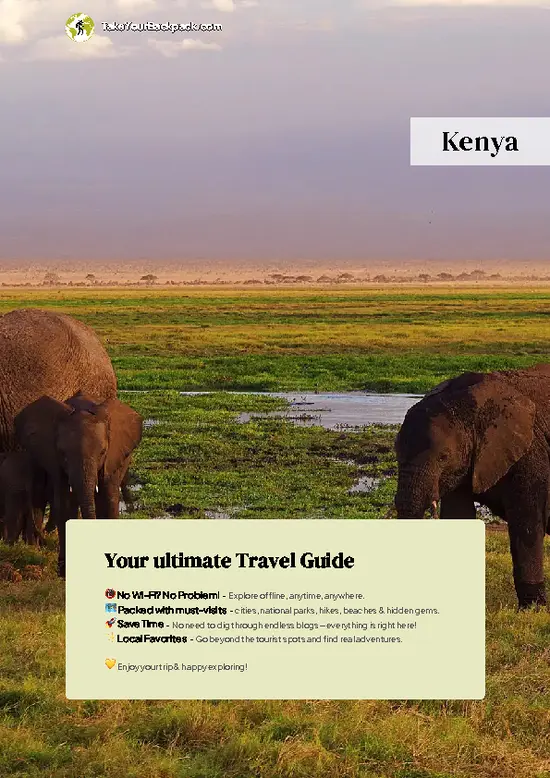
example page 0 from our offline Travel Guide for Kenya
example page 1 from our offline Travel Guide for Kenya
example page 2 from our offline Travel Guide for Kenya
example page 3 from our offline Travel Guide for Kenya
example page 4 from our offline Travel Guide for Kenya
example page 5 from our offline Travel Guide for Kenya
example page 6 from our offline Travel Guide for Kenya
example page 7 from our offline Travel Guide for Kenya
The digital guide (365 pages) contains:
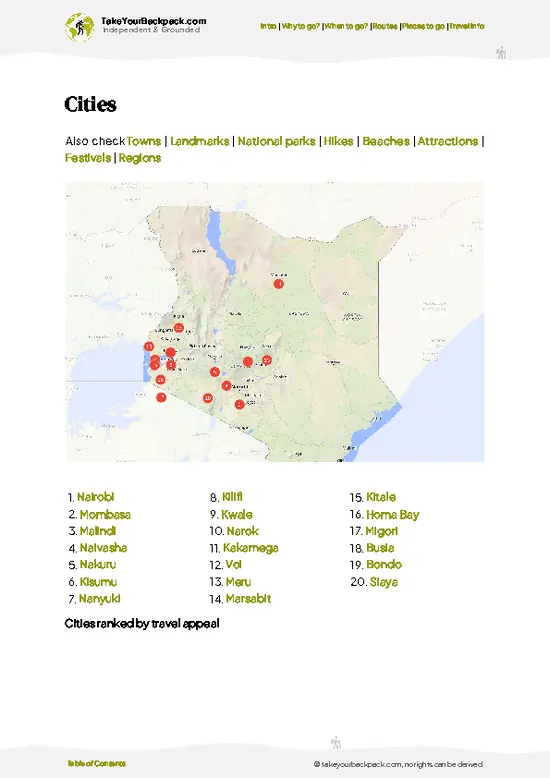
✅ 96 highlights, ranked by travel appeal
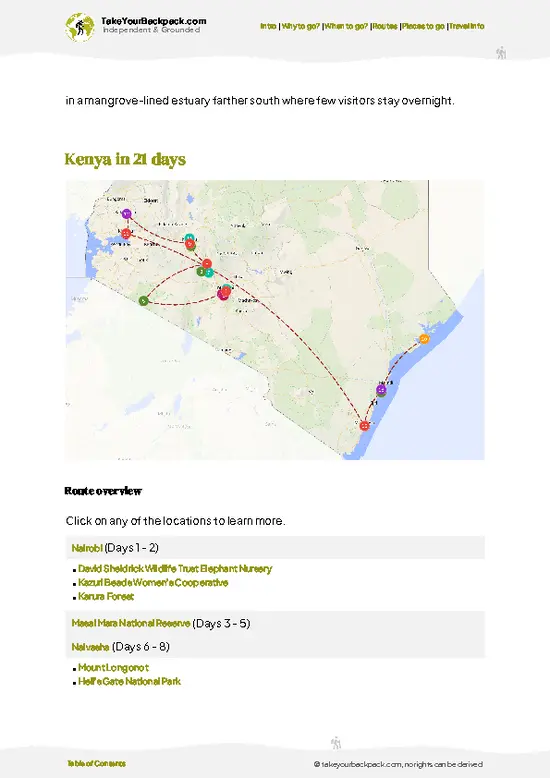
✅ Optimized 7, 14 & 21-day travel routes
✅ Cities, national parks, landmarks, beaches
✅ How to get around
✅ Offline-friendly for travel without Wi-Fi
👉 Click to see all 30+ guide features

📅 Plan smarter in minutes, not weeks
✅ Month by month travel advice
✅ Festivals & national holidays
✅ Budget expectations

🗺️ Go to the right places, skip the overrated ones
✅ Honest pros & cons of destinations
✅ Top hikes, parks & viewpoints
✅ Lesser-known places most travelers miss
✅ Clear “worth it vs skip it” guidance

🛏️ Travel smoothly without rookie mistakes
✅ Best areas to stay
✅ Transport systems explained simply
✅ Common scams & safety advice
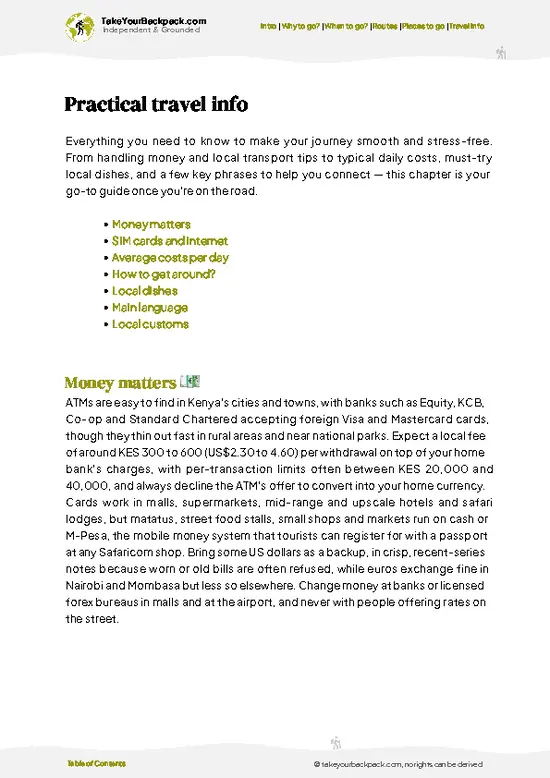
✅ SIM cards, money & practical tips

🌍 Understand the country, not just visit it
✅ Culture & traditions
✅ 52 Essential phrases & customs
✅ Festivals worth planning around
✅ Traveler-friendly historical context
✅ Insights that make places more meaningful

📱 Built for real travel conditions
✅ Fully downloadable PDF
✅ Works completely offline
✅ Optimized for phone use
✅ Useful in remote areas & buses
✅ Everything in one place
Stop searching, start planning
Get instant access to your full guide. 30‑day money-back guarantee.
+ Add another guide for just

By proceeding you agree to our terms.
Sent to your inbox immediately after payment • 100% Secure Checkout
Best Backpacking Travel Advisor 2025 tourism awardBest Backpacking
Travel Advisor
2025
What others say about Take Your Backpack Guides:
⭐⭐⭐⭐⭐
Fantastic, amazing amount of information!
⭐⭐⭐⭐⭐
My goodness this is amazing, it's what I've been looking for hats off too you!
⭐⭐⭐⭐⭐
I think this is absolutely BRILLIANT
⭐⭐⭐⭐
Very complete and informative. It's still missing places, but I gotta to commend you
⭐⭐⭐⭐⭐
This is truly amazing, thank you, can't wait to explore it with my kids!
⭐⭐⭐⭐⭐
Awesome resource, thank you!
⭐⭐⭐⭐⭐
This is amazing! Can't wait to explore the ones I haven't seen
⭐⭐⭐⭐
I love this! Well done, great idea.
⭐⭐⭐⭐⭐
Thanks for taking the time to make this gem!
⭐⭐⭐⭐⭐
This might be the best website I've ever seen.
⭐⭐⭐⭐⭐
Congratulations, and thank you so much for your work; it's incredibly valuable.
⭐⭐⭐⭐
In all seriousness I think you did a great job pointing out the important spots
⭐⭐⭐⭐⭐
10/10 very good
⭐⭐⭐⭐⭐
As someone who's only just starting to visit regularly this is awesome, thank you.
⭐⭐⭐⭐
Thank you very much! I'm going to visit my dad, it's going to be very useful!
⭐⭐⭐⭐⭐
This is really cool! We'll be travelling for the first time and this definitely come in handy.
⭐⭐⭐⭐⭐
You are now our minister of culture, congratulations 👨‍💼
⭐⭐⭐⭐⭐
Just wanted to tell you that this is a pearl! Going to follow your recommendations.
⭐⭐⭐⭐⭐
This is so cool. I'll definitely be using the resource for my travels soon.
⭐⭐⭐⭐⭐
This is very impressive! Good work.
⭐⭐⭐⭐⭐
This is an amazing and informative site. Very well done!

🛏️ Where to stay?Best Stay Options in Kenya

Kenya has a solid spread of hostels, backpacker guesthouses and campsites, with dorm beds typically running KSh 1,500 to 2,500 (about US$12 to 20) and campsites cheaper still. In Nairobi, Westlands has the most nightlife, restaurants and transport links but gets loud on weekends, leafy Kilimani and Kileleshwa are quieter and feel safer to walk at dusk, and Karen and Langata put you close to the national park and giraffe sanctuary at the cost of long, traffic-choked rides into town. The cheap lodgings of the CBD save money but are unpleasant after dark, while on the coast Diani and Lamu Old Town offer the best beach and old-town budget stays, and Naivasha lakeside campsites are the classic low-cost … read more 👉
Kenya has a solid spread of hostels, backpacker guesthouses and campsites, with dorm beds typically running KSh 1,500 to 2,500 (about US$12 to 20) and campsites cheaper still. In Nairobi, Westlands has the most nightlife, restaurants and transport links but gets loud on weekends, leafy Kilimani and Kileleshwa are quieter and feel safer to walk at dusk, and Karen and Langata put you close to the national park and giraffe sanctuary at the cost of long, traffic-choked rides into town. The cheap lodgings of the CBD save money but are unpleasant after dark, while on the coast Diani and Lamu Old Town offer the best beach and old-town budget stays, and Naivasha lakeside campsites are the classic low-cost base in the Rift Valley.

If you enjoy meeting fellow travelers, consider choosing hostels with high ratings for atmosphere. On the other hand, if you prefer having your own space, a hotel might be a better option.

KenyaWhere to Go Next

👋 Meet the founderWho’s Behind Take Your Backpack?

Johan, backpacker and founder of TakeYourBackpackHi, I’m Johan (Netherlands 🇳🇱), the creator of TakeYourBackpack. Over the past 3 decades, I’ve backpacked through 90+ countries across six continents, gaining extensive experience with independent travel, long-term trips, and overland routes.

This site is built on a combination of firsthand travel experience and carefully curated insights from other backpackers. Many guides are based on places I’ve personally visited, while others bring together tips, observations, and practical advice shared by trusted travelers I’ve met along the way.

The goal is to provide realistic, experience-driven guidance — not generic itineraries — so you can explore destinations with better context, clearer expectations, and more confidence.