×

Kenya🇰🇪 | best hikesEssential 9 hikes to Explore in Kenya

Hiking in Kenya means choosing your altitude, your climate and your crowd before you lace a boot. The country stacks volcanic peaks, Rift Valley escarpments, highland forests and coastal hills within a day or two of each other, and each region plays by different rules. Central Kenya and the Aberdares pull the high-altitude trekkers, with park fees, mandatory guides on the big mountains and cold nights above 3,000 meters. The Rift Valley around Naivasha and Baringo offers cheaper, looser day walks where you can often set your own pace, with baboons and acacia for company. The west, near Kakamega and the Cherangani Hills, runs quiet and green, with few foreign visitors and plenty of local hospitality. Independent travelers can stitch these together with matatus and boda-bodas, though remote trailheads reward a little planning. Pack layers, push into the unfamiliar, and let the terrain set the mood.

By Johan Kruseman 🇳🇱 | Updated October 18, 2026
Explore the best beaches in Kenya

Why go?Why Travelers Love These Spots

Kenya hands you an unusual geographic deal: the equator crosses the country, yet altitude drags the climate far from tropical. Mount Kenya reaches 5,199 meters and carries glaciers on the equator, while the Great Rift Valley slices north to south and leaves volcanic cones, crater lakes and sheer escarpments in its wake. That range of elevation means you can hike in alpine moorland one week and dry savanna the next, without leaving one country or changing visas.

The second advantage is infrastructure. Kenya has run organized mountain tourism for decades, so Kenya Wildlife Service parks, community conservancies and licensed guide associations are well established. Park gates, ranger posts and basic huts exist where you need them, and Nairobi works as a hub with flights and buses reaching most … read more 👉
Kenya hands you an unusual geographic deal: the equator crosses the country, yet altitude drags the climate far from tropical. Mount Kenya reaches 5,199 meters and carries glaciers on the equator, while the Great Rift Valley slices north to south and leaves volcanic cones, crater lakes and sheer escarpments in its wake. That range of elevation means you can hike in alpine moorland one week and dry savanna the next, without leaving one country or changing visas.

The second advantage is infrastructure. Kenya has run organized mountain tourism for decades, so Kenya Wildlife Service parks, community conservancies and licensed guide associations are well established. Park gates, ranger posts and basic huts exist where you need them, and Nairobi works as a hub with flights and buses reaching most trailheads within a day.

The cultural layer matters too. Many trails cross land of Kikuyu, Maasai, Samburu, Pokot and Kalenjin communities, and walking with a local guide often means walking with someone who knows the paths, the weather and the village politics.

Know before you choose Kenya: wildlife is a real factor. Buffalo, elephants and occasionally big cats share many trails, so some areas require an armed ranger or a guide, and solo hiking is restricted in several parks. Fees for non-residents are quoted in US dollars and rise quickly on major peaks, which can make budget hiking pricier than expected. Public transport reaches towns, not trailheads, so budget time and a few extra shillings for the last stretch. Altitude sickness is a genuine risk on the high routes, and rain can turn clay tracks to slick mud. Prepare for those, and Kenya rewards you generously.
How the List Was Created
The list of best hikes in Kenya is created based on scenery, challenge, trail quality, landmarks, and overall enjoyment. If you feel a hike is missing in this list, please let us know.

When to go?When to Plan Your Trip

Best months for hiking in Kenya: The best months are January to February and late June to October, when the two main dry seasons keep trails firm and skies clear across most of the highlands and Rift Valley. Days on the mid-altitude trails sit around 20 to 27°C, while nights above 3,000 meters drop toward freezing, so layers matter more than the date on the calendar.

Rainy seasons and shoulder months: The long rains run roughly March to May, with April usually the wettest. Highland areas can see 150 to 250 mm in a month, trails turn to slippery red clay, and some mountain routes and huts close or become unreliable. The short rains arrive around November to early December and tend to bring afternoon downpours rather than all-day soaking, so early starts still work. Shoulder months like March … read more 👉
Best months for hiking in Kenya: The best months are January to February and late June to October, when the two main dry seasons keep trails firm and skies clear across most of the highlands and Rift Valley. Days on the mid-altitude trails sit around 20 to 27°C, while nights above 3,000 meters drop toward freezing, so layers matter more than the date on the calendar.

Rainy seasons and shoulder months: The long rains run roughly March to May, with April usually the wettest. Highland areas can see 150 to 250 mm in a month, trails turn to slippery red clay, and some mountain routes and huts close or become unreliable. The short rains arrive around November to early December and tend to bring afternoon downpours rather than all-day soaking, so early starts still work. Shoulder months like March and November can deliver bright mornings and green, dust-free views, plus lower lodge rates in many areas.

Crowds and prices: Peak pressure falls in July to September and again over Christmas and New Year, when popular parks fill and lodge prices in tourist areas can climb 20 to 50 percent above low season. Weekends near Nairobi bring local day-trippers to the easier escarpments and crater walks. Low season, especially April and May, often brings discounts of 30 percent or more on rooms and guided packages.

Regional differences: The coast and western Kenya behave differently. Kakamega and the western highlands can get rain in almost any month, with heaviest falls from March to May. The coast stays hot and humid all year, with 28 to 32°C days, and the hills there are best walked early, from December to March, before the heat builds. Northern Kenya runs hot and dry, so aim for the cooler months from June to September.

hike hoppingSuggested Travel Strategies

How long a multi-hike trip takes: A trip linking several hikes in Kenya needs 10 to 14 days to feel unhurried, and 7 to 9 days if you accept long travel days and fewer stops. Build it around Nairobi, which acts as the hinge for nearly every road, bus and flight.

Which regions pair well: The most natural cluster runs north from Nairobi through the highlands: central Kenya and the mountain region around Nanyuki, then the Aberdares side. From there, drop west to the Rift Valley (Naivasha, Nakuru, Baringo) and continue to western Kenya around Kisumu and Kakamega, finishing with a bus or short flight back to Nairobi. Going clockwise lets you start with the high altitude, then ease into lower, warmer country. If you want the coast, treat it as a separate bolt-on at the end, using the SGR train … read more 👉
How long a multi-hike trip takes: A trip linking several hikes in Kenya needs 10 to 14 days to feel unhurried, and 7 to 9 days if you accept long travel days and fewer stops. Build it around Nairobi, which acts as the hinge for nearly every road, bus and flight.

Which regions pair well: The most natural cluster runs north from Nairobi through the highlands: central Kenya and the mountain region around Nanyuki, then the Aberdares side. From there, drop west to the Rift Valley (Naivasha, Nakuru, Baringo) and continue to western Kenya around Kisumu and Kakamega, finishing with a bus or short flight back to Nairobi. Going clockwise lets you start with the high altitude, then ease into lower, warmer country. If you want the coast, treat it as a separate bolt-on at the end, using the SGR train between Nairobi and Mombasa (about 5 hours) to recover.

Time per stop and between regions: Allow 2 to 4 days for a major peak or mountain range, including acclimatization and rest, and 1 to 2 days for Rift Valley and escarpment walks. Typical road times are Nairobi to Nanyuki 3 to 4 hours, Nairobi to Naivasha 1.5 to 2.5 hours, Naivasha to Kisumu 4 to 5 hours, and Nairobi to Kakamega 6 to 8 hours. Matatus run all of these, but fill before leaving and can be slow.

Planning mistakes to avoid: Travelers often stack a high mountain right after a long overnight bus, then struggle with altitude. Build a rest day first. Another common slip is underestimating transfers: a 200 km road can eat a full day. Pick fewer regions and give each a buffer day. Finally, booking guides and park entry at the last minute in peak months leaves gaps, so reserve key stops ahead and keep the rest flexible.

The ListHighly Recommended hikes of Kenya

1 Mount Longonot

steep crater rim, volcanic ash, Rift Valley panorama, open savanna

Scramble up dusty slopes to circle a jagged crater rim, rewarded by wide-open Rift Valley views and a sense of raw geology.

2 Hell’s Gate Gorge

towering cliffs, geothermal vents, slot canyons, rock towers

Walk beneath sheer cliffs and through narrow gorges, where geothermal steam and dramatic rock formations shape every step.

kenya-hike-hells-gate-gorge
© Google |

3 Ngong Hills

windy ridgeline, rolling summits, Nairobi views, open grassland

Follow a breezy ridge across grassy summits, with Nairobi on one side and the Great Rift Valley stretching out on the other.

kenya-hike-ngong-hills
© Google |

4 Menengai Crater

massive caldera, crater rim, Rift Valley views, geothermal fields

Circle the vast caldera rim for sweeping Rift Valley vistas, then descend to explore the crater’s geothermal features and forested floor.

kenya-hike-menengai-crater
© Google |

5 Loita Hills

remote forests, Maasai culture, rolling ridges, wildlife corridors

Traverse dense forests and open ridges, encountering Maasai herders and wildlife in a region rarely visited by outsiders.

6 Karura Forest

urban woodland, waterfalls, cycling trails, shaded paths

Wander through cool forest trails, past waterfalls and quiet streams, just minutes from Nairobi’s city bustle.

kenya-hike-karura-forest
© Google |

7 Mount Suswa

double crater, lava caves, Maasai lands, panoramic rim

Descend into a volcanic landscape where ancient lava tubes, wildlife, and sweeping views meet Maasai traditions and untamed wilderness.

kenya-hike-mount-suswa
© Google |

8 Taita Hills

ancient granite, cloud forest, endemic birds, terraced slopes

Hike through misty forests and terraced hillsides, discovering rare birds and unique plants found nowhere else in Kenya.

9 Ol Donyo Sabuk

single peak, montane forest, buffalo herds, distant city views

Climb a solitary mountain through thick forest, watching for buffalo and monkeys, with Nairobi’s skyline visible on clear days.

Loading the map 🌍

Expert viewPro Tips for Exploring the Best

How many hikes to take on: I advise three to five hikes in one trip. Three gives you one high-altitude push, one Rift Valley outing and one low-key local walk, which covers Kenya’s range without turning the trip into a transfer marathon. Five works if you have two weeks and enjoy early starts. Beyond that, you spend more time on matatus than on trails, and each added stop costs a day of road time and a night of lodging for diminishing views. The sweet spot for most backpackers sits at four.

Choosing between kinds of hikes: If your budget is tight, prioritize escarpment, crater and community-run walks. They cost the least in money, ask little of your body and need minimal gear, so they give the best value for the shilling. If you crave a big summit, accept the high-mountain trek: it costs … read more 👉
How many hikes to take on: I advise three to five hikes in one trip. Three gives you one high-altitude push, one Rift Valley outing and one low-key local walk, which covers Kenya’s range without turning the trip into a transfer marathon. Five works if you have two weeks and enjoy early starts. Beyond that, you spend more time on matatus than on trails, and each added stop costs a day of road time and a night of lodging for diminishing views. The sweet spot for most backpackers sits at four.

Choosing between kinds of hikes: If your budget is tight, prioritize escarpment, crater and community-run walks. They cost the least in money, ask little of your body and need minimal gear, so they give the best value for the shilling. If you crave a big summit, accept the high-mountain trek: it costs far more and demands four or five days plus proper cold-weather kit, but it delivers the single largest experience in the country and earns its price. Wildlife-heavy park walks sit in the middle, adding comfort through ranger escorts at a moderate fee. Travelers short on time should pick one high peak and fill the rest with day walks. Slow, social travelers get the most from western and highland community routes, where a half-day with a local guide costs little and opens doors no signpost can.

What it costs: Plan on US$40 to 80 a day for a budget hiker who mixes day walks and hostels, and US$120 to 250 a day on a guided high-mountain trek, where park fees alone for non-residents often run US$80 to 100 per day, plus guide, porter and cook costs. A typical day walk in a conservancy or national park runs US$15 to 30 entry plus a guide at KES 1,500 to 4,000 (about US$12 to 30). Matatus between towns cost KES 300 to 1,500 (US$2 to 12), and the last stretch by boda-boda adds KES 200 to 600. Dorms or simple guesthouses run KES 1,500 to 4,000 a night. Cash helps at trailheads, though M-Pesa works widely.

Safety on the trail: Wildlife is the main factor. Buffalo and elephants use many paths, and rangers or guides are required in several areas. Follow their route calls without argument. Altitude sickness can strike above 3,000 meters, so ascend gradually, drink steadily and turn around if headaches or nausea persist. Weather flips fast: pack a waterproof shell and warm layers even in dry months. Carry a charged phone, a paper map where possible and travel insurance that covers trekking to the altitude you plan to reach. Avoid hiking alone and avoid dusk starts or finishes.

Cultural considerations: Many trails cross land owned or managed by communities, so ask your guide before photographing people or livestock, and expect to pay a small fee for some community visits. Dress modestly in villages, greet people with a handshake and a few words of Swahili (“Jambo” and “Asante” go a long way), and buy water, snacks and meals locally. Hiring a local guide rather than an agency from Nairobi keeps money in the area and usually means better trail knowledge. Tipping guides, porters and cooks is standard: roughly US$10 to 20 per guide per day on big treks and US$5 to 10 on day walks.

✈️ The backpacker research shortcutKenya Travel Guide

An offline-friendly backpacking guide with optimized travel routes, ranked highlights, transport advice, and the best areas to stay.
example page 0 from our offline Travel Guide for Kenya
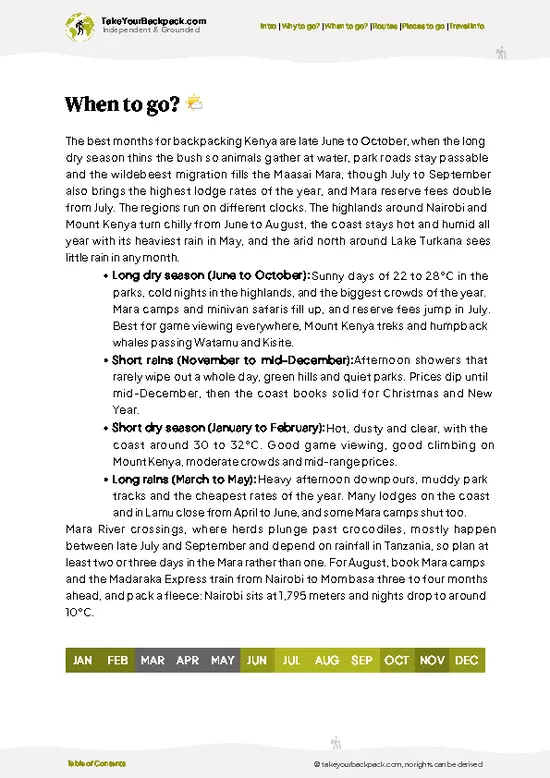
example page 1 from our offline Travel Guide for Kenya
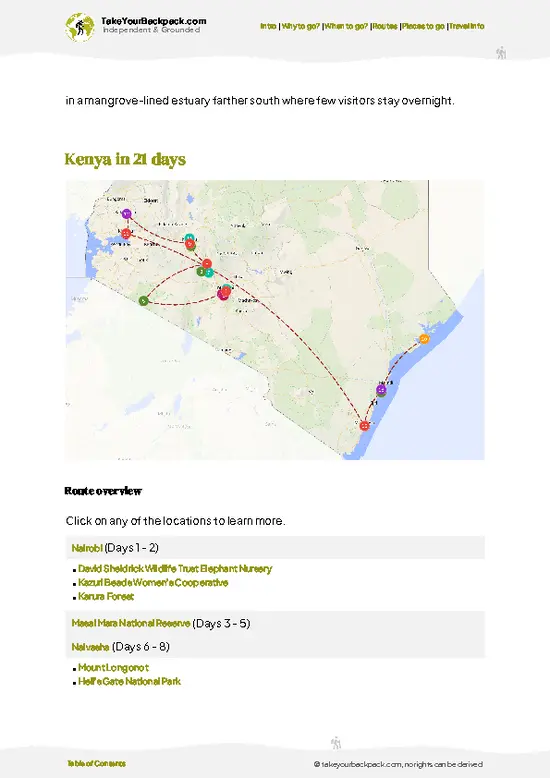
example page 2 from our offline Travel Guide for Kenya
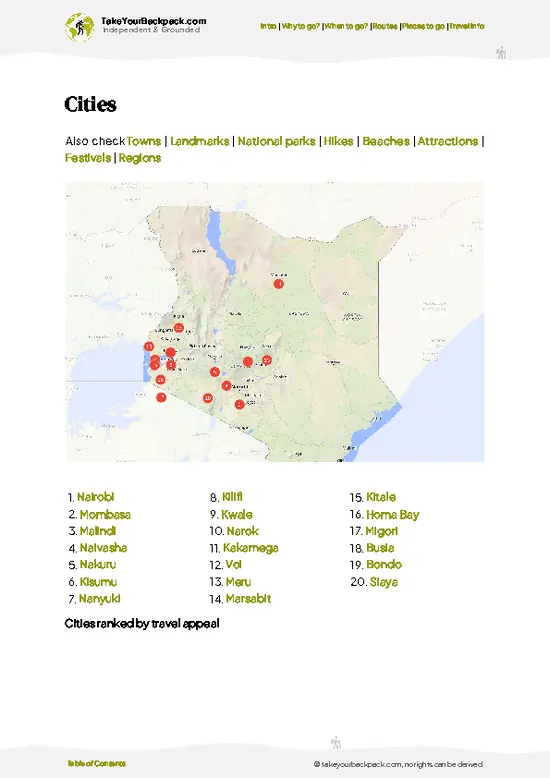
example page 3 from our offline Travel Guide for Kenya
example page 4 from our offline Travel Guide for Kenya
example page 5 from our offline Travel Guide for Kenya
example page 6 from our offline Travel Guide for Kenya
example page 7 from our offline Travel Guide for Kenya
The digital guide (365 pages) contains:
✅ 96 highlights, ranked by travel appeal
✅ Optimized 7, 14 & 21-day travel routes
✅ Cities, national parks, landmarks, beaches
✅ How to get around
✅ Offline-friendly for travel without Wi-Fi
👉 Click to see all 30+ guide features

📅 Plan smarter in minutes, not weeks
✅ Month by month travel advice
✅ Festivals & national holidays
✅ Budget expectations

🗺️ Go to the right places, skip the overrated ones
✅ Honest pros & cons of destinations
✅ Top hikes, parks & viewpoints
✅ Lesser-known places most travelers miss
✅ Clear “worth it vs skip it” guidance

🛏️ Travel smoothly without rookie mistakes
✅ Best areas to stay
✅ Transport systems explained simply
✅ Common scams & safety advice
✅ SIM cards, money & practical tips

🌍 Understand the country, not just visit it
✅ Culture & traditions
✅ 52 Essential phrases & customs
✅ Festivals worth planning around
✅ Traveler-friendly historical context
✅ Insights that make places more meaningful

📱 Built for real travel conditions
✅ Fully downloadable PDF
✅ Works completely offline
✅ Optimized for phone use
✅ Useful in remote areas & buses
✅ Everything in one place
Stop searching, start planning
Get instant access to your full guide. 30‑day money-back guarantee.
+ Add another guide for just

By proceeding you agree to our terms.
Sent to your inbox immediately after payment • 100% Secure Checkout
Best Backpacking Travel Advisor 2025 tourism awardBest Backpacking
Travel Advisor
2025
What others say about Take Your Backpack Guides:
⭐⭐⭐⭐⭐
Fantastic, amazing amount of information!
⭐⭐⭐⭐⭐
My goodness this is amazing, it's what I've been looking for hats off too you!
⭐⭐⭐⭐⭐
I think this is absolutely BRILLIANT
⭐⭐⭐⭐
Very complete and informative. It's still missing places, but I gotta to commend you
⭐⭐⭐⭐⭐
This is truly amazing, thank you, can't wait to explore it with my kids!
⭐⭐⭐⭐⭐
Awesome resource, thank you!
⭐⭐⭐⭐⭐
This is amazing! Can't wait to explore the ones I haven't seen
⭐⭐⭐⭐
I love this! Well done, great idea.
⭐⭐⭐⭐⭐
Thanks for taking the time to make this gem!
⭐⭐⭐⭐⭐
This might be the best website I've ever seen.
⭐⭐⭐⭐⭐
Congratulations, and thank you so much for your work; it's incredibly valuable.
⭐⭐⭐⭐
In all seriousness I think you did a great job pointing out the important spots
⭐⭐⭐⭐⭐
10/10 very good
⭐⭐⭐⭐⭐
As someone who's only just starting to visit regularly this is awesome, thank you.
⭐⭐⭐⭐
Thank you very much! I'm going to visit my dad, it's going to be very useful!
⭐⭐⭐⭐⭐
This is really cool! We'll be travelling for the first time and this definitely come in handy.
⭐⭐⭐⭐⭐
You are now our minister of culture, congratulations 👨‍💼
⭐⭐⭐⭐⭐
Just wanted to tell you that this is a pearl! Going to follow your recommendations.
⭐⭐⭐⭐⭐
This is so cool. I'll definitely be using the resource for my travels soon.
⭐⭐⭐⭐⭐
This is very impressive! Good work.
⭐⭐⭐⭐⭐
This is an amazing and informative site. Very well done!

🛏️ Where to stay?Where to Stay: Kenya Edition

Kenya has a solid spread of hostels, backpacker guesthouses and campsites, with dorm beds typically running KSh 1,500 to 2,500 (about US$12 to 20) and campsites cheaper still. In Nairobi, Westlands has the most nightlife, restaurants and transport links but gets loud on weekends, leafy Kilimani and Kileleshwa are quieter and feel safer to walk at dusk, and Karen and Langata put you close to the national park and giraffe sanctuary at the cost of long, traffic-choked rides into town. The cheap lodgings of the CBD save money but are unpleasant after dark, while on the coast Diani and Lamu Old Town offer the best beach and old-town budget stays, and Naivasha lakeside campsites are the classic low-cost … read more 👉
Kenya has a solid spread of hostels, backpacker guesthouses and campsites, with dorm beds typically running KSh 1,500 to 2,500 (about US$12 to 20) and campsites cheaper still. In Nairobi, Westlands has the most nightlife, restaurants and transport links but gets loud on weekends, leafy Kilimani and Kileleshwa are quieter and feel safer to walk at dusk, and Karen and Langata put you close to the national park and giraffe sanctuary at the cost of long, traffic-choked rides into town. The cheap lodgings of the CBD save money but are unpleasant after dark, while on the coast Diani and Lamu Old Town offer the best beach and old-town budget stays, and Naivasha lakeside campsites are the classic low-cost base in the Rift Valley.

If you enjoy meeting fellow travelers, consider choosing hostels with high ratings for atmosphere. On the other hand, if you prefer having your own space, a hotel might be a better option.

KenyaExplore Beyond This Category

👋 Meet the founderWho’s Behind Take Your Backpack?

Johan, backpacker and founder of TakeYourBackpackHi, I’m Johan (Netherlands 🇳🇱), the creator of TakeYourBackpack. Over the past 3 decades, I’ve backpacked through 90+ countries across six continents, gaining extensive experience with independent travel, long-term trips, and overland routes.

This site is built on a combination of firsthand travel experience and carefully curated insights from other backpackers. Many guides are based on places I’ve personally visited, while others bring together tips, observations, and practical advice shared by trusted travelers I’ve met along the way.

The goal is to provide realistic, experience-driven guidance — not generic itineraries — so you can explore destinations with better context, clearer expectations, and more confidence.