
×

Kiribati🇰🇮 | best townsTop-Rated towns in Kiribati

Towns in Kiribati are strung-out villages more than urban centers: coral roads, coconut shade, tin roofs and the constant hush of surf on one side and lagoon on the other. South Tarawa is crowded, loud with motorbikes and minibuses, and pricier. The outer islands are quiet, slow and hard to reach. Independent travel here rewards flexibility, since flights and boats set the pace.

By Johan Kruseman 🇳🇱 | Updated October 18, 2026
Explore the best villages in Kiribati

Why go?Why These town Stand Out

Kiribati has no towns in the usual sense. Its 33 atolls are thin rings of coral, often under 3 kilometers wide and only a few meters above sea level, so settlement stretches along a single road or lagoon shore. Almost half the population lives on South Tarawa, where density is high, while the outer islands run on fishing, copra and village meeting houses called maneaba. That split defines everything.

Before choosing Kiribati for its towns, know that infrastructure is basic. Fresh water is scarce, power and internet can be patchy, and food is mostly fish, rice, coconut and imported tins. Flights are infrequent and often delayed, and the sun is fierce on bare coral. Expect sandy lanes, the smell of drying fish and warm, welcoming locals instead of sights and nightlife.
Evaluating the Top Choices
The list of best towns in Kiribati is created based on charm, local culture, atmosphere, hidden gems, and visitor appeal. If you feel a town is missing in this list, please let us know.

When to go?Timing Your Visit for the Best Experience

Best months: The best months are May to October, when the trade winds are steadier, humidity eases slightly and rain is lighter. Daytime temperatures sit near 28 to 32°C all year, so the season changes comfort more than heat. Evenings bring a welcome breeze off the lagoon.
Wetter months: November to April is the wetter season, especially in the southern Gilberts, with heavy squalls, muggy nights and occasional king tides that flood low roads. Rainfall in the north near the equator can be unpredictable, and some years bring drought instead. Flights and boats are more likely to slip during stormy spells.
Crowds and prices: There is no true peak season, and tourist numbers stay tiny. Prices change little by month, though around Christmas and New Year local travel surges and seats fill quickly. Book flights early then.

town hoppingOptimizing Your Multi-Stop Itinerary

Time needed: A trip combining several towns in Kiribati needs 10 to 14 days, because inter-island flights are scarce and delays are normal. Cluster by distance: South Tarawa is the hub and arrival point, and most outer islands are reached from there. Work outward from Tarawa, then return for your international departure.
Pacing: Plan 2 to 4 days per stop. Flights from Tarawa to nearby Gilbert islands take roughly 45 minutes to 2 hours, and far northern or southern islands can take longer. Cargo boats take days and run irregularly.
Mistakes to avoid: Travelers often pack in too many islands, then lose days to cancelled flights. Leave a 2 to 3 day buffer before any international flight. Do not book fixed accommodation without confirming flights first, and carry cash, since outer islands have few banks or ATMs.

The ListMust-Visit towns in Kiribati

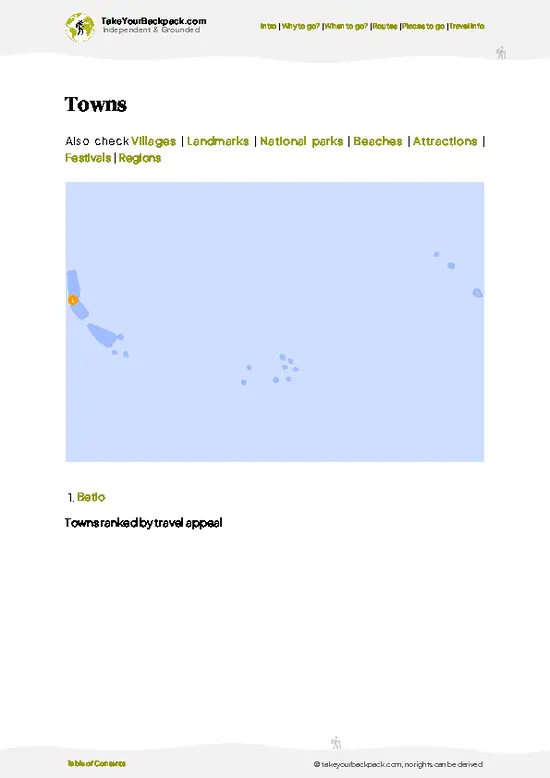
1 Betio

1943 bunkers, rusting guns, Red Beach, port crowds

Walk between houses to find Japanese bunkers, shore guns and tank wrecks, then watch tuna come in at the harbor fish market.

Loading the map 🌍

Expert viewInsights from Locals and Experts

How many towns: I would advise two to three places, with at most one on the outer islands. Flights are infrequent, delays eat days, and slow island time is the point. Staying longer in fewer places gives you the lagoon light at dawn, the sound of te kaintiku drums and conversations that never happen when rushing.
Which kind: Choose South Tarawa for services, food variety, WWII history and easier logistics. Choose an outer island for quiet, village stays and fishing, but expect basic rooms, rationed water and little choice at the table, which is usually fresh fish, rice and breadfruit.
What it costs: Budget about A$60 to 120 (US$40 to 80) a day on South Tarawa, using the Australian dollar that Kiribati uses. Guesthouses run around A$50 to 100 a night, and local meals are A$5 to 12. Outer islands … read more 👉
How many towns: I would advise two to three places, with at most one on the outer islands. Flights are infrequent, delays eat days, and slow island time is the point. Staying longer in fewer places gives you the lagoon light at dawn, the sound of te kaintiku drums and conversations that never happen when rushing.
Which kind: Choose South Tarawa for services, food variety, WWII history and easier logistics. Choose an outer island for quiet, village stays and fishing, but expect basic rooms, rationed water and little choice at the table, which is usually fresh fish, rice and breadfruit.
What it costs: Budget about A$60 to 120 (US$40 to 80) a day on South Tarawa, using the Australian dollar that Kiribati uses. Guesthouses run around A$50 to 100 a night, and local meals are A$5 to 12. Outer islands can be a little cheaper per night but add flights of roughly A$100 to 250 each way. Guides, motorbike rides or boat charters usually cost A$20 to 80 per outing, and fuel makes boats pricey.
Safety and culture: Crime is low, but dress modestly: shoulders and knees covered, and swimwear only at the beach. Ask before photographing people and before entering a maneaba, where you sit on the mat and avoid standing over elders. Alcohol is restricted on some islands. Drink only boiled or bottled water, use strong sun protection, and avoid swimming in the polluted lagoon waters near crowded South Tarawa villages. At night, watch for stray dogs and unlit roads.

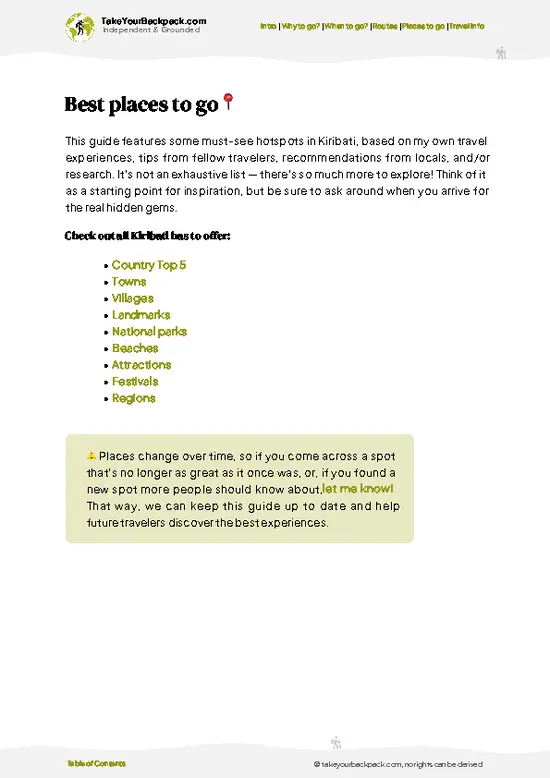
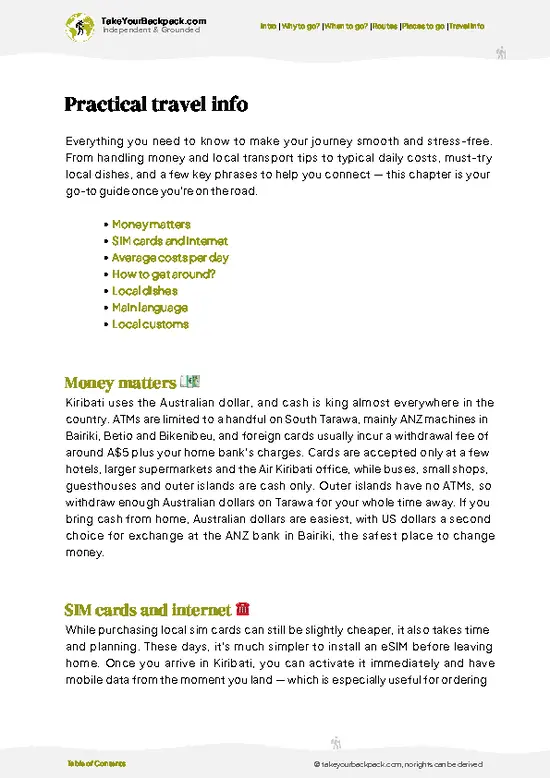
✈️ The backpacker research shortcutKiribati Travel Guide

What the free pages can't give you: ready-made routes, every place ranked, and it works offline. All in 1 guide.
example page 0 from our offline Travel Guide for Kiribati
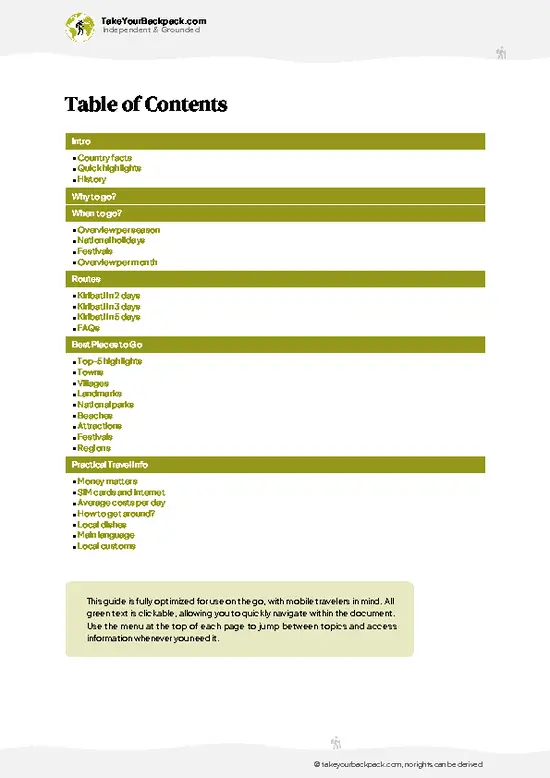
example page 1 from our offline Travel Guide for Kiribati
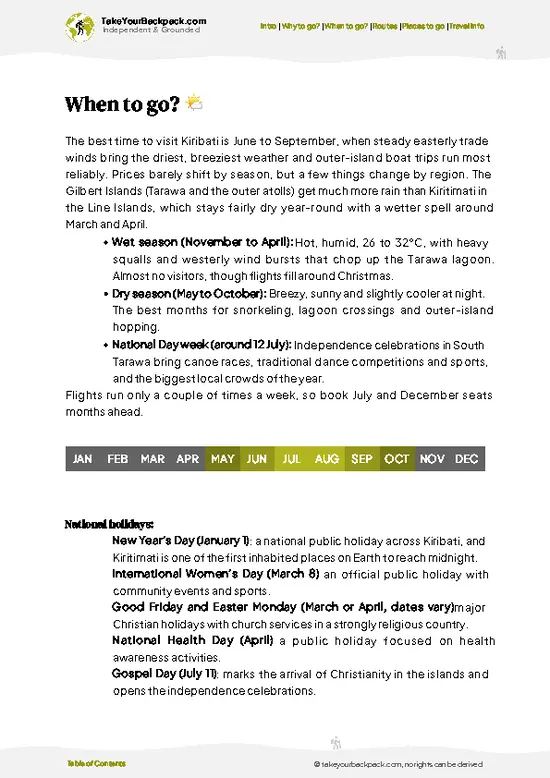
example page 2 from our offline Travel Guide for Kiribati
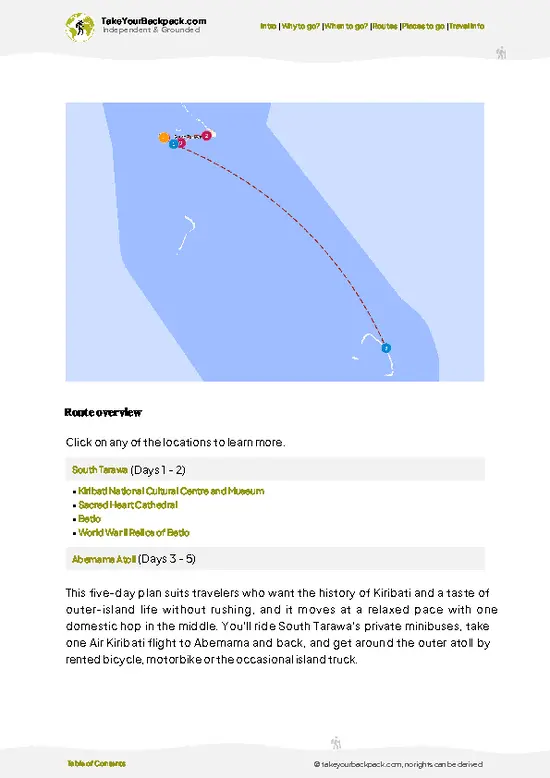
example page 3 from our offline Travel Guide for Kiribati
example page 4 from our offline Travel Guide for Kiribati
example page 5 from our offline Travel Guide for Kiribati
example page 6 from our offline Travel Guide for Kiribati
example page 7 from our offline Travel Guide for Kiribati
The digital guide (120 pages) contains:-page digital guide:
✅ Ready-made 2, 3 & 5-day routes
✅ All 25 places ranked, so you skip the overrated ones
✅ Works offline, all in 1 guide
✅ Cities, national parks, landmarks, beaches
✅ How to get around
👉 Click to see all 30+ guide features

📅 Plan smarter in minutes, not weeks
✅ Month by month travel advice
✅ Festivals & national holidays
✅ Budget expectations

🗺️ Go to the right places, skip the overrated ones
✅ Honest pros & cons of destinations
✅ Top hikes, parks & viewpoints
✅ Lesser-known places most travelers miss
✅ Clear “worth it vs skip it” guidance

🛏️ Travel smoothly without rookie mistakes
✅ Best areas to stay
✅ Transport systems explained simply
✅ Common scams & safety advice
✅ SIM cards, money & practical tips

🌍 Understand the country, not just visit it
✅ Culture & traditions
✅ 52 Essential phrases & customs
✅ Festivals worth planning around
✅ Traveler-friendly historical context
✅ Insights that make places more meaningful

📱 Built for real travel conditions
✅ Fully downloadable PDF
✅ Works completely offline
✅ Optimized for phone use
✅ Useful in remote areas & buses
✅ All in 1 guide
Stop searching, start planning
Get instant access to your full guide. 30‑day money-back guarantee.


By proceeding you agree to our terms.
Sent to your inbox immediately after payment • 100% Secure Checkout
Best Backpacking Travel Advisor 2025 tourism awardBest Backpacking
Travel Advisor
2025
What others say about Take Your Backpack Guides:
⭐⭐⭐⭐⭐
Fantastic, amazing amount of information!
⭐⭐⭐⭐⭐
My goodness this is amazing, it's what I've been looking for hats off too you!
⭐⭐⭐⭐⭐
I think this is absolutely BRILLIANT
⭐⭐⭐⭐
Very complete and informative. It's still missing places, but I gotta to commend you
⭐⭐⭐⭐⭐
This is truly amazing, thank you, can't wait to explore it with my kids!
⭐⭐⭐⭐⭐
Awesome resource, thank you!
⭐⭐⭐⭐⭐
This is amazing! Can't wait to explore the ones I haven't seen
⭐⭐⭐⭐
I love this! Well done, great idea.
⭐⭐⭐⭐⭐
Thanks for taking the time to make this gem!
⭐⭐⭐⭐⭐
This might be the best website I've ever seen.
⭐⭐⭐⭐⭐
Congratulations, and thank you so much for your work; it's incredibly valuable.
⭐⭐⭐⭐
In all seriousness I think you did a great job pointing out the important spots
⭐⭐⭐⭐⭐
10/10 very good
⭐⭐⭐⭐⭐
As someone who's only just starting to visit regularly this is awesome, thank you.
⭐⭐⭐⭐
Thank you very much! I'm going to visit my dad, it's going to be very useful!
⭐⭐⭐⭐⭐
This is really cool! We'll be travelling for the first time and this definitely come in handy.
⭐⭐⭐⭐⭐
You are now our minister of culture, congratulations 👨‍💼
⭐⭐⭐⭐⭐
Just wanted to tell you that this is a pearl! Going to follow your recommendations.
⭐⭐⭐⭐⭐
This is so cool. I'll definitely be using the resource for my travels soon.
⭐⭐⭐⭐⭐
This is very impressive! Good work.
⭐⭐⭐⭐⭐
This is an amazing and informative site. Very well done!

🛏️ Where to stay?Top Areas to Stay

Kiribati has no backpacker hostels in the dorm-bed sense, so budget travel here means simple guesthouses, family-run lodges and motels, typically AU$80 to 150 (about US$55 to 100) a night for a private room with a fan or air-con. On South Tarawa, Bairiki and nearby Teaoraereke put you closest to government offices, banks and the causeway minibuses, while Betio sits beside the WWII battle sites but is crowded and noisier. Bikenibeu and Bonriki in the east are quieter, with lagoon views and easy airport access, at the cost of a 40-minute minibus ride to the main sights.

If you enjoy meeting fellow travelers, consider choosing hostels with high ratings for atmosphere. On the other hand, if you prefer … read more 👉
Kiribati has no backpacker hostels in the dorm-bed sense, so budget travel here means simple guesthouses, family-run lodges and motels, typically AU$80 to 150 (about US$55 to 100) a night for a private room with a fan or air-con. On South Tarawa, Bairiki and nearby Teaoraereke put you closest to government offices, banks and the causeway minibuses, while Betio sits beside the WWII battle sites but is crowded and noisier. Bikenibeu and Bonriki in the east are quieter, with lagoon views and easy airport access, at the cost of a 40-minute minibus ride to the main sights.

If you enjoy meeting fellow travelers, consider choosing hostels with high ratings for atmosphere. On the other hand, if you prefer having your own space, a hotel might be a better option.

KiribatiDiscover the Country

👋 Meet the founderWho’s Behind Take Your Backpack?

Johan, backpacker and founder of TakeYourBackpackHi, I’m Johan (Netherlands 🇳🇱), the creator of TakeYourBackpack. Over the past 30 years, I’ve backpacked through 88 countries across six continents, gaining extensive experience with independent travel, long-term trips, and overland routes.

This site is built on a combination of firsthand travel experience and carefully curated insights from other backpackers. Many guides are based on places I’ve personally visited, while others bring together tips, observations, and practical advice shared by trusted travelers I’ve met along the way.

The goal is to provide realistic, experience-driven guidance — not generic itineraries — so you can explore destinations with better context, clearer expectations, and more confidence.