×

Kiribati🇰🇮 | regionsMakinMakin maneaba, sailing canoes, lagoon snorkeling, pandanus weaving | things to do and best time to go

Explore Kiritimati IslandExplore Tarawa Atoll

Backpacking in Makin
👀 For curious travelersregion ranked #7
By Johan Kruseman 🇳🇱 | Updated October 15, 2026

Coconut-frond shade, a pandanus-scented breeze, and the thump of a pig-cart wheel on coral gravel: that is a morning in Makin village. This is Makin Atoll, in the north of Kiribati, the northernmost of the Gilbert Islands, a small group of green islets just northeast of Butaritari. It is quiet, intensely local and almost untouched by visitors. Expect few sights in the usual sense, but real village life, maneaba meetings, fishing canoes and clear water. The hard parts are part of it: simple food, no nightlife, patchy power and flights that slip. Flights from Tarawa run infrequently, so the smarter move is to book a return with slack built in, because schedules shift and a cancelled seat can strand you. Bring cash, since nothing out here takes cards, and arrange a homestay through a local contact.

Discover everything you want to know in the 📖 Kiribati Travel Guide.


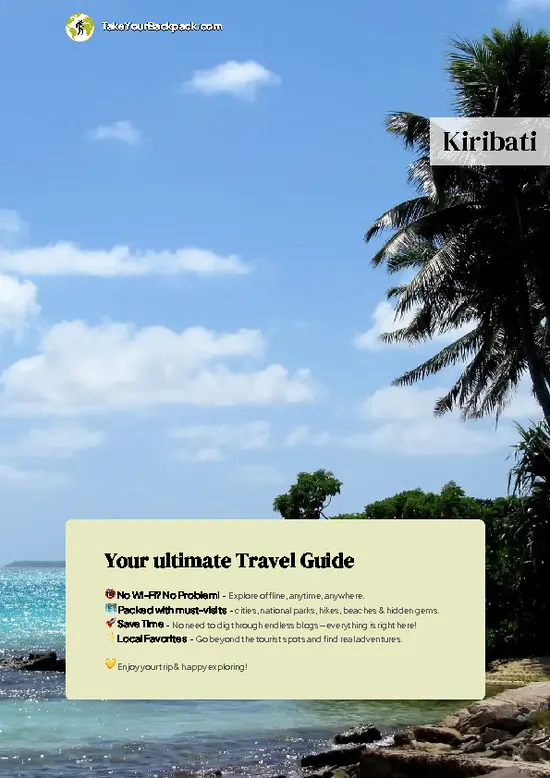
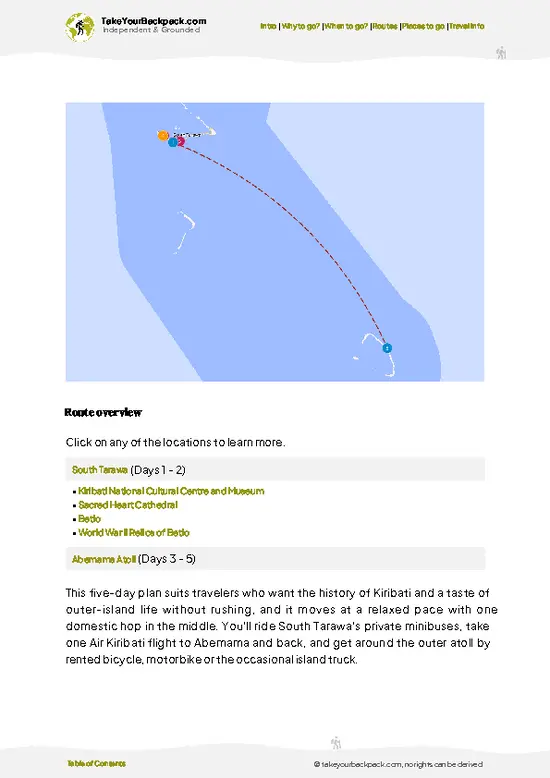
example page 0 from our offline Travel Guide for Kiribati
example page 1 from our offline Travel Guide for Kiribati
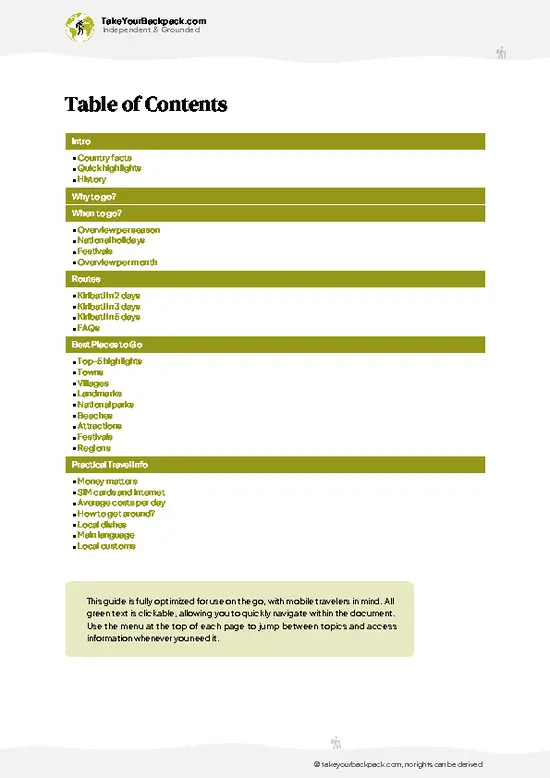
example page 2 from our offline Travel Guide for Kiribati
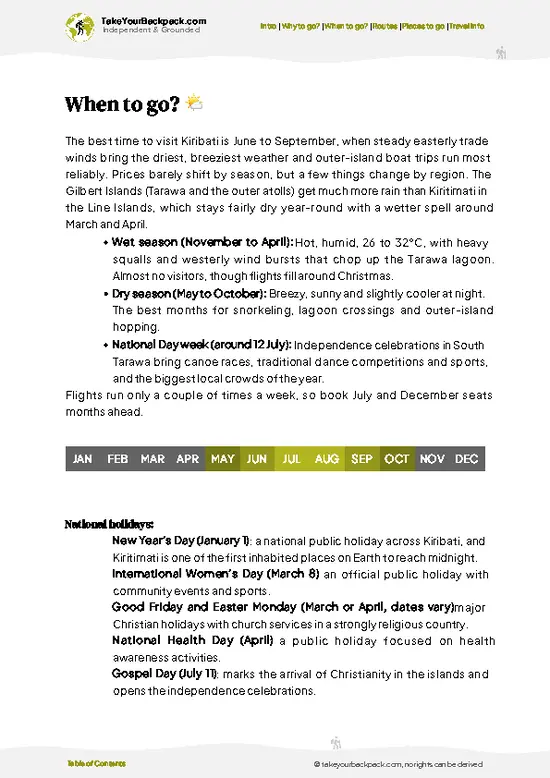
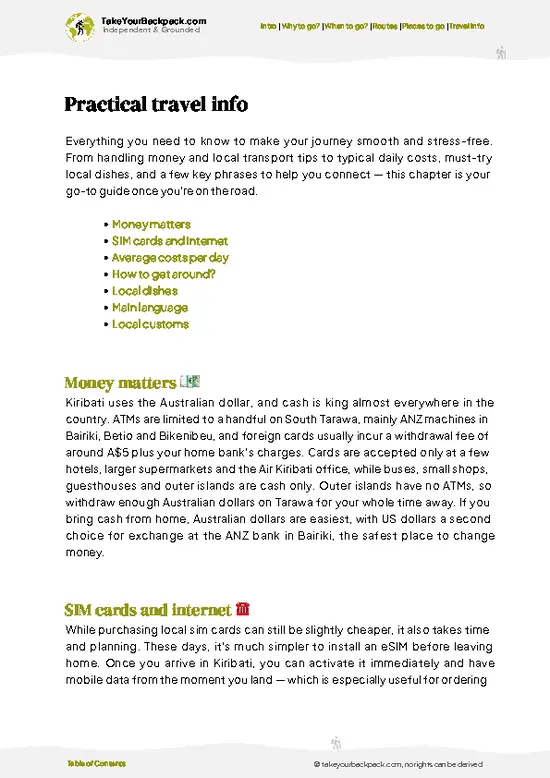
example page 3 from our offline Travel Guide for Kiribati
example page 4 from our offline Travel Guide for Kiribati
example page 5 from our offline Travel Guide for Kiribati
example page 6 from our offline Travel Guide for Kiribati
example page 7 from our offline Travel Guide for Kiribati
Loading the map 🌍
CLICK TO FILTER
towns
villages
landmarks
national parks
beaches
attractions
festivals
regions
SHOW COUNTRY’S BESTSHOW ALL

✨ Why go?
Ranked #7 region in Kiribati
Reasons people choose to visit here

Makin rewards people who want to sit in a place long enough to be noticed. The first reason is the pace: with only a few villages, you meet the same maneaba meeting house hosts, fishermen and children on repeat, and invitations follow. Nothing here is staged for tourists, so you eat what the family catches and join what is happening. The second is the water. The shallow water inside the reef is calm and clear enough for snorkeling and paddling a canoe without a guide shouting schedules. Third, the atoll is small enough that you can walk or cycle between settlements on the main islets, so you rarely need transport once you arrive. Because the flights from Tarawa are so limited, the trip forces slow travel, and you stop trying to collect sights. That suits anyone tired of ticking boxes.

💡 HighlightsTop highlights of Makin

  1. Makin Village and its Maneaba: the main community, where a large open-sided meeting house still hosts discussions, dances and welcomes. Ask permission before entering.
  2. Lagoon Snorkeling: calm, shallow, clear water with coral patches and reef fish, best on a rising tide.
  3. Traditional Sailing Canoes: local fishermen still use outrigger canoes, and a ride or a look at the building is possible through your host.
  4. Toddy Cutting at Dawn: watch men climb coconut palms to collect sap, a daily routine that sustains households.
  5. Causeway Edges and Lagoon Shores: wading flats where you can see rays and herons at low tide.
  6. Village Church Services: Sunday singing in harmony is loud, warm and moving, and visitors are welcome if modestly dressed.
  7. Coastal Walk on the Ocean Side: wave-pounded coral rock, driftwood
… read more 👉
  1. Makin Village and its Maneaba: the main community, where a large open-sided meeting house still hosts discussions, dances and welcomes. Ask permission before entering.
  2. Lagoon Snorkeling: calm, shallow, clear water with coral patches and reef fish, best on a rising tide.
  3. Traditional Sailing Canoes: local fishermen still use outrigger canoes, and a ride or a look at the building is possible through your host.
  4. Toddy Cutting at Dawn: watch men climb coconut palms to collect sap, a daily routine that sustains households.
  5. Causeway Edges and Lagoon Shores: wading flats where you can see rays and herons at low tide.
  6. Village Church Services: Sunday singing in harmony is loud, warm and moving, and visitors are welcome if modestly dressed.
  7. Coastal Walk on the Ocean Side: wave-pounded coral rock, driftwood and quiet beaches, far from any crowd.
  8. Pandanus Weaving Sessions: women weave mats and baskets from leaves, and many will show you the process.
  9. Fishing Weirs and Reef Flats: learn how locals trap fish with stone and net arrangements at low water.
  10. Sunset at the Lagoon Jetty: the light turns copper, children swim off the end, and it is the best free evening show.
For a first visit, the maneaba in Makin village is the one to prioritize, because it explains everything else.
Spotted a mistake or missing something? Contact us.

⌛️ 5 daysHow to make the most of Makin

Day 1: Makin Village: Fly in from Tarawa, since the limited schedule sets the pace of everything, and settle into your homestay. Walk the village in the late afternoon, ask your host to introduce you at the maneaba, and let people come to you. Nothing here runs by timetable, so the first evening is for orientation and small gifts of rice or sugar for the household.
Day 2: Lagoon and Reef Flats: Go out at low tide with a local guide to see the fishing weirs and reef flats, then snorkel the lagoon when the water rises. Morning is calmer, so use it for the water and keep the afternoon for rest in the shade.
Day 3: Toddy and Weaving: Start before sunrise with the toddy cutters, then spend the day with weavers and cooks. This is the cultural core, and it works because your host arranges everything … read more 👉
Day 1: Makin Village: Fly in from Tarawa, since the limited schedule sets the pace of everything, and settle into your homestay. Walk the village in the late afternoon, ask your host to introduce you at the maneaba, and let people come to you. Nothing here runs by timetable, so the first evening is for orientation and small gifts of rice or sugar for the household.
Day 2: Lagoon and Reef Flats: Go out at low tide with a local guide to see the fishing weirs and reef flats, then snorkel the lagoon when the water rises. Morning is calmer, so use it for the water and keep the afternoon for rest in the shade.
Day 3: Toddy and Weaving: Start before sunrise with the toddy cutters, then spend the day with weavers and cooks. This is the cultural core, and it works because your host arranges everything by word of mouth.
Day 4: Ocean Side Detour: Take a long walk or bike ride to the ocean coast for wild surf, empty beaches and driftwood. It adds scale without needing a boat, and you can be back by dusk.
Day 5: Departure Buffer: Keep this day light, confirm the flight with the airline and your host, and say your goodbyes. Flights can shift, so no plans should depend on them.
If you only get one day to justify the trip, make it Day 3.

🌤️ When to go?Best time to visit Makin

  • Drier months (roughly May to October): Northeast trade winds ease the humidity a little, with highs of 29 to 31°C (84 to 88°F) and nights around 26°C (79°F). Seas are calmer for lagoon boat trips and fishing outings.
  • Wetter months (roughly November to April): Squalls roll in off the Pacific, rainfall climbs, and the air turns thick. Temperatures barely move, but the wind can shift and make small-boat crossings rougher.
  • Daylight: Sunrise falls between about 6:10 and 6:45 a.m. and sunset between about 6:10 and 6:45 p.m. all year, so plan travel and village walks around a fixed 12-hour day.
  • Crowds and prices: Visitors are rare in any month. Prices for homestays and food stay flat, but boat and flight seats tighten around Christmas and local holidays such as Independence Day on July 12.
Book the Tarawa … read more 👉
  • Drier months (roughly May to October): Northeast trade winds ease the humidity a little, with highs of 29 to 31°C (84 to 88°F) and nights around 26°C (79°F). Seas are calmer for lagoon boat trips and fishing outings.
  • Wetter months (roughly November to April): Squalls roll in off the Pacific, rainfall climbs, and the air turns thick. Temperatures barely move, but the wind can shift and make small-boat crossings rougher.
  • Daylight: Sunrise falls between about 6:10 and 6:45 a.m. and sunset between about 6:10 and 6:45 p.m. all year, so plan travel and village walks around a fixed 12-hour day.
  • Crowds and prices: Visitors are rare in any month. Prices for homestays and food stay flat, but boat and flight seats tighten around Christmas and local holidays such as Independence Day on July 12.
Book the Tarawa flight with a few days of slack, since schedules shift with weather and plane availability.


source: climatestotravel.comJANJanuary: fair for travelingFEBFebruary: fair for travelingMARMarch: fair for travelingAPRApril: highly recommended for travelingMAYMay: excellent for travelingJUNJune: highly recommended for travelingJULJuly: highly recommended for travelingAUGAugust: highly recommended for travelingSEPSeptember: excellent for travelingOCTOctober: highly recommended for travelingNOVNovember: fair for travelingDECDecember: fair for traveling
when-to-go

✈️ The backpacker research shortcutKiribati Travel Guide

An offline-friendly backpacking guide with optimized travel routes, ranked highlights, transport advice, and the best areas to stay.
example page 0 from our offline Travel Guide for Kiribati
example page 1 from our offline Travel Guide for Kiribati
example page 2 from our offline Travel Guide for Kiribati
example page 3 from our offline Travel Guide for Kiribati
example page 4 from our offline Travel Guide for Kiribati
example page 5 from our offline Travel Guide for Kiribati
example page 6 from our offline Travel Guide for Kiribati
example page 7 from our offline Travel Guide for Kiribati
The digital guide (120 pages) contains:
✅ 25 highlights, ranked by travel appeal
✅ Optimized 2, 3 & 5-day travel routes
✅ Cities, national parks, landmarks, beaches
✅ How to get around
✅ Offline-friendly for travel without Wi-Fi
👉 Click to see all 30+ guide features

📅 Plan smarter in minutes, not weeks
✅ Month by month travel advice
✅ Festivals & national holidays
✅ Budget expectations

🗺️ Go to the right places, skip the overrated ones
✅ Honest pros & cons of destinations
✅ Top hikes, parks & viewpoints
✅ Lesser-known places most travelers miss
✅ Clear “worth it vs skip it” guidance

🛏️ Travel smoothly without rookie mistakes
✅ Best areas to stay
✅ Transport systems explained simply
✅ Common scams & safety advice
✅ SIM cards, money & practical tips

🌍 Understand the country, not just visit it
✅ Culture & traditions
✅ 52 Essential phrases & customs
✅ Festivals worth planning around
✅ Traveler-friendly historical context
✅ Insights that make places more meaningful

📱 Built for real travel conditions
✅ Fully downloadable PDF
✅ Works completely offline
✅ Optimized for phone use
✅ Useful in remote areas & buses
✅ Everything in one place
Stop searching, start planning
Get instant access to your full guide. 30‑day money-back guarantee.
+ Add another guide for just

By proceeding you agree to our terms.
Sent to your inbox immediately after payment • 100% Secure Checkout
Best Backpacking Travel Advisor 2025 tourism awardBest Backpacking
Travel Advisor
2025
What others say about Take Your Backpack Guides:
⭐⭐⭐⭐⭐
Fantastic, amazing amount of information!
⭐⭐⭐⭐⭐
My goodness this is amazing, it's what I've been looking for hats off too you!
⭐⭐⭐⭐⭐
I think this is absolutely BRILLIANT
⭐⭐⭐⭐
Very complete and informative. It's still missing places, but I gotta to commend you
⭐⭐⭐⭐⭐
This is truly amazing, thank you, can't wait to explore it with my kids!
⭐⭐⭐⭐⭐
Awesome resource, thank you!
⭐⭐⭐⭐⭐
This is amazing! Can't wait to explore the ones I haven't seen
⭐⭐⭐⭐
I love this! Well done, great idea.
⭐⭐⭐⭐⭐
Thanks for taking the time to make this gem!
⭐⭐⭐⭐⭐
This might be the best website I've ever seen.
⭐⭐⭐⭐⭐
Congratulations, and thank you so much for your work; it's incredibly valuable.
⭐⭐⭐⭐
In all seriousness I think you did a great job pointing out the important spots
⭐⭐⭐⭐⭐
10/10 very good
⭐⭐⭐⭐⭐
As someone who's only just starting to visit regularly this is awesome, thank you.
⭐⭐⭐⭐
Thank you very much! I'm going to visit my dad, it's going to be very useful!
⭐⭐⭐⭐⭐
This is really cool! We'll be travelling for the first time and this definitely come in handy.
⭐⭐⭐⭐⭐
You are now our minister of culture, congratulations 👨‍💼
⭐⭐⭐⭐⭐
Just wanted to tell you that this is a pearl! Going to follow your recommendations.
⭐⭐⭐⭐⭐
This is so cool. I'll definitely be using the resource for my travels soon.
⭐⭐⭐⭐⭐
This is very impressive! Good work.
⭐⭐⭐⭐⭐
This is an amazing and informative site. Very well done!

🛏️ Where to stay?Choosing the right base

Makin Village, near the main landing and the airstrip, is the easiest place to settle. Stays here are mostly family-run guesthouses and homestays at roughly A$30 to 70 a night, often including meals.
The appeal is simple: you eat with a family, and learn the island’s rhythms quickly. It is safe and relaxed, and a solo traveler will be noticed and greeted by name within a day.
Staying near the main road keeps the shop, the church, the dock and the airstrip within a short walk or bike ride. Villages farther along the island are quieter, with fewer services, so they suit people who want to sleep to … read more 👉
Makin Village, near the main landing and the airstrip, is the easiest place to settle. Stays here are mostly family-run guesthouses and homestays at roughly A$30 to 70 a night, often including meals.
The appeal is simple: you eat with a family, and learn the island’s rhythms quickly. It is safe and relaxed, and a solo traveler will be noticed and greeted by name within a day.
Staying near the main road keeps the shop, the church, the dock and the airstrip within a short walk or bike ride. Villages farther along the island are quieter, with fewer services, so they suit people who want to sleep to the sound of waves and do not mind arranging a ride.
Social backpacker scenes do not exist here. Your company will be hosts, fishermen and the occasional researcher or volunteer, and that is the draw.

🚌 Getting aroundGetting around like a local

A ride on a shared local truck or minibus costs roughly A$1 to 2 (about US$0.70 to 1.30), paid in cash to the driver when you get off. Makin’s main islet is small, and nearly everything happens along one sandy road with the lagoon on one side and the ocean on the other. Cash is the only currency that works, so carry small Australian dollar notes, since drivers rarely have change.
  • Flights from Tarawa: Air Kiribati serves Makin with small planes, usually twice a week, for around A$250 to 400 one way. Schedules are set by weather and aircraft, which is why experienced travelers book a return with several spare days and confirm in Bairiki a day before.
  • Pickup trucks and minibuses: Few vehicles run, and they follow no printed timetable, so you flag one down on the coral road and listen for the engine
… read more 👉
A ride on a shared local truck or minibus costs roughly A$1 to 2 (about US$0.70 to 1.30), paid in cash to the driver when you get off. Makin’s main islet is small, and nearly everything happens along one sandy road with the lagoon on one side and the ocean on the other. Cash is the only currency that works, so carry small Australian dollar notes, since drivers rarely have change.
  • Flights from Tarawa: Air Kiribati serves Makin with small planes, usually twice a week, for around A$250 to 400 one way. Schedules are set by weather and aircraft, which is why experienced travelers book a return with several spare days and confirm in Bairiki a day before.
  • Pickup trucks and minibuses: Few vehicles run, and they follow no printed timetable, so you flag one down on the coral road and listen for the engine over the surf. Ask your host to arrange the driver the evening before, which beats waiting in the heat.
  • Bicycles and walking: The road is flat, shaded by coconut and pandanus, and the sand is cool underfoot in early morning. Borrow a bike from your homestay for about A$5 to 10 a day and ride before 9 a.m., since by noon the sun hammers the open stretches.
  • Motorboats and canoes: Boats cross the lagoon to other islets and villages, with fuel the main cost, often A$20 to 60 per trip. Agree the price and return time first, because the smell of petrol and spray tells you little about how long the crossing will take.
Carry water, a hat and a dry bag, and ask your host to phone ahead for any transport, since village talk moves faster than any schedule.

🍲 FoodEating & Drinking in Makin

Eat fresh fish first: tuna, wahoo and reef fish, grilled over coconut husk or served raw in coconut cream with lime. The smoky char and sweet milk taste of the island itself. Staple sides are breadfruit, pandanus in sweet, sticky preserves, and rice, with crab and lobster turning up when the catch is good.
For drinks, toddy is the island classic, tapped from coconut flowers. Fresh, it is sweet and cloudy, and a day later it turns sour and fizzy. Green coconuts cost little and quench better than anything bottled.
Meals mostly happen at your homestay, where the family cooks on an open fire and sets food down on a mat. Small village shops sell tinned fish, noodles, biscuits and bread, so stock up in Makin Village and carry snacks along.
Wash your hands first, eat with your right hand when sharing, … read more 👉
Eat fresh fish first: tuna, wahoo and reef fish, grilled over coconut husk or served raw in coconut cream with lime. The smoky char and sweet milk taste of the island itself. Staple sides are breadfruit, pandanus in sweet, sticky preserves, and rice, with crab and lobster turning up when the catch is good.
For drinks, toddy is the island classic, tapped from coconut flowers. Fresh, it is sweet and cloudy, and a day later it turns sour and fizzy. Green coconuts cost little and quench better than anything bottled.
Meals mostly happen at your homestay, where the family cooks on an open fire and sets food down on a mat. Small village shops sell tinned fish, noodles, biscuits and bread, so stock up in Makin Village and carry snacks along.
Wash your hands first, eat with your right hand when sharing, and accept what is offered. Refusing a plate can sting, and finishing it is polite. Bring any special dietary needs up in advance, since there are no restaurants to fall back on.

FAQTraveler FAQ

Three to five days is enough for Makin Atoll, and the flight schedule from Tarawa often decides the length. Allow one day for the village road by bike, one for a lagoon boat trip or fishing outing, and a spare day in case the plane is delayed. A homestay with meals runs around A$30 to 70 a night.
Without a car, you get around by bicycle, on foot, or by flagging down a shared truck, which costs roughly A$1 to 2 per ride. The main road is short, flat and shaded in places. For lagoon crossings, ask your host to arrange a motorboat, usually A$20 to 60 depending on fuel and distance.
Makin is the northernmost island group of the Gilberts, just northeast of Butaritari, with coconut groves and taro pits. Its name is tied to the 1942 Makin Raid and the 1943 Battle of Makin, although both were fought on neighboring Butaritari. Visitors come for traditional village life, fishing, toddy and homestays, with few other travelers around.
⚠️ Things can change over time, so always validate details locally before you go.

Other I-Kiribati regions near Makin

Explore more nearby:

  • Butaritari—Makin Raid markers, Japanese bunkers, taro pits, canoe crossings| 35 km away
  • Marakei—Enclosed lagoon, fish weirs, coast-road cycling, homestays| 156 km away
  • Abaiang—Wade-in landings, lagoon sandbars, village homestays, Sunday hymns| 171 km away

💡 Not sure where to go next?
Create a personalized itinerary for Kiribati including Makin and the places that fit your trip.

Generate my itinerary

👉 Discover all regions

Or checkout all Kiribati has to offer (think cities, towns, villages, national parks, hikes, beaches, festivals)
Country photo of Kiribati

We 💚 feedbackKey takeaways before you go

Stay at least five days, and add a spare one for flight changes. Two or three nights would only get you through the introductions. I would bring small gifts for your host family, a good book and patience, because the best moments come when nothing is scheduled and someone invites you to sit down.

✍️ Help improve this page!
The information on this page is based on in-depth research, insights shared by experienced travelers, and feedback from the local travel community in Kiribati. While every effort is made to keep the information accurate and current, conditions can change — so if you spot anything incorrect or outdated, please get in touch.


🙋‍♂️ Give feedback

👋 Meet the founderWho’s Behind Take Your Backpack?

Johan, backpacker and founder of TakeYourBackpackHi, I’m Johan (Netherlands 🇳🇱), the creator of TakeYourBackpack. Over the past 3 decades, I’ve backpacked through 90+ countries across six continents, gaining extensive experience with independent travel, long-term trips, and overland routes.

This site is built on a combination of firsthand travel experience and carefully curated insights from other backpackers. Many guides are based on places I’ve personally visited, while others bring together tips, observations, and practical advice shared by trusted travelers I’ve met along the way.

The goal is to provide realistic, experience-driven guidance — not generic itineraries — so you can explore destinations with better context, clearer expectations, and more confidence.