Short version: yes, Kyrgyzstan is one of the easiest Central Asian countries to backpack independently, as long as you’re comfortable with a bit of chaos and problem‑solving.
Why it’s easy:
- Visa: Many nationalities get visa‑free entry for 30–60 days, which removes a huge headache.
- Costs: Dorm beds, homestays, and shared taxis are cheap, so you can stretch your budget without living on instant noodles.
- Trekking culture: Popular routes around Karakol, Jyrgalan, and Ala‑Archa are well‑trodden, with guesthouses, CBT offices (Community Based Tourism), and locals used to hikers.
- Safety: Street crime against travelers is relatively low; the bigger risks are weather, altitude, and bad roads, not people.
Where it gets tricky:
- Language: Outside Bishkek and Osh, English drops off fast. Russian is the main travel language; Kyrgyz in villages. Offline translators and a few key phrases go a long way.
- Transport: There’s no nationwide rail network and flights are limited. You’ll rely on marshrutkas (minibuses), shared taxis, and the occasional hitchhike.
- Info gaps: Trail markings can be vague, and bus schedules are more “tradition” than “timetable.” You solve this by asking locals, other travelers, and CBT offices.
Backpacker‑friendly tips:
- Use CBT and similar local networks for homestays, yurt stays, and trekking logistics; they bridge the language and planning gap.
- Download offline maps (Maps.me, Organic Maps) and offline translation before you land.
- Travel with flexible plans; assume delays, weather changes, and last‑minute route tweaks.
If you’ve handled places like Georgia, Nepal, or rural Balkans, Kyrgyzstan will feel very doable. If it’s your first “off‑grid” country, it’s still manageable, just build in extra time and patience.
For a budget backpacker, the sweet spot is 2–3 weeks, but you can do something meaningful in as little as 7–10 days.
Rough time guidelines:
- 7–10 days (fast but solid intro):
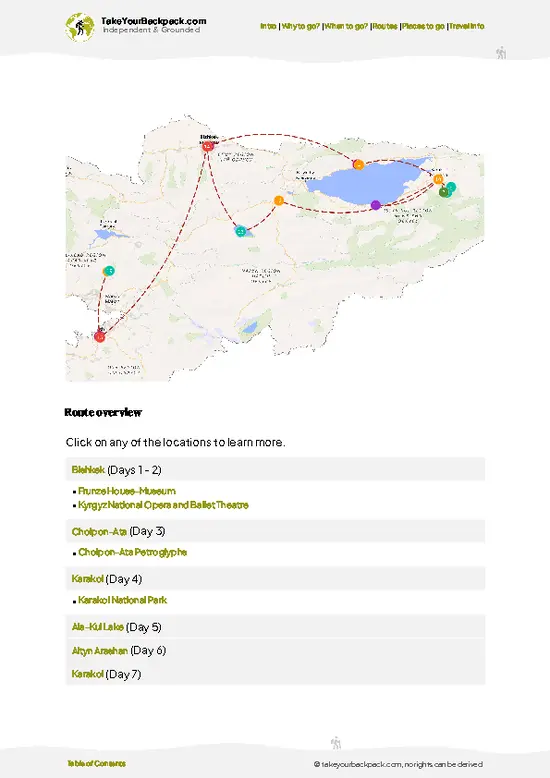
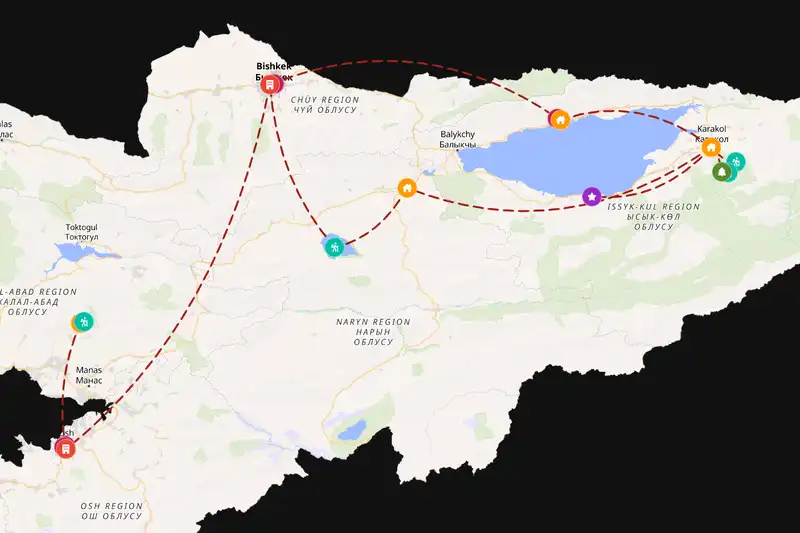
- Bishkek: 1–2 days for markets, marshrutka logistics, and a day hike in Ala‑Archa.
- Karakol region: 4–5 days for one major trek (e.g., Ala‑Kul or Altyn Arashan) plus a day around town or nearby canyons.
- Issyk‑Kul south shore or Song‑Kul: 2–3 days for a yurt stay and horse trekking.
- 2 weeks (ideal starter trip):
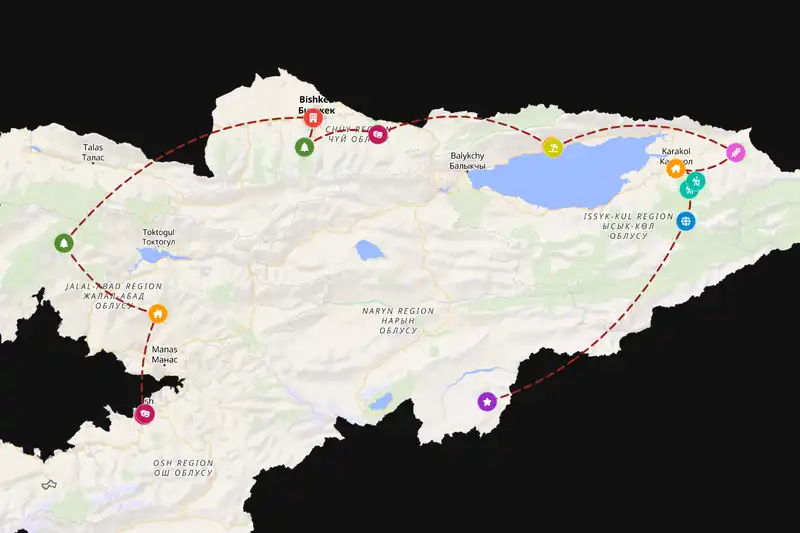
- Bishkek + Ala‑Archa: 2–3 days.
- Karakol + trekking (Ala‑Kul / Altyn Arashan / Jeti‑Oguz): 5–6 days.
- Song‑Kul: 2–3 days (including travel time; roads and shared taxis are slow).
- Extra 2–3 days to plug in: Jyrgalan, Issyk‑Kul south shore, or a buffer day for weather and transport hiccups.
- 3–4 weeks (deep dive):
- Everything above, plus:
- Jyrgalan multi‑day trek or horse trek.
- Osh and the south (Sary‑Chelek, Arslanbob, or as a launch point for the Pamir Highway).
- More remote valleys like Naryn region or At‑Bashy.
Why you want more than a week:
- Distances are short on the map but slow in reality; a “4‑hour” ride can easily become 6–7.
- Weather can shut down high passes or make trails miserable for a day or two.
- The best parts (treks, yurt stays, horse trips) are better if you don’t rush in and out in a single night.
If you’re truly squeezed, prioritize one region (Karakol + Issyk‑Kul or Song‑Kul) instead of trying to “see the whole country.”
Yes, you can absolutely get around Kyrgyzstan without renting a car, but you trade comfort and predictability for price and local flavor.
Your main tools:
- Marshrutkas (minibuses):
- Cheapest way to move between cities and larger towns.
- Leave when full, not on a strict schedule, so mornings are your friend.
- Expect cramped seats, loud music, and frequent stops; bring water and snacks.
- Shared taxis:
- Slightly pricier but faster and more comfortable than marshrutkas.
- Great for routes like Bishkek–Karakol, Karakol–Jyrgalan, or Naryn–Kochkor.
- You pay per seat; you can pay for extra seats if you want more space or to leave sooner.
- Hitchhiking:
- Common and generally safe by regional standards, especially in rural areas.
- Often semi‑paid: drivers may expect a small contribution, especially on long routes.
- Best used to fill gaps between villages, trailheads, and main roads.
- Local taxis:
- Cheap inside towns; always agree on a price before you get in.
- Useful for early‑morning departures to trailheads or marshrutka stations.
- Organized transfers:
- CBT offices and guesthouses can arrange private or shared transfers to places like Song‑Kul, remote valleys, or specific trailheads.
- More expensive than DIY, but they save you from multi‑step, uncertain connections.
Constraints to keep in mind:
- Remote areas (Song‑Kul, some Naryn valleys, side valleys around Karakol) may have no regular public transport; you’ll rely on arranged rides, hitchhiking, or walking extra kilometers.
- Weather and road conditions can slow or stop traffic, especially early/late in the trekking season.
- Travel days eat time; plan full days just for moving between regions.
If you’re patient, start early, and stay flexible, you can see a lot of the country without ever touching a steering wheel.
For a budget backpacker, the must‑visits are the places that combine raw landscapes, easy-ish logistics, and strong local character.
Top priorities:
- Bishkek (as a base, 1–2 days):
- Not the main attraction, but useful for acclimating, buying SIM cards, changing money, and sorting trekking logistics.
- Osh Bazaar and Dordoi for people‑watching and cheap supplies.
- Day trip to Ala‑Archa National Park for a first taste of Kyrgyz mountains.
- Karakol and surroundings (4–6 days):
- The best all‑round base for backpackers: cheap guesthouses, trekking agencies, and easy access to trails.
- Ala‑Kul trek: classic high‑altitude lake, mountain passes, and the kind of scenery that justifies the effort.
- Altyn Arashan: hot springs, valley views, and yurt stays; can be combined with Ala‑Kul as a loop.
- Jeti‑Oguz and nearby canyons: red rock formations and shorter hikes if you’re not up for a big trek.
- Song‑Kul (2–3 days):
- High‑altitude lake ringed by pastures and yurt camps.
- Best for horse trekking, simple yurt stays, and seeing semi‑nomadic life up close.
- Nights are cold even in summer; bring layers and expect basic facilities.
- Issyk‑Kul south shore (1–3 days):
- Quieter and more scenic than the north shore.
- Good for low‑effort hikes, beaches, and staying in small guesthouses or homestays.
- Nice recovery stop between bigger treks.
- Jyrgalan (2–4 days):
- Small mountain village turned trekking hub.
- Great for day hikes or 2–3 day treks with fewer crowds than the classic Karakol routes.
- Osh and the south (if you have time, 3–5 days):
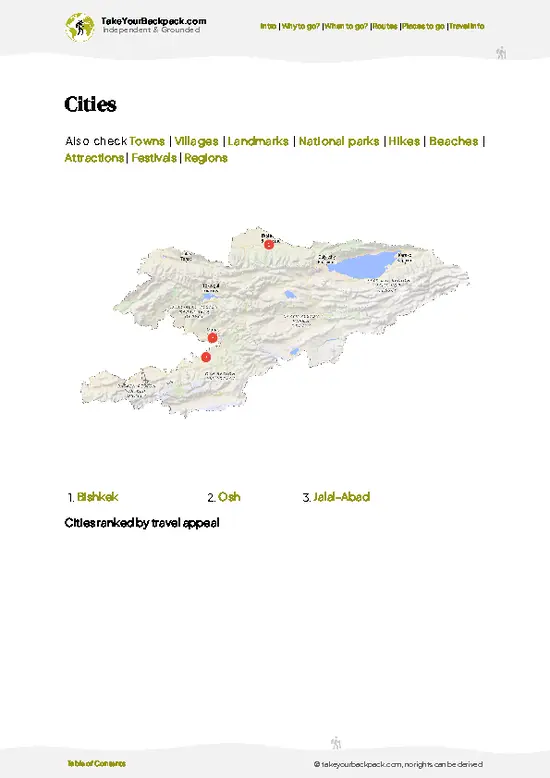
- Osh city for markets and a different cultural flavor from the north.
- Launchpad for Sary‑Chelek, Arslanbob, or the Pamir Highway if you’re extending your trip.
If you have limited time, focus on: Bishkek + Ala‑Archa, Karakol region (with at least one serious trek), and either Song‑Kul or the Issyk‑Kul south shore.
If you’re short on time or cash, skip anything that eats days of transit without giving you a clearly different experience from what you already have on your route.
Low priority for a tight itinerary:
- Issyk‑Kul north shore (Cholpon‑Ata and big resorts):
- Feels more like generic beach tourism with concrete hotels and crowds.
- If you’re already doing the south shore or Song‑Kul, you won’t miss much by skipping the north.
- Too many cities:
- Bishkek is useful as a hub, but more than 2–3 days there is overkill for most backpackers.
- If you’re choosing between extra city time and another night in the mountains, pick the mountains.
- Very remote valleys in Naryn region (on a short trip):
- Places like At‑Bashy and some far‑flung jailoos are beautiful but require long, slow travel and often paid 4x4s.
- If you only have 1–2 weeks, you’ll get similar alpine scenery more efficiently around Karakol, Jyrgalan, or Song‑Kul.
- Over‑stacking treks:
- Doing Ala‑Kul, then another big multi‑day trek, then a long horse trek can blur together and burn your legs and budget.
- If time is tight, pick one flagship trek (Ala‑Kul or a Jyrgalan route) and one shorter or horse‑based trip instead of three similar epics.
- Long detours just to “tick” Osh:
- Osh is interesting, but if your whole route is in the north and you only have 10–12 days, the extra overnight transport there and back can eat too much time.
- Only add Osh if you’re continuing toward the Pamir Highway or already heading south.
When in doubt, skip the extra city or extra valley and give yourself more time in one or two key regions. Depth beats a rushed checklist in Kyrgyzstan, especially when buses are slow and mountains are the main event.