×

Lesotho🇱🇸 | best festivalsYour Guide to the 5 Best festivals in Lesotho

Festivals in Lesotho are cultural gatherings more than staged events: horse-mounted Basotho in wool blankets and gumboots, brass bands, and the thud of mokorotlo hats and drums on dry highland air. The Maseru lowlands bring tarred roads, music crowds and higher prices, while the mountain districts mean gravel tracks, cold nights and small, local audiences. Independent travelers get the most from the second kind.

By Johan Kruseman 🇳🇱 | Updated October 23, 2026
Explore the best regions in Lesotho

Why go?Key Factors That Shape the Experience

Lesotho is the only country entirely above 1,000 meters, and that altitude shapes everything. Villages sit far apart on steep ridges, so community gatherings grow from Basotho traditions of horsemanship, initiation, praise poetry and choral singing, kept alive by herders who still ride ponies between settlements. Smoke from dung and wood fires drifts over stone huts, and the air smells of dust and wool.

The flip side is infrastructure. Outside Maseru, roads turn to gravel, minibus taxis leave only when full, and many events have no formal ticketing, signage or online schedule. Dates often shift with weather, harvest and the local chief’s calendar. Expect basic lodging, cash-only payments in maloti, and big temperature swings between sunny afternoons and freezing dawns. Arrive curious and … read more 👉
Lesotho is the only country entirely above 1,000 meters, and that altitude shapes everything. Villages sit far apart on steep ridges, so community gatherings grow from Basotho traditions of horsemanship, initiation, praise poetry and choral singing, kept alive by herders who still ride ponies between settlements. Smoke from dung and wood fires drifts over stone huts, and the air smells of dust and wool.

The flip side is infrastructure. Outside Maseru, roads turn to gravel, minibus taxis leave only when full, and many events have no formal ticketing, signage or online schedule. Dates often shift with weather, harvest and the local chief’s calendar. Expect basic lodging, cash-only payments in maloti, and big temperature swings between sunny afternoons and freezing dawns. Arrive curious and flexible, and you get a country where the crowd is mostly neighbors, not tourists.
Our Approach to Ranking
The list of best festivals in Lesotho is created based on energy, traditions, crowd experience, activities, and overall excitement. If you feel a festival is missing in this list, please let us know.

When to go?When to Plan Your Trip

Best months for festivals in Lesotho: The best months are March to May and September to November, when days run roughly 15 to 25°C, skies are clear and the tracks are mostly dry. Autumn smells of woodsmoke and dry grass, and the light turns amber by late afternoon.
Shoulder seasons and weather to plan around: Summer (December to February) brings afternoon thunderstorms, with most of the 700 to 800 mm annual rainfall falling in the lowlands and washing out gravel roads. Winter (June to August) is bone dry but harsh: highland nights in Mokhotlong and Thaba-Tseka drop well below freezing, and snow can close passes such as Mafika-Lisiu. Lowland Maseru stays milder, around 0 to 17°C. Prices barely change by season, though lodging near popular events can fill, so book ahead in the lowlands.

festival hoppingTips for Visiting Multiple Destinations

How many days to combine festivals: A trip combining several festivals in Lesotho needs 7 to 12 days, because distances are short on a map but slow on the ground.
Grouping regions and direction: Start in Maseru, the transport hub, and work through the western lowlands (Teyateyaneng, Maseru, Mafeteng). Then head east into the mountains via Thaba-Tseka or Mokhotlong, finishing high so cold nights come last. Allow 1 to 2 days per stop. Maseru to Teyateyaneng takes about 45 minutes, while Maseru to Mokhotlong runs 6 to 8 hours on minibus taxis and winding mountain roads.
Planning mistakes: Travelers often pack in too much and ignore that minibus taxis leave only when full, often by early morning. Leave a spare day between regions, carry cash, and check local conditions before crossing passes, since rain or snow can stall everything.

The ListThe Best festivals of Lesotho

1 Morija Arts and Cultural Festival

Mohobelo stomping, choirs and famo, museum grounds, week-long program

Spend a cold, dry week among sandstone hills watching mohobelo dancers, choirs and horse races, then browse the neighboring Morija Museum.

2 Moshoeshoe Day

March 11, royal graves, national ceremony, wreath-laying

Climb the sandstone fortress where Moshoeshoe I is buried, then join the free national ceremony of speeches, brass bands and massed choirs.

3 Thaba-Bosiu Arts and Cultural Festival

Craft stalls, ndlamo dance, lekolulo flute, mountain-foot festival ground

Browse mohair and pottery stalls, then listen to ndlamo dancers and choirs on the plain below the mountain of Moshoeshoe I.

4 Maletsunyane Braai Festival

Open braai fires, Semonkong gravel road, live sets, frosty tents

Camp near Semonkong, share plates of grilled lamb and pap around the fires, and hear Maletsunyane Falls roar between band sets.

5 Lesotho Ultra Trail

Maloti ridgelines, multi-distance trail running, river crossings, village aid stations

Run or hike three days of treeless ridges and cold river crossings, with herders on ponies and villagers handing out fruit at remote checkpoints.

Loading the map 🌍

Expert viewInsights from Locals and Experts

How many festivals to visit: I advise two or three, not more. Transport takes real hours, schedules shift, and each gathering deserves a full day of standing in dust, wool-blanket smells and brass-band noise. Two lets you absorb the atmosphere; a third adds variety without turning the trip into a chase.
Prioritizing by travel style: Budget travelers and culture seekers should pick village gatherings in the mountains: small crowds, close contact with herders and singers, and a meal of papa and moroho shared in a courtyard. Comfort-minded visitors suit lowland events near Maseru, where tarred roads, guesthouses and cafes make logistics easy, and the reward is a lively music crowd. Photographers should lean mountain-side, where light slants across horse-mounted riders at dawn.
What it costs: Plan … read more 👉
How many festivals to visit: I advise two or three, not more. Transport takes real hours, schedules shift, and each gathering deserves a full day of standing in dust, wool-blanket smells and brass-band noise. Two lets you absorb the atmosphere; a third adds variety without turning the trip into a chase.
Prioritizing by travel style: Budget travelers and culture seekers should pick village gatherings in the mountains: small crowds, close contact with herders and singers, and a meal of papa and moroho shared in a courtyard. Comfort-minded visitors suit lowland events near Maseru, where tarred roads, guesthouses and cafes make logistics easy, and the reward is a lively music crowd. Photographers should lean mountain-side, where light slants across horse-mounted riders at dawn.
What it costs: Plan US$25 to 50 a day in maloti: guesthouses US$20 to 45 a night, shared minibus taxis US$2 to 15 per leg, and meals US$3 to 8. Entry is often free or a few dollars at village events, while organized lowland events can run US$5 to 20. A local guide or pony hire costs roughly US$15 to 40 a day, and it earns its fee in the mountains.
Safety and etiquette: Cold is the main hazard. Carry a wool layer and sleeping bag liner, since highland nights can freeze even in autumn. Keep valuables hidden in Maseru crowds and travel in daylight; mountain roads have livestock and sharp bends. Dress modestly and ask before photographing people, especially during ritual moments. Greet elders first with “Lumela, ntate” or “Lumela, ’m’e.” Do not wear a mokorotlo hat as a costume, and accept offered food or sorghum beer with both hands, which gets you invited to stay.

✈️ The backpacker research shortcutLesotho Travel Guide

An offline-friendly backpacking guide with optimized travel routes, ranked highlights, transport advice, and the best areas to stay.
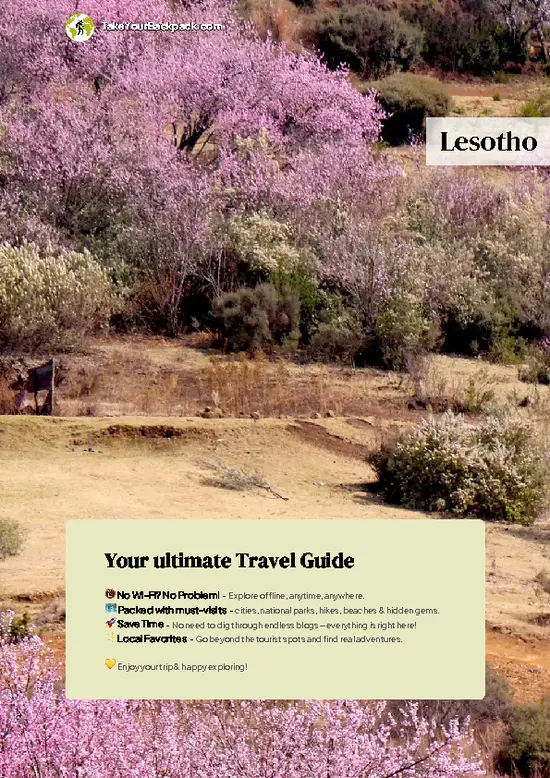
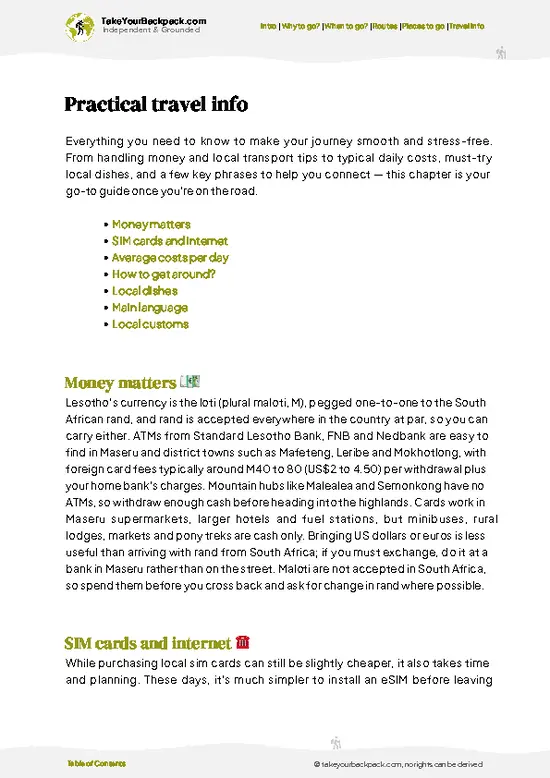
example page 0 from our offline Travel Guide for Lesotho
example page 1 from our offline Travel Guide for Lesotho
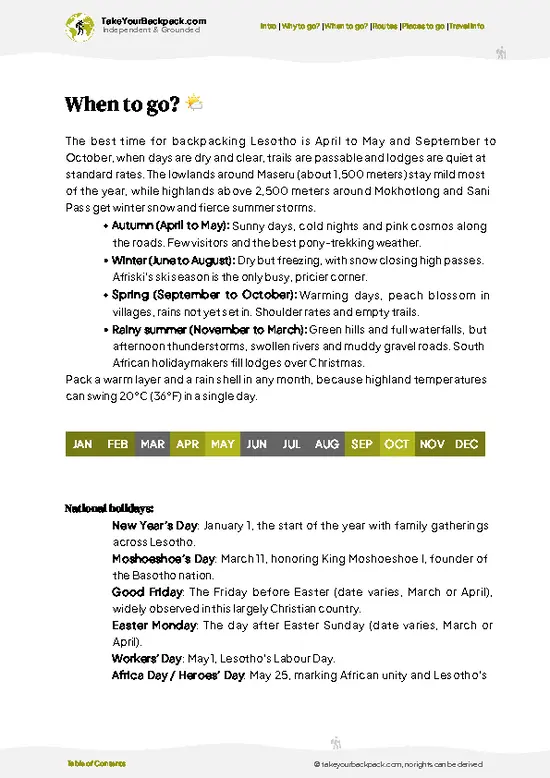
example page 2 from our offline Travel Guide for Lesotho
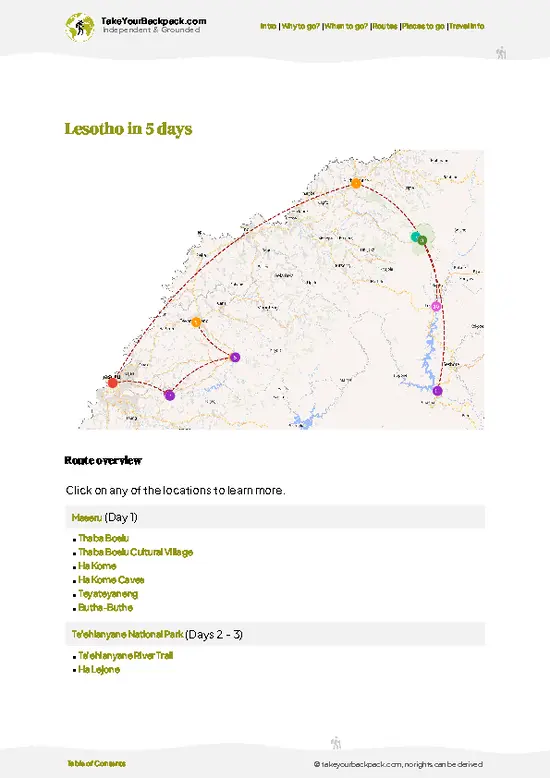
example page 3 from our offline Travel Guide for Lesotho
example page 4 from our offline Travel Guide for Lesotho
example page 5 from our offline Travel Guide for Lesotho
example page 6 from our offline Travel Guide for Lesotho
example page 7 from our offline Travel Guide for Lesotho
The digital guide (154 pages) contains:
✅ 35 highlights, ranked by travel appeal
✅ Optimized 2, 3 & 5-day travel routes
✅ Cities, national parks, landmarks, beaches
✅ How to get around
✅ Offline-friendly for travel without Wi-Fi
👉 Click to see all 30+ guide features

📅 Plan smarter in minutes, not weeks
✅ Month by month travel advice
✅ Festivals & national holidays
✅ Budget expectations

🗺️ Go to the right places, skip the overrated ones
✅ Honest pros & cons of destinations
✅ Top hikes, parks & viewpoints
✅ Lesser-known places most travelers miss
✅ Clear “worth it vs skip it” guidance

🛏️ Travel smoothly without rookie mistakes
✅ Best areas to stay
✅ Transport systems explained simply
✅ Common scams & safety advice
✅ SIM cards, money & practical tips

🌍 Understand the country, not just visit it
✅ Culture & traditions
✅ 52 Essential phrases & customs
✅ Festivals worth planning around
✅ Traveler-friendly historical context
✅ Insights that make places more meaningful

📱 Built for real travel conditions
✅ Fully downloadable PDF
✅ Works completely offline
✅ Optimized for phone use
✅ Useful in remote areas & buses
✅ Everything in one place
Stop searching, start planning
Get instant access to your full guide. 30‑day money-back guarantee.
+ Add another guide for just

By proceeding you agree to our terms.
Sent to your inbox immediately after payment • 100% Secure Checkout
Best Backpacking Travel Advisor 2025 tourism awardBest Backpacking
Travel Advisor
2025
What others say about Take Your Backpack Guides:
⭐⭐⭐⭐⭐
Fantastic, amazing amount of information!
⭐⭐⭐⭐⭐
My goodness this is amazing, it's what I've been looking for hats off too you!
⭐⭐⭐⭐⭐
I think this is absolutely BRILLIANT
⭐⭐⭐⭐
Very complete and informative. It's still missing places, but I gotta to commend you
⭐⭐⭐⭐⭐
This is truly amazing, thank you, can't wait to explore it with my kids!
⭐⭐⭐⭐⭐
Awesome resource, thank you!
⭐⭐⭐⭐⭐
This is amazing! Can't wait to explore the ones I haven't seen
⭐⭐⭐⭐
I love this! Well done, great idea.
⭐⭐⭐⭐⭐
Thanks for taking the time to make this gem!
⭐⭐⭐⭐⭐
This might be the best website I've ever seen.
⭐⭐⭐⭐⭐
Congratulations, and thank you so much for your work; it's incredibly valuable.
⭐⭐⭐⭐
In all seriousness I think you did a great job pointing out the important spots
⭐⭐⭐⭐⭐
10/10 very good
⭐⭐⭐⭐⭐
As someone who's only just starting to visit regularly this is awesome, thank you.
⭐⭐⭐⭐
Thank you very much! I'm going to visit my dad, it's going to be very useful!
⭐⭐⭐⭐⭐
This is really cool! We'll be travelling for the first time and this definitely come in handy.
⭐⭐⭐⭐⭐
You are now our minister of culture, congratulations 👨‍💼
⭐⭐⭐⭐⭐
Just wanted to tell you that this is a pearl! Going to follow your recommendations.
⭐⭐⭐⭐⭐
This is so cool. I'll definitely be using the resource for my travels soon.
⭐⭐⭐⭐⭐
This is very impressive! Good work.
⭐⭐⭐⭐⭐
This is an amazing and informative site. Very well done!

🛏️ Where to stay?Where to Stay in Lesotho

Lesotho has very few true hostels, so budget travel here means backpacker lodges with dorms or camping (roughly M200 to 350, about US$11 to 19, for a bed) and simple guesthouses rather than party hostels. In Maseru, the city center around Kingsway puts you near minibus ranks, banks and the few bars but empties out and feels unsafe after dark, while Maseru West is quieter and safer with guesthouses near the embassies, though you will need taxis to get anywhere. The best-value stays sit outside the capital: Malealea and Semonkong have rustic mountain lodges right by pony trekking and hiking trails with zero nightlife, and Roma, a university town 35 km from Maseru, has calm, cheap lodging in a … read more 👉
Lesotho has very few true hostels, so budget travel here means backpacker lodges with dorms or camping (roughly M200 to 350, about US$11 to 19, for a bed) and simple guesthouses rather than party hostels. In Maseru, the city center around Kingsway puts you near minibus ranks, banks and the few bars but empties out and feels unsafe after dark, while Maseru West is quieter and safer with guesthouses near the embassies, though you will need taxis to get anywhere. The best-value stays sit outside the capital: Malealea and Semonkong have rustic mountain lodges right by pony trekking and hiking trails with zero nightlife, and Roma, a university town 35 km from Maseru, has calm, cheap lodging in a green valley.

If you enjoy meeting fellow travelers, consider choosing hostels with high ratings for atmosphere. On the other hand, if you prefer having your own space, a hotel might be a better option.

LesothoMore of Lesotho

👋 Meet the founderWho’s Behind Take Your Backpack?

Johan, backpacker and founder of TakeYourBackpackHi, I’m Johan (Netherlands 🇳🇱), the creator of TakeYourBackpack. Over the past 3 decades, I’ve backpacked through 90+ countries across six continents, gaining extensive experience with independent travel, long-term trips, and overland routes.

This site is built on a combination of firsthand travel experience and carefully curated insights from other backpackers. Many guides are based on places I’ve personally visited, while others bring together tips, observations, and practical advice shared by trusted travelers I’ve met along the way.

The goal is to provide realistic, experience-driven guidance — not generic itineraries — so you can explore destinations with better context, clearer expectations, and more confidence.