×

Lesotho🇱🇸 | best landmarksYour Guide to the 5 Best landmarks in Lesotho

Lesotho has no turnstile-and-gift-shop monuments. Its landmarks are cliff-face rock art, dinosaur tracks, basalt passes and villages where woodsmoke and wet wool hang in thin air. The highlands mean cold wind, gravel roads and few other visitors. The lowlands near Maseru are easier and cheaper. Backpacking here suits independent travelers happy with slow minibuses and short days.

By Johan Kruseman 🇳🇱 | Updated October 23, 2026
Explore the best national parks in Lesotho

Why go?Key Factors That Shape the Experience

Lesotho sits entirely above 1,000 meters, and its lowest point is the highest of any country on earth. That elevation shapes everything. Sandstone and basalt crumble into overhangs, caves and escarpments, so many landmarks are natural or ancient rather than built, and the light on them at dawn is sharp and low. The Basotho kingdom grew out of mountain strongholds in the 1820s, and that history lives in hilltop sites and living villages, not in grand museums.

Before choosing Lesotho, know that infrastructure is thin. Signage is patchy, tarmac ends abruptly, and many sites depend on a local guide with a key or a pony. Roads can turn to red mud after storms, and mountain air is cold even when the sun burns your neck. Expect quiet, not polish.
Behind the Scenes of Selection
The list of best unique sites in Lesotho is created based on history or culture, wow factor, atmosphere, quirks, and memorability. If you feel a unique site is missing in this list, please let us know.

When to go?When to Plan Your Trip

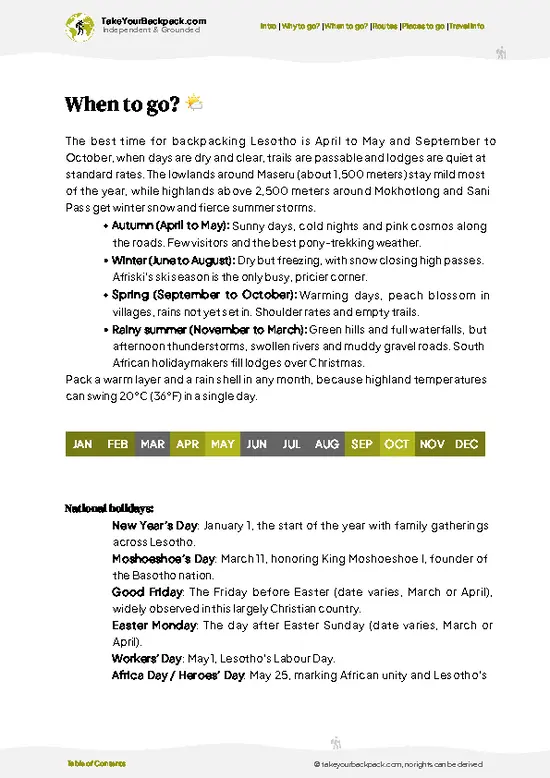
Best months and why: Plan for April to May and September to October, when skies are mostly clear, roads are dry and daytime highs sit around 15 to 24°C. Summer, from November to March, brings afternoon thunderstorms, most of the roughly 700 to 800 mm of annual rain in the lowlands, and slick, sometimes impassable tracks, though hillsides turn green and smell of wet grass.

Winter and the highlands: June to August is dry and brilliantly sunny by day, yet nights in the highlands fall well below freezing, and snow can close passes such as those near Mokhotlong and Thaba-Tseka for days. Lowlands around Maseru stay milder, with frosty mornings. Crowds are small year-round, and prices barely shift, though guesthouses in the mountains can be thinly staffed in deep winter.

unique site hoppingTips for Visiting Multiple Destinations

How many days to allow: A trip linking several landmarks needs 7 to 10 days, because distances look short on a map but gravel and switchbacks slow everything. Group stops by region: the western lowlands around Maseru and Teyateyaneng, then the northern and eastern highlands, entering or leaving via Butha-Buthe or Mokhotlong. Travel in one direction, finishing back near a border, rather than doubling back over the same passes.

Pacing and transport: Allow half a day to a full day per stop, including a guide and a walk. Between regions, expect 3 to 6 hours by shared minibus, which leave when full and thin out after midday. A common mistake is cramming two highland stops into one day. Instead, leave a buffer day for weather, and book a 4x4 or pony for remote tracks.

The ListThe Best landmarks of Lesotho

1 Thaba Bosiu

Flat-topped fortress, royal graves, Khubelu Pass, guided summit climb

Climb past stone gateways with a local guide to a grassy summit plateau, King Moshoeshoe I’s grave and wide views over the Phuthiatsana valley.

lesotho-unique-site-thaba-bosiu
© Google |

2 Katse Dam

185-meter arch wall, high mountain pass, turquoise reservoir, alpine botanical garden

Cross the dam crest above a long reservoir, join a wall tour, then wander Maloti alpine plants and highland villages around the lake.

3 Ha Kome Caves

Lived-in cave houses, hand-plastered mud walls, sooty overhang, guided walk

Walk room by room through mud-walled homes under a sandstone overhang, where residents still cook and sleep and guides explain how families sheltered.

lesotho-unique-site-ha-kome-caves
© Google |

4 Liphofung Caves

San eland paintings, ochre sandstone shelter, Moshoeshoe I link, rondavel stay

Study faded reddish figures on the back wall with a guide, then walk gentle reserve trails or overnight in a round hut.

5 Source of the Senqu River

Spongy headwater bogs, high Maloti turf, pony trails, Orange River origin

Tread cold, soggy turf where seeps gather into the Senqu, with herders and ponies passing and no signs or railings to mark it.

Loading the map 🌍

Expert viewInsights from Locals and Experts

How many to visit: I advise four to six landmarks over a week or more. Roads are slow, minibuses leave when full, and a single stop often swallows a morning, so more than that becomes a blur of dust and window glass. Fewer leaves the mountains unexplored.

Choosing by travel style: Hikers and rock-art fans should lean toward remote highland sites, where the reward is silence, cold air and wide basalt views. If time or comfort matters, pick lowland cultural and heritage stops reachable by minibus from Maseru, where you get crafts, warm bread and conversation. Mixing one of each gives the best range.

What it costs: Budget US$25 to 45 a day (roughly M450 to 800) including a guesthouse bed, local meals and shared transport. Entry or community fees usually run M30 to 100 per site, and a local … read more 👉
How many to visit: I advise four to six landmarks over a week or more. Roads are slow, minibuses leave when full, and a single stop often swallows a morning, so more than that becomes a blur of dust and window glass. Fewer leaves the mountains unexplored.

Choosing by travel style: Hikers and rock-art fans should lean toward remote highland sites, where the reward is silence, cold air and wide basalt views. If time or comfort matters, pick lowland cultural and heritage stops reachable by minibus from Maseru, where you get crafts, warm bread and conversation. Mixing one of each gives the best range.

What it costs: Budget US$25 to 45 a day (roughly M450 to 800) including a guesthouse bed, local meals and shared transport. Entry or community fees usually run M30 to 100 per site, and a local guide or pony adds M150 to 400 for a half day. Minibus legs cost about M30 to 120 depending on distance. Carry plenty of small maloti notes, as card machines are rare outside Maseru.

Safety and etiquette: Weather is the main hazard. Mountain storms arrive fast, with hail and lightning on open ridges, so start walks early and carry a windproof layer even in summer. Gravel roads and unfenced drops make night driving a bad idea. Petty theft happens in Maseru, so keep valuables out of sight there.

On culture, greet people on the trail with “Lumela” and ask before photographing herders or homes. Many Basotho wear a blanket and a conical hat as everyday dress, not costume. Hire local guides where offered, since the fee stays in the village and they know which trails are safe, and the stories alone make the walk better.

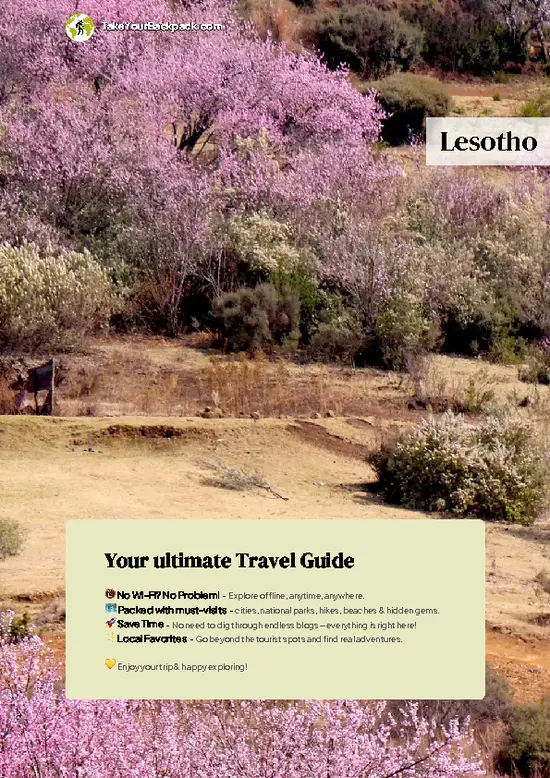
✈️ The backpacker research shortcutLesotho Travel Guide

An offline-friendly backpacking guide with optimized travel routes, ranked highlights, transport advice, and the best areas to stay.
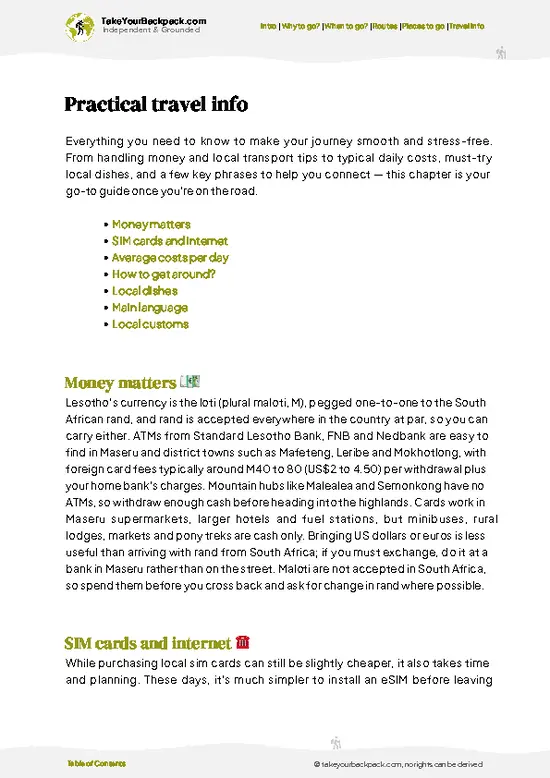
example page 0 from our offline Travel Guide for Lesotho
example page 1 from our offline Travel Guide for Lesotho
example page 2 from our offline Travel Guide for Lesotho
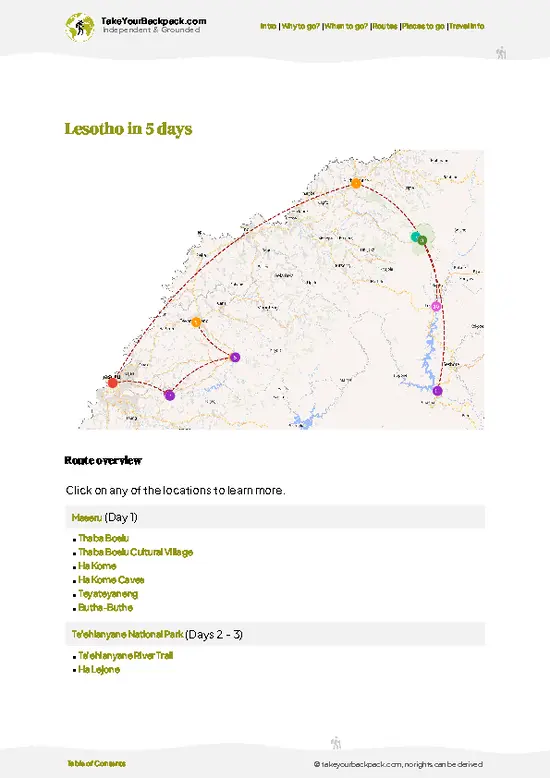
example page 3 from our offline Travel Guide for Lesotho
example page 4 from our offline Travel Guide for Lesotho
example page 5 from our offline Travel Guide for Lesotho
example page 6 from our offline Travel Guide for Lesotho
example page 7 from our offline Travel Guide for Lesotho
The digital guide (154 pages) contains:
✅ 35 highlights, ranked by travel appeal
✅ Optimized 2, 3 & 5-day travel routes
✅ Cities, national parks, landmarks, beaches
✅ How to get around
✅ Offline-friendly for travel without Wi-Fi
👉 Click to see all 30+ guide features

📅 Plan smarter in minutes, not weeks
✅ Month by month travel advice
✅ Festivals & national holidays
✅ Budget expectations

🗺️ Go to the right places, skip the overrated ones
✅ Honest pros & cons of destinations
✅ Top hikes, parks & viewpoints
✅ Lesser-known places most travelers miss
✅ Clear “worth it vs skip it” guidance

🛏️ Travel smoothly without rookie mistakes
✅ Best areas to stay
✅ Transport systems explained simply
✅ Common scams & safety advice
✅ SIM cards, money & practical tips

🌍 Understand the country, not just visit it
✅ Culture & traditions
✅ 52 Essential phrases & customs
✅ Festivals worth planning around
✅ Traveler-friendly historical context
✅ Insights that make places more meaningful

📱 Built for real travel conditions
✅ Fully downloadable PDF
✅ Works completely offline
✅ Optimized for phone use
✅ Useful in remote areas & buses
✅ Everything in one place
Stop searching, start planning
Get instant access to your full guide. 30‑day money-back guarantee.
+ Add another guide for just

By proceeding you agree to our terms.
Sent to your inbox immediately after payment • 100% Secure Checkout
Best Backpacking Travel Advisor 2025 tourism awardBest Backpacking
Travel Advisor
2025
What others say about Take Your Backpack Guides:
⭐⭐⭐⭐⭐
Fantastic, amazing amount of information!
⭐⭐⭐⭐⭐
My goodness this is amazing, it's what I've been looking for hats off too you!
⭐⭐⭐⭐⭐
I think this is absolutely BRILLIANT
⭐⭐⭐⭐
Very complete and informative. It's still missing places, but I gotta to commend you
⭐⭐⭐⭐⭐
This is truly amazing, thank you, can't wait to explore it with my kids!
⭐⭐⭐⭐⭐
Awesome resource, thank you!
⭐⭐⭐⭐⭐
This is amazing! Can't wait to explore the ones I haven't seen
⭐⭐⭐⭐
I love this! Well done, great idea.
⭐⭐⭐⭐⭐
Thanks for taking the time to make this gem!
⭐⭐⭐⭐⭐
This might be the best website I've ever seen.
⭐⭐⭐⭐⭐
Congratulations, and thank you so much for your work; it's incredibly valuable.
⭐⭐⭐⭐
In all seriousness I think you did a great job pointing out the important spots
⭐⭐⭐⭐⭐
10/10 very good
⭐⭐⭐⭐⭐
As someone who's only just starting to visit regularly this is awesome, thank you.
⭐⭐⭐⭐
Thank you very much! I'm going to visit my dad, it's going to be very useful!
⭐⭐⭐⭐⭐
This is really cool! We'll be travelling for the first time and this definitely come in handy.
⭐⭐⭐⭐⭐
You are now our minister of culture, congratulations 👨‍💼
⭐⭐⭐⭐⭐
Just wanted to tell you that this is a pearl! Going to follow your recommendations.
⭐⭐⭐⭐⭐
This is so cool. I'll definitely be using the resource for my travels soon.
⭐⭐⭐⭐⭐
This is very impressive! Good work.
⭐⭐⭐⭐⭐
This is an amazing and informative site. Very well done!

🛏️ Where to stay?Top Places to Consider Staying

Lesotho has very few true hostels, so budget travel here means backpacker lodges with dorms or camping (roughly M200 to 350, about US$11 to 19, for a bed) and simple guesthouses rather than party hostels. In Maseru, the city center around Kingsway puts you near minibus ranks, banks and the few bars but empties out and feels unsafe after dark, while Maseru West is quieter and safer with guesthouses near the embassies, though you will need taxis to get anywhere. The best-value stays sit outside the capital: Malealea and Semonkong have rustic mountain lodges right by pony trekking and hiking trails with zero nightlife, and Roma, a university town 35 km from Maseru, has calm, cheap lodging in a … read more 👉
Lesotho has very few true hostels, so budget travel here means backpacker lodges with dorms or camping (roughly M200 to 350, about US$11 to 19, for a bed) and simple guesthouses rather than party hostels. In Maseru, the city center around Kingsway puts you near minibus ranks, banks and the few bars but empties out and feels unsafe after dark, while Maseru West is quieter and safer with guesthouses near the embassies, though you will need taxis to get anywhere. The best-value stays sit outside the capital: Malealea and Semonkong have rustic mountain lodges right by pony trekking and hiking trails with zero nightlife, and Roma, a university town 35 km from Maseru, has calm, cheap lodging in a green valley.

If you enjoy meeting fellow travelers, consider choosing hostels with high ratings for atmosphere. On the other hand, if you prefer having your own space, a hotel might be a better option.

LesothoMore Places Across Lesotho

👋 Meet the founderWho’s Behind Take Your Backpack?

Johan, backpacker and founder of TakeYourBackpackHi, I’m Johan (Netherlands 🇳🇱), the creator of TakeYourBackpack. Over the past 3 decades, I’ve backpacked through 90+ countries across six continents, gaining extensive experience with independent travel, long-term trips, and overland routes.

This site is built on a combination of firsthand travel experience and carefully curated insights from other backpackers. Many guides are based on places I’ve personally visited, while others bring together tips, observations, and practical advice shared by trusted travelers I’ve met along the way.

The goal is to provide realistic, experience-driven guidance — not generic itineraries — so you can explore destinations with better context, clearer expectations, and more confidence.