×

Lesotho🇱🇸 | best hikesYour Guide to the 3 Best hikes in Lesotho

Hikes in Lesotho mean crossing a high plateau of wind-scoured grassland, basalt cliffs and Basotho herders in wool blankets, with few other walkers around. The northern Maloti and Semonkong offer wilder, colder, cheaper walking on foot or pony. The Sani Pass side is easier to reach and busier. Independent travelers should expect thin air, long gravel roads and nights that smell of dung-fire smoke.

By Johan Kruseman 🇳🇱 | Updated October 23, 2026
Explore the best attractions in Lesotho

Why go?Key Factors That Shape the Experience

Lesotho is the only country in the world entirely above 1,000 meters, and its lowest point sits at about 1,400 meters. That altitude shapes everything: air that thins on climbs, sudden hail in summer afternoons, and frost-stiff grass at dawn. There are few fenced reserves, so walking mostly follows livestock paths between stone-and-thatch villages where herders on horseback pass with a nod. The mountains were a refuge for King Moshoeshoe I in the 1800s, and the Basotho pony remains the standard way to cover ground. Waymarking is rare, mobile signal drops in the valleys, and many roads are rough gravel that needs a high-clearance vehicle or a long minibus ride. Expect self-sufficiency, a hired local guide for anything remote, and water that must be treated because livestock graze above most … read more 👉
Lesotho is the only country in the world entirely above 1,000 meters, and its lowest point sits at about 1,400 meters. That altitude shapes everything: air that thins on climbs, sudden hail in summer afternoons, and frost-stiff grass at dawn. There are few fenced reserves, so walking mostly follows livestock paths between stone-and-thatch villages where herders on horseback pass with a nod. The mountains were a refuge for King Moshoeshoe I in the 1800s, and the Basotho pony remains the standard way to cover ground. Waymarking is rare, mobile signal drops in the valleys, and many roads are rough gravel that needs a high-clearance vehicle or a long minibus ride. Expect self-sufficiency, a hired local guide for anything remote, and water that must be treated because livestock graze above most streams. In return you get huge silence, wide light and almost no crowds.
Our Approach to Ranking
The list of best hikes in Lesotho is created based on scenery, challenge, trail quality, landmarks, and overall enjoyment. If you feel a hike is missing in this list, please let us know.

When to go?When to Plan Your Trip

Best months for Lesotho hikes: The best months are March to May and September to November, when skies are mostly clear and daytime highs sit around 15 to 24°C. Autumn brings gold grass and crisp, dry air. Winter and summer: June to August is cold and dry: nights in the highlands often fall to -5 to -10°C, and snow can close the Sani Pass and cut roads, though bright days make the light sharp and blue. December to February is the wet season, with most of the roughly 700 to 1,000 mm of annual rain arriving as afternoon thunderstorms, lightning on exposed ridges and swollen rivers that block crossings. Mist also hides trails. Prices barely change by season, but South African school holidays in December and April fill the lodges near the Sani Pass, so book ahead. The north-east highlands get the harshest winter weather.

hike hoppingTips for Visiting Multiple Destinations

Time needed to link several hikes: A trip combining several hikes in Lesotho needs 8 to 14 days, because roads are slow and weather can force a rest day. Grouping regions: Maseru, the capital and border hub, works as an entry point. The Semonkong area is roughly 2.5 to 3 hours by road to the south-east, and the Sani Pass corner is another long day away, about 6 to 8 hours by minibus and 4x4. The northern highlands around Butha-Buthe and Katse sit 3 to 5 hours from Maseru. A sensible direction is a loop from Maseru, going north first, then south toward Sani, and leaving via South Africa. Allow 2 to 4 days per region. Common mistakes: Travelers often cram three regions into a week and spend it in minibuses that leave only when full, sometimes after a two-hour wait. Plan one slack day per transfer, … read more 👉
Time needed to link several hikes: A trip combining several hikes in Lesotho needs 8 to 14 days, because roads are slow and weather can force a rest day. Grouping regions: Maseru, the capital and border hub, works as an entry point. The Semonkong area is roughly 2.5 to 3 hours by road to the south-east, and the Sani Pass corner is another long day away, about 6 to 8 hours by minibus and 4x4. The northern highlands around Butha-Buthe and Katse sit 3 to 5 hours from Maseru. A sensible direction is a loop from Maseru, going north first, then south toward Sani, and leaving via South Africa. Allow 2 to 4 days per region. Common mistakes: Travelers often cram three regions into a week and spend it in minibuses that leave only when full, sometimes after a two-hour wait. Plan one slack day per transfer, and fill water and fuel before leaving towns.

The ListThe Best hikes of Lesotho

1 Maletsunyane Falls

192-meter single drop, Semonkong base, slick gorge descent, abseil option

Walk the gentle track to the rim, then drop into the basalt gorge to stand beneath the river’s 192-meter fall and its soaking mist.

lesotho-hike-maletsunyane-falls
© Google |

2 Ts’ehlanyane River Trail

Cold river crossings, native forest, basalt plunge pools, park camping

Follow a clear mountain river upstream through rare woodland and rock-hop its crossings, then climb to windy grassland above a ledge of green pools.

lesotho-hike-tsehlanyane-river-trail
© Google |

3 Sani Pass

Gravel hairpins, border post summit, 2,800-meter pub, bearded vultures

Climb the zigzag track up the Drakensberg wall on foot, stamp into Lesotho on the plateau and finish with a beer by the stove.

lesotho-hike-sani-pass
© Google |
Loading the map 🌍

Expert viewInsights from Locals and Experts

How many hikes to choose: Pick two or three hikes. Distances between trailheads are long, altitude makes each day tiring, and a single storm can swallow a day, so a short list leaves room for sleeping in a stone-walled hut with a paraffin lamp and a cold dawn. Choosing a kind: Backpackers on a tight budget should favor village-to-village walks with a local guide, which put money directly into homes and end with maize porridge and sweet tea. Those short on time suit day hikes from a lodge near the Sani Pass or Semonkong. Pony treks suit tired legs and give access to long ridgelines. Overnight camping suits experienced walkers carrying a four-season tent. What it costs: Budget about US$30 to 60 a day, or roughly M550 to 1,100 in Lesotho maloti (equal to South African rand). Guides run around … read more 👉
How many hikes to choose: Pick two or three hikes. Distances between trailheads are long, altitude makes each day tiring, and a single storm can swallow a day, so a short list leaves room for sleeping in a stone-walled hut with a paraffin lamp and a cold dawn. Choosing a kind: Backpackers on a tight budget should favor village-to-village walks with a local guide, which put money directly into homes and end with maize porridge and sweet tea. Those short on time suit day hikes from a lodge near the Sani Pass or Semonkong. Pony treks suit tired legs and give access to long ridgelines. Overnight camping suits experienced walkers carrying a four-season tent. What it costs: Budget about US$30 to 60 a day, or roughly M550 to 1,100 in Lesotho maloti (equal to South African rand). Guides run around M250 to 500 a day, ponies M300 to 600, and village homestays or basic huts M150 to 400 a night. Minibus rides cost M50 to 200 per leg. Park or village entry fees are small, typically under M100, and cash is needed because ATMs vanish outside towns. Safety and customs: Weather turns fast: pack a waterproof shell, warm layers and a headlamp even in summer, and turn back when thunderclouds build over ridges, because open plateaus offer no cover. Mist can erase paths in minutes. Carry a map app downloaded offline and treat all stream water. Greet every herder, and ask before photographing people or their blankets and ponies. Stay on paths near fields and close gates. Leave valuables out of sight at trailheads, since petty theft occurs. Never walk alone on remote routes.

✈️ The backpacker research shortcutLesotho Travel Guide

An offline-friendly backpacking guide with optimized travel routes, ranked highlights, transport advice, and the best areas to stay.
example page 0 from our offline Travel Guide for Lesotho
example page 1 from our offline Travel Guide for Lesotho
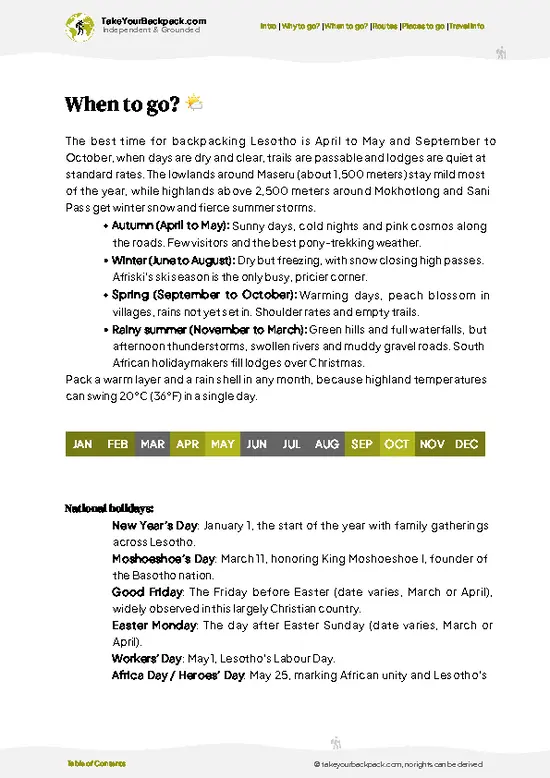
example page 2 from our offline Travel Guide for Lesotho
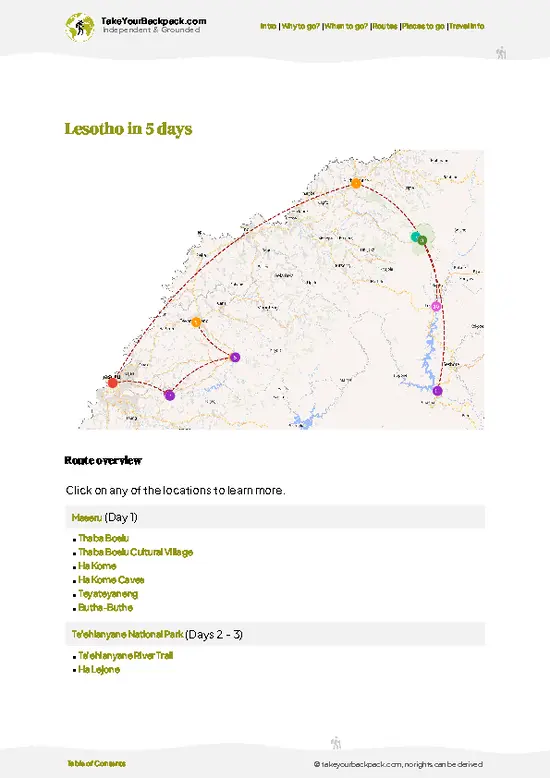
example page 3 from our offline Travel Guide for Lesotho
example page 4 from our offline Travel Guide for Lesotho
example page 5 from our offline Travel Guide for Lesotho
example page 6 from our offline Travel Guide for Lesotho
example page 7 from our offline Travel Guide for Lesotho
The digital guide (154 pages) contains:
✅ 35 highlights, ranked by travel appeal
✅ Optimized 2, 3 & 5-day travel routes
✅ Cities, national parks, landmarks, beaches
✅ How to get around
✅ Offline-friendly for travel without Wi-Fi
👉 Click to see all 30+ guide features

📅 Plan smarter in minutes, not weeks
✅ Month by month travel advice
✅ Festivals & national holidays
✅ Budget expectations

🗺️ Go to the right places, skip the overrated ones
✅ Honest pros & cons of destinations
✅ Top hikes, parks & viewpoints
✅ Lesser-known places most travelers miss
✅ Clear “worth it vs skip it” guidance

🛏️ Travel smoothly without rookie mistakes
✅ Best areas to stay
✅ Transport systems explained simply
✅ Common scams & safety advice
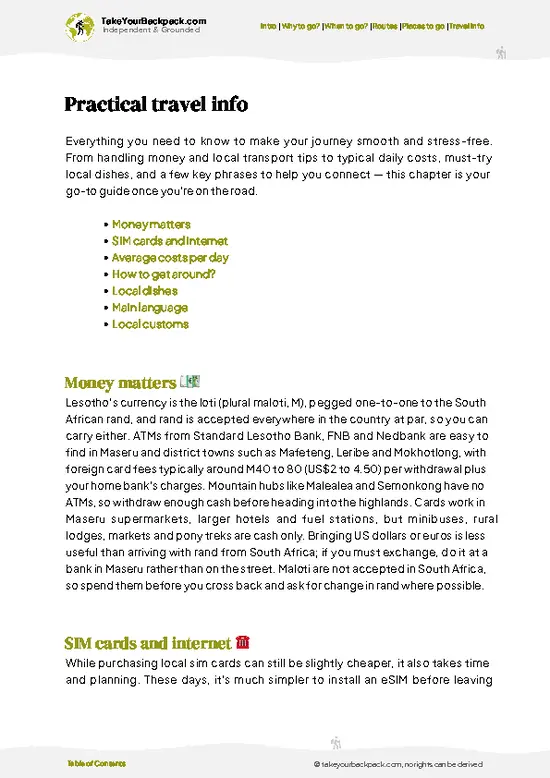
✅ SIM cards, money & practical tips

🌍 Understand the country, not just visit it
✅ Culture & traditions
✅ 52 Essential phrases & customs
✅ Festivals worth planning around
✅ Traveler-friendly historical context
✅ Insights that make places more meaningful

📱 Built for real travel conditions
✅ Fully downloadable PDF
✅ Works completely offline
✅ Optimized for phone use
✅ Useful in remote areas & buses
✅ Everything in one place
Stop searching, start planning
Get instant access to your full guide. 30‑day money-back guarantee.
+ Add another guide for just

By proceeding you agree to our terms.
Sent to your inbox immediately after payment • 100% Secure Checkout
Best Backpacking Travel Advisor 2025 tourism awardBest Backpacking
Travel Advisor
2025
What others say about Take Your Backpack Guides:
⭐⭐⭐⭐⭐
Fantastic, amazing amount of information!
⭐⭐⭐⭐⭐
My goodness this is amazing, it's what I've been looking for hats off too you!
⭐⭐⭐⭐⭐
I think this is absolutely BRILLIANT
⭐⭐⭐⭐
Very complete and informative. It's still missing places, but I gotta to commend you
⭐⭐⭐⭐⭐
This is truly amazing, thank you, can't wait to explore it with my kids!
⭐⭐⭐⭐⭐
Awesome resource, thank you!
⭐⭐⭐⭐⭐
This is amazing! Can't wait to explore the ones I haven't seen
⭐⭐⭐⭐
I love this! Well done, great idea.
⭐⭐⭐⭐⭐
Thanks for taking the time to make this gem!
⭐⭐⭐⭐⭐
This might be the best website I've ever seen.
⭐⭐⭐⭐⭐
Congratulations, and thank you so much for your work; it's incredibly valuable.
⭐⭐⭐⭐
In all seriousness I think you did a great job pointing out the important spots
⭐⭐⭐⭐⭐
10/10 very good
⭐⭐⭐⭐⭐
As someone who's only just starting to visit regularly this is awesome, thank you.
⭐⭐⭐⭐
Thank you very much! I'm going to visit my dad, it's going to be very useful!
⭐⭐⭐⭐⭐
This is really cool! We'll be travelling for the first time and this definitely come in handy.
⭐⭐⭐⭐⭐
You are now our minister of culture, congratulations 👨‍💼
⭐⭐⭐⭐⭐
Just wanted to tell you that this is a pearl! Going to follow your recommendations.
⭐⭐⭐⭐⭐
This is so cool. I'll definitely be using the resource for my travels soon.
⭐⭐⭐⭐⭐
This is very impressive! Good work.
⭐⭐⭐⭐⭐
This is an amazing and informative site. Very well done!

🛏️ Where to stay?Best Stay Options in Lesotho

Lesotho has very few true hostels, so budget travel here means backpacker lodges with dorms or camping (roughly M200 to 350, about US$11 to 19, for a bed) and simple guesthouses rather than party hostels. In Maseru, the city center around Kingsway puts you near minibus ranks, banks and the few bars but empties out and feels unsafe after dark, while Maseru West is quieter and safer with guesthouses near the embassies, though you will need taxis to get anywhere. The best-value stays sit outside the capital: Malealea and Semonkong have rustic mountain lodges right by pony trekking and hiking trails with zero nightlife, and Roma, a university town 35 km from Maseru, has calm, cheap lodging in a … read more 👉
Lesotho has very few true hostels, so budget travel here means backpacker lodges with dorms or camping (roughly M200 to 350, about US$11 to 19, for a bed) and simple guesthouses rather than party hostels. In Maseru, the city center around Kingsway puts you near minibus ranks, banks and the few bars but empties out and feels unsafe after dark, while Maseru West is quieter and safer with guesthouses near the embassies, though you will need taxis to get anywhere. The best-value stays sit outside the capital: Malealea and Semonkong have rustic mountain lodges right by pony trekking and hiking trails with zero nightlife, and Roma, a university town 35 km from Maseru, has calm, cheap lodging in a green valley.

If you enjoy meeting fellow travelers, consider choosing hostels with high ratings for atmosphere. On the other hand, if you prefer having your own space, a hotel might be a better option.

LesothoWhere to Go Next

👋 Meet the founderWho’s Behind Take Your Backpack?

Johan, backpacker and founder of TakeYourBackpackHi, I’m Johan (Netherlands 🇳🇱), the creator of TakeYourBackpack. Over the past 3 decades, I’ve backpacked through 90+ countries across six continents, gaining extensive experience with independent travel, long-term trips, and overland routes.

This site is built on a combination of firsthand travel experience and carefully curated insights from other backpackers. Many guides are based on places I’ve personally visited, while others bring together tips, observations, and practical advice shared by trusted travelers I’ve met along the way.

The goal is to provide realistic, experience-driven guidance — not generic itineraries — so you can explore destinations with better context, clearer expectations, and more confidence.