×

Lesotho🇱🇸 | landmarksHa Kome CavesLived-in cave houses, hand-plastered mud walls, sooty overhang, guided walk | things to do and best time to go

Explore Ha MatelaExplore Katse Dam

Backpacking in Ha Kome Caves
👍 Recommendedunique site ranked #3
By Johan Kruseman 🇳🇱 | Updated October 22, 2026

Some of the cave houses at Ha Kome Caves are still lived in, so you walk past working kitchens and sleeping spaces rather than roped-off ruins. The site sits in Berea District in Lesotho, east of Teyateyaneng and northeast of Maseru. Sandstone overhangs shelter mud-walled rooms that Basotho families built while fleeing the wars of the early 1800s, and the walls are still smoothed by hand. Entry is cheap, but a local guide comes with the visit, and there is little in the way of food or shops. Crowds are rare, and the final stretch of track is rough for low cars. Expect dust, cool stone, woodsmoke and a pale cliff glowing against dry grass. Photographers get textured walls and tight doorways, though residents deserve a polite ask first. Spend a morning on the guided walk, then browse the weaving workshops in Teyateyaneng in the afternoon.

Discover everything you want to know in the 📖 Lesotho Travel Guide.


example page 0 from our offline Travel Guide for Lesotho
example page 1 from our offline Travel Guide for Lesotho
example page 2 from our offline Travel Guide for Lesotho
example page 3 from our offline Travel Guide for Lesotho
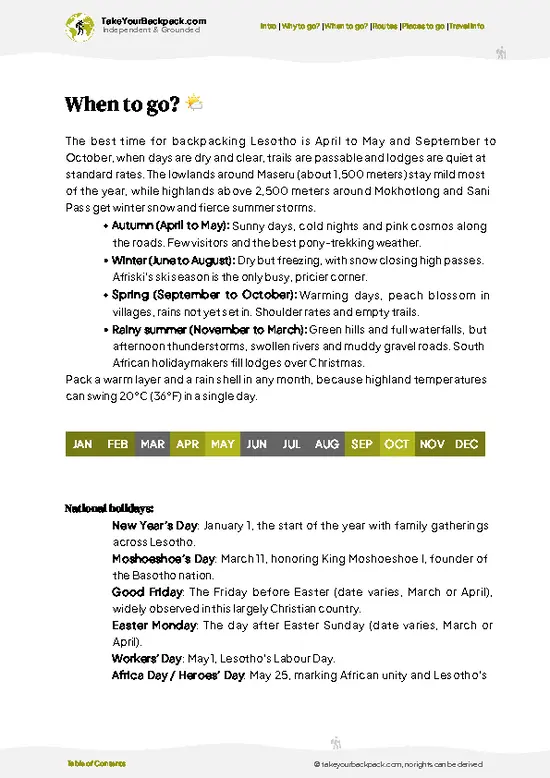
example page 4 from our offline Travel Guide for Lesotho
example page 5 from our offline Travel Guide for Lesotho
example page 6 from our offline Travel Guide for Lesotho
example page 7 from our offline Travel Guide for Lesotho
Loading the map 🌍
CLICK TO FILTER
cities
towns
villages
landmarks
national parks
hikes
attractions
festivals
regions
SHOW COUNTRY’S BESTSHOW ALL

✨ Why go?
Ranked #3 unique site in Lesotho
Why Ha Kome Caves should be on your travel list

Ha Kome Caves is one of the few places in southern Africa where you can step into a cave village that families still call home. That changes the visit. You are not reading a plaque about the past, you are standing in a doorway while someone explains why the wall behind you gets replastered with mud. The guides come from the community, so your fee goes to the people who keep the place going.

The effort is modest. The site sits in the lowlands of Berea District, close enough to the capital that it fits into a loop with the mohair weaving studios of Teyateyaneng, and it makes a gentle contrast to the high-mountain trekking that most travelers come to Lesotho for. After days of altitude and pony tracks, a morning among sandstone shelters is a different kind of Lesotho.

It also tells the story … read more 👉
Ha Kome Caves is one of the few places in southern Africa where you can step into a cave village that families still call home. That changes the visit. You are not reading a plaque about the past, you are standing in a doorway while someone explains why the wall behind you gets replastered with mud. The guides come from the community, so your fee goes to the people who keep the place going.

The effort is modest. The site sits in the lowlands of Berea District, close enough to the capital that it fits into a loop with the mohair weaving studios of Teyateyaneng, and it makes a gentle contrast to the high-mountain trekking that most travelers come to Lesotho for. After days of altitude and pony tracks, a morning among sandstone shelters is a different kind of Lesotho.

It also tells the story of the Lifaqane upheavals better than most museums, because the evidence is the architecture itself. If you want one stop that explains how Basotho families once survived by tucking homes beneath rock, this is it.

💡 HighlightsEssential experiences to have while visiting Ha Kome Caves

  1. The cave dwellings: Mud-walled rooms built beneath a long sandstone overhang, with the rock itself serving as the roof. This is the reason to come, and the guided entry usually costs around US$3 to 5.
  2. The guided walk: Local guides lead you room by room and explain who lived where, how families cooked and slept, and how the shelters were defended. Their stories add what the walls cannot say.
  3. Hand-plastered walls: Look closely at the mud finish, smoothed by palm and fingertip and still patched by residents. The texture catches low light well and gives the best close-up photographs.
  4. Soot-darkened ceilings: Generations of cooking fires have blackened the rock overhead. It is a quiet, physical record of how long people have lived under this cliff.
  5. The sandstone cliff face: Pale, layered and eroded
… read more 👉
  1. The cave dwellings: Mud-walled rooms built beneath a long sandstone overhang, with the rock itself serving as the roof. This is the reason to come, and the guided entry usually costs around US$3 to 5.
  2. The guided walk: Local guides lead you room by room and explain who lived where, how families cooked and slept, and how the shelters were defended. Their stories add what the walls cannot say.
  3. Hand-plastered walls: Look closely at the mud finish, smoothed by palm and fingertip and still patched by residents. The texture catches low light well and gives the best close-up photographs.
  4. Soot-darkened ceilings: Generations of cooking fires have blackened the rock overhead. It is a quiet, physical record of how long people have lived under this cliff.
  5. The sandstone cliff face: Pale, layered and eroded into hollows, the cliff is striking from a short distance back, especially against the dry grassland of the lowlands.
  6. Views across Berea District: From the ledge you look out over farmland and scattered villages, a reminder that the caves were chosen for shelter and for watching the approaches.
  7. Elelloang Basali weaving center in Teyateyaneng: A short drive away, local weavers produce mohair and wool tapestries and rugs on large looms. You can watch the work and buy direct from the makers.
At Ha Kome Caves the only paid item is the guided entry, while browsing the weaving studios and looking out from the cliff approach cost nothing.
Spotted a mistake or missing something? Contact us.

Things to do near Ha Kome Caves

Ratings based on Tripadvisor reviews. When you book through this link, you support our work at no extra cost to you.

🌤️ When to go?Best time to visit Ha Kome Caves

  • Autumn (March to May): Clear skies and dry trails make this the most comfortable window. Days run about 18 to 22°C (64 to 72°F), nights drop to 3 to 8°C (37 to 46°F), and the Berea Plateau is quiet.
  • Winter (June to August): Mornings often fall below freezing, around -5 to 2°C (23 to 36°F), with daytime highs of 8 to 15°C (46 to 59°F). Light snow can close the dirt road to the caves. Daylight is short, so start early. Crowds are minimal and lodging is at its cheapest.
  • Spring (September to November): Temperatures climb to 15 to 24°C (59 to 75°F), wind picks up, and the first storms arrive in November. Prices stay low.
  • Summer (December to February): Highs reach 24 to 28°C (75 to 82°F) with afternoon thunderstorms that turn the access track to mud. Days are long, so you can walk the area in the evening.
… read more 👉
  • Autumn (March to May): Clear skies and dry trails make this the most comfortable window. Days run about 18 to 22°C (64 to 72°F), nights drop to 3 to 8°C (37 to 46°F), and the Berea Plateau is quiet.
  • Winter (June to August): Mornings often fall below freezing, around -5 to 2°C (23 to 36°F), with daytime highs of 8 to 15°C (46 to 59°F). Light snow can close the dirt road to the caves. Daylight is short, so start early. Crowds are minimal and lodging is at its cheapest.
  • Spring (September to November): Temperatures climb to 15 to 24°C (59 to 75°F), wind picks up, and the first storms arrive in November. Prices stay low.
  • Summer (December to February): Highs reach 24 to 28°C (75 to 82°F) with afternoon thunderstorms that turn the access track to mud. Days are long, so you can walk the area in the evening. South African holidays push up rates in late December and January.
Plan your visit for a weekday morning, when the village is calm and the light is best for the rock shelters.


source: climatestotravel.comJANJanuary: below average for travelingFEBFebruary: below average for travelingMARMarch: fair for travelingAPRApril: fair for travelingMAYMay: highly recommended for travelingJUNJune: excellent for travelingJULJuly: excellent for travelingAUGAugust: excellent for travelingSEPSeptember: excellent for travelingOCTOctober: fair for travelingNOVNovember: below average for travelingDECDecember: below average for traveling
lesotho-unique-site-ha-kome-caves
© Google |

✈️ The backpacker research shortcutLesotho Travel Guide

An offline-friendly backpacking guide with optimized travel routes, ranked highlights, transport advice, and the best areas to stay.
example page 0 from our offline Travel Guide for Lesotho
example page 1 from our offline Travel Guide for Lesotho
example page 2 from our offline Travel Guide for Lesotho
example page 3 from our offline Travel Guide for Lesotho
example page 4 from our offline Travel Guide for Lesotho
example page 5 from our offline Travel Guide for Lesotho
example page 6 from our offline Travel Guide for Lesotho
example page 7 from our offline Travel Guide for Lesotho
The digital guide (154 pages) contains:
✅ 35 highlights, ranked by travel appeal
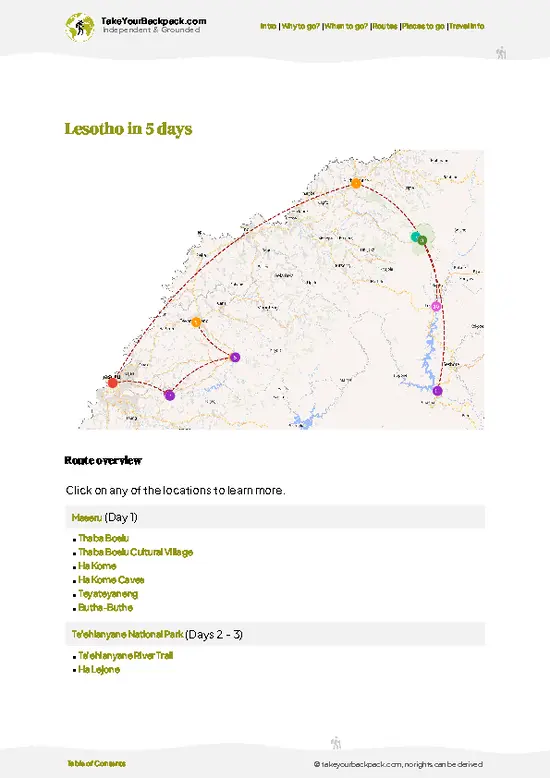
✅ Optimized 2, 3 & 5-day travel routes
✅ Cities, national parks, landmarks, beaches
✅ How to get around
✅ Offline-friendly for travel without Wi-Fi
👉 Click to see all 30+ guide features

📅 Plan smarter in minutes, not weeks
✅ Month by month travel advice
✅ Festivals & national holidays
✅ Budget expectations

🗺️ Go to the right places, skip the overrated ones
✅ Honest pros & cons of destinations
✅ Top hikes, parks & viewpoints
✅ Lesser-known places most travelers miss
✅ Clear “worth it vs skip it” guidance

🛏️ Travel smoothly without rookie mistakes
✅ Best areas to stay
✅ Transport systems explained simply
✅ Common scams & safety advice
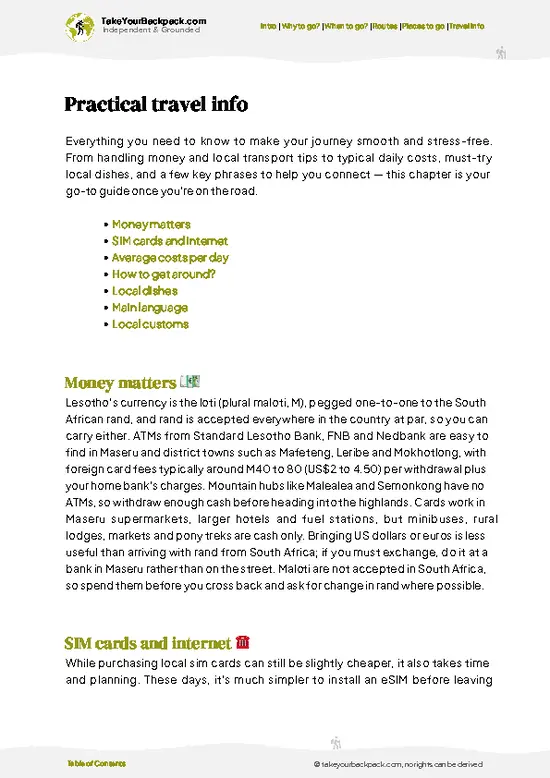
✅ SIM cards, money & practical tips

🌍 Understand the country, not just visit it
✅ Culture & traditions
✅ 52 Essential phrases & customs
✅ Festivals worth planning around
✅ Traveler-friendly historical context
✅ Insights that make places more meaningful

📱 Built for real travel conditions
✅ Fully downloadable PDF
✅ Works completely offline
✅ Optimized for phone use
✅ Useful in remote areas & buses
✅ Everything in one place
Stop searching, start planning
Get instant access to your full guide. 30‑day money-back guarantee.
+ Add another guide for just

By proceeding you agree to our terms.
Sent to your inbox immediately after payment • 100% Secure Checkout
Best Backpacking Travel Advisor 2025 tourism awardBest Backpacking
Travel Advisor
2025
What others say about Take Your Backpack Guides:
⭐⭐⭐⭐⭐
Fantastic, amazing amount of information!
⭐⭐⭐⭐⭐
My goodness this is amazing, it's what I've been looking for hats off too you!
⭐⭐⭐⭐⭐
I think this is absolutely BRILLIANT
⭐⭐⭐⭐
Very complete and informative. It's still missing places, but I gotta to commend you
⭐⭐⭐⭐⭐
This is truly amazing, thank you, can't wait to explore it with my kids!
⭐⭐⭐⭐⭐
Awesome resource, thank you!
⭐⭐⭐⭐⭐
This is amazing! Can't wait to explore the ones I haven't seen
⭐⭐⭐⭐
I love this! Well done, great idea.
⭐⭐⭐⭐⭐
Thanks for taking the time to make this gem!
⭐⭐⭐⭐⭐
This might be the best website I've ever seen.
⭐⭐⭐⭐⭐
Congratulations, and thank you so much for your work; it's incredibly valuable.
⭐⭐⭐⭐
In all seriousness I think you did a great job pointing out the important spots
⭐⭐⭐⭐⭐
10/10 very good
⭐⭐⭐⭐⭐
As someone who's only just starting to visit regularly this is awesome, thank you.
⭐⭐⭐⭐
Thank you very much! I'm going to visit my dad, it's going to be very useful!
⭐⭐⭐⭐⭐
This is really cool! We'll be travelling for the first time and this definitely come in handy.
⭐⭐⭐⭐⭐
You are now our minister of culture, congratulations 👨‍💼
⭐⭐⭐⭐⭐
Just wanted to tell you that this is a pearl! Going to follow your recommendations.
⭐⭐⭐⭐⭐
This is so cool. I'll definitely be using the resource for my travels soon.
⭐⭐⭐⭐⭐
This is very impressive! Good work.
⭐⭐⭐⭐⭐
This is an amazing and informative site. Very well done!

🛏️ Where to stay?Choosing the right base

The best base for Ha Kome Caves is the village of Teyateyaneng (TY), about 30 to 40 minutes by road from the cave settlement, with Maseru as the backup if you want more beds and more company. Teyateyaneng is the Berea District capital, a low-rise town known for its mohair and tapestry-weaving cooperatives (a good half-hour browse), and it has a handful of guesthouses and a couple of small eateries. It is quiet, walkable and safe by day, but you will mostly meet other travelers at the guesthouse itself rather than in a nightlife scene. Expect US$20 to 45 a night for a simple room.

Maseru, roughly … read more 👉
The best base for Ha Kome Caves is the village of Teyateyaneng (TY), about 30 to 40 minutes by road from the cave settlement, with Maseru as the backup if you want more beds and more company. Teyateyaneng is the Berea District capital, a low-rise town known for its mohair and tapestry-weaving cooperatives (a good half-hour browse), and it has a handful of guesthouses and a couple of small eateries. It is quiet, walkable and safe by day, but you will mostly meet other travelers at the guesthouse itself rather than in a nightlife scene. Expect US$20 to 45 a night for a simple room.

Maseru, roughly 1.5 hours by road, has the widest choice, including dorm-style backpacker accommodation at about US$12 to 20 a bed, plus shared minibus taxis that fan out to the rest of the country. It is the place to meet other budget travelers heading to Semonkong, Thaba-Bosiu or the Sani Pass. Stay in the quieter central and Maseru West areas, and keep to taxis after dark.

The cave settlement itself has no formal lodging, so overnighting right there means arranging a homestay through the local community or guides, which is simple, friendly and strictly basic. Book ahead where you can, bring cash in maloti or rand, and plan an early start so you reach the caves before the midday heat.

👛 Costs (as of 22 October 2026)Money, prices, and spending tips

Ha Kome Caves costs about US$45 per day for a backpacker who stays in a basic guesthouse near Maseru or Teyateyaneng and uses shared transport.
CategoryBudget RangeLocal Reality
Accommodation (high season)US$15 to 30Dorm bed or basic room in Maseru or TY. Prices rise in December and January.
Cave entry and guideUS$3 to 8Small fee paid to the local community guide, usually in cash.
TransportUS$5 to 15Minibus taxis to TY cost a few dollars, then a hired car or driver covers the last stretch on gravel.
FoodUS$6 to 12Papa with stew and takeaway meals in town. Self-catering is cheaper.
Water and snacksUS$1 to 3Buy supplies in town, since the village has few shops.
Total Daily BudgetUS$45Increases to US$70 or more if you hire a private driver for the day.
⚠️ Prices can change and everyone travels differently, so take this as a rough guide. Hope it helps you plan your adventure!

FAQCommon questions from travelers

Ha Kome Caves is a cluster of sandstone rock shelters in Berea District, where families of Basotho people still live in mud-walled houses built under the overhangs. The dwellings date back roughly 200 years, to the time of the Difaqane conflicts, when people sought refuge in the rock. The caves lie about 25 km from Teyateyaneng, and a local guide takes you through for a small fee.
Ha Kome Caves needs about 1 to 2 hours on site, since the guided walk through the dwellings is short. Allow a half day from Teyateyaneng or most of a day from Maseru once you factor in the gravel road. If you want to meet villagers and enjoy the surrounding plateau, a night in the area extends the visit comfortably.
To reach Ha Kome Caves, take a minibus taxi from Maseru to Teyateyaneng (about 1 hour, US$2 to 4), then hire a car or driver for the last 20 to 30 minutes on rough gravel. A 4x4 helps after rain, though a regular car with careful driving usually manages in dry weather. Self-drivers from Maseru should allow around 1.5 hours in total and fill the tank in town.
⚠️ Things can change over time, so always validate details locally before you go.

Other Basotho landmarks near Ha Kome Caves

Explore more nearby:

  • Thaba Bosiu—flat-topped mountain, national monument, Basotho stronghold| 23 km away
  • Liphofung Caves—rock art, sandstone shelter, archaeological site| 62 km away
  • Katse Dam—engineering landmark, reservoir views, mountain water project| 63 km away

💡 Not sure where to go next?
Create a personalized itinerary for Lesotho including Ha Kome Caves and the places that fit your trip.

Generate my itinerary

👉 Discover all landmarks

Or checkout all Lesotho has to offer (think cities, towns, villages, national parks, hikes, beaches, festivals)
Country photo of Lesotho

We 💚 feedbackWhat to keep in mind

Ha Kome Caves rewards anyone who looks up. The ceilings are the bare sandstone overhang, black from generations of cooking fires, and that soot says more about daily life than any sign. I would arrive in the morning, wear shoes with grip for the ledge, and ask your guide to point out which walls were replastered recently.

✍️ Help improve this page!
The information on this page is based on in-depth research, insights shared by experienced travelers, and feedback from the local travel community in Lesotho. While every effort is made to keep the information accurate and current, conditions can change — so if you spot anything incorrect or outdated, please get in touch.


🙋‍♂️ Give feedback

👋 Meet the founderWho’s Behind Take Your Backpack?

Johan, backpacker and founder of TakeYourBackpackHi, I’m Johan (Netherlands 🇳🇱), the creator of TakeYourBackpack. Over the past 3 decades, I’ve backpacked through 90+ countries across six continents, gaining extensive experience with independent travel, long-term trips, and overland routes.

This site is built on a combination of firsthand travel experience and carefully curated insights from other backpackers. Many guides are based on places I’ve personally visited, while others bring together tips, observations, and practical advice shared by trusted travelers I’ve met along the way.

The goal is to provide realistic, experience-driven guidance — not generic itineraries — so you can explore destinations with better context, clearer expectations, and more confidence.