×

Madagascar🇲🇬 | hikesLokobe Reserve TrailBlack lemurs, mangrove pirogue, leaf-tailed geckos, ylang-ylang plots | things to do and best time to go

Explore Isalo Window TrailExplore Zombitse-Vohibasia Trail

Backpacking in Lokobe Reserve Trail
By Johan Kruseman 🇳🇱 | Updated October 15, 2026

Lokobe Reserve sits on the southeastern tip of Nosy Be, an island off the northwest coast of Madagascar, and it is best known as the easiest place to see the black lemur in wild forest. Guides lead you in on foot from Ambatozavavy village, so you move through damp leaf litter, mangrove edges and tall humid trees with a ranger who knows each lemur sleeping spot. Trails are short and moderately hilly, roughly 2 to 4 hours, and the nearest town, Hell-Ville, is a taxi or tuk-tuk ride from the departure point. The downside is that many visits start with a pirogue ride, which adds cost. I paid for the ranger at the park hut first, then asked him to point out the tiny leaf-tailed gecko pressed against a trunk, which took him two seconds to find. Unlike Nosy Be's open-sun Mont Passot viewpoint, Lokobe is shaded, quiet and all about animals.

Discover everything you want to know in the 📖 Madagascar Travel Guide.
Best time to go: May - October
Duration: 3 hours
Distance: 5 kilometers
Total ascent: 150 meters


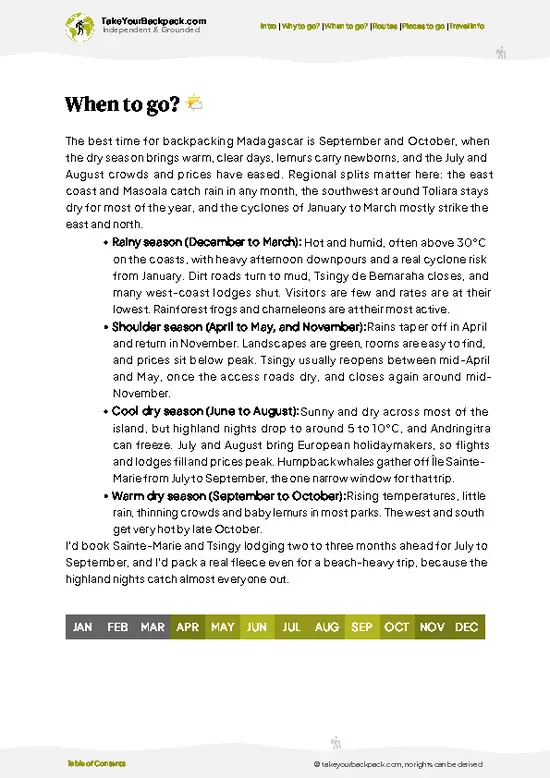
example page 0 from our offline Travel Guide for Madagascar
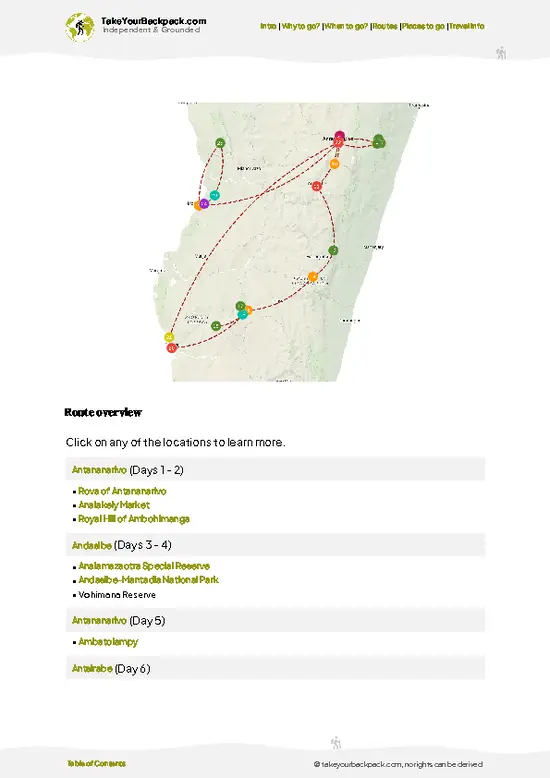
example page 1 from our offline Travel Guide for Madagascar
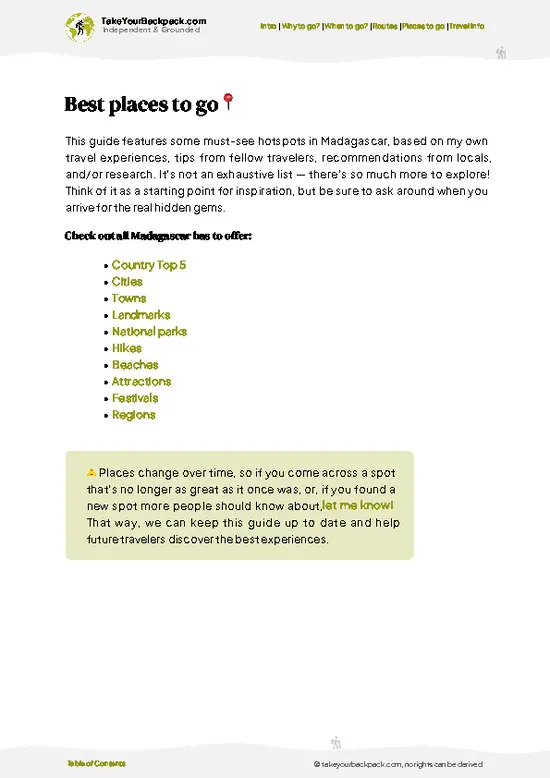
example page 2 from our offline Travel Guide for Madagascar
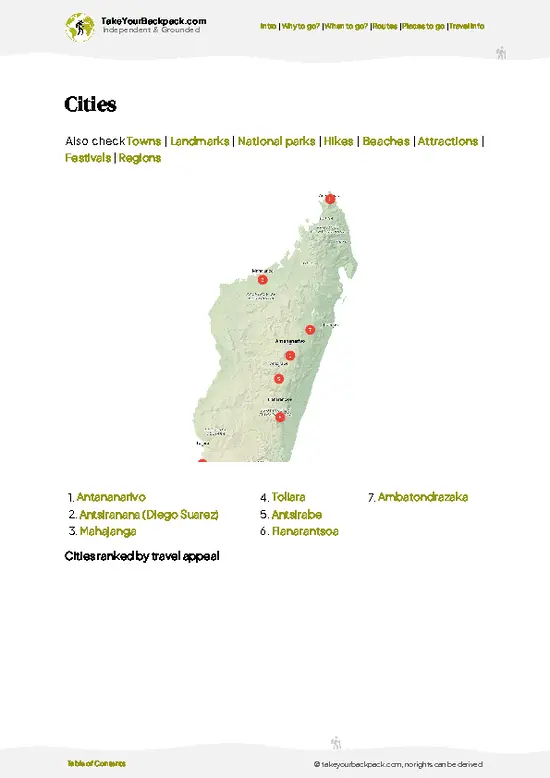
example page 3 from our offline Travel Guide for Madagascar
example page 4 from our offline Travel Guide for Madagascar
example page 5 from our offline Travel Guide for Madagascar
example page 6 from our offline Travel Guide for Madagascar
example page 7 from our offline Travel Guide for Madagascar
Loading the map 🌍
CLICK TO FILTER
cities
towns
landmarks
national parks
hikes
beaches
attractions
festivals
regions
SHOW COUNTRY’S BESTSHOW ALL

✨ Why go?
Ranked #99 hike in Madagascar
What makes it a must-see hike

Backpackers come for the black lemurs of Lokobe and the chance to see them without a multi-day expedition. Few places in northern Madagascar let you meet wild lemurs, chameleons and geckos on a single short walk, and the trail stays under a closed canopy, so you are walking in shade while the island's beaches bake outside. The pirogue crossing from Ambatozavavy is the other draw: a hand-carved outrigger canoe carries you along mangrove shores before you step into the forest, which makes the morning feel like a small journey rather than a tick on a list. Distances are flexible. You can do a quick loop of a couple of hours or ask your ranger for a longer circuit that reaches the ridge and the old village paths. It fits easily into a Nosy Be stay between beach days, snorkeling trips and visits … read more 👉
Backpackers come for the black lemurs of Lokobe and the chance to see them without a multi-day expedition. Few places in northern Madagascar let you meet wild lemurs, chameleons and geckos on a single short walk, and the trail stays under a closed canopy, so you are walking in shade while the island's beaches bake outside. The pirogue crossing from Ambatozavavy is the other draw: a hand-carved outrigger canoe carries you along mangrove shores before you step into the forest, which makes the morning feel like a small journey rather than a tick on a list. Distances are flexible. You can do a quick loop of a couple of hours or ask your ranger for a longer circuit that reaches the ridge and the old village paths. It fits easily into a Nosy Be stay between beach days, snorkeling trips and visits to Nosy Komba or Nosy Tanikely, with no camping gear or planning needed.

💡 HighlightsTop highlights of Lokobe Reserve Trail

  1. Black lemurs (Eulemur macaco): The reserve's headline animal. Males are jet black and females chestnut with white ear tufts, so you can tell the sexes apart at a glance. Rangers know where troops rest during the day.
  2. Mangrove shoreline by pirogue: The approach from Ambatozavavy follows tangled roots and shallow tidal channels. Herons stalk the mud and the hull of the canoe makes the only sound.
  3. Leaf-tailed geckos (Uroplatus): Almost invisible against bark, these reptiles are the guides' favorite party trick. Expect to be told where to look and still need a minute to spot one.
  4. Panther and Parson's chameleons: Slow, color-shifting and often on low branches along the trail. Rangers can usually find a few within the first hour.
  5. Ylang-ylang and forest-edge villages: Paths near the reserve pass small
… read more 👉
  1. Black lemurs (Eulemur macaco): The reserve's headline animal. Males are jet black and females chestnut with white ear tufts, so you can tell the sexes apart at a glance. Rangers know where troops rest during the day.
  2. Mangrove shoreline by pirogue: The approach from Ambatozavavy follows tangled roots and shallow tidal channels. Herons stalk the mud and the hull of the canoe makes the only sound.
  3. Leaf-tailed geckos (Uroplatus): Almost invisible against bark, these reptiles are the guides' favorite party trick. Expect to be told where to look and still need a minute to spot one.
  4. Panther and Parson's chameleons: Slow, color-shifting and often on low branches along the trail. Rangers can usually find a few within the first hour.
  5. Ylang-ylang and forest-edge villages: Paths near the reserve pass small farm plots, fragrant flowering trees and fishing families, which add a human thread to the walk.
Start with the black lemurs, since they are most active and easiest to find in the cooler early morning, before they settle into the canopy for the day.
Spotted a mistake or missing something? Contact us.

🌤️ When to go?Choosing the right time of year

  • Dry Season (May to October): Lokobe is most comfortable from June to September, with daytime highs of 27 to 30°C (81 to 86°F), cooler mornings near 20°C (68°F), and almost no rain, so the forest paths stay firm. Sunrise is around 6:00 and sunset around 17:45. Lemurs and chameleons are easy to spot, and this is also when guides in Hell-Ville and Nosy Be are busiest.
  • Hot, Wet Season (November to April): Expect 30 to 34°C (86 to 93°F), heavy humidity, and downpours that turn the trails to mud. Cyclone risk peaks January to March, and boat crossings can be canceled. Days run longer, about 12.5 hours of light, and prices for guides and boats often dip slightly.
  • Shoulder Months (April to May, October to November): Rain is lighter, forests are green, and crowds thin. Reptiles are active, and you may
… read more 👉
  • Dry Season (May to October): Lokobe is most comfortable from June to September, with daytime highs of 27 to 30°C (81 to 86°F), cooler mornings near 20°C (68°F), and almost no rain, so the forest paths stay firm. Sunrise is around 6:00 and sunset around 17:45. Lemurs and chameleons are easy to spot, and this is also when guides in Hell-Ville and Nosy Be are busiest.
  • Hot, Wet Season (November to April): Expect 30 to 34°C (86 to 93°F), heavy humidity, and downpours that turn the trails to mud. Cyclone risk peaks January to March, and boat crossings can be canceled. Days run longer, about 12.5 hours of light, and prices for guides and boats often dip slightly.
  • Shoulder Months (April to May, October to November): Rain is lighter, forests are green, and crowds thin. Reptiles are active, and you may find some negotiating room on guide fees.
Start the walk by 7:00 to beat both the midday heat and the tour groups landing from the pirogues.


source: climatestotravel.comJANJanuary: below average for travelingFEBFebruary: below average for travelingMARMarch: below average for travelingAPRApril: fair for travelingMAYMay: highly recommended for travelingJUNJune: excellent for travelingJULJuly: excellent for travelingAUGAugust: excellent for travelingSEPSeptember: highly recommended for travelingOCTOctober: highly recommended for travelingNOVNovember: fair for travelingDECDecember: below average for traveling
when-to-go

✈️ The backpacker research shortcutMadagascar Travel Guide

An offline-friendly backpacking guide with optimized travel routes, ranked highlights, transport advice, and the best areas to stay.
example page 0 from our offline Travel Guide for Madagascar
example page 1 from our offline Travel Guide for Madagascar
example page 2 from our offline Travel Guide for Madagascar
example page 3 from our offline Travel Guide for Madagascar
example page 4 from our offline Travel Guide for Madagascar
example page 5 from our offline Travel Guide for Madagascar
example page 6 from our offline Travel Guide for Madagascar
example page 7 from our offline Travel Guide for Madagascar
The digital guide (305 pages) contains:
✅ 96 highlights, ranked by travel appeal
✅ Optimized 7, 14 & 21-day travel routes
✅ Cities, national parks, landmarks, beaches
✅ How to get around
✅ Offline-friendly for travel without Wi-Fi
👉 Click to see all 30+ guide features

📅 Plan smarter in minutes, not weeks
✅ Month by month travel advice
✅ Festivals & national holidays
✅ Budget expectations

🗺️ Go to the right places, skip the overrated ones
✅ Honest pros & cons of destinations
✅ Top hikes, parks & viewpoints
✅ Lesser-known places most travelers miss
✅ Clear “worth it vs skip it” guidance

🛏️ Travel smoothly without rookie mistakes
✅ Best areas to stay
✅ Transport systems explained simply
✅ Common scams & safety advice
✅ SIM cards, money & practical tips

🌍 Understand the country, not just visit it
✅ Culture & traditions
✅ 52 Essential phrases & customs
✅ Festivals worth planning around
✅ Traveler-friendly historical context
✅ Insights that make places more meaningful

📱 Built for real travel conditions
✅ Fully downloadable PDF
✅ Works completely offline
✅ Optimized for phone use
✅ Useful in remote areas & buses
✅ Everything in one place
Stop searching, start planning
Get instant access to your full guide. 30‑day money-back guarantee.
+ Add another guide for just

By proceeding you agree to our terms.
Sent to your inbox immediately after payment • 100% Secure Checkout
Best Backpacking Travel Advisor 2025 tourism awardBest Backpacking
Travel Advisor
2025
What others say about Take Your Backpack Guides:
⭐⭐⭐⭐⭐
Fantastic, amazing amount of information!
⭐⭐⭐⭐⭐
My goodness this is amazing, it's what I've been looking for hats off too you!
⭐⭐⭐⭐⭐
I think this is absolutely BRILLIANT
⭐⭐⭐⭐
Very complete and informative. It's still missing places, but I gotta to commend you
⭐⭐⭐⭐⭐
This is truly amazing, thank you, can't wait to explore it with my kids!
⭐⭐⭐⭐⭐
Awesome resource, thank you!
⭐⭐⭐⭐⭐
This is amazing! Can't wait to explore the ones I haven't seen
⭐⭐⭐⭐
I love this! Well done, great idea.
⭐⭐⭐⭐⭐
Thanks for taking the time to make this gem!
⭐⭐⭐⭐⭐
This might be the best website I've ever seen.
⭐⭐⭐⭐⭐
Congratulations, and thank you so much for your work; it's incredibly valuable.
⭐⭐⭐⭐
In all seriousness I think you did a great job pointing out the important spots
⭐⭐⭐⭐⭐
10/10 very good
⭐⭐⭐⭐⭐
As someone who's only just starting to visit regularly this is awesome, thank you.
⭐⭐⭐⭐
Thank you very much! I'm going to visit my dad, it's going to be very useful!
⭐⭐⭐⭐⭐
This is really cool! We'll be travelling for the first time and this definitely come in handy.
⭐⭐⭐⭐⭐
You are now our minister of culture, congratulations 👨‍💼
⭐⭐⭐⭐⭐
Just wanted to tell you that this is a pearl! Going to follow your recommendations.
⭐⭐⭐⭐⭐
This is so cool. I'll definitely be using the resource for my travels soon.
⭐⭐⭐⭐⭐
This is very impressive! Good work.
⭐⭐⭐⭐⭐
This is an amazing and informative site. Very well done!

🛏️ Where to stay?Choosing the right base

If you enjoy meeting fellow travelers, consider choosing hostels with high ratings for atmosphere. On the other hand, if you prefer having your own space, a hotel might be a better option.

🥾 Hike detailsHike details: route, duration, and difficulty of Lokobe Reserve Trail

Total Distance: Short loops run about 4 to 7 km depending on the route you agree with your ranger.
Duration: 2 to 4 hours of walking, plus the canoe or boat crossing.
Difficulty: Easy to moderate. Paths are uneven, with roots, short slopes and muddy patches after rain.
Starting Point: Ambatozavavy village on the edge of the reserve, reached from Hell-Ville by taxi, tuk-tuk or shared transport, then a short pirogue hop. Rangers wait at the park office.
Major Landmarks:
  • Park office: Where you register and hire a mandatory local guide.
  • Lemur resting areas: Guides check known branches for black lemurs.
  • Mangrove
… read more 👉
Total Distance: Short loops run about 4 to 7 km depending on the route you agree with your ranger.
Duration: 2 to 4 hours of walking, plus the canoe or boat crossing.
Difficulty: Easy to moderate. Paths are uneven, with roots, short slopes and muddy patches after rain.
Starting Point: Ambatozavavy village on the edge of the reserve, reached from Hell-Ville by taxi, tuk-tuk or shared transport, then a short pirogue hop. Rangers wait at the park office.
Major Landmarks:
  • Park office: Where you register and hire a mandatory local guide.
  • Lemur resting areas: Guides check known branches for black lemurs.
  • Mangrove shore: Tidal creeks and aerial roots at the start.
  • Ridge paths: Longer routes climb gently for glimpses of the coast through gaps in the canopy.
Terrain and Scenery: Packed earth, leaf litter, roots and rocky steps beneath a dense canopy. Light is dim, the air smells of damp wood and tidal mud, and the forest is full of insect noise.
Vegetation: Remnant lowland rainforest with mangroves, large hardwoods, vines, ferns and palms.
Wildlife: Black lemurs, chameleons, leaf-tailed geckos, snakes, tree frogs, tropical birds and hawk moths. Wear closed shoes, carry water and bring insect repellent.
⚠️ Hiking info can sometimes be outdated or inaccurate. Before you hit the trail, check the latest conditions with locals. If you do spot anything that's off, I'd love to hear from you, so I can update it for fellow travelers.

🛡️ SafetyScams, Hazards, and Annoyances

Lokobe is a short, well-trodden forest walk where the main problems are heat, humidity, and slippery footing. Trails are narrow and root-covered, and after rain the clay gets greasy, so wear shoes with real grip rather than sandals. Bring at least 1.5 liters of water per person, a hat, and insect repellent, since mosquitoes are active in the shade, especially at dusk. Navigation is not something to attempt alone: the forest paths branch and look alike, and local guides know the routes and where animals roost. Lemurs, chameleons, and snakes are present but harmless if left alone. Do not touch or feed them, keep a few meters back, and skip flash photography. Boat transfers by pirogue can be wet and tippy, so keep phones and cameras in a dry bag and carry cash in a sealed pocket.

FAQTraveler FAQ

Most visitors spend two to four hours on the guided loop through Lokobe, usually after a 30 to 45 minute pirogue or boat transfer from Hell-Ville or Ampasipohy. Longer routes with a night walk add another two to three hours. Starting by 7:00 gives the best chance of seeing black lemurs and sleeping chameleons.
Easy to moderate, with short distances but humid heat and uneven ground. Paths are mostly flat to gently rolling, with a few steep, root-tangled sections that get muddy in the wet months. Expect to cover roughly 4 to 8 kilometers (2.5 to 5 miles), and carry plenty of water.
A local guide is required in practice, and you pay a park entry fee, roughly 55,000 to 60,000 Malagasy ariary (about US$12 to 14), plus a guide fee that is usually negotiated per group, often 40,000 to 80,000 ariary. Tickets are bought at the Madagascar National Parks office or arranged through a Nosy Be tour operator. No separate trekking permit is needed beyond the entry ticket.
⚠️ Things can change over time, so always validate details locally before you go.

Other Malagasy hikes near Lokobe Reserve Trail

Explore more nearby:


💡 Not sure where to go next?
Create a personalized itinerary for Madagascar including Lokobe Reserve Trail and the places that fit your trip.

Generate my itinerary

👉 Discover all hikes

Or checkout all Madagascar has to offer (think cities, towns, villages, national parks, hikes, beaches, festivals)
Country photo of Madagascar

We 💚 feedbackWhat to keep in mind

Go early, ideally at first light, when black lemurs are moving and feeding and the forest is still cool and loud with birds. Midday visits are quieter and hotter. I would bring a small flashlight for dim trail sections and pay the ranger directly at the park office.

✈️ When did I visit Madagascar?
Madagascar I went backpacking in October 2019. With a friend I rented a 4WD and drove around the southern part of Madagascar.

✍️ Help improve this page!
The information on this page is based on my own backpacking experience in Madagascar, supplemented with up-to-date research and feedback from other travelers. Travel details can change, so if you notice anything outdated or incomplete, feel free to let me know.


🙋‍♂️ Give feedback

👋 Meet the founderWho’s Behind Take Your Backpack?

Johan, backpacker and founder of TakeYourBackpackHi, I’m Johan (Netherlands 🇳🇱), the creator of TakeYourBackpack. Over the past 3 decades, I’ve backpacked through 90+ countries across six continents, gaining extensive experience with independent travel, long-term trips, and overland routes.

This site is built on a combination of firsthand travel experience and carefully curated insights from other backpackers. Many guides are based on places I’ve personally visited, while others bring together tips, observations, and practical advice shared by trusted travelers I’ve met along the way.

The goal is to provide realistic, experience-driven guidance — not generic itineraries — so you can explore destinations with better context, clearer expectations, and more confidence.