×

Madagascar🇲🇬 | hikesZombitse-Vohibasia Trailtransitional forest, baobab stands, birdwatching hotspots | things to do and best time to go

Explore Lokobe Reserve TrailExplore Montagne d’Ambre Circuit

Backpacking in Zombitse-Vohibasia Trail
👀 For curious travelershike ranked #8
By Johan Kruseman 🇳🇱 | Updated September 3, 2026

The first real fork in the dusty road at Zombitse-Vohibasia isn’t about which trail to take—it’s whether you’ll sweat it out on foot or just snap a few lemur photos and call it a day. That choice matters, because the Zombitse-Vohibasia Trail isn’t just a stroll; it’s a test of patience and curiosity, winding through the dry, thorny forest of southwest Madagascar, about halfway between Tulear and Isalo. The path is short—usually under two hours—but the heat presses down, and the ground crunches underfoot. You’ll dodge spiny bushes, spot Verreaux’s sifakas leaping like gymnasts, and catch the scent of sun-baked earth. Public transport drops you on the main road, but you’ll hoof it to the park gate. Compared to the lush drama of Andringitra or Ranomafana, Zombitse is raw, scrappy, and less crowded—more grit, less gloss. I’ve finished this trail with red dust in my shoes and a grin on my face, every time.

Discover everything you want to know in the 📖 Madagascar Travel Guide.
Best time to go: April - November
Duration: 2 days
Distance: 25 kilometers
Total ascent: 600 meters
Loading the map 🌍
CLICK TO FILTER
cities
towns
villages
landmarks
national parks
hikes
beaches
attractions
festivals
regions
SHOW COUNTRY’S BESTSHOW ALL

✨ Why go?
Ranked #8 hike in Madagascar
Why Zombitse-Vohibasia Trail should be on your travel list

The Zombitse-Vohibasia Trail in Madagascar is a backpacker’s playground, where the scenery-to-effort ratio is off the charts. You’ll trek through a mix of dry deciduous forest and lush greenery, spotting unique wildlife like the Verreaux’s sifaka and chameleons that pop against the backdrop. The trail is accessible via public transport, making it easy to hop on a taxi-brousse from nearby towns.

Cost? Minimal. You’ll spend a few bucks on entry fees and maybe a local guide, but the experience is priceless. The trail offers flexible distances, allowing you to customize your hike based on your energy levels or time constraints.

This hike fits seamlessly into a longer backpacking route, serving as a perfect pit stop between Morondava and Isalo National Park. After a day of sweating it out on … read more 👉
The Zombitse-Vohibasia Trail in Madagascar is a backpacker’s playground, where the scenery-to-effort ratio is off the charts. You’ll trek through a mix of dry deciduous forest and lush greenery, spotting unique wildlife like the Verreaux’s sifaka and chameleons that pop against the backdrop. The trail is accessible via public transport, making it easy to hop on a taxi-brousse from nearby towns.

Cost? Minimal. You’ll spend a few bucks on entry fees and maybe a local guide, but the experience is priceless. The trail offers flexible distances, allowing you to customize your hike based on your energy levels or time constraints.

This hike fits seamlessly into a longer backpacking route, serving as a perfect pit stop between Morondava and Isalo National Park. After a day of sweating it out on the trail, you’ll be rewarded with a cold beer at a local shack, savoring the moment as the sun dips below the horizon. It’s not just a hike; it’s a slice of Madagascar’s soul.
Want to include Zombitse-Vohibasia Trail in your Madagascar route?
Create a personalized Madagascar itinerary that includes Zombitse-Vohibasia Trail and the places that fit your trip — based on your travel style, budget, and available time. Get your route in seconds.

Generate my trip

💡 HighlightsMust-see experiences and standout moments

  1. Appert’s tetraka and endemic birdlife — This park is one of the few reliable places to see true southwestern endemics, so the dawn chorus is special: thin, focused, and full of birds you won’t hear elsewhere. Expect skulking tetrakas, several coua species and other dry-forest specialists that make every early start feel worthwhile. (Personal favorite — nothing beats the first hour of bird activity.)
  2. Nocturnal lemur encounters — Guided night walks turn the forest magical: tiny mouse lemurs, sportive lemurs and other nocturnal species peek and hop through the understory. Encounters are intimate rather than theatrical — close-up, quiet, and perfectly suited to a headlamp and patience.
  3. Transitional dry-deciduous to spiny vegetation — Zombitse sits where two very different Malagasy ecosystems
read more 👉
  1. Appert’s tetraka and endemic birdlife — This park is one of the few reliable places to see true southwestern endemics, so the dawn chorus is special: thin, focused, and full of birds you won’t hear elsewhere. Expect skulking tetrakas, several coua species and other dry-forest specialists that make every early start feel worthwhile. (Personal favorite — nothing beats the first hour of bird activity.)
  2. Nocturnal lemur encounters — Guided night walks turn the forest magical: tiny mouse lemurs, sportive lemurs and other nocturnal species peek and hop through the understory. Encounters are intimate rather than theatrical — close-up, quiet, and perfectly suited to a headlamp and patience.
  3. Transitional dry-deciduous to spiny vegetation — Zombitse sits where two very different Malagasy ecosystems meet, so the mix of gnarled dry-forest trees, spiny succulents and seasonally leafless silhouettes feels like nowhere else. The shapes and textures of the plants are great for slow-walking and photography; odd orchids and epiphytes turn up if you look closely.
  4. Sandstone outcrops and panoramic viewpoints — Short climbs lead to rocky ledges that open onto wide views of the surrounding plains and the distant Isalo massif; sunsets here can be unexpectedly dramatic. The viewpoints are compact and easy to reach, so you get big scenery without a long slog.
  5. Local Bara culture and zebu-landscapes — The trail threads through territory used by Bara herders, so you often pass simple cattle tracks, grazing zebu and small village clearings. It’s a good place to see how people and landscape interact in the south — practical, unvarnished, and often friendly if you stop to chat.
Spotted a mistake or missing something? Contact us.
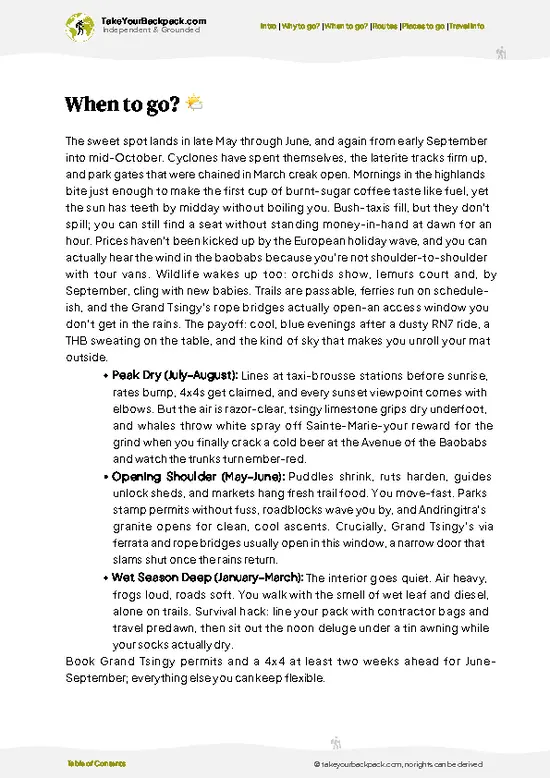
🌤️ When to go?Best time to hike the Zombitse-Vohibasia Trail


  • Weather: The dry season from April to November is your best bet. Expect minimal rain, which means trails stay firm and manageable. The wet season (December to March) turns paths into slippery mud traps and brings relentless downpours.

  • Temperature: Daytime temps hover between 20-28°C (68-82°F) during the dry months, perfect for hiking without overheating. Nights can dip to 10-15°C (50-59°F), so pack layers for early mornings and evenings.

  • Daylight Hours: Madagascar’s near-equatorial position keeps daylight steady year-round, roughly 11-12 hours daily. This gives you ample time to push through the trail without rushing.

  • Crowds: The trail sees fewer visitors outside July and August, when European holidays boost numbers. For solitude and a more raw experience, aim for shoulder months
read more 👉

  • Weather: The dry season from April to November is your best bet. Expect minimal rain, which means trails stay firm and manageable. The wet season (December to March) turns paths into slippery mud traps and brings relentless downpours.

  • Temperature: Daytime temps hover between 20-28°C (68-82°F) during the dry months, perfect for hiking without overheating. Nights can dip to 10-15°C (50-59°F), so pack layers for early mornings and evenings.

  • Daylight Hours: Madagascar’s near-equatorial position keeps daylight steady year-round, roughly 11-12 hours daily. This gives you ample time to push through the trail without rushing.

  • Crowds: The trail sees fewer visitors outside July and August, when European holidays boost numbers. For solitude and a more raw experience, aim for shoulder months like May or September.

  • Seasonal Activities: Dry months coincide with better wildlife spotting—lemurs and endemic birds are more active and visible. Wet season dampens animal activity and trail accessibility.

  • Price Fluctuations: Peak dry season, especially July-August, drives up accommodation and guide fees. Traveling just before or after this window can save you cash without sacrificing conditions.


Pro-tip: Start your hike early in the dry season to catch crisp mornings, avoid crowds, and lock in better rates—then let the trail’s raw energy fuel your day.


source: climatestotravel.comJANJanuary: below average for travelingFEBFebruary: below average for travelingMARMarch: below average for travelingAPRApril: highly recommended for travelingMAYMay: excellent for travelingJUNJune: highly recommended for travelingJULJuly: highly recommended for travelingAUGAugust: highly recommended for travelingSEPSeptember: excellent for travelingOCTOctober: excellent for travelingNOVNovember: highly recommended for travelingDECDecember: below average for traveling
when-to-go

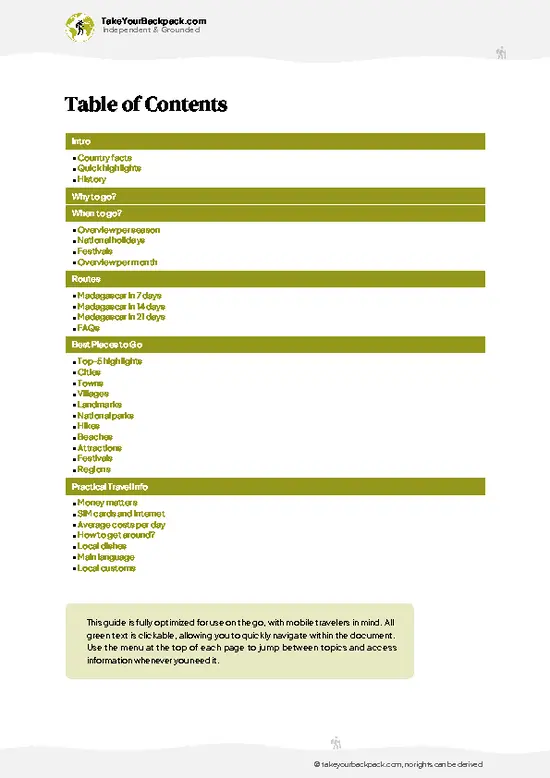
✈️ The backpacker research shortcutMadagascar Travel Guide

An offline-friendly backpacking guide with optimized travel routes, ranked highlights, transport advice, and the best areas to stay.
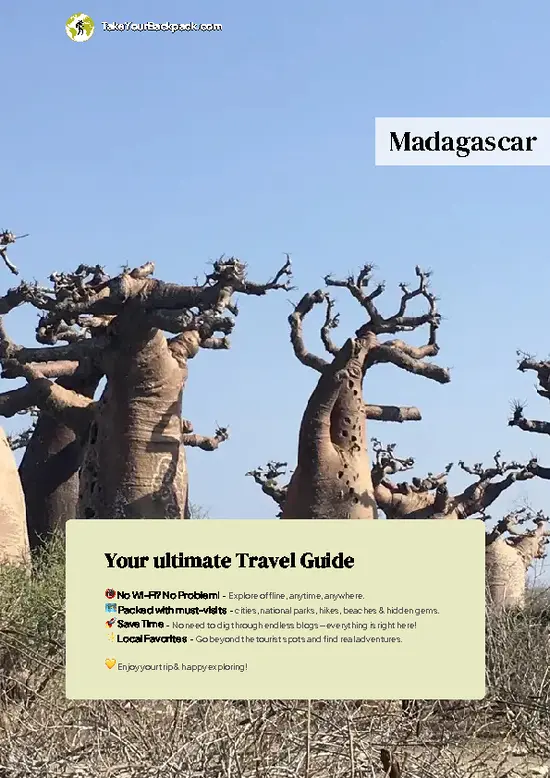
example page 0 from our offline Travel Guide for Madagascar
example page 1 from our offline Travel Guide for Madagascar
example page 2 from our offline Travel Guide for Madagascar
example page 3 from our offline Travel Guide for Madagascar
example page 4 from our offline Travel Guide for Madagascar
example page 5 from our offline Travel Guide for Madagascar
example page 6 from our offline Travel Guide for Madagascar
example page 7 from our offline Travel Guide for Madagascar
The digital guide (418 pages) contains:
110 highlights, ranked by travel appeal
Optimized 7, 14 & 21-day travel routes
Cities, national parks, landmarks, beaches
How to get around
Offline-friendly for travel without Wi-Fi
👉 Click to see all 30+ guide features

📅 Plan smarter in minutes, not weeks
Month by month travel advice
Festivals & national holidays
Budget expectations

🗺️ Go to the right places, skip the overrated ones
Honest pros & cons of destinations
Top hikes, parks & viewpoints
Lesser-known places most travelers miss
Clear “worth it vs skip it” guidance

🛏️ Travel smoothly without rookie mistakes
Best areas to stay
Transport systems explained simply
Common scams & safety advice
SIM cards, money & practical tips

🌍 Understand the country, not just visit it
Culture & traditions
52 Essential phrases & customs
Festivals worth planning around
Traveler-friendly historical context
Insights that make places more meaningful

📱 Built for real travel conditions
Fully downloadable PDF
Works completely offline
Optimized for phone use
Useful in remote areas & buses
Everything in one place
Save weeks of stressful planning
Get instant access to your full guide. 30‑day money-back guarantee.
+ Add another guide for just US$7.80

By proceeding you agree to our terms.
Sent to your inbox immediately after payment • 100% Secure Checkout
Best Backpacking Travel Advisor 2025 tourism awardBest Backpacking
Travel Advisor
2025
What others say about Take Your Backpack Guides:
⭐⭐⭐⭐⭐
Fantastic, amazing amount of information!
⭐⭐⭐⭐⭐
My goodness this is amazing, it's what I've been looking for hats off too you!
⭐⭐⭐⭐⭐
I think this is absolutely BRILLIANT
⭐⭐⭐⭐
Very complete and informative. It's still missing places, but I gotta to commend you
⭐⭐⭐⭐⭐
This is truly amazing, thank you, can't wait to explore it with my kids!
⭐⭐⭐⭐⭐
Awesome resource, thank you!
⭐⭐⭐⭐⭐
This is amazing! Can't wait to explore the ones I haven't seen
⭐⭐⭐⭐
I love this! Well done, great idea.
⭐⭐⭐⭐⭐
Thanks for taking the time to make this gem!
⭐⭐⭐⭐⭐
This might be the best website I've ever seen.
⭐⭐⭐⭐⭐
Congratulations, and thank you so much for your work; it's incredibly valuable.
⭐⭐⭐⭐
In all seriousness I think you did a great job pointing out the important spots
⭐⭐⭐⭐⭐
10/10 very good
⭐⭐⭐⭐⭐
As someone who's only just starting to visit regularly this is awesome, thank you.
⭐⭐⭐⭐
Thank you very much! I'm going to visit my dad, it's going to be very useful!
⭐⭐⭐⭐⭐
This is really cool! We'll be travelling for the first time and this definitely come in handy.
⭐⭐⭐⭐⭐
You are now our minister of culture, congratulations 👨‍💼
⭐⭐⭐⭐⭐
Just wanted to tell you that this is a pearl! Going to follow your recommendations.
⭐⭐⭐⭐⭐
This is so cool. I'll definitely be using the resource for my travels soon.
⭐⭐⭐⭐⭐
This is very impressive! Good work.
⭐⭐⭐⭐⭐
This is an amazing and informative site. Very well done!

🛏️ Where to stay?Choosing the right base

If you enjoy meeting fellow travelers, consider choosing hostels with high ratings for atmosphere. On the other hand, if you prefer having your own space, a hotel might be a better option.

🥾 Hike detailsTrail overview: what to expect on the hike

Total Distance: Approximately 10 kilometers (6.2 miles) round trip.

Estimated Duration: Expect to spend about 4 to 6 hours on the trail, depending on your pace and how often you stop to soak in the sights.

Difficulty Level: Moderate. There are some steep sections and uneven terrain, so a decent level of fitness is recommended, but it’s not overly technical.

Starting Point: The trailhead is located near the Zombitse-Vohibasia National Park entrance. To get there, take a taxi-brousse (shared minibus) from Toliara to the village of Betroka. From Betroka, you can catch another taxi-brousse or … read more 👉
Total Distance: Approximately 10 kilometers (6.2 miles) round trip.

Estimated Duration: Expect to spend about 4 to 6 hours on the trail, depending on your pace and how often you stop to soak in the sights.

Difficulty Level: Moderate. There are some steep sections and uneven terrain, so a decent level of fitness is recommended, but it’s not overly technical.

Starting Point: The trailhead is located near the Zombitse-Vohibasia National Park entrance. To get there, take a taxi-brousse (shared minibus) from Toliara to the village of Betroka. From Betroka, you can catch another taxi-brousse or arrange a local taxi to take you to the park entrance.

Major Landmarks Along the Route:
  • Park Entrance: A small hut where you can pay the entrance fee and get a map.
  • Viewpoints: There are several spots along the way with breathtaking views of the surrounding landscape.
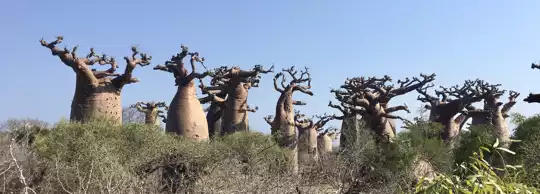
  • Baobab Trees: Iconic Madagascar baobabs dot the trail, offering great photo ops.

Type of Terrain and Scenery: The trail features a mix of rocky paths, dirt trails, and some muddy sections after rain. You’ll wander through dry deciduous forests, open grasslands, and rocky outcrops, making for a diverse hiking experience. The scenery shifts from dense foliage to sweeping vistas, so keep your camera handy.

Typical Vegetation and Wildlife:
  • Vegetation: Expect to see a variety of endemic plants, including spiny forest flora, baobabs, and various types of ferns.
  • Wildlife: Keep your eyes peeled for lemurs, particularly the Verreaux’s sifaka, as well as chameleons and a range of bird species. The park is a haven for birdwatchers.

This trail is a gem for those looking to experience Madagascar’s unique biodiversity without the crowds. Just be sure to bring plenty of water, snacks, and a good sense of adventure!
⚠️ Hiking info can sometimes be outdated or inaccurate. Before you hit the trail, check the latest conditions with locals. If you do spot anything that's off, I'd love to hear from you, so I can update it for fellow travelers.

🛡️ SafetyStaying Safe: What Travelers Should Know

The Zombitse-Vohibasia Trail is a thrilling mix of rugged beauty and manageable challenges. Expect variable weather; the sun can blaze, then rain can sweep in unexpectedly. Dress in layers and pack a lightweight poncho. The terrain is mostly well-marked, but some sections can be steep and rocky. Watch your footing, especially on descents, and take your time navigating the occasional river crossing.

Wildlife encounters are part of the magic here. Keep your distance from lemurs and other critters; they’re curious but can be unpredictable. Stay calm and respect their space.

First-timers often underestimate the trail’s length. Start early to savor the experience and avoid the midday heat. A solid pair of hiking boots and trekking poles can make a world of difference. Embrace the sweat; the … read more 👉
The Zombitse-Vohibasia Trail is a thrilling mix of rugged beauty and manageable challenges. Expect variable weather; the sun can blaze, then rain can sweep in unexpectedly. Dress in layers and pack a lightweight poncho. The terrain is mostly well-marked, but some sections can be steep and rocky. Watch your footing, especially on descents, and take your time navigating the occasional river crossing.

Wildlife encounters are part of the magic here. Keep your distance from lemurs and other critters; they’re curious but can be unpredictable. Stay calm and respect their space.

First-timers often underestimate the trail’s length. Start early to savor the experience and avoid the midday heat. A solid pair of hiking boots and trekking poles can make a world of difference. Embrace the sweat; the reward is a stunning view and the satisfaction of conquering the trail.

FAQCommon questions from travelers

The Zombitse-Vohibasia Trail hike typically takes about 3 to 4 hours to complete, covering roughly 7 kilometers. It is usually done as a half-day hike, allowing time to observe wildlife and the unique dry forest ecosystem.
The hike is considered moderate in difficulty, with some uneven terrain and occasional steep sections. It is suitable for most hikers with a reasonable level of fitness, but proper footwear is recommended due to rocky paths.
Yes, a guide is required to hike the Zombitse-Vohibasia Trail, and a permit must be purchased at the park entrance. The guide fee is usually around 20,000 Ariary, and the permit costs about 25,000 Ariary, both payable locally.
⚠️ Things can change over time, so always validate details locally before you go.

Other Malagasy hikes near Zombitse-Vohibasia Trail

Explore more nearby:


💡 Not sure where to go next?
Create a personalized itinerary for Madagascar including Zombitse-Vohibasia Trail and the places that fit your trip.

Generate my itinerary

👉 Discover all hikes

Or checkout all Madagascar has to offer (think cities, towns, villages, national parks, hikes, beaches, festivals)
Country photo of Madagascar

We 💚 feedbackKey takeaways before you go

The Zombitse-Vohibasia Trail is a wild ride through Madagascar’s unique ecosystem. You’ll feel the pulse of the forest, hear the calls of lemurs, and spot rare birds that make every step worthwhile. But be ready for the heat and humidity; it can drain your energy fast. Bring plenty of water and pace yourself. The payoff? Those breathtaking views and the sheer thrill of being in such an untouched paradise.

✈️ When did I visit Madagascar?
Madagascar I went backpacking in October 2019. With a friend I rented a 4WD and drove around the southern part of Madagascar.

✍️ Help improve this page!
The information on this page is based on my own backpacking experience in Madagascar, supplemented with up-to-date research and feedback from other travelers. Travel details can change, so if you notice anything outdated or incomplete, feel free to let me know.


🙋‍♂️ Give feedback

👋 Meet the founderWho’s Behind Take Your Backpack?

Johan, backpacker and founder of TakeYourBackpackHi, I’m Johan (Netherlands 🇳🇱), the creator of TakeYourBackpack. Over the past decade, I’ve backpacked through 80+ countries across six continents, gaining extensive experience with independent travel, long-term trips, and overland routes.

This site is built on a combination of firsthand travel experience and carefully curated insights from other backpackers. Many guides are based on places I’ve personally visited, while others bring together tips, observations, and practical advice shared by trusted travelers I’ve met along the way.

The goal is to provide realistic, experience-driven guidance — not generic itineraries — so you can explore destinations with better context, clearer expectations, and more confidence.

Get full Madagascar guide •
Instant download • 110 highlights • Full Offline guide