×

Malawi🇲🇼 | best citiesBest cities in Malawi

Cities in Malawi are small, low-rise and loud with life: minibus conductors shouting destinations, charcoal smoke at dusk, roadside tomato pyramids, the hum of tailors’ sewing machines under veranda roofs. The country has no sprawling megacity, so the differences come from geography. The capital and commercial hubs in the Central and Southern Regions are dusty, practical and cheap, with the best markets and transport links. The lakeshore towns trade traffic for fishing canoes, mango trees and sand underfoot, but cost more. Northern towns are cooler, greener and far less visited. For backpackers and independent travelers, minibuses make everything reachable, though slowly.

By Johan Kruseman 🇳🇱 | Updated October 19, 2026
Explore the best towns in Malawi

Why go?Understanding Their Importance

Malawi is a landlocked, densely farmed country of roughly 20 million people, and most of them live in villages. That shapes its cities. They grew around colonial administration, trade routes and the shores of Lake Malawi, so they work as market and transport centers rather than monument-filled urban cores. Expect compact, walkable centers, red-dirt side streets, tin-roofed stalls, and the smell of fried cassava and woodsmoke. Formal sightseeing is limited. The appeal is daily life, craft markets, and the speed at which a city gives way to lake, escarpment or hills.

The Great Rift Valley is the geographic logic behind it all. Altitude changes temperature sharply, so a town on the lake can feel entirely different from one on a plateau only a few hours away. Infrastructure is the main thing … read more 👉
Malawi is a landlocked, densely farmed country of roughly 20 million people, and most of them live in villages. That shapes its cities. They grew around colonial administration, trade routes and the shores of Lake Malawi, so they work as market and transport centers rather than monument-filled urban cores. Expect compact, walkable centers, red-dirt side streets, tin-roofed stalls, and the smell of fried cassava and woodsmoke. Formal sightseeing is limited. The appeal is daily life, craft markets, and the speed at which a city gives way to lake, escarpment or hills.

The Great Rift Valley is the geographic logic behind it all. Altitude changes temperature sharply, so a town on the lake can feel entirely different from one on a plateau only a few hours away. Infrastructure is the main thing to understand before choosing Malawi for its cities. Power cuts and fuel shortages are common, ATMs sometimes fail, and distances take longer than the map suggests because roads are shared with bicycles, goats and overloaded minibuses. Card payments are patchy, so carry kwacha. In return, you get a country where people greet you, bargain cheerfully and have time to talk, which suits travelers who prefer texture over checklists.
How the List Was Created
The list of best cities in Malawi is created based on culture, vibe, attractions, transport ease, and local charm. If you feel a city is missing in this list, please let us know.

When to go?Optimal Periods for Travel

Best months for city travel: The best months are May to August, when the dry season brings clear blue skies, dust-free mornings and daytime highs of about 22 to 28°C, so walking markets and waiting for minibuses is comfortable. Rain is almost absent between May and October.
Shoulder seasons: September to November turns hot and dry, with temperatures reaching 30 to 36°C in the Lower Shire and along the lakeshore. Jacaranda and mango blossom appear, haze builds, and the light turns orange at dusk. Low-lying southern towns are the hardest to bear in October. April and early May are green and warm after the rains, and a good compromise before prices and crowds shift.
Rainy season: November to April brings heavy downpours, often as afternoon storms, with annual rainfall of roughly 700 to 1,400 mm … read more 👉
Best months for city travel: The best months are May to August, when the dry season brings clear blue skies, dust-free mornings and daytime highs of about 22 to 28°C, so walking markets and waiting for minibuses is comfortable. Rain is almost absent between May and October.
Shoulder seasons: September to November turns hot and dry, with temperatures reaching 30 to 36°C in the Lower Shire and along the lakeshore. Jacaranda and mango blossom appear, haze builds, and the light turns orange at dusk. Low-lying southern towns are the hardest to bear in October. April and early May are green and warm after the rains, and a good compromise before prices and crowds shift.
Rainy season: November to April brings heavy downpours, often as afternoon storms, with annual rainfall of roughly 700 to 1,400 mm depending on altitude. Streets turn to red mud, unsealed roads slow transport, and humidity is thick. The rains are heaviest from December to March, and the Northern Region and highlands stay wettest and coolest. Mosquito pressure peaks too.
Prices and crowds: July and August, plus the December holidays, are the busiest times on the lakeshore, when lodges fill and room rates can rise 20 to 40 percent. City markets and minibuses stay about the same price year-round. Nights from June to August can drop to 8 to 12°C in highland towns, so pack a fleece.

city hoppingOptimizing Your Multi-Stop Itinerary

How many days to plan: A trip combining several cities in Malawi needs 10 to 14 days, because even short distances eat hours. Allow 2 to 3 nights per stop, which gives time to see markets, handle money and laundry, and recover from the road.
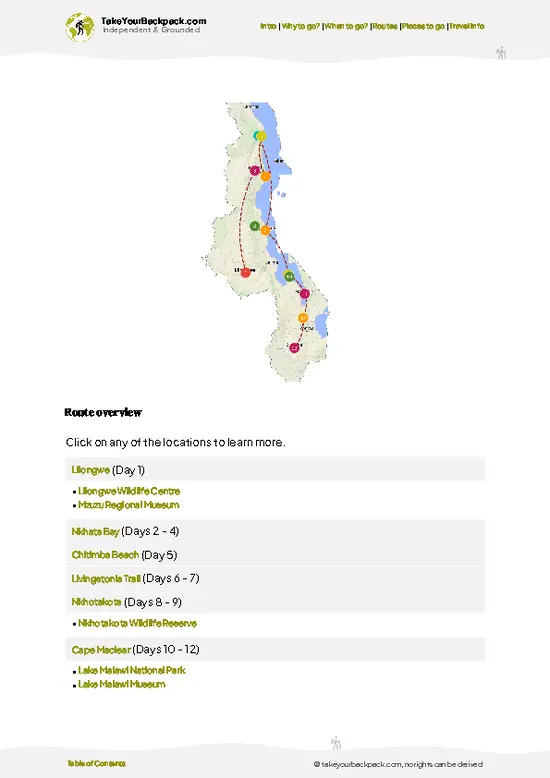
Grouping regions and direction: The Central and Southern Regions group easily along the main M1 and M5 corridors, with Lilongwe and Blantyre as the main transport hubs. Travel between them takes roughly 4 to 5 hours by minibus or coach. The lakeshore connects off the M5, adding 2 to 4 hours from either hub. Northern towns lie 6 to 10 hours further along the M1, so treat the north as its own leg. The most sensible direction is a loop or a line from south to north, ending where your flight home leaves from, usually Lilongwe, so the longest, most tiring stretch … read more 👉
How many days to plan: A trip combining several cities in Malawi needs 10 to 14 days, because even short distances eat hours. Allow 2 to 3 nights per stop, which gives time to see markets, handle money and laundry, and recover from the road.
Grouping regions and direction: The Central and Southern Regions group easily along the main M1 and M5 corridors, with Lilongwe and Blantyre as the main transport hubs. Travel between them takes roughly 4 to 5 hours by minibus or coach. The lakeshore connects off the M5, adding 2 to 4 hours from either hub. Northern towns lie 6 to 10 hours further along the M1, so treat the north as its own leg. The most sensible direction is a loop or a line from south to north, ending where your flight home leaves from, usually Lilongwe, so the longest, most tiring stretch comes when you are rested.
Planning mistakes: The classic error is judging by map distance. Roads are narrow, minibuses wait until full, and a stated 3-hour ride can take 5. Book nothing tight on the same day. Another mistake is cramming north, center and south into a week, which leaves only bus windows to look through. Choose two regions and go deep. Leave mornings for long rides, since buses are cooler and fewer after 3 pm, and arrive before dark, when finding a room becomes harder.

The ListTop cities of Malawi

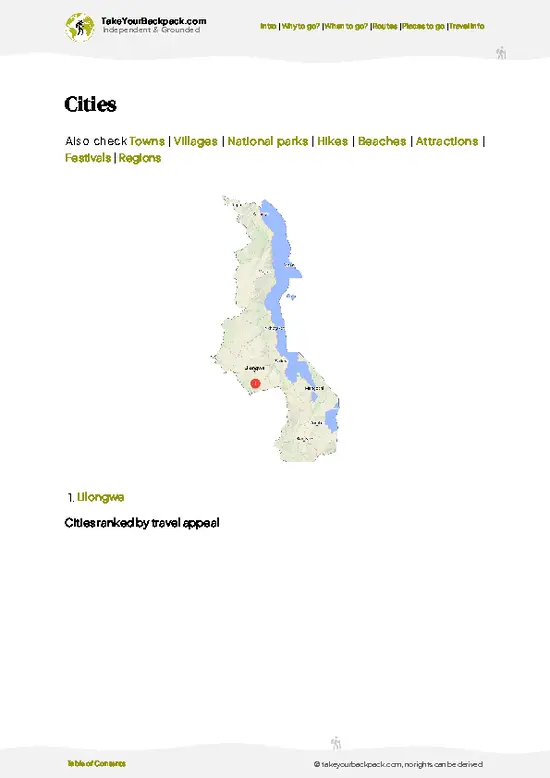
1 Lilongwe

government center, sprawling layout, wildlife sanctuary, local markets

Navigate a city split between modern government zones and traditional markets, with green spaces and wildlife never far from daily life.

malawi-city-lilongwe
© Google |
Loading the map 🌍

Expert viewInsights from Locals and Experts

How many cities to visit: I advise three to four cities on a typical trip of two weeks. Any more and you spend your days in minibus yards, wedged between sacks of maize, watching the clock. Three stops leave room for slow afternoons at a market, a long lunch of grilled fish and nsima, and unplanned detours when someone invites you to a football match or church choir.
Choosing the kind of city: Match the type to your style. Capital and commercial cities suit travelers who want craft markets, supplies, banks and onward transport, and they have the cheapest food. Lakeshore towns suit those who want sand, snorkeling and sunsets with a cold Carlsberg or Kuche Kuche beer, but they cost more and feel quieter. Northern towns suit slow travelers who want cool air, green hills and few other foreigners. … read more 👉
How many cities to visit: I advise three to four cities on a typical trip of two weeks. Any more and you spend your days in minibus yards, wedged between sacks of maize, watching the clock. Three stops leave room for slow afternoons at a market, a long lunch of grilled fish and nsima, and unplanned detours when someone invites you to a football match or church choir.
Choosing the kind of city: Match the type to your style. Capital and commercial cities suit travelers who want craft markets, supplies, banks and onward transport, and they have the cheapest food. Lakeshore towns suit those who want sand, snorkeling and sunsets with a cold Carlsberg or Kuche Kuche beer, but they cost more and feel quieter. Northern towns suit slow travelers who want cool air, green hills and few other foreigners. Mixing one of each is usually the best balance.
What it costs: Budget US$25 to 45 a day (about MWK 43,000 to 78,000) for a dorm or simple guesthouse, street food and minibuses. Dorm beds run roughly US$7 to 15, private rooms US$15 to 40, and a plate of chicken and nsima at a local eatery about US$1.50 to 3. Short minibus hops cost US$1 to 4, and long runs between hubs US$5 to 12. Museum and market entry is usually free or under US$5, and a local guide for half a day costs US$10 to 25. Taxi and motorbike rides within town are US$1 to 4, but agree on the price first.
Safety and culture: Malawi is among the friendlier countries in Africa, but petty theft around bus stations and crowded markets is real. Keep phones in front pockets, avoid walking after dark, and take a registered taxi at night. Use hotel safes for cash, since ATMs can be empty. Dress modestly, especially in Muslim-majority lakeshore areas, and cover shoulders and knees. Greet people before asking anything, which opens doors, and ask before photographing anyone. Bargaining is expected at craft stalls, but keep it good-humored. Carry small kwacha notes, because change is scarce, and expect power cuts, so keep a headlamp and a charged power bank. Malaria prophylaxis, a net and repellent matter in every low-lying town.

✈️ The backpacker research shortcutMalawi Travel Guide

An offline-friendly backpacking guide with optimized travel routes, ranked highlights, transport advice, and the best areas to stay.
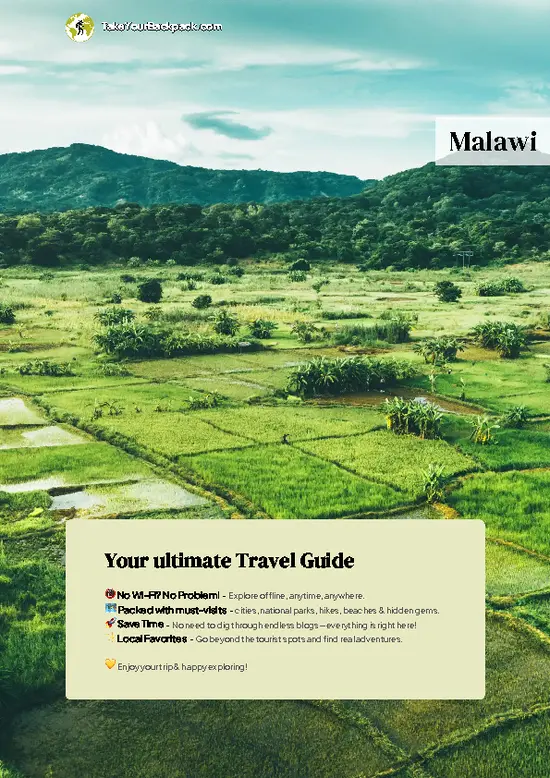
example page 0 from our offline Travel Guide for Malawi
example page 1 from our offline Travel Guide for Malawi
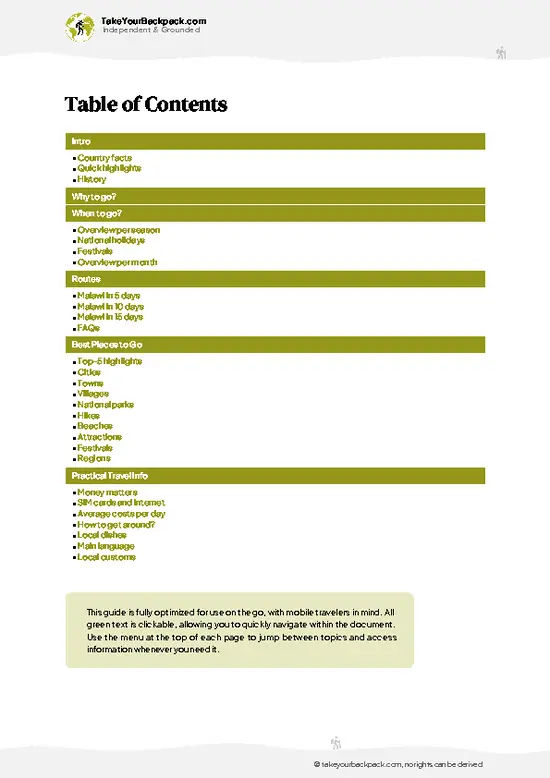
example page 2 from our offline Travel Guide for Malawi
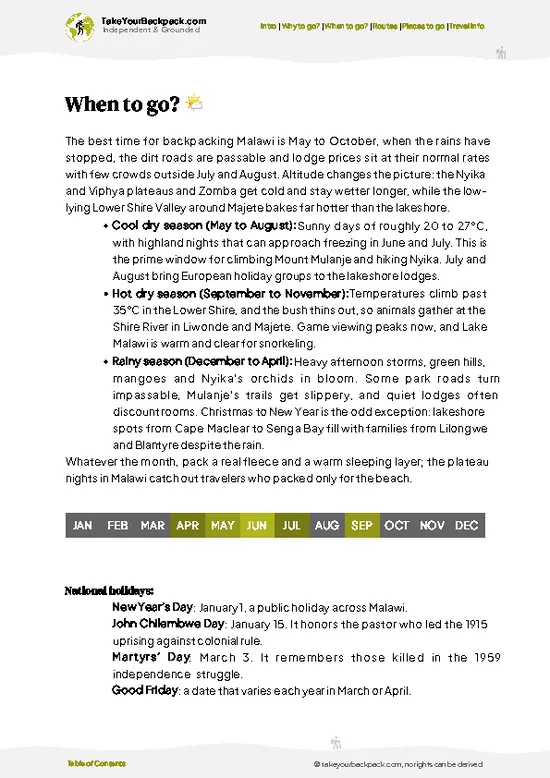
example page 3 from our offline Travel Guide for Malawi
example page 4 from our offline Travel Guide for Malawi
example page 5 from our offline Travel Guide for Malawi
example page 6 from our offline Travel Guide for Malawi
example page 7 from our offline Travel Guide for Malawi
The digital guide (263 pages) contains:
✅ 65 highlights, ranked by travel appeal
✅ Optimized 5, 10 & 15-day travel routes
✅ Cities, national parks, landmarks, beaches
✅ How to get around
✅ Offline-friendly for travel without Wi-Fi
👉 Click to see all 30+ guide features

📅 Plan smarter in minutes, not weeks
✅ Month by month travel advice
✅ Festivals & national holidays
✅ Budget expectations

🗺️ Go to the right places, skip the overrated ones
✅ Honest pros & cons of destinations
✅ Top hikes, parks & viewpoints
✅ Lesser-known places most travelers miss
✅ Clear “worth it vs skip it” guidance

🛏️ Travel smoothly without rookie mistakes
✅ Best areas to stay
✅ Transport systems explained simply
✅ Common scams & safety advice
✅ SIM cards, money & practical tips

🌍 Understand the country, not just visit it
✅ Culture & traditions
✅ 52 Essential phrases & customs
✅ Festivals worth planning around
✅ Traveler-friendly historical context
✅ Insights that make places more meaningful

📱 Built for real travel conditions
✅ Fully downloadable PDF
✅ Works completely offline
✅ Optimized for phone use
✅ Useful in remote areas & buses
✅ Everything in one place
Stop searching, start planning
Get instant access to your full guide. 30‑day money-back guarantee.
+ Add another guide for just

By proceeding you agree to our terms.
Sent to your inbox immediately after payment • 100% Secure Checkout
Best Backpacking Travel Advisor 2025 tourism awardBest Backpacking
Travel Advisor
2025
What others say about Take Your Backpack Guides:
⭐⭐⭐⭐⭐
Fantastic, amazing amount of information!
⭐⭐⭐⭐⭐
My goodness this is amazing, it's what I've been looking for hats off too you!
⭐⭐⭐⭐⭐
I think this is absolutely BRILLIANT
⭐⭐⭐⭐
Very complete and informative. It's still missing places, but I gotta to commend you
⭐⭐⭐⭐⭐
This is truly amazing, thank you, can't wait to explore it with my kids!
⭐⭐⭐⭐⭐
Awesome resource, thank you!
⭐⭐⭐⭐⭐
This is amazing! Can't wait to explore the ones I haven't seen
⭐⭐⭐⭐
I love this! Well done, great idea.
⭐⭐⭐⭐⭐
Thanks for taking the time to make this gem!
⭐⭐⭐⭐⭐
This might be the best website I've ever seen.
⭐⭐⭐⭐⭐
Congratulations, and thank you so much for your work; it's incredibly valuable.
⭐⭐⭐⭐
In all seriousness I think you did a great job pointing out the important spots
⭐⭐⭐⭐⭐
10/10 very good
⭐⭐⭐⭐⭐
As someone who's only just starting to visit regularly this is awesome, thank you.
⭐⭐⭐⭐
Thank you very much! I'm going to visit my dad, it's going to be very useful!
⭐⭐⭐⭐⭐
This is really cool! We'll be travelling for the first time and this definitely come in handy.
⭐⭐⭐⭐⭐
You are now our minister of culture, congratulations 👨‍💼
⭐⭐⭐⭐⭐
Just wanted to tell you that this is a pearl! Going to follow your recommendations.
⭐⭐⭐⭐⭐
This is so cool. I'll definitely be using the resource for my travels soon.
⭐⭐⭐⭐⭐
This is very impressive! Good work.
⭐⭐⭐⭐⭐
This is an amazing and informative site. Very well done!

🛏️ Where to stay?Where to Stay in Malawi

Malawi has a solid spread of hostels, backpacker lodges and lakeside campsites, with dorm beds typically around US$10 to 20 a night (paid in Malawian kwacha or US dollars). In Lilongwe, Area 3 in the Old Town is the easiest base, with walkable cafés, ATMs and the main minibus depot nearby, while Area 10 is greener, quieter and safer after dark but needs taxis to get anywhere. Along the lake, Nkhata Bay and Cape Maclear (Chembe village) have the most lodges and the liveliest bar scene, though both empty out in the rainy season, and Blantyre’s Sunnyside and Mandala areas suit a calm overnight stop near the city’s colonial sights rather than a party.

If you enjoy meeting fellow travelers, consider … read more 👉
Malawi has a solid spread of hostels, backpacker lodges and lakeside campsites, with dorm beds typically around US$10 to 20 a night (paid in Malawian kwacha or US dollars). In Lilongwe, Area 3 in the Old Town is the easiest base, with walkable cafés, ATMs and the main minibus depot nearby, while Area 10 is greener, quieter and safer after dark but needs taxis to get anywhere. Along the lake, Nkhata Bay and Cape Maclear (Chembe village) have the most lodges and the liveliest bar scene, though both empty out in the rainy season, and Blantyre’s Sunnyside and Mandala areas suit a calm overnight stop near the city’s colonial sights rather than a party.

If you enjoy meeting fellow travelers, consider choosing hostels with high ratings for atmosphere. On the other hand, if you prefer having your own space, a hotel might be a better option.

MalawiMore of Malawi

👋 Meet the founderWho’s Behind Take Your Backpack?

Johan, backpacker and founder of TakeYourBackpackHi, I’m Johan (Netherlands 🇳🇱), the creator of TakeYourBackpack. Over the past 3 decades, I’ve backpacked through 90+ countries across six continents, gaining extensive experience with independent travel, long-term trips, and overland routes.

This site is built on a combination of firsthand travel experience and carefully curated insights from other backpackers. Many guides are based on places I’ve personally visited, while others bring together tips, observations, and practical advice shared by trusted travelers I’ve met along the way.

The goal is to provide realistic, experience-driven guidance — not generic itineraries — so you can explore destinations with better context, clearer expectations, and more confidence.