×

Maldives🇲🇻 | best villagesYour Guide to the 12 Best villages in Maldives

Maldives villages are local islands, not resorts: a few hundred to a few thousand residents, one sandy main road, a mosque and a harbor. Here’s the split. The Kaafu and Ari atolls sit close to Malé, with cheap speedboats and easy guesthouse bookings. Far-flung atolls cost more to reach but stay quiet. Independent travelers should book ferries first, then rooms, and dress modestly on the streets.

By Johan Kruseman 🇳🇱 | Updated October 23, 2026
Explore the best landmarks in Maldives

Why go?Why Travelers Love These Spots

Maldives is unusual because nearly every village is its own island, sometimes only a kilometer long, separated from the next by open sea. That shapes everything: fishing (tuna above all) and boat-building are the old backbone, and the villages are almost entirely Sunni Muslim. Since local guesthouses were legalized in 2009, tourism has grown fast, but alcohol is not sold on local islands, and bikini rules apply away from designated “bikini beaches”. Before choosing, know that getting between islands depends on public ferries that run only on set days, or on pricier speedboats. Friday is the quiet day of rest. Bring cash for small shops, and expect rising sea levels and imported food to be part of daily life.
How the List Was Created
The list of best villages in Maldives is created based on authenticity, scenic beauty, community spirit, traditions, and overall character. If you feel a village is missing in this list, please let us know.

When to go?Best Time to Visit Maldives for villages

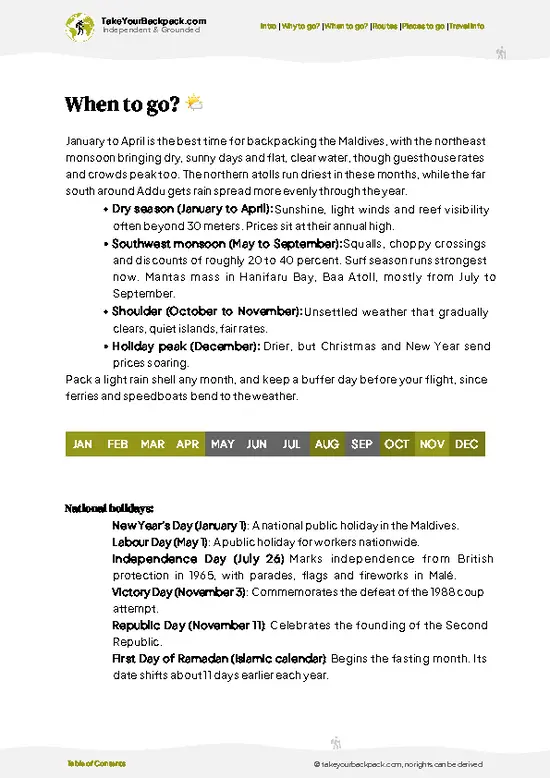
Best months: The best months for villages are December to April, the northeast monsoon (iruvai), when skies are mostly clear, seas are calm and temperatures hover around 28 to 31°C. Ferries run more reliably and snorkeling visibility is at its best.
Shoulder and wet season: May to November brings the southwest monsoon, with more rain (roughly 200 to 300 mm a month at peak), gusty wind and rougher crossings. Guesthouse rates can drop 20 to 40 percent, and the sea is still warm at about 28 to 29°C. May and October are decent compromises. Book ahead for Christmas to New Year and for Eid, when prices jump and local families travel home on the same boats. Ramadan shifts each year; cafés close by day, so plan for that.

village hoppingSuggested Travel Strategies

How many days: A trip linking several villages needs 8 to 14 days, because ferries are the limiting factor, not distance. Cluster by atoll: Kaafu, Ari and Vaavu link well from the Malé hub, while the far north or south needs its own domestic flight (about 1 to 1.5 hours) or a very long boat. Travel in one direction, moving outward from Malé and returning via the same hub before your international flight.
Pace and common mistakes: Allow 2 to 4 nights per stop, since arrival days vanish in transfers. Public ferries between neighboring atolls often take 2 to 5 hours and may run only a few days a week, so check the schedule before booking rooms. Travelers often cram six islands into a week or leave the airport day without a buffer. Build in a spare night near Malé, and ask guesthouses to arrange the boat.

The ListThe Best villages of Maldives

1 Dhigurah

long sandbank, whale shark encounters, village gardens

Swim alongside gentle giants, stroll a sandbank stretching into turquoise water, and notice how gardens blend with the village’s relaxed pace.

2 Thoddoo

fruit orchards, agricultural fields, quiet beaches

Taste fresh papaya and watermelon, cycle past fields, and find uncrowded stretches of sand beyond the cultivated landscape.

maldives-city-thoddoo
© Google |

3 Dhiffushi

narrow lanes, local guesthouses, sunrise beach

Wake early to watch fishermen return, wander quiet sandy streets, and experience daily island life shaped by the rhythm of the sea.

4 Fulidhoo

Small local island, traditional bodu beru, nurse shark sites

Join a close-knit island community, observe authentic music rituals, and snorkel clear channels frequented by gentle marine life.

maldives-city-fulidhoo
© Google |

5 Ukulhas

eco initiatives, organized streets, house reefs

Notice clean lanes and recycling efforts, swim with reef fish just offshore, and see how community pride shapes the environment.

6 Thulusdhoo

surf culture, soda factory, colorful murals

Experience the pulse of local surf life, spot painted walls, and see how industry and creativity shape the island’s identity.

maldives-city-thulusdhoo
© Google |

7 Dharavandhoo

domestic airport, manta ray hotspots, village cafes

Arrive by plane, join a dive to see mantas, and unwind in simple cafés where travelers and locals cross paths.

8 Kudahuvadhoo

ancient mounds, archaeological sites, quiet beaches

Visit an island known for mysterious coral stone structures and tranquil shores, where archaeological remains offer insight into early Maldivian culture.

9 Himmafushi

surf breaks, local crafts, working harbor

Watch surfers tackle reef waves, browse woodcarvers’ stalls, and get a sense of daily commerce at the busy waterfront.

maldives-city-himmafushi
© Google |

10 Huraa

mangrove forest, spice plantations, island mosque

Walk shaded trails through mangroves, sample homegrown spices, and notice the influence of history in the village’s architecture.

maldives-city-huraa
© Google |

11 Felidhoo

remote atoll, fishing harbor, quiet alleys

Step into a low-key island where fishing boats set the pace and narrow lanes invite slow exploration away from crowds.

maldives-city-felidhoo
© Google |

12 Hanimaadhoo

domestic airport, northern atoll, quiet coastline

Reach the far north for a slower pace, where infrequent flights and long beaches create a sense of remoteness and space.

Loading the map 🌍

Expert viewExpert Commentary on villages

How many villages to visit: Plan on two or three local islands and no more. Each hop costs half a day of transfers, and the ferries and speedboats run on fixed schedules that don’t bend for you, so a fourth stop mostly buys you extra waiting at jetties. Two islands with different characters give a backpacker the most for the time and money spent.

Choosing the kind that suits you: If you want snorkeling and the cheapest bed, pick an island with a house reef and several guesthouses. Rooms run roughly US$50 to 120 a night, comfort is simple, and a short boat trip to a sandbank or reef is easy to arrange. If you want everyday life, choose a smaller, less visited island. Expect fewer restaurants, fewer organized trips and a quieter night, but the best conversations come from there, and you give … read more 👉
How many villages to visit: Plan on two or three local islands and no more. Each hop costs half a day of transfers, and the ferries and speedboats run on fixed schedules that don’t bend for you, so a fourth stop mostly buys you extra waiting at jetties. Two islands with different characters give a backpacker the most for the time and money spent.

Choosing the kind that suits you: If you want snorkeling and the cheapest bed, pick an island with a house reef and several guesthouses. Rooms run roughly US$50 to 120 a night, comfort is simple, and a short boat trip to a sandbank or reef is easy to arrange. If you want everyday life, choose a smaller, less visited island. Expect fewer restaurants, fewer organized trips and a quieter night, but the best conversations come from there, and you give up almost no comfort once the fan and the hot shower are sorted. Dive-focused travelers should pay for a island near a famous channel or atoll edge. It costs more, around US$40 to 70 per dive, but a long boat ride from a cheaper island burns both hours and fuel surcharges.

What it actually costs: A lean day lands at US$60 to 110 per person sharing a room, including a guesthouse bed, local cafe meals at US$4 to 8, and one snorkeling excursion at about US$25 to 50. Public ferries cost only US$1 to 3 and speedboat transfers about US$10 to 40, while domestic flights run US$60 to 150. Guesthouses add a green tax of about US$6 per person per night. Villages have no entry fees, but guided island walks or cultural evenings are sometimes arranged for US$10 to 25. Book the public ferry when you can: it takes longer, but it saves real money and is where you meet locals.

Safety and etiquette: Maldives is overwhelmingly Muslim, and local islands follow Islamic norms. Alcohol is illegal on them, and bringing it in is a criminal matter. Cover shoulders and knees in the streets, and swim in bikini or regular swimwear only on the designated tourist beach. Respect prayer times and expect many shops to pause briefly. Ask before photographing people. Reef currents and boat traffic are the real hazards, so wear a vest on channel snorkels.

✈️ The backpacker research shortcutMaldives Travel Guide

An offline-friendly backpacking guide with optimized travel routes, ranked highlights, transport advice, and the best areas to stay.
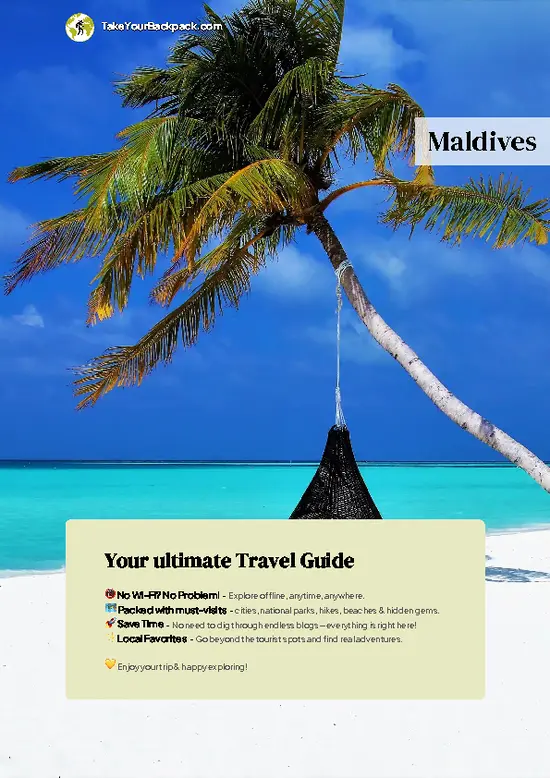
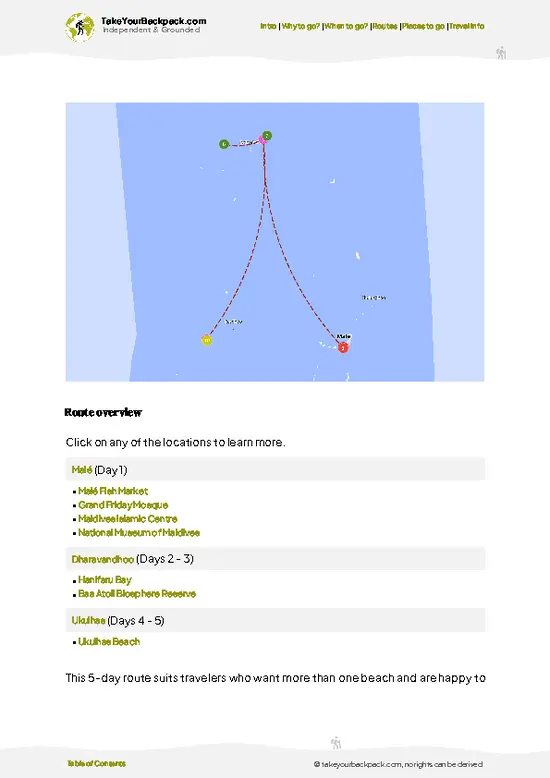
example page 0 from our offline Travel Guide for Maldives
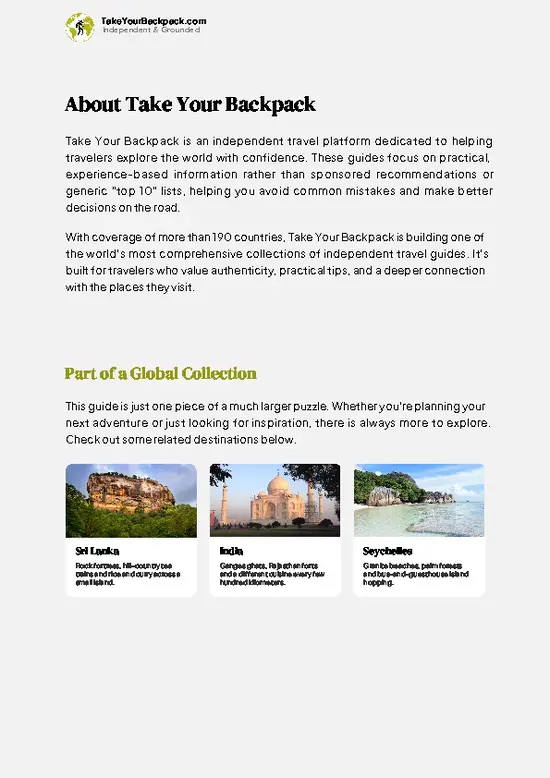
example page 1 from our offline Travel Guide for Maldives
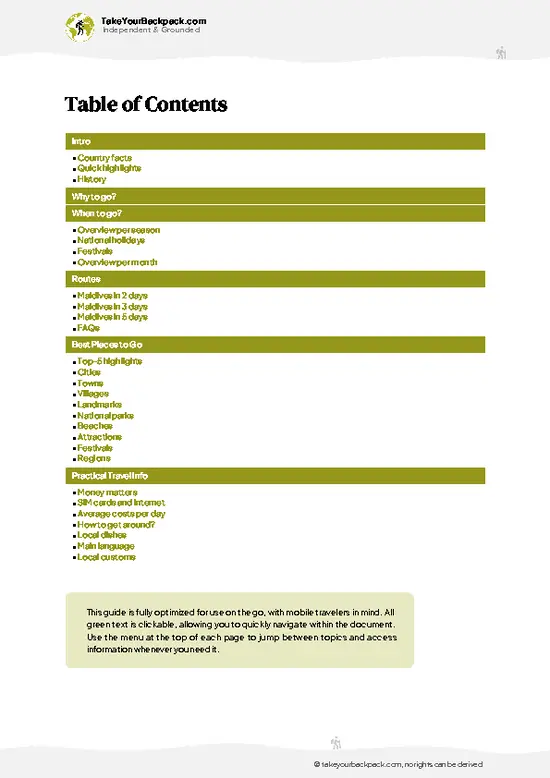
example page 2 from our offline Travel Guide for Maldives
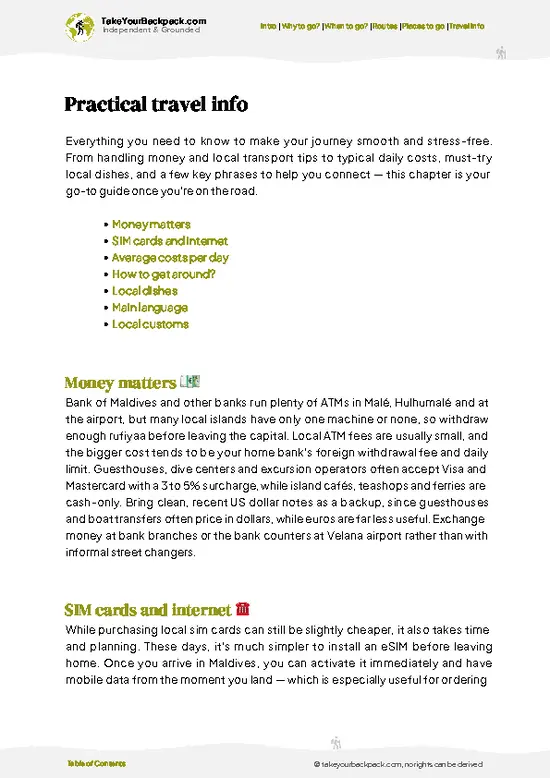
example page 3 from our offline Travel Guide for Maldives
example page 4 from our offline Travel Guide for Maldives
example page 5 from our offline Travel Guide for Maldives
example page 6 from our offline Travel Guide for Maldives
example page 7 from our offline Travel Guide for Maldives
The digital guide (177 pages) contains:
✅ 42 highlights, ranked by travel appeal
✅ Optimized 2, 3 & 5-day travel routes
✅ Cities, national parks, landmarks, beaches
✅ How to get around
✅ Offline-friendly for travel without Wi-Fi
👉 Click to see all 30+ guide features

📅 Plan smarter in minutes, not weeks
✅ Month by month travel advice
✅ Festivals & national holidays
✅ Budget expectations

🗺️ Go to the right places, skip the overrated ones
✅ Honest pros & cons of destinations
✅ Top hikes, parks & viewpoints
✅ Lesser-known places most travelers miss
✅ Clear “worth it vs skip it” guidance

🛏️ Travel smoothly without rookie mistakes
✅ Best areas to stay
✅ Transport systems explained simply
✅ Common scams & safety advice
✅ SIM cards, money & practical tips

🌍 Understand the country, not just visit it
✅ Culture & traditions
✅ 52 Essential phrases & customs
✅ Festivals worth planning around
✅ Traveler-friendly historical context
✅ Insights that make places more meaningful

📱 Built for real travel conditions
✅ Fully downloadable PDF
✅ Works completely offline
✅ Optimized for phone use
✅ Useful in remote areas & buses
✅ Everything in one place
Stop searching, start planning
Get instant access to your full guide. 30‑day money-back guarantee.
+ Add another guide for just

By proceeding you agree to our terms.
Sent to your inbox immediately after payment • 100% Secure Checkout
Best Backpacking Travel Advisor 2025 tourism awardBest Backpacking
Travel Advisor
2025
What others say about Take Your Backpack Guides:
⭐⭐⭐⭐⭐
Fantastic, amazing amount of information!
⭐⭐⭐⭐⭐
My goodness this is amazing, it's what I've been looking for hats off too you!
⭐⭐⭐⭐⭐
I think this is absolutely BRILLIANT
⭐⭐⭐⭐
Very complete and informative. It's still missing places, but I gotta to commend you
⭐⭐⭐⭐⭐
This is truly amazing, thank you, can't wait to explore it with my kids!
⭐⭐⭐⭐⭐
Awesome resource, thank you!
⭐⭐⭐⭐⭐
This is amazing! Can't wait to explore the ones I haven't seen
⭐⭐⭐⭐
I love this! Well done, great idea.
⭐⭐⭐⭐⭐
Thanks for taking the time to make this gem!
⭐⭐⭐⭐⭐
This might be the best website I've ever seen.
⭐⭐⭐⭐⭐
Congratulations, and thank you so much for your work; it's incredibly valuable.
⭐⭐⭐⭐
In all seriousness I think you did a great job pointing out the important spots
⭐⭐⭐⭐⭐
10/10 very good
⭐⭐⭐⭐⭐
As someone who's only just starting to visit regularly this is awesome, thank you.
⭐⭐⭐⭐
Thank you very much! I'm going to visit my dad, it's going to be very useful!
⭐⭐⭐⭐⭐
This is really cool! We'll be travelling for the first time and this definitely come in handy.
⭐⭐⭐⭐⭐
You are now our minister of culture, congratulations 👨‍💼
⭐⭐⭐⭐⭐
Just wanted to tell you that this is a pearl! Going to follow your recommendations.
⭐⭐⭐⭐⭐
This is so cool. I'll definitely be using the resource for my travels soon.
⭐⭐⭐⭐⭐
This is very impressive! Good work.
⭐⭐⭐⭐⭐
This is an amazing and informative site. Very well done!

🛏️ Where to stay?Where to Base Yourself

Budget accommodation in the Maldives means guesthouses on inhabited local islands, where doubles typically run US$40 to 90 a night plus the US$6 green tax, while true dorm beds are rare and mostly found in Malé and Hulhumalé. Maafushi has the biggest cluster of guesthouses and the easiest snorkel and sandbank trips, with a designated bikini beach and floating bars offshore (local islands are alcohol-free), but it gets crowded; Hulhumalé is quiet, safe and 10 minutes from the airport with a long city beach, making it the obvious pick for first and last nights. Malé itself puts you next to the public ferry terminals and cheap local cafés, though it is dense, noisy and has no nightlife to speak … read more 👉
Budget accommodation in the Maldives means guesthouses on inhabited local islands, where doubles typically run US$40 to 90 a night plus the US$6 green tax, while true dorm beds are rare and mostly found in Malé and Hulhumalé. Maafushi has the biggest cluster of guesthouses and the easiest snorkel and sandbank trips, with a designated bikini beach and floating bars offshore (local islands are alcohol-free), but it gets crowded; Hulhumalé is quiet, safe and 10 minutes from the airport with a long city beach, making it the obvious pick for first and last nights. Malé itself puts you next to the public ferry terminals and cheap local cafés, though it is dense, noisy and has no nightlife to speak of, while Thoddoo, Dhigurah and Fulidhoo trade convenience for empty beaches and slow evenings.

If you enjoy meeting fellow travelers, consider choosing hostels with high ratings for atmosphere. On the other hand, if you prefer having your own space, a hotel might be a better option.

MaldivesExpand Your Journey

👋 Meet the founderWho’s Behind Take Your Backpack?

Johan, backpacker and founder of TakeYourBackpackHi, I’m Johan (Netherlands 🇳🇱), the creator of TakeYourBackpack. Over the past 3 decades, I’ve backpacked through 90+ countries across six continents, gaining extensive experience with independent travel, long-term trips, and overland routes.

This site is built on a combination of firsthand travel experience and carefully curated insights from other backpackers. Many guides are based on places I’ve personally visited, while others bring together tips, observations, and practical advice shared by trusted travelers I’ve met along the way.

The goal is to provide realistic, experience-driven guidance — not generic itineraries — so you can explore destinations with better context, clearer expectations, and more confidence.